
Category: Uncategorized

Blogging for Business: The Power of Consistent Content Marketing

Natalie Thayer , Senior Copywriter

There’s an old content marketing saying: a business is only as big as its blog. Okay — we may have made that up, but the central message is still true. If you’re running a business and trying to get your company’s website to climb the digital ladder — we’re talking more visitors, increased visibility and higher search rankings — having…

Keep Your Brand Top of Mind with Email Marketing

Natalie Thayer , Senior Copywriter

Today, our lives are more tethered to the digital realm than ever before — thank you, smart phones, Zoom meetings, cryptocurrency and the Metaverse. So, it’s probably no surprise that digital tools play an important role in your business’ marketing strategy. Email marketing is just one such tool that’s invaluable to have in your toolkit.

Combining speed and flexibility with a relatively small price tag, email marketing offers businesses of all sizes and in all industries the chance to get valuable facetime with customers. At the same time, it strengthens brand awareness with each eblast. If you ask us, that sounds like a win-win. Of course, there are a few pitfalls to avoid to keep you from being relegated to the dreaded “spam” folder. That’s why we’re here to walk you through a few ways to make the most of your email marketing journey.

Less is More.

While it might be tempting to send out back-to-back eblasts to your entire email list — we’re going to stop you right there before you hit “send.” Think about all the unread emails piling up in your inbox from retailers, community organizations, apps and social media platforms. Even if you’ve opted into the list, having your inbox flooded with messages can be annoying at best. Instead, think about frequency strategically. Set a cadence that keeps your brand on your audience’s radar without overwhelming them. This might take the form of a monthly newsletter, quarterly recap or seasonal sale. 

Get Personal.

With nearly 60% of email marketers citing personalization as one of the best ways to increase engagement, it makes sense that we’re seeing a trend toward personalized messages. If you’re asking customers to share personal information with you, it’s a great way to show them that you’re listening. Segment your list according to their personal details — for example, by industry or title — and create targeted content for each segment. Celebrate birthdays with a quick note or special discount, call people by their first names in the body or subject line and craft customer journeys that are relevant to where they are in the sales process.

Highlight Your Brand.

When it comes to building brand awareness, consistency is key. For example, Forbes reported that brand consistency across platforms could boost revenue by up to 23%. A big part of this is pretty simple: As people become more familiar with your brand elements — colors, logo, tagline and even stylistic voice — it’s easier for them to remember it in the future. Email marketing offers a great way to reinforce those elements. Each piece of email marketing should align with your overall brand messaging, helping build recognition and encourage connection.

Be Real.

Brand loyalty is driven by emotional connection. Showcasing the people, processes, traditions or values instilled in your company can help tell your story in a way that resonates with your audience. This may take the form of team spotlights, Q&As, community initiatives or time lapse videos of a special project. While this may look different, depending on your industry and business model, all companies have a story to tell. Email marketing offers an avenue for sharing a behind-the-scenes look at the things that bring your business together.

Don’t Wait, Authenticate.

Don’t let all that hard work end up in the junk folder, never to see the light of day. Before you send your very first campaign, you’ll want to make sure you authenticate your domain. Without getting too into the technical weeds, email authentication essentially acts as a “digital signature” to show that your emails are legit. This helps with deliverability, making sure you’re reaching the inboxes of most, if not all, of the recipients on your list.

These steps can help you get started developing a strategic plan — but this is still just the tip of the iceberg. Email marketing is multifaceted and offers numerous options for engaging with customers, showcasing your brand and building awareness. If you want to learn more about how these tips — and more — can help you grow your business, let us know. Our team is here to help.

Why Website Personalization is Key to Website Design

Design At Work

When it comes to content in website design, messages can get lost in a sea of never-ending information on a company’s website. Website personalization is geared around creating a personal digital experience for customers who venture on to a webpage. Why is this important? Because the more engaged a customer is, and the more relatable the content, the more likely they are to be repeat customers.

Website personalization builds a custom experience for each visitor as they enter a webpage, tailoring content based on the visitor’s personal preferences of data collected from previous online behavior. By collecting information on items that have been clicked on prior, other items of similar interest can be suggested to the customer. Email reminders that entice them with more information on products they have already looked at are also a way to invite customers back to your website. Let’s investigate why website content should be based on personal preferences and past behaviors.

Understand Your Audience.

Hone in on the needs of your target audience. By responding to their needs, preferences and expectations, your business can better connect and keep them engaged. For example, this would allow your business the opportunity to make more in-demand items available on your website. When you know what they like, you can make sure you offer it to them.

Increase Customer Loyalty.

Simply put, if you offer them what they want, they will keep coming back for more. A customer is more likely to be a repeat customer if they can relate the message received and website content with their lifestyle. Having options suggested based on their personal preference means they do not have to dig through multiple pages to find what they want. The more user-friendly the website is, the more likely they are to come back and use it again.

Keep Visitors on Your Site Longer.

The average visitor only spends 45 seconds on a website before ditching it. If they stay longer, it’s quite the accomplishment. Capturing a visitor’s attention makes them more inclined to stay awhile. The longer they stay, the higher the likelihood is they will purchase something. When it is personal and more about what you can do for them versus what your company offers in general this is easily achieved.

With only 45 seconds to capture the attention of the average online visitor, you need to hook them — and fast. Website personalization helps you keep your customers engaged and coming back for me. Ready to add personalization to your site? The team at Design At Work, named one of Houston’s best web design companies by DesignRush in 2021, is here to help. Contact us to learn more!

Eat With Your Eyes: Marketing Strategy Tips for the Hospitality Industry

Design At Work

If your hospitality industry marketing strategy doesn’t include great photography, you’ll be fighting an uphill battle. From high-end fine dining to greasy spoons and everything in between, when a plate of food hits the table, diners want to be wowed. The same is true when it comes to the online marketing of your restaurant. If you want people to step foot into the business you’ve put all your time and energy into, the best way to do so is to make sure that you’ve got a great portfolio of restaurant photos to show off.

In the age of smartphones and Instagram, displaying stunning images of your food is more important than ever. Great restaurant photos will get people in the door, who in turn often take their own photos, share them online and influence people to check you out. An afternoon spent taking photos of your dishes can pay off again and again, especially if you follow these tips.

Opt for Professional Equipment, Including a DSLR and Digital Photo Editing Software.

Smartphones have come a long way, and while they can be magic in more casual uses, this is not the time to skimp on technology. If you’ve got the budget, hire a professional photographer with experience shooting food, who uses DSLR camera and a lighting kit, as they’ll know how to present your food in the best possible light. Getting great restaurant photos is more than just pointing a camera at a plate, so don’t rush whomever is shooting.

Get Large, High-Quality Images.

You’re going to be using these images in a variety of ways, both in print and online. While you can always shrink photos to make them more user-friendly online, you can’t make them bigger without sacrificing image quality. Make sure the photos you get are at least 4000 pixels wide. While the file sizes will be big, you’ll be glad you have the flexibility when it comes to using the photos on your website, social media posts, brochures and other marketing materials.

Take Photos of Everything on the Menu.

Don’t just get photos of your star dishes. You never know when a journalist or food critic is going to pop in and fall in love with something you’ve created. When they reach out, you want to be able to provide them with photos of the dish that wowed them, otherwise you’re leaving it in their hands to show off your food.

Not sure how to use those great restaurant photos after you’ve had them taken? Design At Work can help you make the most of those photos online and in print. Get in touch today so that more people can start falling in love with your food.

Social Media Mistakes: How To Respond When Social Media Goes Wrong

Allison Garcia , Senior Copywriter & PR Director

You can’t ignore social media. Eighty one percent of Americans have at least one social media account somewhere, and that percentage is only going to continue to rise. Whether we’re showing off photos on Instagram, promoting blog posts on Facebook or sharing tips on Twitter, having a social media presence can be an important part of marketing success. With that comes knowing how to deal with social media mistakes.

Things happen, even to the biggest brands on the planet. However, your business is not defined by the mistakes you make on social media, but by how you respond to those mistakes. Before we look at some common social media mistakes, we want to remind you of two of the golden rules of social media.

The Golden Rules of Social Media:

  1. Always double-check your work. Even when you’re in a rush, taking a few extra seconds to make sure everything looks perfect on a social media post will save you headaches. You can’t be called out for mistakes you didn’t make.
  2. If you do get called out for something, step away from the computer before responding. The world is full of people who want to revel in your mistakes. Don’t give them the satisfaction of responding when you’re fired up.

Even when keeping rule number one in mind, errors can happen. Here’s how to deal with some of the more common social media mistakes.

Examples of Problems and Solutions for Tricky Social Media Situations.

Problem: You’ve misspelled something in a post.

Solution: If the post doesn’t have an interaction associated with it, quietly delete it then repost it again with the corrected spelling. If people are interacting with your post in spite of the misspelling, keep the post up, but post a corrected version later. If anyone calls you out on the misspelling, thank them politely for catching it before posting an updated version of the post.

Problem: You’ve linked to the wrong media.

Solution: Copy/paste fails are rare, but they’re usually not the end of the world. Delete your post, and make sure to apologize for the error when reposting. This is a great time to show off that social media voice you’ve developed in order to come off as sincere and personable.

Problem: You’ve posted something from your personal account on your business account.

Solution: Again, this is something that can happen to any company, no matter how large. If in the heat of the moment you forget to make sure you’re logged into your personal account, delete the post and make sure to explain the mistake quickly. Be honest, be sincere and apologize if necessary.

Need more help with your social media strategies? Design At Work would love to apply our experience to your business.

The Best Color Palettes for Technology Marketing

Allison Garcia , Senior Copywriter & PR Director

From staffing the best team members to communicating with clients and staying a step ahead of the competition, there’s a lot that goes into running a successful technology company. Something you might not have considered? The ideal color palette for technology marketing, from your logo and website to sales collateral.

Color plays a tremendous role in establishing a company’s overall feel. By developing a specific palette, you create a consistent look while also tapping into people’s subliminal thought processes — and that can affect the way people choose to interact with your business. Design At Work has compiled a few helpful tips for choosing colors that speak to who your company is, help you stand out from the crowd and elicit the reactions you’re going for.

Practice restraint.

They say less is more, and nowhere is that more true than in the world of color. Incorporating too many hues into an advertisement or web page tends to draw the eye in numerous directions at once diluting the look and taking away from your message. Instead of going full-on rainbow, select two primary colors that complement one another, yet have the right amount of contrast. Color calculators such as this one by Sessions College are a great place to start. Once you’ve established your main tones, select two to three accent colors which allow you to add something different to your brand without taking away from the overall look.

Know what (and who) you’re up against.

It isn’t enough to create a combination that is pleasing to the eye. Choosing the same palette as a competitor — or even one that is too similar — can create confusion among colleagues, customers and, worst of all, potential customers. Before deciding on your chosen hues, do a quick online search and pull competitor logos together into one document you can easily reference throughout the color choice process.

Go beyond mere visuals.

Sure, it’s OK to use your favorite colors as an initial guideline, but remember there is psychology involved. Hues affect people in ways they aren’t even aware, and it’s important to consider the ways various colors translate. Blue, for instance, is a calm color known to encourage feelings of trust, order and security. As such, it is a common color among technology companies. Orange tends to make people feel warm and energized, while green conjures, among other things, thoughts of nature and health.

Of course, these are just a few of the things you’ll want to consider when developing a custom color palette for your technology company. If you’d like to know more, feel free to get in touch with Design At Work’s graphic design gurus. You can also reach us through our Contact page. We look forward to hearing from you!

Social Media Graphics: A Picture Paints a Thousand Words

Kelcey Hesse , Executive Vice President & Account Director

Since we live in a graphic culture, companies that want their social media posts to generate more views and shares, higher click-through rates and greater overall engagement with potential customers often include photos, videos, screenshots and other graphics in addition to compelling text.

Although text-based posts will always be a part of your social media strategy, as you begin to set your company apart, here are some helpful tips that will take your social media graphics to the next level.

  1. Images: Catching the eye of potential customers with visual content shows off your products and services. People are more inclined to read what you post if you also share an original image. Going a step further and posting pictures of your employees and brand lets your audience get to know your company on a personal level, building their trust. Incorporating images into your posts also entices viewers to learn more about your company’s offerings, supporting search optimization and boosting the number of views and clicks your website has.
  2. Videos: Potential customers want to see your products in action and hear you talk about what makes them stand out from the rest, to picture how they will work for them. Including promotional and marketing videos or product tours on your social media accounts will drum up conversation about all your company has to offer.
  3. Infographics: This type of graphic provides potential clients easy to consume bites of information, since they consist mostly of statistics and data with accompanying images. Regardless of language, your followers will understand the message you are trying to convey, making infographics a prime visual to add to your social media. Additionally, infographics tend to be circulated more than text only content, improving the number of times your post is shared, liked, re-tweeted or commented on.
  4. Presentations: By posting presentations, you are conveying to your social media audience your willingness to go the extra mile, extending the outreach of your company. Presentations also generate engagement of users and bolster communication. Due to the attractive designs, images and branded colors, presentations spark interest, driving more people to view them and learn what your business has to offer.

When you are ready to step-up your social media strategy, think about including an eye-catching image, striking video, impactful infographic or distinctive presentation to attract an audience consumed with graphics. Design At Work is here to help you up your posting game so your company is on the brain of your potential customers.

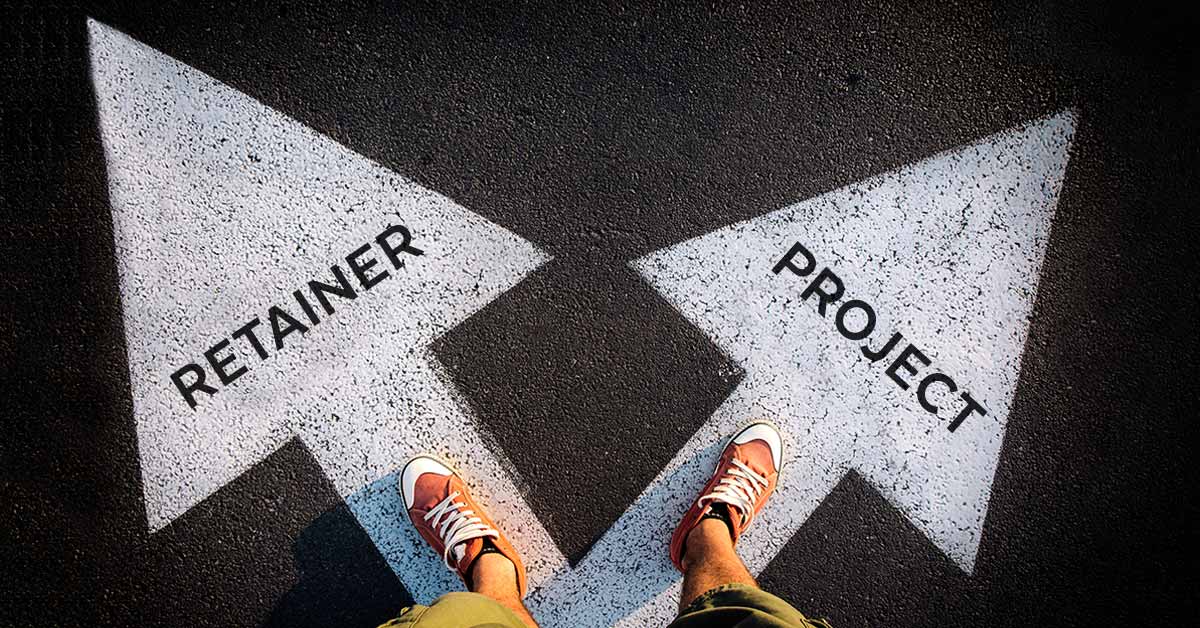
What’s the Difference? Outsourced Marketing: Retainer vs. Project Work

Design At Work

You know marketing is important, but don’t have the time to be consistent about it. Maybe you’ve considered hiring a marketing firm to help you. You’re just not sure if you should use a freelancer for occasional projects, or go with the outsourced marketing model and have a full agency team to help with all marketing. It’s a big decision to make, no matter the size of your business.

Before jumping into all the details of hiring a marketing firm, let’s talk about the basics. What’s the difference between a retainer-based marketing firm and a project-based marketing firm?

Typically with a retainer-based marketing agency, you receive ongoing monthly marketing efforts. This includes a plan that looks ahead, rather than just taking care of immediate needs. And a big benefit to working with an agency on a monthly basis? They get to know the two most important things: You and your business goals.

When it comes to retainer services, pricing should be a flat fee. Every advertising agency is a little different. For example, at Design At Work we don’t charge for meetings, email response time or conference calls. We feel communication is necessary to get the type of traction needed to keep your marketing moving, and, most importantly, build a relationship with you and your team.

The other option to consider is project-based services. This can be helpful when you know exactly what you need, and just need someone with the skillset to help make a project come to life. When it comes to project-based services, pricing can vary. Be knowledgeable about revision costs or additional fees that may apply. For project-based work to be really cost-efficient, you should have a clear idea of what type of project you need, and what elements should be included in the finished product. When a project’s outcome isn’t quite what you had in mind and needs some tweaking, revision fees can add up fast.

OUTSOURCED MARKETING Retainer vs. Project-Based Services 

Retainer-Based Services

• Flat monthly fee
• Broad range of services and deliverables
• Dedicated account team
• Long-term and ongoing marketing needs

Project-Based Services

• Per project cost
• Well-defined project scope and deliverables
• Rotation of available talent
• Short-term or one-off projects

Focusing on what your goal is in your business’s big picture can help you decide between retainer- or project-based services. Are you wanting a one-off piece to help improve a specific part of your business, or are you looking to take a more holistic marketing approach that could touch all aspects of your company?

At Design At Work, we’d love to talk to you about what’s on your mind. We may not be the right fit for you right now, but maybe one day. And hey, if we’re not for you, we’d love to point you in the right direction.

The Gift of Customer Loyalty

Allison Garcia , Senior Copywriter & PR Director

It’s easy in the day-to-day grind to focus on only one area of business. For many businesses, that one area is the goal of gaining new customers. It sounds simple enough — more customers means more sales, which in turn means a better bottom line. But without caution, that goal may have you overlooking your biggest sales force.

The Gift of Loyalty.

Did you know that over the span of your business relationship, your most loyal customers will outspend your average customers by as much as 10 times more? Altogether, those loyal customers will also make up approximately 70% of the business you do. Now that’s a lot of loyalty! That also means you may have a very large untapped profit area if you aren’t keeping in touch with your loyal customers.

The Gift of the Repeat Customer.

One of the most common and easiest ways of showing customer appreciation is by starting a loyalty program. Now, you may be thinking “but I’m supposed to be gaining business, not giving discounts!” But before you go too far, consider that a loyal customer will buy more than they originally planned 60-70% of the time. Taken a step further, these same VIP customers are more likely to talk about your business to others. That’s right — we’ve come full circle and are back to those new customers you were hoping to find. By saying thanks to your repeat customers, not only are they buying more, but they’re also sharing the good news and recruiting new customers for you.

The Gift of Knowing their Needs.

Are you convinced? That’s great! Before you get started though, take a moment to identify your best customers and what would be most valuable to them. Here are a few pointers to help get you started:

  • Talk to your customers. Go straight to the source to find out what would be most useful to your customers. You may be surprised at what you hear. At the end of the day, the more beneficial they find the perks, the more likely they will be to keep coming back.
  • Seal the deal with a KISS. There are lots of different loyalty customer programs out there competing for your customers’ attention. So remember — keep it simple stupid. Simple to join and simple to use.
  • Spread the word. Once you’ve worked out the kinks, it’s time to spread the word. That’s where we come in. We’ll make sure everyone knows, and in no time, your loyal customers will be saying thank you and your average customers might just upgrade to VIP status.

The Evolution of the Ad Agency

Design At Work

How One Modern Agency Stacks Up Against Mad Men’s Sterling Cooper of the 1960s.

As Mad Men prepares to enter the second half of its final season, Houston–based advertising agency Design At Work is also anticipating a monumental milestone in its own history — the celebration of its 25th anniversary. While times and advances in technology have certainly driven marked changes in the advertising industry, a comparison of Mad Men’s Sterling Cooper and real–life agency Design At Work reveals that many aspects — the creative process, client relations and even the character traits of a successful executive — have remained constant through the decades.

The Process: Man vs. Machine.

According to John Lowery, founder and CEO of Design At Work, the AMC series provides an accurate depiction of the advertising process and how ads used to be created. Drawing the artwork, stripping, bleeds, color separation, all of the design aspects of creating an ad that are now done using computers used to be done by hand.

While computers have made the design process far less labor intensive, what hasn’t changed is the thought process behind each ad development. “I believe that the creative is a derivative not the driving force, and you end up with better creative by starting with the needs of the client in mind,” Lowery explained. “Our designers still start with a concept and an idea first.” Meaning, just like in the 1960’s, people are still the mechanism responsible for advertisements that truly speak to customers, not the almighty computer.

The Clients: Corporations vs. Small– to Mid–Size Businesses.

In its most simple form, the advertising industry is about two things: winning clients and keeping clients. As both Don Draper and Roger Sterling state in the first season, “The day you sign a client is the day you start losing one (him).” And though Sterling Cooper may go after big corporations while Design At Work targets small– to mid–size businesses, these two firms are one–in–the–same when it comes to satisfying clients’ needs and keeping business in the door.

“This is the same scenario all agencies encounter today,” Lowery said. “I truly believe we can help anyone sell anything, but we also have to build relationships and constantly reaffirm our value in the minds of the clients.”

The Staff: Gender vs. Talent.

The role of women in the work place in the 1960s is an undercurrent that runs through the entire Mad Men series. Peggy’s constant struggle to be seen and treated as an equal among her male copywriting counterparts and Joan’s objectification illustrate the idea that men ran the advertising world in that era.

Flash–forward to 2015 when only 8 of the 32 employees at Design At Work are men. Once a male–dominated company like the rest, it’s arguable that current executive vice president of Design At Work, Tricia Park, was the catalyst for this shift. In 1997, she started as a part time administrator and quickly rose to the top to become Lowery’s right–hand woman.

“We’ve always interviewed objectively, but in many cases the women put more heart into their work. They are more detail–oriented and more nurturing with clients. For the majority of the roles in our company, the female candidates continue to be a better fit.” Lowery said.

The Boss: Don Draper vs. John Lowery. Don and John — even the coincidental rhyming of names hints at the profound similarities between these two advertising executives. Neither Draper nor Lowery came from affluent beginnings, suggesting the career success of each is the product of the unrelenting drive, determination and hard work that characterize both men.

Like Draper, Lowery’s life has been marked by an endless pursuit of more and better. At eight years old, Lowery’s grandfather introduced him to the field of advertising; at 23, he started Design At Work and served as its sole employee. As the business approaches its 25th year, Design At Work has more than 30 employees and is expanding its space to accommodate even more growth. “My goal is to be known as the best advertising agency and the best employer,” Lowery said.

His similarities to Draper, however, stop there. Whereas Draper is aggressive, brooding and unsympathetic, Lowery is hungry and ambitious, yet compassionate and understanding. And while his strive for growth and perfection never wanes, he is also able to find satisfaction in all he has achieved thus far. Something that cannot be said for his silver screen counterpart.

ABOUT DESIGN AT WORK.

Design At Work (DAW) is a full–service advertising and public relations firm that helps small to midsize companies market their products or services through integrated campaigns including advertising, public relations, collateral materials, logo identity, graphic design and website development.