Category: Lead Generation

Which Online Marketing Strategy Has the Biggest Impact on ROI?            

Return on investment in digital marketing is an incredibly valuable business metric that should not be ignored. Several types of integrated marketing channels are available, from social media and email lists to paid ads and in-depth search engine optimization. In order to achieve consistent growth, companies must leverage these channels and follow the proper steps to maintain optimal return on investment.

But which marketing method has the highest impact on overall ROI? Let’s discuss.

What is Digital Marketing ROI?

In the world of digital marketing, Return on Investment (ROI) is known as the measure of profit or loss generated on your campaign efforts. A positive ROI essentially means that a campaign is making more money than what was spent—and vice versa for a negative ROI.

As a rule of thumb, digital marketers should aim for an average ROI of 5:1 — that’s $5 gained for every $1 spent on a marketing campaign.

And if this doesn’t satisfy you, set the bar a little higher! Exceptional marketing ROI is considered 10:1 or higher. It will likely require more resources and knowledge to achieve this goal, but it is possible, nonetheless. On the other hand, ROI below 2:1 is non-profitable and is indicative that your marketing strategy needs some work.

Why Measure ROI in Marketing?

Measuring ROI is critical in digital marketing to determine the success of your campaigns. Otherwise, you would be marketing “blind” and potentially wasting your budget. Obviously, ROI will vary depending on the campaign type and other contributing factors. But by analyzing the results, you will be able to confidently take actionable steps toward improvement. The more familiar you are with marketing ROI, the better your campaigns will perform. In this article, we will discuss which online marketing campaigns have the highest ROI so that you can plan your marketing strategy accordingly.

How To Calculate ROI in Marketing

Calculating ROI values in digital marketing is simple. A basic ROI formula would look something like this:


roi formula

Which Digital Marketing Strategy Has the Best ROI (1)

Top 4 Digital Marketing Strategies for Success

Now that we’ve explained what digital marketing ROI is and how to calculate it, let’s explore a few different campaign strategies that are known for their positive ROI. We’ll explain the pros and cons of each to ultimately decide which strategy offers the best revenue return.

  1. Search Engine Optimization (SEO)
  2. Email Marketing
  3. Social Media Marketing (SMM)
  4. Pay-per-Click (PPC)

1. Search Engine Optimization

Search engine optimization, or SEO, is one of the most successful and widely used digital marketing strategies for growth. When properly executed, SEO marketing can deliver impressive results at a very low cost.

SEO marketing has an average ROI of 22:1 — that’s 2,200 percent!

Effective SEO can give businesses huge opportunities for driving traffic to their website. Plus, the results are long-term. Your site has the potential to continually grow in rankings over the years, delivering positive ROI with little to no effort on your end. For these reasons and more, SEO remains one of the top online marketing strategies for ROI.

2. Email Marketing

Email marketing is reported as one of the highest ROI digital marketing strategies. It’s a well-known method that requires some initial investment but has high success when it comes to exposing your brand to customers.

Email marketing has an average ROI of 42:1 — that’s 4,200 percent!

So, in theory, for every $1 spent on email marketing, you’ll make $42 in return. It’s no wonder why this method is so popular amongst digital marketers. Creating contact lists and sending out emails is relatively cost- and time-effective when compared to other campaign methods. Also, campaign effeteness will only increase as you expand your audience and grow your email list. In addition, email marketing can be used in conjunction with other online marketing strategies for maximum effectiveness.

The primary drawback of email marketing is the fact that it requires having access to a substantial database of customer emails. Tips for building a sizable contact list include using subscription incentives, sign-up lists, and giving customers the ability to create on-site accounts. Follow these steps, and in time, you can expect results and substantial business growth.

If you are going to run an email campaign, you should consider measuring these metrics when calculating your digital marketing ROI:

  • Open rate
  • Conversions
  • Click-through rate (CTR)
  • Unsubscribe rate
  • Bounce rate
  • Leads acquired

3. Social Media Marketing

Social media marketing is another effective marketing channel that doesn’t require a huge budget or amount of time to succeed. Depending on the extent of your campaign, you can spend hundreds or thousands of dollars per month.

Social media marketing offers several valuable benefits that affect ROI, including:

  • Helps customers discover new products
  • Sparks positive interactions with consumers
  • Provides customer service and engages with followers
  • Increases brand traffic and obtains new customers
  • Contributes to overall marketing strategy

Measuring social media ROI is a bit more complex than measuring the results you’ll get from other types of digital marketing tactics. In social media marketing, you can determine campaign effectiveness by measuring specific metrics. Below we listed the top metrics marketers use to measure the ROI of social media campaigns.

  • Engagement rates
  • Click-through rate (CTR)
  • Clicks
  • Conversions
  • Leads acquired
  • New followers

4. PPC Marketing

When done right, PPC services will generate a positive ROI in digital marketing.

Return on ad spend (ROAS) is much simpler to calculate than the overall ROI for PPC campaigns. The formula is essentially the same as the ROI formula we mentioned previously; it just replaces “marketing” with “PPC.”

ROAS FORMULA

This value, however, does not factor in all costs—just the cost of the paid ads. If you want a more precise estimate of your PPC campaign’s profitability, you’ll want to factor in some additional costs, such as:

  • technology & equipment
  • credit card processing fees
  • fulfillment
  • employee salaries

Unlike SEO marketing, PPC advertising is not long-term; once you turn the ads off, the campaign is over. The only lasting value is the sales from the ads while they were still active.

Which Digital Marketing Strategy Has the Best ROI?

In conclusion, SEO and email marketing have the best reputation when it comes to ROI. However, keep in mind that PPC and social media marketing are also known to achieve positive ROI.

Now, it’s up to you to maximize the ROI of your online marketing campaign. Will you choose email marketing, PPC, SEO, SMM, or perhaps a combination? Be sure to consider your company, budget, and individual marketing style before making this decision.
roi marketing

Improve Your Marketing ROI With MARION Today

If your company is looking to optimize your digital marketing ROI, MARION is happy to help! We are a marketing agency in Texas with decades of experience delivering strategic search engine optimization, PPC services, and various marketing campaigns.

Contact our team of experts today and find out how we can help you get started with your online marketing strategy.

Marketing emails you’ll actually want to read.

Get marketing tips and news sent to 
your inbox.

This field is for validation purposes and should be left unchanged.
Name(Required)

Boost Conversions with Multivariate Testing for Digital Marketing

Multivariate testing helps businesses to make the most of each and every one of their website’s visitors by improving conversion rates by testing different web elements. In this article, we break down how to use digital marketing testing techniques to boost conversions and improve your digital strategy. 

What Is Multivariate Testing in Digital Marketing?

Multivariate testing is a technique used in digital marketing for testing different variables on a webpage to find the most effective combination. Elements such as images, copy, font or color can all be tested concurrently on audiences to determine which combination yields the highest results, such as click through rate or open rate.

In addition to web pages, multivariate testing is often used for other marketing channels such as PPC ads, social media marketing, email marketing and more. Regardless of the type of digital marketing campaign, the ultimate goal of multivariate testing is to help determine which variation is most successful out of all of the possible combinations.

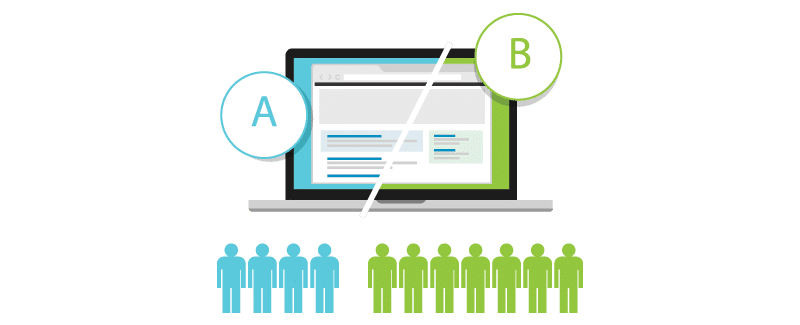
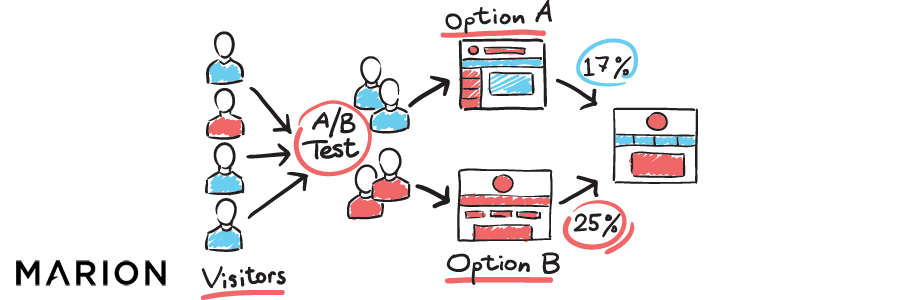
A/B testing in digital marketing

Multivariate vs. A/B Testing in Digital Marketing

Multivariate testing and A/B testing are very similar. The only difference lies in the fact that multivariate tests involve testing the effects of changing more than one variable on your site, whereas an A/B test strictly tests the effect of changing only one variable. It’s common for both techniques to be used in UX design and web design strategies.

A/B testing, also referred to as split testing, is an approach to website optimization in which live traffic is used to simultaneously test two versions of a page to determine which version performs the best. In this method, site visitors are randomly sent to either version A or version B of a page, and their interactions are simultaneously tracked. A marketer will quickly be able to decide which version is most effective by seeing which page achieved the highest conversion rates.

Multivariate testing uses all these same core mechanisms, but compares several variables at once, therefore revealing more valuable information about how certain elements interact with one another. Data from each combination is compared to determine the most successful design, as well as reveal which components have the greatest impact on a visitor’s interaction.

Time and Traffic Requirements

The biggest difference between multivariate and A/B testing is the amount of traffic and time required to see results. Since you are only testing two versions with the A/B method, you’ll need a smaller amount of visitors before you start seeing results.

Meanwhile, the multivariate tactic needs several different versions to be tested, requiring a much larger number of visitors before obtaining accurate results. If you have a minimal amount of traffic, this system can take quite a while. However, if you’ve spent time building an online presence and your website has a high number of visitors per day, multivariate testing will be a quick and easy process.

A major benefit of multivariate testing on your website is that a winning variation could improve your marketing KPIs by leaps and bounds, while A/B testing usually delivers marginal improvements. This means that multivariate testing marketing elements on your site can accelerate your timeline for meeting marketing goals and objectives.

multivariate testing in digital marketing

How Does Multivariate Web Testing Work?

In multivariate testing, web analytics are used to determine the best combination of elements to maximize results. Here are the steps you should take when using multivariate testing for your business:

1. Determine Potential Pitfalls & Areas for Improvement on Your Website

Take an unbiased look at your site as if you were a potential customer. Go through the buyer’s journey and make notes of bad UX design examples, potential pitfalls and/or potential areas for improvement. Identify any problems that a visitor may come across when browsing your site.

2. Formulate a Hypothesis

With the notes you took in step one, think of ways in which you can solve the problems. For example, are visitors potentially deterred from submitting a form because the form isn’t visible enough? Maybe it’s placed below the fold and needs to be moved higher up the page, or maybe it doesn’t stand out enough, so visitors tend to gloss over it without taking any notice.

You can then hypothesize that moving the form up the page, and/or making it stand out more from the content would increase form submissions on the page. 

3. Create Variations

Once you know what different elements you need to test and what changes you need to make to test out your hypothesis, you can then create the different variables to test. Consider changing the text, location, size, font, color, images and other elements to make your call-to-action more noticeable and enticing.

multivariate web testing

If you’re not an expert at making website edits, don’t worry! Our experienced digital team offers Dallas, Houston, and Austin web design help to Texas businesses.

4. Determine Your Sample Size

It’s almost time to start driving traffic to your pages, but first you need to determine your sample size. How many visitors will each page need to generate before you can draw conclusions about your tests’ findings?

5. Test Your Tools

Test everything on your site before you start running tests, just to be on the safe side. Ensure that all links are correct, CTA buttons are working properly as well as any other important aspect of your campaign.

6. Start Driving Traffic

Now that you’ve completed your variations and know exactly how much traffic you need, it’s time to start running traffic to them. A downside to multivariate tests is the massive amount of traffic needed before seeing results, so you’ll have to be patient.

If you’re located in Texas, partnering with a Dallas, Houston, or Austin SEO agency can help build a strategy that attracts plenty of relevant users to your website.

7. Analyze and Learn from Your Results

Each of your tests can be used to learn something valuable about your pages and visitors. You can use this information to make changes and even for future tests.


3 Examples of Multivariate Experimental Design

When using multivariate testing, you can change several different design elements such as headlines, clickable links, and image placement. There’s no limit to the number of variations you can run. Let’s look at some examples of multivariate experimenting in digital marketing.

1. Example of Multivariate Testing Email Marketing

In multivariate testing, marketing specialists can experiment with different elements of their email marketing strategy in order to see which method gets the most attention from their audience. You can test several variables such as subject line, from name, content, phrasing, send time and more.

multivariate testing email marketing

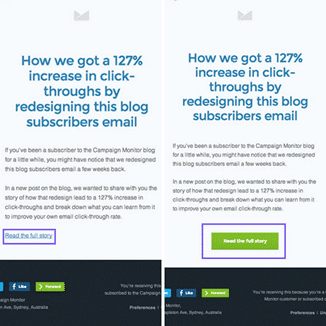
Source: Campaign Monitor

In the above email, Campaign Monitor tested which call to action readers preferred: link text or a button. After testing these two variations, results showed that there was a 28% increase in click-throughs on the email with a button CTA.

Here are a few ideas to consider for multivariate testing in your email marketing campaigns:

  • Are subscribers more responsive to emails with your company name in the subject line?
  • Will including images increase engagement?
  • Are your subscribers more likely to click linked text or a linked image?
  • Will newsletters with colored text increase click rate?

If you want help with professional web design in Houston, Austin, or Dallas/Fort Worth, our experienced team is ready to assist your Texas-based business!

2. Example of Multivariate Landing Page Testing

Multivariate testing allows you to develop high-converting landing pages by experimenting with the performance of different variables. Never underestimate the importance of landing pages—they’re what turns a visitor into a prospect and a prospect into a conversion.

With multivariate testing, a website’s landing page will be split into several slightly different versions to be randomly assigned to your site’s visitors. Each version’s success will be tracked, ultimately showing you the best way to run your site.

multivariate experimental design on landing pages

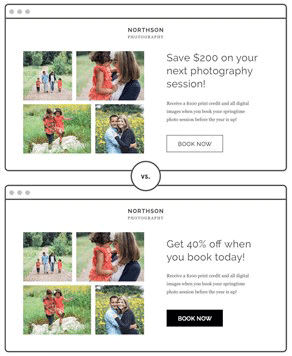
Source: Leadpages

Your landing page copywriting is key to persuading your audience to take action. Consider testing different lengths and tones and sentiments.

In this example, both landing pages’ headlines present the same offer while using unique language. The only way to know which one is better is by testing it.

3. Example of Digital Content Testing on Social Media

When testing your digital content strategy on social media channels, the goal is to determine which combinations are well-received by your audience. Consider these key metrics for social media marketing when running multivariate tests:

  • Engagement: Which version results in more likes, comments, shares, or clicks?
  • Impressions: Which version reaches the largest number of people?
  • Traffic: Which version drives the most visitors to your site?
digital marketing testing techniques

Source: Sprout Social

In this example, Entrepreneur is testing both the title copy and featured image. Note that the caption, subtext and link all remain the same. The goal of a test like this is to understand which combination will get the most clicks.

Here are a few other multivariable testing ideas worth trying:

  • GIFs vs. static images
  • Use the same content with different audiences
  • Change the tone of voice
  • Experiment with different CTA buttons
  • Incorporating videos vs. images

While testing content changes on your website, keep in mind that your page copy has an effect on maintaining an SEO-friendly website design. If you’re based in East Texas, an Austin, Dallas, or Houston SEO company can help reconcile your verbiage changes with your ongoing strategy.

MARION Can Help Your Business Create High-Performance Digital Marketing Assets

Multivariate testing can be a powerful optimization method, regardless of your business. It’s a sure-fire way to drive traffic to your website and improve customer experience. Not quite ready to take on multivariate testing on your own? We’re here to help! MARION is a Texas-based digital marketing agency that offers traditional and internet marketing services.

Marketing emails you’ll actually want to read.

Get marketing tips and news sent to 
your inbox.

This field is for validation purposes and should be left unchanged.
Name(Required)

Demand Generation vs. Lead Generation in Marketing – How Are They Different?

Honing your product or service is a key element of running a successful business. However, contrary to Emerson’s adage, simply building a better mousetrap will not cause the world to beat a path to your door.

Today’s world is filled with marketing noise and competition. If you have a service or product that the world will love, you must make sure they’re aware of it before they can patronize your business.

This demonstrates why demand and lead generation are critical to the success of your business, but you need to understand what they are and how they work together.

Demand Gen vs. Lead Gen

It’s common for performance marketers to throw terms like “demand generation,” and “lead generation,” around, even using them interchangeably. While there is a lot of overlap in the goals and tactics used within lead and demand generation, they are distinct marketing processes.

It’s not critical for small business marketers to delineate the two as both functions are frequently managed by one person. However, larger businesses that separate the job functions are looking for employees that have a strength in one or the other. When you use MARION as your outsourced marketing department in Texas, we handle the details for you.

We will dive deeper into the differences in demand creation vs. lead generation in this article. For now, the concepts can be differentiated using these two questions about your audience:

  1. Do they know who you are?
  2. Do you know who they are?

If you answer “yes” to question one, but “no” to question two – that’s demand generation.

If you answer “yes” to both questions – that’s lead generation.

You’ve got a fundamental grasp on demand and lead generation already, now take a closer look at what they involve.

What Is Demand Generation Marketing?

demand generation vs. lead generation

Demand generation marketing is the comprehensive process of generating awareness and interest in your business’s product/service through different marketing channels. Demand gen makes up the first touchpoints that a potential customer will have with your business. However, not every person that is reached by your demand creation efforts will continue down your marketing funnel.

The chief aim of B2C and B2B demand generation is to set the stage for an individual to recognize and further engage with your business. Digital marketing KPIs for demand gen include reach, impressions, clicks, and visits. Awareness for the sake of awareness is rarely the goal, especially for small business marketers whose budgets demand they are much more targeted in their efforts.

Some examples of demand gen include blog and social media posts related to your product/service or industry at large that grab the attention of your target audience. We cover more examples of demand generation below.

Demand Generation vs. Marketing in General

Demand generation is a subset of marketing. If you’re familiar with marketing funnels, demand generation is represented by the top of the funnel, while the entire funnel is considered marketing. In short, all demand generation is marketing, but not all marketing is demand generation.

What Is Lead Generation in Marketing?

demand gen vs. lead gen

Lead gen is the process of attracting and stimulating the interest of your target audience to the point that they provide you with their contact information in exchange for something of value. For example, you can convert a stranger from your target audience into a lead by offering them a relevant free whitepaper or checklist in exchange for their name and email address.

Demand generation is a subset of lead generation. Demand gen grabs the initial attention of your target audience, while lead generation aims to grow that attention until contact information can be collected. The driving marketing goal behind lead generation is to fill your business’s sales pipeline so that you can further qualify and convert a lead into a paying customer.

We cover more examples of lead generation in the section below.

Lead Generation vs. Lead Qualification

Just because you’ve generated leads for your business through your site doesn’t mean that your new contact is interested in or capable of becoming a customer. For example, someone can subscribe to your weekly blog because they love learning despite not wanting your product or service. Someone interested in what your business can offer may also not have the budget to work with you.

Lead qualification is the process of connecting with leads, either manually or through an automated system, to see if they are truly a potential customer. Once a lead is qualified, it’s time to begin nurturing them toward a sale.

Lead Generation vs. Business Development

Business development is another function that is frequently mixed up with lead generation. The most important differentiating factor about business development is that it focuses on building strategic relationships to generate customer referrals, whereas lead generation is more of a one-by-one approach to identifying potential customers.

Here’s a situation that will help you draw the line. I used to work at a payroll software company where the marketing team and business development team were entirely separate.

  • The marketers tried to attract and convert individual businesses that needed payroll software.
  • The business development team tried to connect with accountants that had several business clients that needed payroll software.

Examples of Demand Generation Marketing

lead and demand generation

Demand generation takes many shapes and sizes. Popular types of demand gen content include but are not limited to the list below.

  • Blog posts on your website
  • Guest blog posts on external websites
  • Case studies
  • Podcasts
  • Co-marketing with supplementary/complementary businesses
  • Videos
  • Press releases
  • Free tools and resources
  • Infographics
  • Social media posts

Demand Generation Process

Demand gen can be broken up into two main sections:

  1. Identifying what content to create
  2. Determining how to distribute that content to the right audience

The list above are examples of content types that are frequently used for demand gen. The actual information and messaging that you share will require research of your target market and existing customers.

Once you create content assets, how will you distribute them? Most marketing experts recommend considering how your content will be distributed before you create it so you can tailor it to a specific channel.

For example, maybe your plan to get your blogs, videos, and infographics in front of your ideal audience involves targeted social media ads. Make sure your videos are short and engaging enough that a social media user would engage with your message.

Examples of Lead Generation in Marketing

B2B demand generation and lead generation

Lead generation requires an offer of perceived value to your target audience. This person has already engaged with your free content, but now it’s time to gain a direct line to their attention. The following lead magnets are common examples of content that will help you earn someone’s contact info.

  • Email subscriptions to a blog feed or newsletter
  • Gated eBooks, whitepapers, checklists, or cheat sheets
  • Webinars
  • Product or service demos
  • Contests
  • Free consultations or product trials
  • Free interactive tools relevant to your industry

Lead Generation Process

The process of lead generation requires a significant amount of research. You must have a deep understanding of your target customer and what drives them before you can create content for which they will willingly give you their contact information.

This can be done through competitor research (see what they are offering their audience), or customer surveys and interviews. Once you know what makes them tick, your demand generation efforts must gain enough audience exposure for your lead generation campaigns to seal the deal.

One popular form of lead gen campaign is the retargeting campaign. You can use retargeting display ads and social media ads to put your offer in front of people who have already visited your website but haven’t given you their contact information. The right offer to this already-engaged audience can be just what you need to secure a potential customer’s email address or phone number.

If you’re wondering how long this will take, consider the marketing rule of 7. Age old wisdom says that a stranger will need to see your business branding up to seven times before engaging. If your short term B2C or B2B demand generation campaigns haven’t led helped you generate any leads yet, you may need to accommodate more touches with your brand.

Trust MARION to Generate Interest and Leads for Your Texas Business

MARION has been serving Texas businesses since 1981 and has evolved with the marketing industry to best serve your needs. Our award-winning marketing agency in Texas offers a mix of branding, traditional, and digital marketing services to meet the broad range of needs that face today’s businesses face.

Check out our design portfolio and marketing case studies to see how we’ve helped businesses like yours!

Contact us today to schedule a free consultation and learn how we can help grow your business.

Marketing emails you’ll actually want to read.

Get marketing tips and news sent to 
your inbox.
This field is for validation purposes and should be left unchanged.
Name(Required)

So, Your Marketing Budget has Been Cut – Now What?

It’s clear the COVID-19 pandemic has affected nearly every business across the globe. In MARION’s headquarter city of Houston, TX, over 90% of small businesses have lost revenue due to the pandemic.

In times of economic hardship, marketing is usually one of the first departments to get its budget sliced. The current state of the economy is already leading to marketing budget cuts for many businesses.

A recent survey from Gartner shows that 45% of marketers say that budget cuts have resulted in campaign launches being delayed and 34% said cuts required creative ad content to be altered.

But companies should not be so quick to give marketing the axe! Many surveys show that in times of economic uncertainty, businesses should actually increase — not decrease —  their marketing spend to help increase sales and market share.

optimizing a reduced marketing budget

How to Optimize Your Reduced Marketing Budget

If your budget has already been cut, here are some things you can do to optimize your marketing budget breakdown.

Focus on Cost-effective Channels

Turn your attention to channels where you can reach your audience and drive organic traffic without spending advertising money. These include social media pages, email marketing, and on-page and off-page SEO.

This B2B growth case study highlights how MARION’s SEO in Houston helped drive organic traffic to meet business goals.

Reach Your Audience Where They Are

There is nothing worse than spending time and money on a platform that your users are not actually on. Sometimes, businesses can get caught up in wanting to be active on every platform just to be active, even if they are not seeing any real benefit from the channels. I call this “marketing just for the sake of marketing.”

Now that your budget has been cut, you must take a close look at what is really working for your company and direct your resources to the appropriate channels to maximize ROI. Use analytics and marketing metrics to track where your target audience spends time and put all your eggs in the highest-performing baskets.

Taking a hard look at the data often surprises many marketers, disproving their assumptions about where their ideal customer is active. An example of this would be a B2B company that thinks they should spend ad dollars on LinkedIn when social media analytics show their target audience is 30% more active and engaged with companies on Facebook.

Learn how MARION’s social media marketing in Houston, Austin, and DFW can help identify the highest impact opportunities for your business.

reducing paid advertising

Reduce Paid Advertising Effectively

When your marketing budget gets cut, the last thing you want to do is just start slashing paid ad budgets willy-nilly. When slimming down your paid ad spend, thoroughly review the data for each platform and campaign to ensure you optimize your high performing ads. Advertising through social media or using PPC services in Houston, DFW, and Austin can still be an effective marketing tools for your business despite budget decreases.

Look at what has been proven to work for you and double down on that. Pause experimental campaigns or ads that are not giving the best ROI. When your marketing budget has been slashed, it’s no time to spend money on low performing channels and campaigns.

Remember not to consider vanity metrics when making these decisions. Take a good look at your marketing goals and your key performance indicators to judge which ads are truly your top performers.

Use Tools to Free Up Time

Reevaluate your marketing tool and software subscriptions to see where your company is lacking. There’s no shortage of free marketing tools available to help improve your team’s productivity and save valuable time and resources.

For everything from email workflows and social media to SEO and stock photography — the internet is overflowing with free tools for you to take advantage of, so get searching! To help you get a good start, here are some of our favorite free social media management tools.

outsource marketing to reduce budget

Outsource Your Marketing

A survey conducted by Deloitte showed roughly 60% of businesses cited that their top reason for outsourcing was to help reduce or control cost. Look at your team structure to see what core competencies you should keep in house. Then, seek help from an outsourced marketing agency for specialized marketing tasks you need help with.

Let MARION worry about your outsourced marketing so you can concentrate on your business! We provide a suite of affordable outsourced marketing services for Texas businesses to help you optimize you marketing resources — including branding and design, digital marketing, and traditional marketing. Contact us today to learn more!

Focus on Your Existing Customers

Focusing on your current customer base can help lower your cost of acquisition. Pay attention to your customers’ wants and needs. Then, use customer retention strategies such as cross-selling or creating complementary services to help increase customer lifetime value and delight your customers.

Also, ask your loyal customers and fans to recommend you to others, via reviews on Google, social media or word-of-mouth. This advertising strategy is free and proven to work — as studies show 92% of consumers believe suggestions from friends and family over company advertising.

Your loyal customers can also help you reach a new audience through their marketing results. Ask your customers for permission to use them in a case study or post about their success on social media.

MARION Can Help Keep Your Marketing on Track

So, while you may be working with a smaller marketing budget now, don’t throw in the towel. Using these tips can help you optimize what money you do have and continue to reach your business goals.

MARION is a full-service marketing agency in Texas that has been helping local businesses for nearly 40 years. If you need help planning for a smaller marketing budget, our strategists can help.

Contact us to schedule a free consultation today!

Marketing emails you’ll actually want to read.

Get marketing tips and news sent to 
your inbox.

This field is for validation purposes and should be left unchanged.
Name(Required)

How to Make a High-Converting Landing Page [With 3 Examples!]

As a small business owner or marketing manager, having to balance operations, marketing and sales, and customer service leaves you with a packed schedule. Establishing a marketing budget for your small business is one thing, but being responsible for potentially thousands of advertising dollars can be a lofty task.

You can put your advertising dollars to work by maximizing the odds that your potential customers convert every time they encounter your ads. Learn how to make a high-converting landing page to realize the best return on your marketing spend.

What Is a Landing Page on a Website?

Unlike other pages on your site, landing pages are standalone pages; in other words, you will not find them in the navigation menu, nor are they linked to any other page on your site. They are specifically designed for marketing campaigns.

For example, if someone clicks on your Facebook ad or a PPC ad, they would be directed to the landing page, rather than an existing page on your site.

Purpose of a Landing Page

Landing pages are created with a specific goal and call-to-action in mind, in the hopes of maximizing the number of conversions you can capture from your digital marketing campaigns. While other pages on your site may have several different goals, the sole purpose of a landing page is to drive conversions.

The singular purpose of landing pages makes them invaluable tools in your B2C or B2B marketing strategy toolkit.

Schedule a free consultation today to learn how MARION can incorporate landing page optimization into your comprehensive outsourced marketing services.

how to create the best landing page

Why Create a Landing Page Anyway?

With an ad, you typically offer an incentive or a value proposition that entices people to click on the ad. However, you are unlikely to feature this prominently on your general-purpose website, or if you do, your website contains so much additional information that it may get lost in the sea of information. This is where your landing page comes into play.

A landing page enables you to mirror and elaborate on the message featured in your ads without having to make any form of changes to your website. It narrows the visitors’ focus on the message.

Splash Page vs. Landing Page

There are many similarities between a splash page and a landing page, but the main way in which a splash page differs from a landing page is that a splash page is not a standalone page. It’s not even a page at all, despite what the name may imply.

Instead, a splash page is a large screen that appears when visitors first enter a site. While the goal of both a splash page and a landing page is to drive more conversions on your site, splash pages are intended to convert more visitors to the site as a whole and are not necessarily catered to any specific digital campaign.

Do Landing Pages Work?

The short answer is yes, landing pages do work.

Landing pages are more effective than the typical page on your website because they are specifically designed with only one goal in mind: conversions. The best converting landing pages have content and information that is incredibly relevant to the ads that you are running, and the lack of extraneous information keeps the visitors’ focus on the page, helping to drive them further down the marketing funnel towards the conversion.

what makes an effective landing page

Elements of a Good Landing Page

Making a good landing page can seem overwhelming, but the following six elements of an effective page will eliminate some of your confusion.

  1. Headlines that match
  2. Compelling Content
  3. CTA
  4. Images & Videos
  5. Forms
  6. Ongoing Testing

1. Headlines That Match Intent of Source

One of the very first things visitors notice when they land on your page is the landing page headline. First and foremost, your headline needs to align with the ad the user clicked on to find your landing page.

Then, in very few words, your headline needs to be interesting and eye-catching, telling visitors exactly what they can get from your company. Once you have grabbed their attention and given them an idea of what your product or service is with your headline, you can use your sub-headline to further convince them to take the desired action.

Should a Landing Page Have Navigation?

Landing pages are more limited than a regular page on your site, including where navigation is concerned. Unlike the other pages on your site, you would not include a full navigation menu on the landing page, as the lack of navigation focuses your visitor’s attention on the content on the page.

For that reason, some design experts advise you to limit the use of navigation as much as possible; potentially even limiting it down to simply including your logo that links to your home page.

At MARION, we’ve experienced mixed results from eliminating page navigation. Easily accessible navigation is a major part of what makes a good website. Ultimately, you’ll want to test this out on your landing pages to see which method gets the best results with your unique audience.

2. Compelling Content

The key to a high-converting landing page is compelling content. In a concise manner, communicate the benefits of what you have to offer and how it will meet the needs of your landing page visitor. You know what you have to offer, so communicate that to your visitors as well. If you featured a special or incentive in your ads, be sure to elaborate on those offers on the landing page.

Your digital content strategy should ultimately depend on your offer. When PPC advertising is concerned, the better you can match your landing page content with the information found on your PPC ads and the keywords you use in your campaigns, the better your campaign and your landing page will perform.

3. Call-to-Action

As with any digital ads, a call-to-action is critical to driving conversions. That rule does not exclude landing pages. Your landing page should prominently display your call-to-action, telling visitors exactly what they need to do to get in contact with you.

As with your headlines and content, your call-to-action must be compelling and persuasive. The design, color, and placement of your CTA are all factors that need to be taken into account in order to create high-converting landing pages.

4. Supporting High-Quality Images and Videos

Images and videos are an eye-catching and persuasive way to provide context and give visitors an even more clear idea of what it is you can do for them. Showing, in addition to telling them, is key for effective landing pages. Keep in mind that your images must be high-quality and relevant.

If you’re interested in customized graphic design in Houston, Austin, or DFW, MARION can help created supporting images that will resonate with your audience.

5. High-Visibility Form

Having a high-visibility form on your website is what makes a great landing page truly effective. Your landing page form is one of the most critical elements to include as it simplifies the conversion process, thereby making it easier to convince visitors to convert.

6. Continuous Testing

As with virtually everything else in digital marketing, continuously A/B testing your landing page is the key to ensuring that your landing page is maximizing the number of conversions it could potentially capture. It allows you to see what elements do or do not work and make any necessary changes.

creating an effective landing page

Process for Creating Landing Pages that Convert

The process for creating landing pages that convert can vary depending on your requirements for your page. For the most part though, you’ll want to start by creating a wireframe that outlines the page structure and layout.

If you choose to work with a professional designer, they will then be able to use your wireframe to come up with a clean, organized design with minimal elements and contents that is sure to convert. A developer can then use the design to code the website and get it to look and function as it should.

For the best odds of choosing a web designer that brings your visualizations to life, research some selection criteria that will help you identify the right fit.

How Long Does It Take to Create a Landing Page?

As with the process for creating landing pages, the time it takes to create a website landing page depends on several different factors: Is it a custom landing page, or a templated one? There are many benefits of custom web design, but completely custom landing pages take longer to create than a templated one.

The bigger the scope of the landing page, the more elements added to it, and the more complex the design, the longer it will take to create. Are you attempting to create it yourself or are you going through an agency? If you do go through an agency, the time it takes would depend on the agency’s process, their workload, and the speed of the individuals working on the landing page.

3 Examples of Landing Pages that Convert

Before learning how to create a converting landing page on your own, look at the following three examples of landing pages that convert. These companies have clearly been using a thoughtful landing page development process to hone their pages into what they are today.

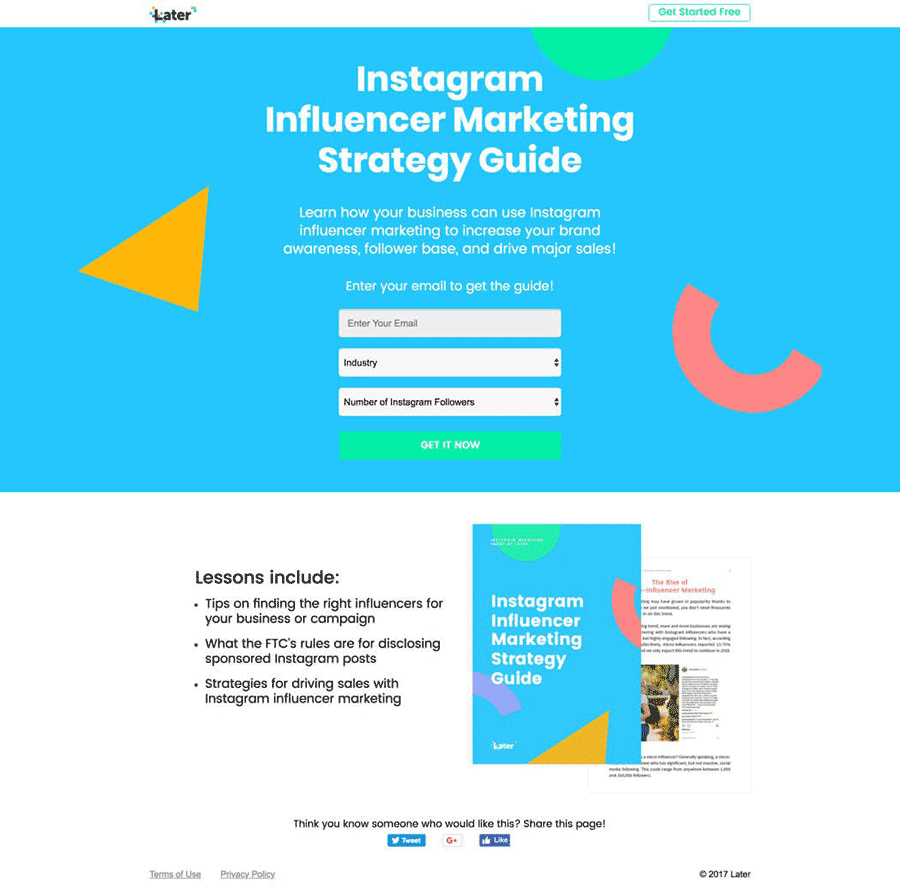
1. Later

best converting landing pages

Source: Later

Later has does an excellent job creating an effective landing page that is sure to convert. At a glance, you can see exactly what the page is about, what you can expect to gain from it, and how you can convert via the form. The content is concise and straight to the point, giving you all the pertinent information.

The call-to-action “Get It Now” is also compelling and sure to get people to convert. If you look closely, you’ll also notice that there is no navigation menu. They utilize high quality images that gives you a clear idea of what you will get once you convert. While we can’t know if they are conducting A/B tests, they have included all the elements of a persuasive landing page.

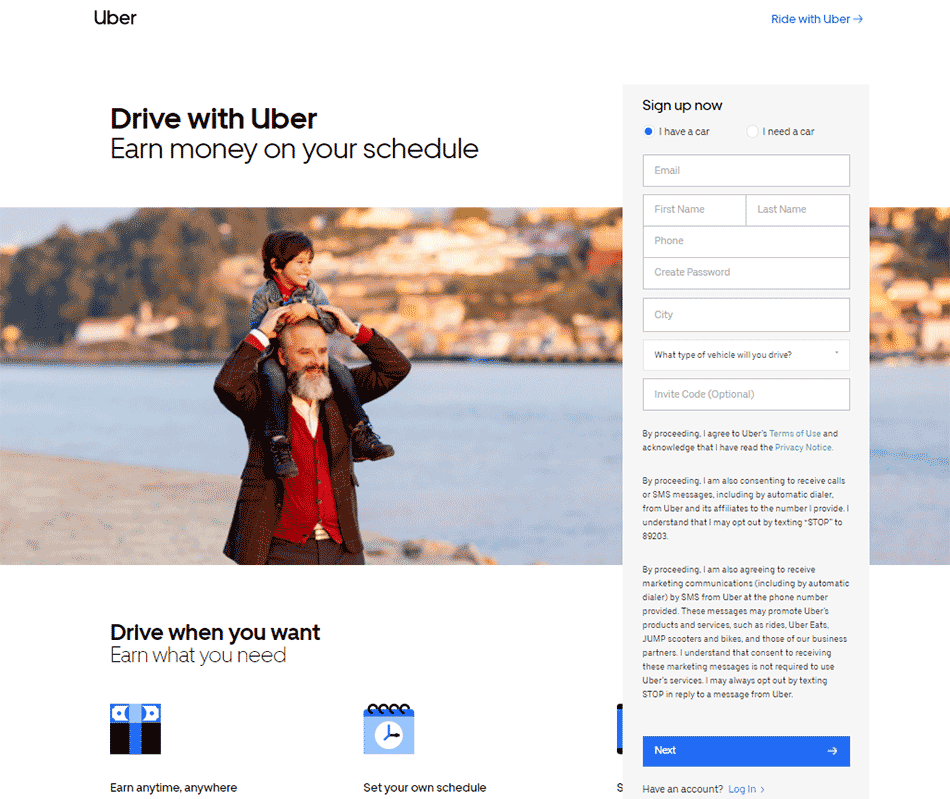
2. Uber

high-converting landing page examples - Uber

Source: Uber

Though Uber’s landing page does not have as much content as the previous example, the content they do have is concise and to the point. You know exactly what the page is about, what you can expect to gain from signing up, and you can see immediately how to sign up.

3. Paycor

persuasive landing page - Paycor

Source: Paycor

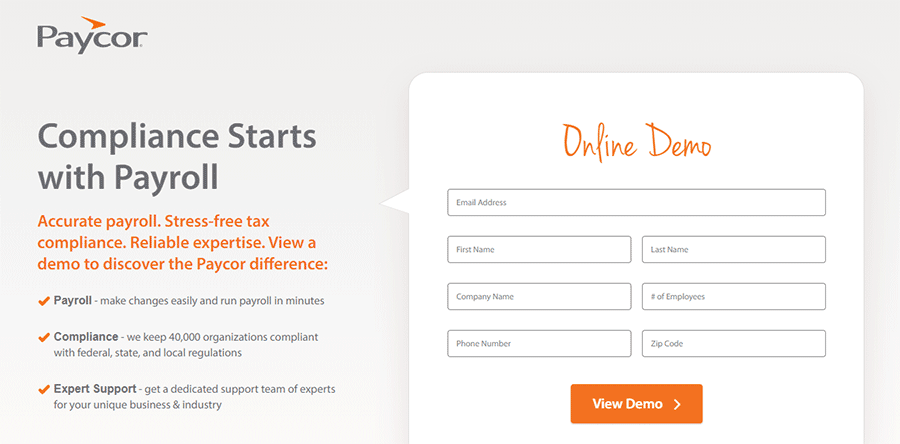
So, what makes a great landing page? Paycor definitely has the answer. This landing page is linked to a search ad, and their heading and subheading closely align the intent of the original search.

Right off the bat, they make their content compelling with a clear landing page value proposition. Their service is the solution to a common pain point of small business owners – compliance.

Their demo call to action is clear, and there is a highly-visible form near the top of the page. As a bonus, there is no top navigation to lead users away from the main CTA.

To improve one aspect of this landing page according to best practices, Paycor may benefit from adding supporting imagery or video.

MARION’s Web Design Team Can Help You Craft Effective Landing Pages

It’s clear that your business is a success, but growth has become a priority and landing page design is not your expertise. MARION has been around for nearly 40 years, and our Austin, DFW, and Houston web design capabilities have evolved to suit the needs of your business.

Schedule a free consultation today to learn more about how our web design services can amplify the effectiveness of your ad budget.

Marketing emails you’ll actually want to read.

Get marketing tips and news sent to 
your inbox.
This field is for validation purposes and should be left unchanged.
Name(Required)

5 Ways to Reduce Your Facebook CPL

If you’re a business advertising through social media, you know how important it is to closely monitor the performance of your account. Savvy business owners and managers know that you must set marketing KPIs and adjust your campaigns based on their performance.

Learning how to generate leads or how to get more followers on your Facebook business page can vastly improve your company’s bottom line, but it comes at a cost. The cost per lead of your Facebook Ads show how much you’re paying to acquire each lead. 

Databox found the average CPL for a Facebook campaign falls between the $0 and $25 mark. 

But if you’ve checked your reporting dashboard and realized you’re paying over the odds for each lead, you’ll have one question: How do you reduce your CPL?

How to Reduce Cost per Lead on Facebook

Here are five simple techniques you can use:

1. Use the Lead Generation Campaign Goal

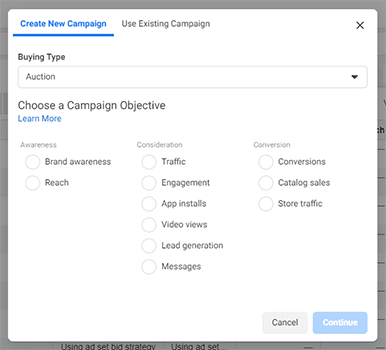
You’ll have to choose a goal for a Facebook campaign whenever you create new adverts.

reducing Facebook cost per lead

This is the main result you want from the ads, and impacts who the advertising algorithm shows your content to, such as:

  • Brand awareness (showing your ad to the largest group of people)
  • Link clicks (showing your ad to people likely to click on Facebook links)
  • Conversions (showing your ad to people likely to purchase items from Facebook)

Technically, you can use any of these goals to run your Facebook campaigns. But if your main goal is to increase lead quality and reduce the cost of each, it makes sense to set your goal to lead generation. That way, Facebook will be more likely to show your ad to people with a history of submitting forms.

Sean Collins of Barrel explains that this reduces your CPL “because the traffic never leaves the platform, we get some very low-cost leads.”

2. Think About Audience Targeting

The next stage of your Facebook campaign creation is to pick the people you want to target. But this goes beyond adding their interests and doubling-down on the age of your target lead. 

You can use two audiences to reduce your CPL, according to some experts:

  • Lookalike audience: A list of new Facebook users similar to those who’ve already filled-in your forms. Alejandro Rioja says: “Since you receive leads exclusively from Facebook, a lookalike audience derived from the lead ads will be higher quality.”
  • Retargeted audience: These might be people who’ve visited your website, liked your Facebook Page, or watched a video. According to Ali Rizvi of Dream Superhero, “using an engagement audience from the lead ads is the best way to lower your cost and increase volume.”

3. Play on Your Audience’s Pain Point

Talk to your sales team and really get to know what your ideal customer looks like. Chances are, these are the people you’re hoping to attract with your Facebook campaigns.

What pain point are they struggling with? Some examples include:

  • The product is too expensive
  • They can’t get buy-in from their boss
  • They don’t know anyone who can vouch for you/the product

Find the pain points your target leads are battling with, then use that within the copy of your Facebook ad to reduce its CPL, as POSH Digital Media’s Joe Karasin explains: “For example, when we are running FB ads for mortgage lenders, we start our ads with ”If you’re planning on refinancing…”

“By using specific language, we are able to both qualify and disqualify leads, so we don’t end up with a bunch of useless clicks,” Karasin adds.

4. Use a Giveaway as Your Hook

People are unlikely to fill in a form unless they’re really interested in what you’ve got to say, or you’re solving a pain point of theirs. Depending on your business, that might be a small portion of your audience—hence why the CPL of your Facebook campaigns is sky-high. 

You’re able to boost interest (and the number of people turning into a lead) by giving them an incentive, such as:

  • Entries to a giveaway or sweepstake
  • A free product
  • Vouchers or discounts on their next purchase

Michael Dinich explains that The Money Mix ads “were averaging a $2 CPA to gain email subscribers, but after implementing sweepstakes our CPA has an average 13 cents or less.”

5. Split-test the Number of Form Fields

“The best way to lower your CPL for Facebook Ads is to continually run an A/B test to optimize your ad,” says Katherine Hunter-Blyden of KHB Marketing Group.

how to reduce cost per lead on Facebook ads

You can split-test anything from your ad copy to your audience targeting. However, David Denning of Jumpstart Go thinks you should split-test the number of fields on your form because “the more questions and steps they have to take, the less will finish and come through as leads (which increases your cost per lead).”

Research backs this up: One company increased their conversions by 120% after dropping from 11 to 4 fields on their forms. 

Split-test to see whether your Facebook campaigns have the same impact.

Final Thoughts on Reducing Facebook CPL

The CPL of your Facebook campaigns is something you should be keeping a close eye on—no matter the goal of your campaign. It shows how much you’re paying to acquire each customer. 

Compare your CPL to other financial metrics, like your CLV, to see whether Facebook Ads are generating a return on your investment. If it isn’t, these five tips are bound to help you reduce your CPL (and start making a profit.)

Let MARION Help Improve Your Social Media Performance

MARION has been helping Texas businesses successfully market themselves for nearly 40 years. Our team of strategists offers branding, traditional, and digital marketing services that can grow your business into a revenue-generating machine.

Contact us today to schedule a free consultation if you need help with social media marketing in Houston, Austin, or DFW.

Marketing emails you’ll actually want to read.

Get marketing tips and news sent to 
your inbox.
This field is for validation purposes and should be left unchanged.
Name(Required)


How to Target the Ideal Audience in Google Ads

Google Ads audiences can be a complex topic to understand. Each available audience type and its function differs depending on the type of campaign that you run. Finding the right audience to target can help you reduce ad spend, increase your ad conversion rate, and ultimately increase your company’s revenue.

For this blog, we have narrowed our focus to the two most common Google Ads campaign types – Search and Display.

What Are Audiences in Google Ads?

Google Ads audiences give you more context for users that are clicking on your ads. This includes their demographic information, what their interests are, what they actively search for, and in the case of remarketing audiences, how they have previously interacted with your business.

You can use audiences to narrow your scope so that your ads only target a specific audience, or you can put in place bid adjustments to drive a greater amount of higher-converting traffic.

For expert help with your PPC in Houston, contact MARION today.

What Is Audience Targeting in Google Ads

Audiences play a much more significant role in Google display campaigns than they do in search campaigns. Without audiences for Google display ads, you would ultimately target anyone and everyone in your specified location(s), as much as your budget would allow. Audiences in Google display ads function to narrow the scope and allow you to get more targeted with your ads.

When it comes to search campaigns, you can use search audiences in Google Ads to target users that are more likely to convert by setting bid adjustments. However, the main targeting in Google Ads search campaigns comes from the keywords you select, rather than from the audiences themselves.

The Austin PPC professionals at MARION can help you create and target a custom audience. Contact us for a free consultation today.

5 Types of Audiences in Google Ads

create an audience in Google Ads

1. Demographic Dimensions

Demographic audiences differ from all other audiences on this list. When it comes to demographics targeting, there are some things that you can exclude, and others that you can’t.

For example, you can specify the exact location that you want to target as well as exclude the geographic locations that you in no way want your ads to be served.

Under the “Audiences” tab, you can add or exclude specific demographic groups that fall under any of the following categories – parents, marital status, education, and homeownership status.

When it comes to the remaining demographic categories – age, gender, and household income – you do not have as much flexibility. While the categories are fairly inclusive of all demographics, you cannot exclude any group of people.

While bid adjustments are an option and help give you better control over how much visibility each group gets, the most you can decrease the bid by is 90%. In other words, while the group will likely still get some visibility, said visibility will be at a minimum.

Demographic audience targeting is available across Display, Search, and Video campaigns.

2. In-Market Audiences

In-market audiences are comprised of people that are actively searching for specific products or services. Keep in mind that Google’s machine learning systems determine if a searcher is in a particular in-market audience based on their recent activity. The exact criteria that these searchers must meet is not known outside of Google.

In-Market audiences are available across Display, Search, and Video campaigns.

3. Affinity Audiences

Affinity audiences enable you to target searchers based on their lifestyles, purchasing habits, and long-term interests. This isn’t necessarily what they are currently searching for (you would use in-market audiences for that), but things they have shown repeated interest in over time. “Coffee Shop Regulars,” “Do-It- Yourselfers,” “Bargain Hunters,” and “Sports Fans” are just a few examples of specific affinity audiences in Google Ads.

Affinity audiences are available across Display, Search, and Video campaigns.

4. Custom Intent Audiences

Google Ads custom intent audiences are currently available for Display & Video campaigns only. With custom intent audiences, you use keywords and URLs to create an audience in Google Ads based on products and services for which users are actively searching (like in-market audiences).

5. Retargeting Audiences

Retargeting audiences are made up of people that have already interacted with your ads or website before. This is considered direct behavioral targeting in Google Ads, because you have an explicit record of these users interacting with one of your web properties. You can create retargeting audiences with your Google Analytics audience builder, or with a Google Ads retargeting pixel.

Retargeting audiences are available across all campaign types.

How to Target an Audience on Google Ads

As we mentioned before, not all audience types are available nor will they have the same role across all campaign types.

When implementing certain demographic audiences, as well as affinity, custom intent, in-market, and remarketing audiences, you can either choose for them to be “Targeting” audiences or “Observation” audiences. Targeting audiences will limit your reach to only those that fall under any of the audiences that you select.

Observation audiences, on the other hand, don’t narrow the scope at all, but rather give you insights. This way, you can segment your audiences to see how they perform, then pursue the top performers more aggressively in the future.

Implementing Affinity, Custom Intent, & In-Market Audiences

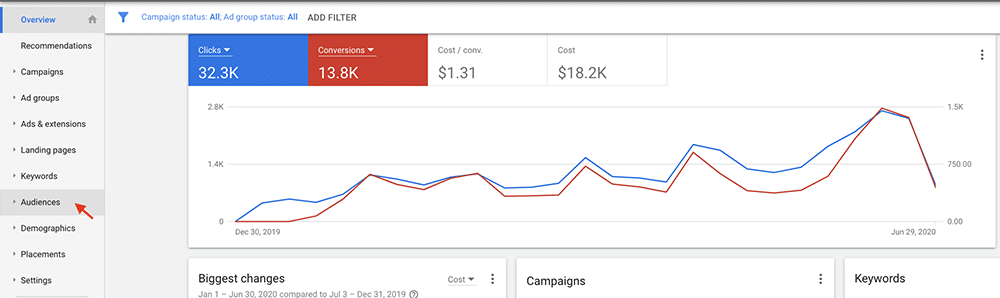
Once you log into your Google Ads account, find the “Audiences” tab in the left-hand menu.

search audience in Google Ads

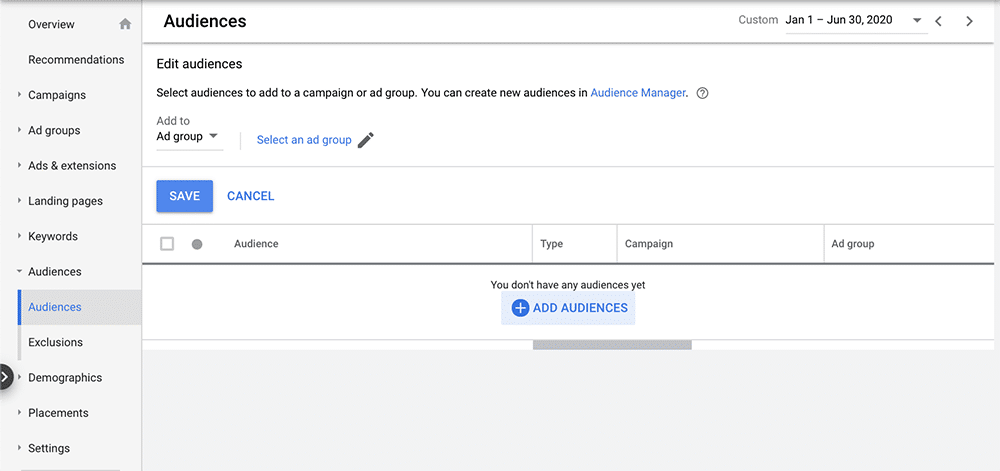
Select the Campaign/Ad group where you want to implement the audience(s) and then click on “Add Audiences”

behavioral targeting in Google Ads

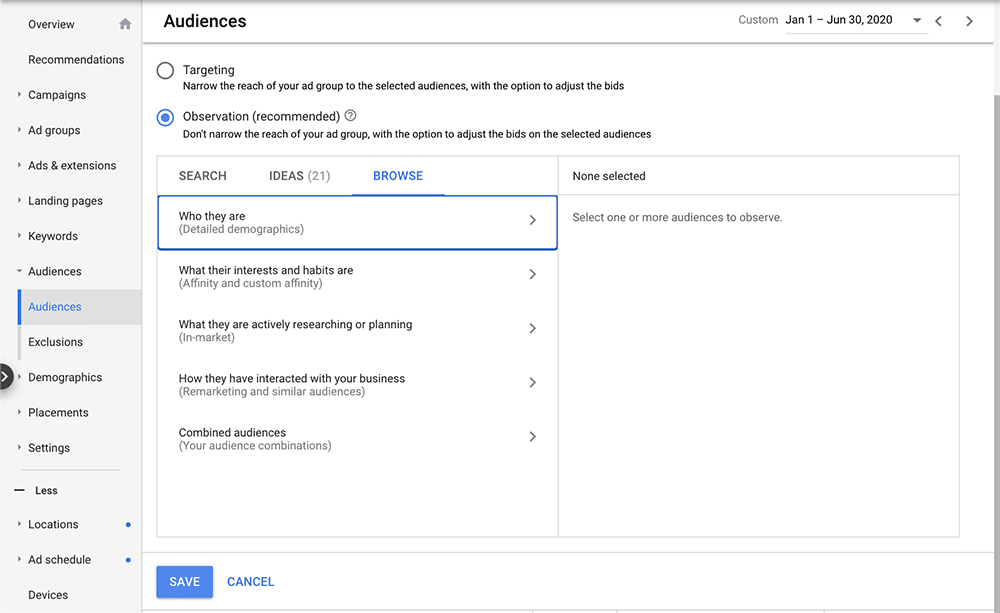
Here is where you can select whether the audiences you implement will be Targeting audiences or Observation audiences.

If you do not have a specific audience in mind that you want to target, you can click on the “BROWSE” tab to view the options that are available to you.

custom audiences in Google Ads

Once you have selected the audiences you want, click Save.

Implementing Remarketing Audiences

Though the steps to implement your remarketing audience is the same as what we outlined above, with remarketing audiences you must create them first before you can implement them into your campaign(s).

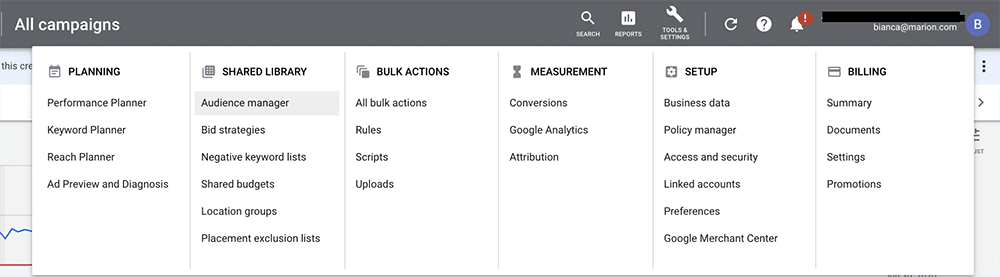
To start off, you must first ensure that your Google Ads & Google Analytics accounts have been linked or you have implemented a Google Ads tracking tag on your site. You will have to set up the audience source before you can implement any remarketing audience. Once that has been completed, click on the “Tools & Settings” wrench on the top right. Under “Shared Library,” click on “Audience Manager.”

how to target an audience on Google Ads

On the following page, click on the blue plus sign Google Ads interest targeting.

You may choose to create an audience list for all visitors or strictly for visitors that viewed certain pages on your site, depending on your campaign and goals. Once your remarketing audience list has been created, you can follow the steps we outlined previously for other audiences to implement your new remarketing audience.

Implementing Locations & Demographics (Age, Gender, & Household Incomes)

The age, gender, and household income demographics can be found under the “Demographics” tab on the left-hand menu. Location can also be found in its own separate tab on the left-hand menu.

MARION Can Help Your Paid Ads Reach the Perfect Audience

Implementing Google Ads audiences is just a small portion of running an effective PPC campaign. Our Texas marketing agency has the expertise needed to generate the results you are looking for.

Contact us today to schedule a free consultation with one of our Google Ads marketing experts!

Marketing emails you’ll actually want to read.

Get marketing tips and news sent to 
your inbox.

This field is for validation purposes and should be left unchanged.
Name(Required)


How to Market as Businesses Reopen During COVID-19

Over the past few months, life has looked different for everyone, and businesses have been left to figure out how to quickly navigate to an ever-changing “new normal.” As states and cities around the U.S. begin to reopen, marketers must turn their attention to how they can appropriately start back up business operations.

Today, we’ll share some tips for how your business should market in a post-Coronavirus world. Read on to get all the facts.

Show Empathy in All You Do

While businesses are opening back up, Coronavirus continues to affect hundreds of thousands of Americans. Remember to show empathy and understanding in all your marketing efforts and communications. Remain sensitive to what is going on and continue to remain flexible for whatever changes may lie ahead.

Along that same line, remember to not seem oblivious to the world. While businesses are opening back up slowly, it will be a steady process that will look different throughout the country.

Avoid acting like everything is peachy and Coronavirus is gone — because it is not. Remember, everyone is trying to learn how to navigate a new normal and your tone and messaging should reflect this.

Study Your Customer Behavior Changes

Use this opportunity to pick up on consumer behavior changes and virtually engage with consumers in new ways. In times of crisis, it is crucial for marketers to see consumers as real individuals and not customers grouped into segments.

Use real-time data on customer transactions, and behaviors to help make informed interactions. Using these personalized insights can help you create more relevant, positive engagements with your customers and build stronger relationships.

Create a New Marketing Plan and Budget

marketing for reopening after COVID-19

All your marketing efforts must now be reframed through the lens of COVID-19 and its impact on businesses and consumers.

As the economy begins to open back up, digital will remain a must for marketing, reaching consumers where they are online. Even as we start leaving our homes and interacting more, it is likely there will still be changes to consumer behavior until a vaccine is created — and some changes may even last longer into the future. Invest in a marketing strategy that prioritizes virtual connection and messaging, and work to build relationships using online resources. By targeting the right marketing goals and objectives from the start, you’ll position your business for growth.

Invest more in search engine optimization, social media marketing, and PPC services to reach your consumers online. To learn more about how you can shift your digital marketing strategies during the COVID-19 pandemic. COVID-19 digital marketing

Look at your marketing budget and consider how it should change. Does your business need to cut expenses to stay afloat? Or does it need to prioritize money for marketing efforts to get back on top? While your team may be inclined to the former — you may be surprised to learn that long-term studies show that during economic uncertainty, businesses that increase — not decrease —  their marketing spend are better off.

These studies show advertisers that maintained or grew their ad spending increased sales and market share during a period of recession and afterward. As a popular adage says, “When times are good you should advertise. When times are bad you must advertise.”

If you’re worried that your audience will not be receptive to your messaging during this time, here’s some reassuring news: A survey from the American Association of Advertising Agencies conducted during the height of the Coronavirus crisis in March found that 43% of consumers find it reassuring to hear from brands, while only 15% said they’d rather not hear from companies. Consumers are still open to messaging, but it must be tailored to today’s world and framed in a new and relevant way.

Get Professional Marketing Help from MARION Today!

If you’re unsure how to approach marketing your business during the COVID-19 pandemic, the marketing experts at MARION are here to help! Our digital marketing agency has been helping Texas businesses with traditional and digital marketing for nearly 40 years.

Contact us today for a free consultation!


Social Media for Manufacturers – How to Get B2B Social Media Marketing Results

Social media marketing for B2B may be less straightforward than B2C marketing, but it’s just as important in building your brand and business.

In this blog post, we’ll walk you through which platforms you need to be on as a manufacturer, why it’s an important part of marketing for manufacturing companies, and how to form a manufacturing social media strategy.

Why Social Media for the Manufacturing Industry is Important

Not too long ago, social media didn’t seem like a necessity for B2B companies. However, as the workforce shifts towards a more tech-savvy generation, more and more key decision-makers are going to be looking online for more information before they decide to work with you. This makes social media for manufacturing companies an indispensable channel.

Having a polished social media presence is beneficial for many other reasons. Social media activity can help boost your SEO efforts, generate leads, aid with customer service, and much more.

If your social presence indicates you are a leader in the manufacturing industry and care about communicating with customers, it’s more likely you’ll stand out from your competitors.

Best Social Media Platforms for Manufacturers

Some social media platforms make more sense for manufacturers than others. Your customers will be less inclined to interact on more casual or “trendy” platforms such as Instagram, Pinterest, or Snapchat.

Here are the best manufacturers social media sites to help with your B2B marketing strategies:

LinkedIn manufacturers social media

LinkedIn

LinkedIn is the best B2B social media site to pursue, with over 94% of B2B marketers on the platform. This is a great place for businesses to build thought leadership and develop significant connections.

LinkedIn also has a large number of decision-makers. 45% of LinkedIn members are in upper management. LinkedIn Ads allow for very precise targeting with filters such as job seniority, company size, member age, industry, and much more.

Most users on LinkedIn are on the site to connect with other people in their industry, so that’s already a key step in separating valuable leads from the crowd. LinkedIn also has a Groups feature where you can find, connect, and interact with potential clients in a very targeted pool. Joining a LinkedIn Group is a great platform to showcase content marketing for manufacturing companies, and a fantastic way to drive leads and traffic towards your company.

social media industrial marketing on Facebook

Facebook

Having a page presence on Facebook is still a must. Without a Facebook Page today, your credibility may be questioned. In fact, it could even have a negative impact on local SEO for manufacturing companies.

Many customers will go on your page to contact you through Messenger or public posts and comments. This is a great way to connect with people and direct them to exactly who they need to speak with. These visitors could be looking for quick clarifications and initial questions so it’s important to monitor this channel closely. With over 2.5 billion monthly active users, your social media industrial marketing is bound to reach your target audience through Facebook.

social media marketing for manufacturers on YouTube

YouTube

The possibilities of marketing for your manufacturing company on YouTube are endless. YouTube is a great way to showcase your company and its products to build brand recognition and improve SEO. The video assets you create on YouTube can also be included in your manufacturing website design. While YouTube technically functions as a search engine, many consider it a social media platform because of the engagement it facilitates.

Marketers could upload videos of customer testimonials, product tutorials and demonstrations, service walk-throughs, trade show appearances, and much more. Anything that tells your brand story is worth posting!

Twitter social media marketing for the manufacturing industry

Twitter

Social media marketing for manufacturers doesn’t always prioritize Twitter, but it’s still important to have a company Twitter account. Your role on Twitter should be an educator. Use this channel to share interesting and engaging information.

As a mobile-first platform, many of your clients on-the-go can view your posts easily. If there’s ever a crisis, Twitter is an excellent tool to get any message out quickly and promptly reply to others.

How to Form a Manufacturing Social Media Strategy

The first thing you should do when coming up with a social media strategy for manufacturing is to determine your audience. Which websites are they using the most and which ones are they interacting with you on? If you have no idea, it might be a good idea to investigate what your competitors are doing.

After you decide on which platforms to best reach your potential clients, it’s useful to come up with a content schedule. This way, you can post consistently and build a following that knows they can depend on you.

Make sure you monitor social media regularly so you can quickly respond to customer posts and inquiries. Spread out self-promotion amongst content marketing so long-term followers don’t get fatigued from the same content.

Struggling to Develop a Social Media Strategy? Call MARION Marketing Today!

MARION has years of B2B marketing experience from working closely with industrial manufacturers across Texas. If you need assistance with your social media strategy, our expert team of SEO and social media professionals knows exactly how to craft one customized for your business’s needs.

Contact us today to schedule a free consultation with a member of our marketing agency!

Marketing emails you’ll actually want to read.

Get marketing tips and news sent to 
your inbox.

This field is for validation purposes and should be left unchanged.
Name(Required)


3 Best Contact Us Page Content Examples [With Contact Page SEO Tips!]

The contact page is extremely important because if a visitor is on this page, they’re trying to speak with you or ask some critical questions. This can be a turning point for your business relationship. Make sure you direct them to the right person or department so both parties can benefit.

Content for Contact Us Page

Any effective website contact page should have the following basics:

  • Company name
  • Addresses
  • Phone numbers
  • Email addresses
  • Contact form

Your Contact Us page should also clarify any potentially confusing information, such as multiple locations or departments.

Contact Us Page Message

Your contact page may be the first page a potential customer clicks on after searching for you online. Therefore, it’s good practice to have a short summary of your business including who you are and what you do.

Contact Information

Visitors may have different needs and preferences – generally, businesses should try to include as much contact information as possible in case one might prefer email over calling first. Of course, this may not work in your company’s situation, so keep your specific priorities in mind.

When to Include Phone Numbers

It’s always necessary to have a general office number displayed somewhere easy to see on your contact page. However, if you have multiple departments or specific people to contact about certain issues, you may want to include their numbers, as well.

It’s also a good idea to include office or contact hours when possible if the people behind the phone numbers aren’t reachable 24/7.

When to Include Map

A map isn’t always necessary, but if your business is located in a confusing spot or have frequent visitors, it could be beneficial for you to provide a map to highlight where you are. There are also several tools that allow you to embed interactive maps onto your website so people can get individual directions from their specific locations.

contact page content for forms

Contact Us Form Content

Even if you’ve provided information like phone numbers or emails, a contact form still makes it extremely convenient for a customer to take the next step with your business. Every contact form should include boxes for website users to fill out their:

  • Name
  • Contact information
  • Reason for messaging your business

You can get more specific if you’d like. For example, it might make sense for you to ask them to leave their company name or get the parameters for the potential project they’re inquiring about.

Contact Us Page SEO

A contact page can assist with your website’s SEO, so take advantage of these smaller elements that are often overlooked.

If you’re in need of SEO in Austin or Houston, contact MARION to schedule a free consultation today!

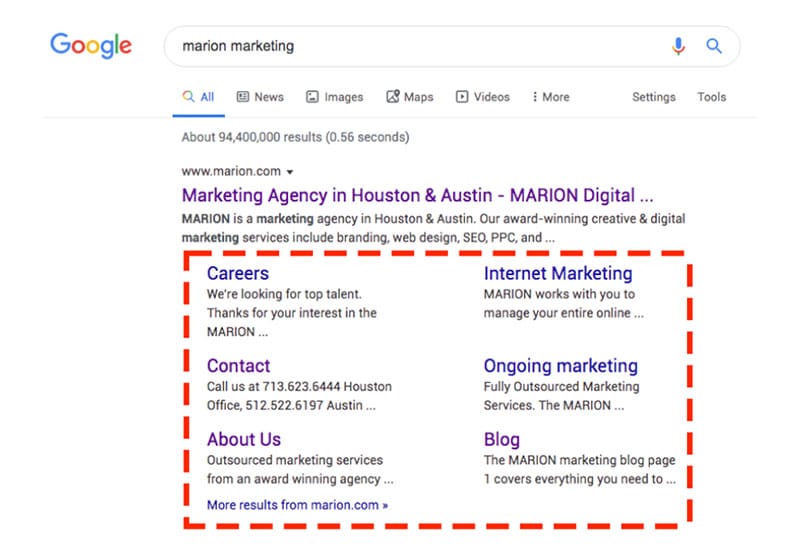
Site Navigation Element Schema

The SiteNavigationElement schema markup allows search engines to understand relevant information about your website’s layout that could affect your business’s search results.

According to a study by Searchmetrics, websites with schema markup rank an average of 4 positions better than websites without, but it’s important to note that this may not be a direct, causal relationship.

With contact pages, Schema and an SEO-friendly web design can make it easier for visitors to directly click on the webpage from search results so they can quickly find the contact information they need.

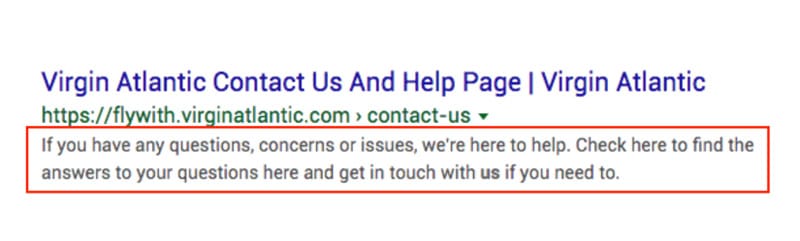
meta-description for contact us page

Contact Us Page Meta Description

A meta description pulls a snippet from the website, but you can also change it to your liking in your website’s CMS (especially if your site uses a WordPress web design).

Try to keep the description around 160 characters and use relevant keywords so it’s direct and to the point. For a contact page, it helps to have a short description letting visitors know they’ve found what they’re looking for.

contact us page SEO

How to Write a Contact Us Page for a Website

When writing a contact page, you want to keep things direct and simple. Make sure you have all the basic information, such as phone numbers, email addresses, physical locations, etc.

For those who don’t want to exit the page or call, a contact form is a great way to generate new leads. If you want to go beyond, you can write additional copy listing which city (or cities) you operate in and the services you offer so new visitors immediately see what your company does.

Contact Page Examples

Look at some of the best contact us page examples we’ve seen recently:

1. FreshBooks

website contact page examples

Source: FreshBooks

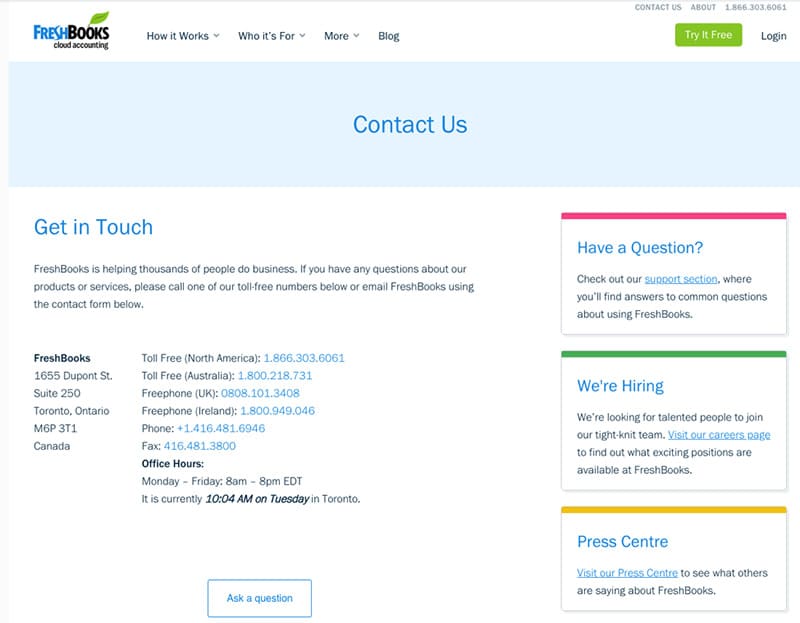
FreshBooks has all the basic information such as their address, phone numbers, and a contact form. Beyond that, this is a good example of a clean and simple, yet innovative contact page. All the relevant phone numbers are displayed in a simple manner so it’s easy to find the correct number for your specific need.

They also list their office hours and have a handy, live notifier underneath to let you know what the current time is in their location. On the right side, they’ve listed other possible departments and webpages you may be looking for.

2. Protest Sportswear

contact us page examples

Source: Protest Sportswear

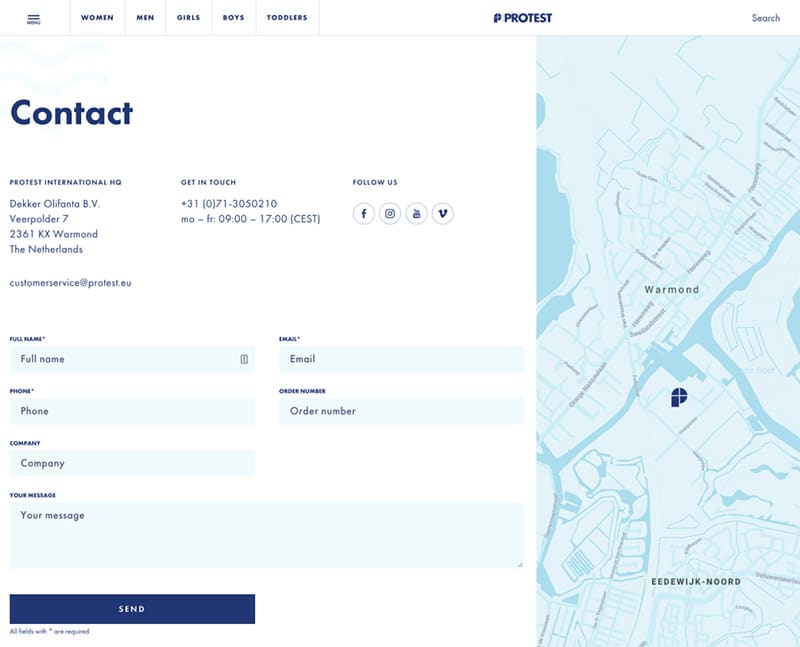
This contact page is very straightforward yet pleasing to look at. They list their address, phone number, email address, office hours, contact form, and buttons to follow their social media profiles. They’ve also incorporated a picture of their location on a map as part of the design of the contact page. This page is effective because it shows you everything you need to know in a clear and direct manner.

3. Wendy’s

how to write a contact page

Source: Wendy’s

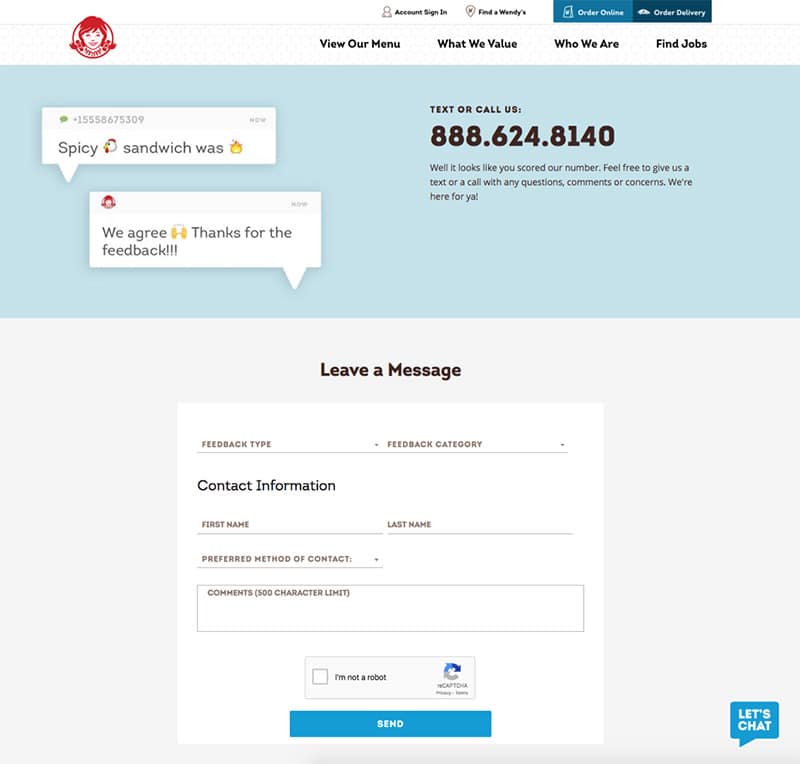
Wendy’s contact page is a good example of making sure your contact page aligns with the rest of your branding without distracting you from critical information. They have a casual message and witty copy with a blown-up phone number so you can’t miss it. There’s a simple contact form underneath if you prefer an electronic “paper trail” as well.

If you’re looking to step up your graphic design in Houston, contact MARION today for a free design consultation.

Let MARION Enhance Your Website and Search Presence

Optimizing your contact page copy is a great way to help boost your website’s SEO, but it can be difficult to know what you’re doing without an experienced Houston marketing agency in your corner. If you’re looking to improve your website’s search presence and user experience, MARION can assist you.

Contact us online today to see how our expert team can help!

Marketing emails you’ll actually want to read.

Get marketing tips and news sent to 
your inbox.

This field is for validation purposes and should be left unchanged.
Name(Required)