Category: Lead Generation

SEO for Lead Generation: How to Turn Traffic into Real Customers

Most businesses invest in SEO expecting more traffic. What they actually want is more leads and customers…the problem is that traffic alone does not generate revenue.

SEO for lead generation focuses on attracting the right audience, guiding them through your website, and turning visitors into real opportunities. In this guide, you will learn how to generate leads with SEO and turn organic traffic into measurable business growth.

What is SEO for Lead Generation?

SEO for lead generation is the process of using search engine optimization to attract potential customers and convert them into leads. This includes:

  • Targeting high intent keywords
  • Creating content that answers real buyer questions
  • Capturing contact information through forms/offers/etc.

Traffic marks the start of the process. The objective is a pipeline of qualified prospects.

How SEO for Lead Generation Works

1. Attract the Right Audience

Not all traffic is equal. Ranking for broad or irrelevant terms might increase visits but will not generate leads. For one of our clients, shifting focus to high-intent terms grew keyword rankings from 28 to over 1,500 in 18 months.

Focus on:

  • Commercial intent keywords: Terms indicating a readiness to purchase.
  • Problem based searches: Queries seeking solutions for specific failures or needs.
  • Industry specific queries: Terms related to engineered systems or application specific solutions.

2. Match Search Intent

If content does not align with user expectations, they will leave. Your content must match the user’s stage in the funnel or they will leave.

For example:

  • Informational searches require technical documentation or educational guides.
  • Service based searches require optimized landing pages with clear conversion paths.

3. Guide Users Through the Funnel

Users have different needs depending on where they are in the buying process. Your content should guide them step by step:

  1. Problem stage → users search for answers and solutions
  2. Research stage → users compare options and providers
  3. Decision stage → users look for companies to hire

Your job is to move them from one stage to the next. When your content matches each stage, users are more likely to move forward and convert.

4. Capture the Lead

You need a clear next step:

  • Contact forms
  • Downloadable resources
  • Free consultations

Without this, traffic leaves without value.

SEO for Lead Gen

SEO Strategies to Generate Leads Consistently

Target High Intent Keywords

Rankings alone do not drive revenue. To generate leads with SEO, focus on search terms that show buying intent.

  • Informational:what is safety training
  • Commercial Intent:safety consulting Houston” or “industrial safety staffing services” By shifting focus to intent-based terms, page one rankings for competitive phrases increased by 1,343 percent over two years for a consulting client.

Prioritize Lead Capturing Architecture

Each page must serve a specific function in the sales funnel. Service pages should provide technical specifications and clear calls to action.

  • Landing Pages: Build pages for application specific solutions.
  • Internal Linking: Connect technical blog posts to related service pages to guide users toward a consultation. This method increased our client’s goal completions (forms and calls) by 145 percent by removing friction between information and action.

Optimize for Local Lead Generation

For businesses serving specific regions, local SEO is a primary driver of qualified prospects.

  • Local Citations: Maintain accurate data across directories.
  • Geo-Specific Content: Create pages that address the requirements of regional markets.

How to Measure SEO Lead Generation Success

Successful lead generation requires moving beyond Google Search Console. You must track the journey from the first click to a closed contract.

  • Closed Loop Reporting: Integrate your website with a CRM (like HubSpot or Salesforce) to see which organic keywords actually generate revenue, not just form fills.
  • Lead Quality Scoring: Analyze the quality of submissions to separate spam from high value prospects interested in reliability and performance engineering.
  • Attribution Models: Use multitouch attribution to see how many times a user interacted with your content before requesting a consultation.

Measuring the cost per lead (CPL) provides the data needed to scale your marketing budget effectively.

Read now: How To Conduct Keyword Research

what is lead generation in marketing?

SEO for Lead Generation FAQs

How long does SEO take to generate leads?

Most businesses start seeing early traction within 3-6 months, with stronger lead flow building over time.

Can SEO generate leads without ads?

Yes. A strong SEO lead generation strategy can consistently bring in qualified prospects without relying on paid ads.

What type of SEO content generates the most leads?

Service pages, comparison content, and guides tend to drive the highest conversions.

Ready to Turn SEO Traffic into Leads?

If your website is bringing in traffic but not generating leads, something is broken in the process. At MARION, we identify where your SEO is losing opportunities and build a strategy that turns visitors into qualified leads.

Schedule a consultation today and see how your SEO can start generating real customers.

Marketing emails you’ll actually want to read.

Get marketing tips and news sent to 
your inbox.

This field is for validation purposes and should be left unchanged.
Name(Required)

How to Choose a Digital Marketing Agency in Houston

Researching how to choose a digital marketing agency? In a market as large and competitive as Houston, your online presence correlates to proposal requests, leads, and sales conversations. For B2B and industrial firms, the stakes are even higher!

If you’re currently deciding how to hire a marketing agency for your business, this guide will show you what to look for, what to avoid, and the best questions to ask a digital marketing agency before you sign any contract.

Why Choosing the Right Digital Marketing Agency in Houston Carries Weight

Houston is one of the most competitive business environments in the country. Energy, manufacturing, logistics, healthcare, construction, and professional services all compete for digital visibility.

For B2B companies, complexity multiplies:

  • Multiple decision makers
  • Technical buyers
  • Long evaluation timelines
  • High contract values

If you’re researching how to choose a B2B digital marketing agency, industry experience should be high on your list. Just think about it: selling industrial equipment to engineers is a lot different from selling ecommerce products to average consumers.

Your Houston digital marketing agency must understand your local competition, industry dynamics, and how to structure campaigns that support long sales cycles.

What Does a Digital Marketing Agency Actually Do?

Many business owners begin with a simple search: “what does a digital marketing agency do?” Before you can decide how to hire a marketing agency, you need clarity on the services involved.

A full service agency typically supports growth across search, paid media, web performance, and content.

Here’s how those services break down:

SEO (Search Engine Optimization & AI Visibility)

SEO drives visibility when prospects actively search for your services. For B2B and industrial companies, Texas search engine optimization usually targets:

  • High intent service keywords
  • Technical product terms
  • Location based queries
  • Competitor comparisons

Effective SEO tactics are technical optimization, keyword research, link building, content development, and ongoing refinement.

If your buyers research solutions before contacting sales (which they probably are), Houston SEO services should be foundational.

PPC & Paid Advertising

Paid advertising accelerates visibility. Google ads, LinkedIn ads, ChatGPT ads, retargeting campaigns,  allow you to:

  • Capture high intent searches immediately
  • Target specific industries or job titles
  • Stay visible during long evaluation cycles

For B2B companies, Houston PPC management services often support new product launches, geographic expansion, competitive positioning, and trade show amplification.

Website Design & Optimization

Your website is your primary sales asset. Industrial and B2B buyers need a web design company that implements the following on your site:

  • Clear positioning
  • Technical depth
  • Case studies
  • Trust signals
  • Fast performance

Website optimization is not limited to aesthetics. It affects conversion rates, SEO performance, and sales enablement.

Content & Social Media Marketing

Content marketing builds authority and supports long sales cycles. For B2B companies like manufacturers, specialty chemicals suppliers, energy service firms, and infrastructure contractors, this content may include:

  • Educational blog articles
  • Technical whitepapers
  • Case studies
  • LinkedIn thought leadership
  • Industry commentary
How to Choose a Digital Marketing Agency

7 Questions to Ask Before Hiring a Digital Marketing Agency

If you’re building a digital marketing agency checklist, this section is your foundation.

These are the questions to ask a digital marketing agency before committing budget. They also represent what to look for in a digital marketing agency if measurable ROI carries weight for your organization.

What industries do you specialize in?

Experience in B2B, manufacturing, industrial services, or energy carries weight. If you’re evaluating how to choose a B2B digital marketing agency, industry fluency should not be optional. Your agency should understand technical messaging, compliance requirements, and procurement processes.

PS: Ask for examples from your sector.

How do you measure ROI?

Unfortunately, traffic alone is not ROI. Also ask:

  • How do you track lead sources?
  • Do you measure cost per lead?
  • Do you connect marketing to sales outcomes?

For B2B companies, marketing must tie into CRM data and revenue reporting. If an agency cannot clearly explain attribution, reconsider.

Who will manage my account?

When deciding how to hire a marketing agency, clarify who runs your campaigns.

Questions to raise:

  • Account structure
  • Strategy ownership
  • Communication cadence
  • Turnaround times

You want direct access to experienced strategists.

What does your reporting look like?

Reporting should be structured and business-focused. You should avoid reports that highlight impressions without explaining revenue impact. Instead look for:

  • Lead volume trends
  • Conversion rates
  • Cost efficiency
  • Strategic recommendations

How long before I see results?

SEO takes time! Paid advertising can produce faster traction. Content marketing supports sustained growth. A credible answer here separates experienced agencies from sales-heavy ones.

What does a digital marketing agency in Houston cost?

Cost depends on scope, competition, and growth targets. When learning how to choose a digital marketing agency, resist the urge to compare proposals purely on price. Underfunded campaigns rarely compete in aggressive Houston markets.

Pricing expectations shown below.

Can you provide case studies or references?

This may be one of the best questions to ask a digital marketing agency. Case studies demonstrate execution (not theory). Look for proof of:

  • Lead growth
  • Improved rankings
  • Increased conversion rates
  • Industry specific results
how to choose a marketing agency

Red Flags to Watch for When Hiring a Marketing Agency

As part of your digital marketing agency checklist, watch for these warning signs:

  • Guaranteed rankings
  • Vague deliverables
  • No clear reporting structure
  • No discussion of conversion rates
  • Heavy focus on social media followers
  • No industry experience
  • Longterm contracts without performance discussions

If you’re serious about how to hire a digital marketing agency that supports revenue growth, these red flags should slow the conversation.

How Much Does a Digital Marketing Agency Cost in Houston?

Budget is one of the most searched topics when researching how to choose a digital marketing agency.

Typical Monthly Retainers

For B2B and industrial companies in Houston, monthly retainers can range from:

  • $3,000-$5,000 for focused campaigns
  • $5,000-$10,000 for integrated multi-channel strategy
  • $10,000+ for competitive industries with aggressive growth goals

The right number depends on revenue targets and competitive pressure.

Project-Based Pricing

Project work may include:

Project pricing varies based on complexity and deliverables.

What Impacts Cost?

Several factors influence pricing:

  • Industry competitiveness
  • Geographic targeting
  • Number of services included
  • Website condition
  • Content requirements
  • Paid media budget

Manufacturing and energy companies often require deeper technical content and longer nurturing campaigns, which affects scope.

Why Cheap Agencies Cost More Long-Term

Low cost agencies frequently outsource work overseas, use generic templates, skip research, and provide minimal strategy. The unfortunate result is stalled growth and reinvestment with a stronger partner later on.

Houston-Specific Factors to Consider

Houston is not a generic market. It is industry-heavy, relationship-driven, and highly competitive. Factors to consider include:

  • Strong presence of energy and manufacturing firms
  • Large B2B service ecosystem
  • Competitive local SEO landscape
  • Industrial procurement cycles

If you’re evaluating how to choose a digital marketing agency in Houston, local industry familiarity can shorten ramp-up time and improve campaign precision.

Should You Hire a Houston Digital Marketing Agency or a National Firm?

When researching how to hire a marketing agency, you may compare local and national firms. National firms may offer brand recognition. Local agencies offer proximity and industry familiarity.

Advantages of a Houston-based agency include:

  • Familiarity with local competitors
  • Knowledge of energy and industrial markets
  • Faster communication
  • On-site meeting capability
  • Regional networking insight

For B2B companies operating in Texas, local experience often improves execution.

how to find a marketing agency

Final Checklist Before You Sign with Any Digital Marketing Agency

Use this digital marketing agency checklist before signing:

  • Clear scope of services
  • Defined KPIs
  • Transparent reporting schedule
  • Identified account lead
  • Realistic timeline expectations
  • Case study proof
  • Alignment with sales objectives

If these elements are unclear, you probably shouldn’t sign a contract with them.

Need a Digital Marketing Agency in Houston?

Choosing the right partner takes time, especially when evaluating how to choose a digital marketing agency that specializes in B2B! Design At Work has worked with Houston-based B2B, industrial, and manufacturing companies for decades, building strategies that generate qualified leads and measurable revenue impact.

If you want a strategic partner focused on pipeline growth, schedule a conversation with Design At Work and start building a marketing engine that supports your sales team!

Marketing emails you’ll actually want to read.

Get marketing tips and news sent to 
your inbox.

This field is for validation purposes and should be left unchanged.
Name(Required)

Should AI be doing your marketing?

Why AI alone isn’t enough — and where agency expertise comes in.

For many businesses, keeping marketing in-house seems like the practical choice. With AI on the scene, it seems more cost-effective than hiring an agency and promises to keep projects moving quickly. After all, if a tool can write copy, design graphics, manage your social calendar and analyze campaign data in seconds, why wouldn’t you let it handle everything?

The challenge is that marketing isn’t just a series of tasks to check off a list. AI, for all its capabilities, can’t replace the strategy, creativity and cross-channel expertise it takes to grow a brand. Without that guidance, even the fastest, most affordable marketing efforts can fall short.

So should AI be doing your marketing? The answer is yes and no.

The limits of “good enough” marketing.

AI can make marketing look easier, but it doesn’t erase the gaps that come with relying on a single, inexperienced hire or asking a non-marketing employee to juggle tasks. These arrangements may keep projects moving, but they rarely produce the kind of coordinated, impactful marketing that fuels growth.

Here are the top five problems with “good enough,” AI-fueled marketing:

1. No clear strategic direction.

AI can produce content on demand, but it doesn’t decide what your brand should say, when to say it or how to connect the dots between campaigns. Without a strong, guiding strategy, marketing efforts can result in a haphazard mix of posts, emails and ads that don’t support measurable goals. The result? Activity without impact.

2. An inconsistent brand voice.

When messaging is created by a single marketing generalist — especially one without deep branding experience — messaging can drift from one piece to the next. AI can mimic tone in isolated pieces, but it can’t ensure your voice is applied consistently across all channels and touchpoints. This kind of inconsistency can erode customer trust and make your brand forgettable.

3. Limited creative perspective.

“AI tools should complement, not replace human creativity.”

— Chad Gilbert, VP of Content Marketing, NP Digital

A lone marketer (or a non-marketing employee) has limited bandwidth and creative diversity to draw from. AI might churn out endless variations, but without the insight to know which ones will resonate, you risk spending time and budget on campaigns that don’t connect with your audience.

4. Fragmented execution.

Effective marketing forms a cohesive ecosystem. Your campaigns, channels and messages should work together to tell one story. A single person juggling multiple responsibilities, even with AI’s help, can find it difficult to keep that ecosystem in balance. Opportunities to cross-promote, retarget or build momentum between campaigns are easily missed.

5. Reactive rather than proactive marketing.

Without dedicated expertise, marketing often becomes reactive, responding to immediate needs instead of building toward long-term growth. AI can accelerate that reactive cycle, producing more content faster — but without direction, it’s just more noise in an already crowded space.

How experts make AI work harder for you.

The smartest approach isn’t choosing between humans and AI. It’s combining the two.

“AI won’t replace humans, but humans with AI will replace humans without AI.”

— Tom Davenport, AI researcher & author

AI can move faster and process more information than any person, but it needs expert direction to ensure the work it produces supports your goals, reflects your brand and reaches the right audience. When guided by experienced marketers, AI becomes a powerful force multiplier that elevates both the quality and the efficiency of your marketing.

How AI enhances productivity.

AI can handle many of the repetitive, time-consuming tasks that slow down marketing teams. But knowing which tasks to automate and which to handle manually takes experience. Agencies can evaluate your current workflow, identify the most valuable opportunities for automation and select the right AI tools to execute them.

That might mean using AI to generate an outline of a blog post, resize campaign graphics for multiple platforms, create A/B test variations for an ad or segment an email list based on behavior and preferences. By automating these routine processes, agencies free up time for the high-value work AI can’t replicate: strategy, creative concept development and campaign refinement.

Brand consistency across every channel with AI.

AI can produce an impressive amount of content in seconds, but speed without oversight can easily lead to brand drift. Without the guardrails of a clear voice, tone and style, messaging can start to sound generic, disconnected or off-brand.

An agency provides that critical layer of review and refinement, ensuring that every piece of AI-assisted content is not only accurate but also aligned with your brand’s personality, values and messaging framework. This means your social media posts, email campaigns, paid ads, blog articles and landing pages all tell the same story — and reinforce it in a way that builds trust over time.

33% of businesses report that brand consistency increases revenue by at least 20%1

Data turned into action.

AI is excellent at producing dashboards, charts and detailed reports. But more data doesn’t automatically lead to better decisions. Without interpretation, it’s just numbers on a screen.

Experienced marketers know how to dig into AI-generated insights to uncover what’s truly driving performance. They can spot patterns that suggest shifts in customer behavior, diagnose why a campaign is underperforming and identify new opportunities for engagement. Just as importantly, they can translate those insights into clear, actionable next steps — adjusting creative, refining targeting or reallocating budget to maximize ROI.

The Best of Both Worlds.

AI won’t replace skilled marketers, but skilled marketers who know how to use AI can replace outdated, inefficient processes. This combination gives your business faster execution, better insights and more impactful campaigns.

Ready to combine AI with marketing expertise? At Design At Work, we blend forward-thinking strategies with the latest AI tools to help companies market smarter, stay competitive and grow with purpose. Contact our marketing experts to learn how we’re using AI tools differently.

Marketing emails you’ll actually want to read.

Get marketing tips and news sent to 
your inbox.

This field is for validation purposes and should be left unchanged.
Name(Required)


Sources:

  1. Capital One Shopping Research, 2025 Branding Statistics Report

New ChatGPT Ads Rollout: What Brands Need to Do Now

ChatGPT is rolling out ads! OpenAI has begun beta testing advertising inside the platform, with broader expansion expected in the coming months. If your brand relies on search or paid advertising, this is not something to watch from the sidelines. Early movers in ChatGPT ads will likely score lower CPCs and less competition. This is a one-of-a-kind opportunity you don’t want to miss.

ChatGPT Ads News: What We Know So Far

OpenAI announced its move toward advertising last month.

In mid-January, the company launched a new “Go” plan at $8 per month. Ads will appear for users on the Free and Go tiers. Subscribers to Plus, Pro, Business, Enterprise, and Education plans will not see ads.

OpenAI has stated:

  • Ads will not influence ChatGPT’s answers.
  • User conversations remain private from advertisers.
  • Ads will be clearly labeled as sponsored.
  • Ads will not appear for users under 18.
  • Ads will not appear next to sensitive topics such as health, politics, or mental health.

In testing, ads have been matched to conversation context, past chats, and prior ad interactions. For example, recipe research may trigger grocery or meal kit ads.

Advertisers receive aggregate performance data such as impressions and clicks. They do not receive access to user conversations.

Users can:

  • Dismiss ads
  • See why an ad was shown
  • Manage personalization settings
  • View and clear ad interaction history

OpenAI previously faced backlash when it tested app suggestions that users viewed as intrusive. Despite that reaction, the company must generate revenue to support the cost of building and operating advanced AI systems.

What Ads in ChatGPT May Look Like

Ads are expected to appear inside responses, not as banner placements.

Likely formats include:

Sponsored Recommendations

When users ask for the best software, tools, or services, sponsored options may appear within the answer. These placements will be labeled.

Paid Placement in Lists

If ChatGPT generates a ranked or curated list of vendors, advertisers may receive priority positioning.

Context-Based Ads

Instead of targeting a single keyword, ads may be informed by the full conversation. Company size, industry, budget, and use case may influence what is shown.

This creates a more intent-driven environment than traditional paid advertising.

Why This Impacts Your Marketing Strategy

ChatGPT is increasingly used for:

  • Product research
  • Vendor comparisons
  • Software recommendations
  • Technical problem solving

If users begin their research inside ChatGPT instead of Google, ad inventory shifts.

This changes three areas:

1. Search Traffic

AI answers reduce reliance on traditional click-through behavior. Brands may compete for inclusion inside an answer instead of competing for blue link traffic.

2. SEO Visibility

Ranking in Google will not be enough if AI systems summarize options directly. Clear positioning, authority signals, and structured content will influence inclusion in AI-generated responses.

3. Paid Media Allocation

OpenAI ChatGPT ads may become a new budget category. Early participation in emerging ad channels has historically led to lower costs before competition increases.

ChatGPT Ads

What Brands Should Do Now

You do not need to overhaul your digital marketing plan, but you do need to prepare!

  • Clarify positioning. If AI systems summarize your category, your value proposition must be specific. Generic messaging will not stand out in automated summaries.
  • Strengthen authority content. Publish detailed, experience-based content in your niche. AI systems draw from existing web content when forming responses.
  • Monitor ad rollout. Watch how OpenAI structures placements and reporting. Early testing will provide insight into cost, conversion behavior, and targeting controls.
  • Plan for budget flexibility. If ChatGPT ads are a success, you will want the ability to allocate spend without waiting for the next annual planning cycle. OpenAI has also indicated that future ad tools may allow businesses (especially small and midsize companies) to describe campaign goals in plain language rather than manage complex dashboards, which could lower the barrier to entry for advertisers.

Frequently Asked Questions About ChatGPT Ads

When will ads appear in ChatGPT?

OpenAI has already begun beta testing ads in the US for logged-in adult users on the Free and Go tiers. These early tests are limited in scope and focused on relevance and user feedback. Based on how major platforms typically roll out new ad products, we expect a broader, more formal launch within the next 3 to 6 months, although that timeline is our estimate.

Where will ads appear inside ChatGPT?

Initial tests place ads at the bottom of responses when there is a relevant sponsored product or service tied to the current conversation. Ads are labeled and visually separated from the main answer.

Does the AI model know when an ad is shown?

According to OpenAI leadership, the model does not know when ads are present and cannot reference them unless a user explicitly asks about the ad itself.

Can users turn off ChatGPT ads?

Users on paid plans such as Plus, Pro, Business, Enterprise, and Education will not see ads. Free-tier users can manage ad personalization settings, dismiss ads, or upgrade to remove ads entirely.

What data do advertisers get from ChatGPT ads?

Advertisers receive only aggregated performance data such as views, clicks, and engagement metrics. They do not receive access to personal chats, prompts, memory, or user identifiers. OpenAI has stated that conversations remain private and are not shared with advertisers.

Prepare Now With Design At Work

New ad channels reward early movers. Cost per click is typically at its lowest when inventory first opens and competition is limited. As more advertisers enter, auction pressure increases and pricing rises. That pattern has repeated across search and social platforms.

ChatGPT ads will follow the same economic logic. Brands that test early gain data, placement experience, and performance benchmarks before the market becomes crowded.

Design At Work can help you:

  • Evaluate if ChatGPT ads fit your acquisition model
  • Prepare messaging that performs inside AI-generated responses
  • Align SEO and PPC strategy for AI-driven discovery
  • Test campaigns as inventory becomes available

Waiting until the channel is saturated means paying higher CPCs and competing against advertisers who already have months of data.

If you want to position your company ahead of that curve, contact Design At Work to start planning for ChatGPT ads now.

Marketing emails you’ll actually want to read.

Get marketing tips and news sent to 
your inbox.

This field is for validation purposes and should be left unchanged.
Name(Required)

What History Shows About the Best Super Bowl Ads

For nearly six decades now, the Super Bowl has given us some of the most iconic and memorable commercials in advertising history. Today, the marketing experts at MARION are diving into the archives to analyze the most successful Super Bowl ads of all time.

Classic Ads

Remember Apple’s iconic “1984” ad? Or Coca-Cola’s polar bears? So many ads like these have become cultural staples, leaving a lasting impact on viewers. These timeless gems that have stood the test of time, along with so many others.

  • Apple “1984”: Apple’s groundbreaking Super Bowl XVIII (1984) commercial, directed by Ridley Scott, introduced the Macintosh computer. It’s often considered one of the greatest Super Bowl ads in history.
  • Wendy’s “Where’s the Beef?”: This Wendy’s ad used humor to question the size of competitors’ hamburger patties and popularized the catchphrase “Where’s the beef?” at the Super Bowl XVIII (1984).
  • Budweiser Clydesdales: Budweiser’s use of Clydesdale horses in various Super Bowl ads over the years, often emphasizing themes of friendship and loyalty, has become a classic element of the brand’s marketing.

Humor Ads

Laughing is contagious, and Super Bowl advertisers know it well. These marketing campaigns are most recognized for their success in combining humor with brand messaging.

  • PepsiCo “Pepsi vs. Coke Ads”: Over the years, Pepsi and Coca-Cola have engaged in friendly competition with humorous ads, such as Pepsi’s “Pepsi for TV Generation” and Coca-Cola’s “Mean Joe Greene.”
  • Snickers “You’re Not You When You’re Hungry”: Snickers’ Super Bowl Super Bowl XLIV (2010) campaign humorously portrayed celebrities and regular people as embodying different personalities when hungry, emphasizing the tagline “You’re Not You When You’re Hungry.”
  • Doritos “Crash the Super Bowl”: From 2006 to 2016, Doritos ran a successful campaign inviting fans to create their own commercials, resulting in some hilarious and creative ads. The winner of the contest had their commercial aired during the Super Bowl.

More recent examples show humor getting a little weirder. Tubi’s 2025 Super Bowl spot followed a boy born with a literal cowboy-hat-shaped head who grows up feeling out of place as other genres take over. When westerns come back into style, he finally fits in. It was odd, a bit uncomfortable, and intentionally slow, and it stood out because it didn’t rush to explain itself or land a quick joke.

Emotional Ads

Some Super Bowl ads tug at heartstrings, leaving a lasting emotional imprint. They often focus on storytelling, relatable experiences, and themes that tug at the heartstrings.

  • Budweiser “Puppy Love”: Budweiser’s heartwarming ad featuring a puppy and the iconic Clydesdales highlighted the bond between animals and humans at the Super Bowl XLVIII (2014).
  • Always “Like a Girl”: At the Super Bowl XLIX (2015), this campaign challenged stereotypes and encouraged empowerment, particularly for young girls, by redefining the phrase “like a girl.”
  • Ram Trucks “Farmer”: Set to Paul Harvey’s “So God Made a Farmer” speech, this Super Bowl XLVI (2012) ad paid tribute to the hardworking American farmer and resonated with a sense of authenticity and nostalgia.

Celebrity Ads

Celebrities and the Super Bowl go hand in hand. They bring an extra layer of entertainment and recognition to commercials, making them stand out in the minds of viewers.

  • Snickers “Betty White”: At the Super Bowl XLIV (2010), Betty White starred in this Snickers commercial, where she played football in a humorous manner. The campaign continued the “You’re Not You When You’re Hungry” theme.
  • Hyundai “Ryan Reynolds”: Ryan Reynolds starred in an ad for the Hyundai Sonata, showcasing its smart parking feature. The humorous Super Bowl LIV (2020) commercial featured Reynolds as a character from his movie “6 Underground.”
  • Amazon Alexa “Not Everything Makes the Cut”: This Amazon Alexa commercial aired during the Super Bowl LIII (2019) featured celebrities like Harrison Ford, Forest Whitaker, and others, humorously exploring failed product ideas for Alexa.

Cultural Ads

Culturally relevant Super Bowl ads often spark discussions and resonate with viewers by addressing meaningful themes or embracing diversity and inclusion.

  • Audi “Daughter”: Audi’s Super Bowl LI (2017) commercial addressed gender pay equality, promoting empowerment and equality for women.
  • Microsoft “Empowering”: At the Super Bowl LIV (2020), Microsoft’s ad highlighted the importance of technology in empowering people, focusing on Katie Sowers, the first female and openly gay coach in the NFL.
  • Budweiser: At the Super Bowl LV (2021), Budweiser opted not to feature their iconic Clydesdales but focused on community support during the COVID-19 pandemic, emphasizing the brand’s commitment to unity.

Our Super Bowl Marketing Predictions for 2026

As the Super Bowl continues to captivate audiences worldwide, advertisers strive to create the next iconic commercial. Here are our predictions for the most anticipated Super Bowl marketing trends in 2024.

1. AI and Emerging Tech Brands

We’ll probably see more Super Bowl ads from companies built around AI and immersive tech. Think AI platforms, digital assistants, self-driving vehicles, and other tech brands that have picked up steam over the past year. For many of these companies, the Super Bowl is a way to put a familiar face on technology that still feels new to a lot of people. Some may add interactive or digital tie-ins, but the bigger change may simply be seeing more of these newer tech brands showing up alongside long-established advertisers.

2. Celebrity Presence Shifts Toward Influencers

This shift has already been happening over the past few years, and it’s likely to continue. Traditional celebrities will still appear, but more brands may lean on creators and influencers with established online audiences and stronger day-to-day engagement. These voices can help extend digital content strategies before and after the game through social content, reactions, and follow-ups, often reaching people who don’t engage with the broadcast itself.

3. AI in the Making of Ads

AI could play a more hands on role in how Super Bowl commercials are made. Instead of being limited to planning or testing ideas, brands may use AI directly in the production process (things like editing, visual effects, background creation, voice elements). Creative teams would still set the direction, but AI tools could take on some of the heavier execution work that used to take more manpower.

Schedule A Free Marketing Consultation with MARION

MARION offers comprehensive content marketing in Houston, Texas that elevates your brand’s visibility and resonates with your target audience. Let us help you create a marketing strategy in 2026.

Contact us today to set up a call.

Marketing emails you’ll actually want to read.

Get marketing tips and news sent to 
your inbox.

This field is for validation purposes and should be left unchanged.
Name(Required)

Ultimate B2B Lead Nurturing Guide for Long Sales Cycles

Most B2B leads are not sales ready when they first convert. That gap between initial interest and a real buying decision is where deals are won or quietly lost.

B2B lead nurturing exists to manage that gap. It is not a campaign, not a tool, and not an email sequence slapped together after a form fill. Rather, it is the process of guiding prospects through a long decision cycle without rushing them or going silent.

What is B2B Lead Nurturing?

B2B lead nurturing is the ongoing process of educating, re-engaging, and qualifying leads over time until a sales conversation makes sense. It focuses on:

  • Timing (instead of pressure)
  • Relevance (instead of volume)
  • Progress (instead of instant conversion)

For companies with long sales cycles, multiple stakeholders, and high deal values, B2B lead nurturing is very important. These lead nurturing strategies will focus on pacing, relevance, and buyer readiness rather than forced conversions. It is the system that keeps revenue moving when decisions take months instead of days.

A nurtured lead is not forced toward a demo. Rather it is given information that matches where the buyer currently sits in their internal process. This might include:

  • Email sequences triggered by behavior
  • Sales touchpoints aligned with engagement signals
  • Content mapped to buying stages
  • Retargeting that reinforces positioning
B2B Website Example

Where B2B Lead Nurturing Fits in the Funnel

B2B teams often mix up demand generation, lead generation, and lead nurturing. They serve different roles.

  • Demand generation builds awareness and interest
  • Lead generation converts interest into contact records
  • Lead nurturing moves contacts toward sales readiness

If demand generation answers “Do they know who you are?” and lead generation answers “Do you know who they are?”, lead nurturing answers a harder question…

Do they trust you enough to move forward?

That trust develops through repeated exposure, consistent messaging, and useful information delivered at the right time.

Lead Qualification vs. Lead Nurturing

Lead nurturing and lead qualification are related, but they are not the same process.

Lead qualification is an evaluation step. It determines fit based on criteria such as company size, role, budget, or readiness indicators.

Lead nurturing is what produces those indicators.

Many B2B leads are not unqualified. They are undecided. Nurturing gives those leads time, context, and repeated interaction so real buying signals can surface. Without nurturing, teams often discard viable opportunities simply because timing does not align with sales targets. Qualification works best as an output of nurturing, not a gate placed in front of it.

Why B2B Lead Nurturing is Different from B2C

B2B buying behavior does not follow consumer patterns. Decisions typically involve longer evaluation periods, multiple stakeholders, budget approval cycles, and a stronger focus on risk reduction.

For example, a B2B buyer might download a guide in January and not speak with sales until Q3. Without consistent follow up during that time, interest fades. B2B nurturing exists to maintain momentum throughout this extended decision window.

Common B2B Lead Nurturing Mistakes

  • Treating every lead the same
  • Sending sales emails immediately after a form fill
  • Relying entirely on automation
  • Ignoring sales feedback
  • Measuring success only by open rates

These mistakes usually come from impatience or poor alignment between marketing and sales.

demand gen vs. lead gen

Core B2B Lead Nurturing Tactics

The 6 sections below outline practical B2B lead nurturing strategies that support long buying cycles and sales-driven organizations.

  1. Email Nurturing
  2. Content by Stage
  3. Sales Timing
  4. Buyer Behavior
  5. Sales and Marketing
  6. Retargeting

1. Email Nurturing

Email remains the backbone of most B2B lead nurturing programs. (We’re not talking newsletters or promotional blasts). You’ll want to make sure to:

  • Respond to specific behaviors
  • Use topic progression instead of repetition
  • Avoid product-first messaging early

A common structure will:

  1. Reinforce the original reason they converted
  2. Expand context with related insights
  3. Introduce problem framing
  4. Present solutions without pitching
  5. Invite conversation, not conversion!

Remember, each message you write should answer one question the buyer already has!

2. Content by Stage

Strong B2B lead nurturing strategies tend to use content tied to stages such as:

  • Problem recognition
  • Internal research
  • Vendor comparison
  • Risk validation
  • Stakeholder alignment

Here are some examples, broken down into the 3 stages:

  • Early stage: industry benchmarks, educational articles
  • Mid stage: use cases, comparison frameworks
  • Late stage: implementation details, ROI modeling

One asset should serve one purpose. Assigning content to these moments prevents repetition and keeps follow-up relevant.

3. Sales Timing

Sales involvement works best when it follows clear signs of engagement rather than arbitrary timelines. Leads who return to pricing or service pages, interact with multiple pieces of content, or reply to nurturing emails are signaling active evaluation. At that stage, outreach feels timely instead of disruptive because it aligns with what the buyer is already doing. The goal of B2B lead nurturing is not to hand sales a list of names, but to surface moments when a human conversation actually adds value.

4. Buyer Behavior

Buying stages help with planning, but behavior reveals intent. Effective B2B strategy relies on behavioral triggers such as:

  • Content category progression
  • Repeat visits within short time windows
  • Increased depth of page consumption
  • Shifts from educational to solution-focused assets

These actions indicate movement even when buyers never explicitly say it. Behavioral data provides sales teams with context that form fills and job titles cannot.

5. Sales and Marketing

 Lead nurturing works best when marketing and sales operate as connected parts of the same system. Marketing typically owns sequencing, timing, and delivery of stage-appropriate content, using engagement patterns to maintain momentum over long buying cycles. Sales steps in when context indicates a conversation will be productive, using those same signals to frame outreach and address real concerns.

When feedback flows both ways, objections uncovered in sales conversations improve future nurturing, and engagement data helps sales prioritize effort. Without that coordination, leads stall regardless of how advanced the tooling may be.

6. Retargeting

Retargeting supports B2B lead nurturing tactics by maintaining visibility without demanding action. Some best use cases are:

  • Reinforcing positioning statements
  • Promoting high-value content
  • Staying present during long evaluation periods

Leads that convert after several months of consistent follow-up are often better informed than those rushed early.

Ultimate Lead Magnet Checklist - CTA banner

How Long B2B Lead Nurturing/Marketing Takes

Sad to report, there is no fixed timeline. Industry, deal size, and internal approval processes all affect velocity. B2B buyers often require repeat exposure before engaging sales in a meaningful way.

Repetition serves a purpose. Familiarity reduces perceived risk, reinforces recall during internal discussions, and keeps vendors visible while priorities shift. That time is not wasted time…it’s decision time!

A lead that converts in month six after consistent nurturing is much stronger than one rushed in week one.

MARION is Your B2B Marketing Partner

MARION is a Houston digital marketing agency that works with companies generating interest but struggling to convert that interest into real sales conversations.

We build lead nurturing systems that connect content, email, paid media, and sales follow up into a single flow. That work often pulls from our email marketing, SEO services, content marketing, paid advertising, and web design so each part of the funnel supports the next!

If your team is generating leads but not seeing consistent progression, MARION can help. Contact us today to set up a consultation. 

Marketing emails you’ll actually want to read.

Get marketing tips and news sent to 
your inbox.

This field is for validation purposes and should be left unchanged.
Name(Required)

Web Marketing vs. Digital Marketing: Same Idea, Different Era

When’s the last time you heard the term web marketing? It can sound dated, but the goal behind it hasn’t changed. Businesses still want to be found online and turn that visibility into growth. What has changed is how the internet works and what it takes to compete.

Web marketing took shape during the early commercial internet era of the 1990s and 2000s. Success meant having a website, running banner ads, applying early SEO tactics and sending basic email campaigns. Modern digital marketing began to take hold around 2010 as search evolved and social platforms, mobile usage, data, automation and AI reshaped how people discover and evaluate businesses.

Original Web Marketing

So, what is web marketing? In its early form, web marketing was centered on visibility.

The goal was straightforward: get a business online, make it searchable and give potential customers a place to land. Strategy focused on presence rather than performance. If someone could find your website, your marketing was doing its job.

This approach made sense at the time. Simply having a website could be a competitive advantage. The internet was new, search results were less crowded and users had fewer options to compare.

Early SEO followed the same logic. Pages were written around exact keywords because that was how search engines worked. Titles were packed with phrases, backlinks were treated as the primary ranking signal and measurement stopped at rankings and traffic counts because visibility itself was the outcome.

Common Web Marketing Channels & Tactics

Traditional marketing relied on a relatively small but effective set of tools, most of which focused on making a website easier to find:

  • Website development as a brochure where pages explained services and established basic credibility
  • Early SEO tactics built around keyword density, exact-match phrases, meta tags and link volume
  • Static content pages created once and rarely updated
  • Web directories and early local listings used to place a business in front of category-based searches
  • Basic banner and display advertising purchased for impressions rather than measurable action
  • Email blasts sent to entire lists with the same message
  • Simple analytics focused on page views, visits and referral sources

A website served as the entry point, the information source and the final destination. There was little emphasis on guiding behavior, testing messaging or improving conversion paths.

Once a site ranked and traffic followed, the work often stopped. That mindset defined the era and set the foundation for everything that followed.

B2B Marketing Strategists

Modern Digital Marketing

As the internet matured, user behavior changed and search technology evolved with it.

People no longer search once and decide. They compare providers, read reviews, check maps, ask follow up questions and increasingly rely on AI-generated summaries to narrow options. Search engines now weigh intent, context, location, credibility and clarity rather than simple keyword usage.

Modern digital marketing grew out of this shift.

Modern Digital Marketing Channels & Tactics

Digital marketing expands the original idea of web marketing into a connected system of channels:

  • Search Engine Optimization (SEO) focused on intent, topical authority and long-term relevance
  • AI Engine Optimization (AIEO) structured to support generative answers and AI-driven summaries
  • Geo-focused optimization (GEO) designed for local and regional discovery
  • Content marketing built to educate and support decision-making
  • Conversion rate optimization (CRO) focused on how users interact with pages
  • Paid search and paid social advertising driven by targeting, testing and measurable return
  • Marketing automation and nurturing that guide prospects after the first interaction
  • Analytics and attribution modeling that connect marketing activity to leads and revenue
  • Social media marketing centered on credibility and engagement
  • Reputation and review management that influences trust and local performance

Generative AI SEO now extends beyond rankings into visibility across traditional results, AI-driven responses and location-aware outputs. Content is written to answer real questions clearly and in ways machines and people can interpret.

Digital marketing still relies on websites and content, but it treats them as part of an ongoing system. Performance is measured by engagement, conversions and business outcomes rather than position alone.

Web marketing asked if a business could be found. Digital marketing asks what happens after it is found.

Email Marketing Customer Journey

How Businesses Should Adapt (If They Haven’t Already)

The shift from old to new integrated marketing is not new and most businesses have already made some version of this transition.

Websites are no longer static brochures. SEO has moved beyond basic keywords. Paid media, content and analytics are already in place for many organizations. The gap is rarely awareness. It is depth and consistency.

Web Marketing Best Practices Today

Below is a practical web marketing checklist focused on execution.

1. Schedule regular marketing reviews.

Treat marketing and advertising like maintenance. At least quarterly, review core pages to identify what is outdated, unclear or misaligned with how customers search and decide.

2. Map each core page to a specific intent.

Every important page should have a clear role. Define the question being answered, the decision being supported and the next reasonable action.

3. Audit entry points into the website.

Have digital marketing audits to review how visitors arrive from search, local listings, AI summaries, referrals and social platforms. Confirm that landing pages provide enough context on their own.

4. Simplify page structure and navigation.

Scan key pages and confirm the main message is clear, the structure is easy to follow and the next step is obvious.

5. Turn marketing data into action items.

Focus on a short list of signals like high-traffic pages with low engagement or content that ranks but does not convert. Use that data to decide what to refine next.

6. Revalidate assumptions behind the content.

Periodically revisit why major pages exist and whether audience needs, competition or expectations have shifted.

Web marketing sits at the center of how people discover, evaluate and return to a business online. Improving it usually comes down to execution discipline, not radical change.

Discover MARION’s Approach to Web Marketing

At MARION, we help businesses refine internet marketing strategies without losing what already works. Our outsourced marketing approach combines website maintenance and management, PPC services, web design, branding, and so much more. We focus on clarity, consistency and systems that adapt as search behavior and technology continue to change. Web marketing laid the foundation. Digital marketing determines how that foundation performs.

Contact us today for a free consultation.

Integrated SaaS Marketing: How to Align Your Website, SEO, and PPC

If you’ve spent any time around early SaaS teams, you’ve probably seen this pattern play out. A founder hears that SEO is the answer, or paid ads are the answer, or content is the answer. They try one tactic, hope it sticks, then shuffle to the next when results fall flat.

The issue usually isn’t effort; rather, it’s fragmentation. SaaS companies grow on recurring revenue, long sales cycles, and crowded markets. When your channels don’t support one another, you end up running hard in different directions without actually moving forward.

An integrated marketing system fixes that. When your website, SEO, and paid media speak the same language, each channel strengthens the next. That’s where compounding growth starts.

Where to Start? Your Website.

Marketing materials for Consulting Firms

Your website isn’t a brochure. It’s the control room for all acquisition. And if it doesn’t immediately answer who you help and why it matters, everything downstream will underperform.

AIDA Keeps SaaS Pages on Track

Awareness: Call out the pain your buyer feels every day.

Interest: Explain the outcome your product creates, not the feature list.

Desire: Use proof so prospects think, “Finally. Someone gets it.”

Action: Give them one clear next step. Not six.

Content That Makes You a Trusted Guide

SaaS buyers research heavily before they talk to a salesperson. Publishing content that genuinely helps them do their jobs gives you a seat at the table early. It fuels SEO, supports paid campaigns, and warms up conversions.

Create:

  • Pain-first blogs
  • Practical guides
  • Use-case explanations
  • Industry-specific insights

If your content makes their jobs easier, they’ll remember your product when they’re ready.

SEO for SaaS

SEO marketing works differently in SaaS. Done right, it compounds. Done poorly, it turns into an expensive guessing game.

A common mistake is launching SEO before your positioning is nailed down. That leads to content that ranks but doesn’t convert.

What Your ICP Searches For

Your audience is typing in:

  • How-to tutorials
  • “X vs Y” comparisons
  • “Best tools for…” lists
  • Deep dives into the problems your product solves

You don’t need to wait until they’re product-aware. Meet them while they’re problem-aware.

SEO Content That Actually Moves Pipeline

Strong SEO for SaaS comes from content that answers real questions and builds trust. Thought leadership gives prospects confidence without overwhelming them. Use case pages help buyers picture your product in their own workflow. Comparison pages meet them where they already are, weighing options. And pillar content backed by smaller supporting pieces shows search engines that you genuinely understand your space. When your site becomes the place buyers visit to get unstuck, Google pays attention.

Paid ads aren’t there to “flip a switch” and generate instant pipeline. In SaaS, they’re your fastest way to test messaging and validate audiences.

Why Paid Often Goes Sideways

Paid campaigns slip off track when teams move too fast. Ads launch before the website is clear, so visitors land on pages that don’t match the promise. Traffic gets pushed to generic pages instead of focused experiences, and budgets scale before anything is proven. In the end, PPC ads magnify whatever foundation you give them. If the message is muddy, the confusion grows just as fast as the spend.

Paid Channels Worth Testing

  • Google Search for keywords that signal high intent.
  • LinkedIn for role-specific targeting.
  • Retargeting for people who already showed interest but aren’t ready to commit.

How to Scale Without Burning Budget

Scaling paid spend works only when you build on what’s already validated. Start small to confirm messaging, then tighten landing pages so visitors see the value instantly. Watch CAC alongside lifetime value to keep growth healthy. Scale only when activation and retention prove you’re attracting the right people. No matter the budget, the goal is the same: show up clearly in the places your buyers already spend time.

Integrated Marketing Campaigns

Integration: Where the Compounding Begins

Running each channel separately creates friction. Integrating them builds momentum.

The SaaS Marketing Flywheel

  • A clear website boosts conversions from every traffic source.
  • SEO insights tell you which pains buyers obsess over.
  • Paid campaigns validate language quickly.
  • Retargeting turns warm attention into real pipeline.

Each channel informs the others. That’s the compounding effect.

When channels operate in isolation, problems show up fast. Paid traffic bounces because the landing page doesn’t match expectations. SEO may bring steady visitors, but without conversion, it adds little value. Messaging drifts away from what buyers actually care about, and potential customers lose confidence. This disconnect drives CAC up, while a unified system naturally brings it back down by removing friction.

A Roadmap for Early SaaS Teams

Here’s a simple sequence that removes guesswork:

  1. Clarify your ICP and the core pains they feel every week.
  2. Rewrite your homepage so value is obvious within seconds.
  3. Run small paid tests to see which messages resonate.
  4. Build SEO content based on validated pains and language.
  5. Align tracking across all channels so insights flow freely.

Follow this path and each step strengthens the next!

When an Outsourced SaaS Marketing Team Makes Sense

Most early SaaS teams are juggling product, support, sales, and growth. Trying to manage three marketing channels on top of everything else usually leads to inconsistent execution.

A seasoned external team steps in with the focus early SaaS companies often lack the bandwidth to maintain. They sharpen your brand positioning so prospects instantly understand what you do. They turn your website into a conversion asset that supports every channel. They create SEO content that attracts the right people and run paid campaigns that learn and improve quickly. With specialists handling these pieces, founders can focus on building the product while still supporting a unified growth engine.

Partner with MARION to Build a Unified SaaS Marketing System

SaaS companies grow faster when their website, SEO, and paid media aren’t competing for attention but working together as one system. If your channels feel disconnected or your results have plateaued, MARION SaaS marketing agency can help unify strategy and execution.

Reach out today and let’s get this tech marketing started!

Marketing emails you’ll actually want to read.

Get marketing tips and news sent to 
your inbox.

This field is for validation purposes and should be left unchanged.
Name(Required)

Construction Marketing Ideas to Prioritize in 2026

Is your construction business focused on commercial work and servicing other businesses?  Do you build retail establishments, restaurants, storefronts or office buildings?  Maybe you’re dedicated to building high-end residential homes or home remodeling. Regardless of what type of business you have, the construction marketing ideas listed below will help to promote your brand and generate new clients in 2026.

How to Market a Construction Company

Marketing the construction business online is a step that will grow the company. The challenge is making sure you’re in the best position to capture new leads, regardless of where they may be in the buying cycle.

For example, your potential clients could be starting the process and determining what the home renovations will be. That is called the top of the funnel. Others may have tried remodeling themselves, failed, and now they need help. Some will have a great idea of what they want, how much they would like to spend and a time frame when they want it done. All of these are qualified construction leads, but they are in different stages of the buying cycle.

The right digital marketing strategy might contain the following elements:

Construction Website Design

Website Design for the Construction Industry

Digital marketing starts with a well-structured website. In 2025, mobile responsiveness, accessibility, and speed are necessities. Your site needs to load quickly on any device, adapt to mobile-first indexing, and meet Google’s UX benchmarks like Core Web Vitals. These day, you’re not just competing with other contractors…you’re also competing with user impatience!

For construction companies, the most visited section is almost always the photo gallery. People want to see what you can do before they reach out. But don’t stop at before-and-after shots. Push this further.

Use the gallery to tell the full story of a project:

  • Include timestamps or timelines to show progress
  • Annotate images with product specs and design notes
  • Layer in short-form video walkthroughs or drone footage
  • Add client testimonials next to completed project visuals

Static image dumps don’t cut it anymore. Interactive case studies and documented workflows give visitors what they actually want: proof you can execute and context around how you work.

Also, make sure your site includes:

  • Clear messaging by service type and geography (e.g., “Kitchen Remodeling in Houston”)
  • Click-to-call buttons and quote request forms that actually work on mobile
  • Schema markup for services, locations, and reviews

Before launch, use this 8 point website launch checklist.

SEO for Construction

Along with detailed images, you’ll need informative and relevant content. Write content that solves problems, answers questions gives examples and showcases the expertise of the company.

Start a blog section of your website that can be used to publish articles that support the main services you provide. If one of the main services is kitchen remodeling, a good supporting blog article could be, “The benefits of remodeling your kitchen and bathroom at the same time.”  As the name implies, this type of article would be written to encourage readers to do both at the same time.

One of the main benefits of blogging for marketing is improved business lead generation. But in 2025, content alone won’t carry your SEO.

Here’s what you need to compete:

  • EEAT content – Your content should demonstrate Experience, Expertise, Authority, and Trust. Don’t publish generic tips straight from ChatGPT. Use real examples from past jobs and be specific about materials, pricing, and timelines. This type of content not only helps you rank but also improves your visibility with AI-powered search experiences, which rely on high-quality source content.
  • Google Business Profile – Keep it updated with photos, Q&As, services, and regular posts. This supports visibility in Google’s map pack and AI-enhanced local searches, which are gaining traction.
  • Local landing pages – Create separate service pages for each city or area you serve. For example, “Bathroom Remodeling in The Woodlands” should have its own dedicated page.
  • Schema markup – Add structured data to highlight your reviews, services, business info, and service areas. In 2025, schema markup is not only useful for search engines, but it also feeds structured results to AI assistants and generative search engines that rely on schema to pull trusted business data.
  • Internal linking – Connect blog posts and service pages using anchor text that reflects how people search. This supports SEO and guides site visitors toward conversion points.
  • Technical SEO – Don’t forget the backend work. Link building is still very important in 2025, especially backlinks from credible sources like trade associations, vendor partners, and local directories. Also focus on fixing broken internal links, submitting updated XML sitemaps, using proper redirects, and compressing images for faster load times. These technical elements still influence visibility and crawlability.

Search algorithms continue to evolve, but the core idea hasn’t changed: create helpful, relevant content that demonstrates authority in your field. That’s what earns trust (both from Google and from modern AI-driven search tools).

PPC for Construction

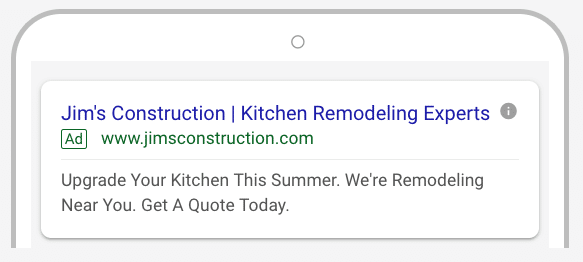
If budget allows, consider a supporting pay per click campaign. This will allow you to strategically target certain areas of town with specific messaging and offers.

For example, if you have identified a wealthier area of the city that has lots of older homes that need remodeling, you can display ads to people in that area. Using Google Ads, you can select a zip code and compose ads that speak directly to those people and offer the services you have.

sample construction ad

MARION Tip: Enable search ads for the zip code where your current construction job is. The ads will be displayed to people who are in the immediate area where you are working. If they can see your crew, professionalism and realize that you also service their area, you have a higher likelihood of closing the deal. Good news is…you’re already in the area. This may reduce the need to transport equipment and labor across town.

Social Media Marketing for Construction

It’s imperative that your construction business engages in social media marketing. At a minimum, set up profiles on Facebook, X, Instagram & LinkedIn. Use the consistent branding discussed earlier and create posts that showcase the business expertise, videos, images and latest construction jobs. In the captions of these posts, include descriptions about the products and services used. Make sure the social media profile is fully complete with the company biography, website links, and contact information.

But the real opportunity in 2025 is short-form video. Think:

  • 15-30 second walkthroughs of finished remodels
  • “What we would’ve done differently” voiceovers for transparency
  • Time-lapse footage of a kitchen or bath build
  • On-site Q&As or team introductions

MARION Tip: Conduct a search on each platform for your services and follow who is talking about it. For example, search Facebook for the term “kitchen remodeling.”  Follow every result that isn’t a business that is in your locality. If they asked a question, business or not, answer it, then follow them. Repeat for the other social media platforms.

Email Marketing for Construction

Monthly email blasts still have their place, but the more impactful strategy in 2025 is automation and personalization based on real client behavior. Rather than just sending newsletters, build trigger-based sequences tied to your services and the timing of past jobs.

Use your CRM or email marketing tool to segment by past project type, install date, or location. For example, if you installed new floors for a client six months ago, schedule a follow-up email that checks in and recommends a seasonal upgrade.

Hey [first name], how’s the flooring holding up? If your kitchen is next on the list, we’re currently offering a 15% loyalty discount for returning customers.

These automated sequences are far more effective than generic blasts, and so much easier to manage once they’re built!

Email is also a good place to resurface content they may have missed:

  • Case studies with before/after results
  • Video walkthroughs of projects like theirs
  • Seasonal offers tied to weather, school calendars, or tax season
construction marketing ideas

Branding for Construction

It seems so cliché, but it is very true. Develop a company brand that people will understand quickly. While this isn’t a necessity, it’s important to clarify that if the name is abstract, people may initially struggle to understand if your company can do what they are looking for. I believe this also depends on where you service clients. If you provide a nationwide service and have a sizeable advertising budget, then an abstract business name and branding could work. Mainly because you have the service area, as well as the resources (time and money) to manage it and promote the new brand.

However, if you are smaller residential construction business, servicing a certain locality, then you may want to choose a name that closely mirrors your specializations. Service focused business name examples would be;

  • Houston Home Renovations
  • Kitchen’s, Bathroom’s & More
  • Katy Home Additions

These are all fictitious company names. The point is, include the core service in the company name when possible. Include it in the company tagline too, especially if it isn’t in the main business name. You could try something like Jim’s Construction – Home Renovations since 1990.

After the name and tagline are determined, choose colors. For the sake of consistent branding, use these same colors everywhere the brand is displayed. Use it offline (vehicle wraps, business cards, flyers, company clothing, commercial signage) in places where potential clients will see it. Be sure to remain consistent with online advertising too. Use the same branding on the company website, social media, and email signatures.

Consistent use of the same look, feel, and imagery, plus providing a great product/service is how you develop a brand that people will remember and want to use again.

Contact MARION to Improve Your Construction Marketing Today!

Before you wrap up your next campaign, take stock of your current construction marketing strategy. Are you reaching your target audience on the right marketing channels? Are your marketing materials aligned with your digital marketing strategy? Too many construction companies still focus only on physical signage or word-of-mouth, missing the opportunity to connect with potential clients online through tactics like search engine optimization, social media management, and paid advertising.

MARION is a construction marketing agency with 40+ years of experience in Texas. For help with turning your construction marketing ideas into reality, contact us today to schedule a consultation!

Marketing emails you’ll actually want to read.

Get marketing tips and news sent to 
your inbox.

This field is for validation purposes and should be left unchanged.
Name(Required)

12 Days of Christmas Marketing Guide for this December

This one’s for anyone trying to pull in traffic and drive conversions during the busiest shopping window of the year. In this holiday marketing guide, each day brings a new idea to use leading up to Christmas and beyond. ’Tis the season to be merry and strategic!

1. Update Your Website’s Landing Page with A Holiday Theme

Give your website a festive makeover and update your landing page with holiday-themed visuals, banners, and colors to create a warm and inviting atmosphere for visitors. Incorporate holiday promotions, exclusive deals, or limited-time offers prominently on the page to capture the attention of potential customers.

A visually appealing and holiday-themed landing page enhances the user experience and signals to visitors that your brand is in tune with the festive spirit.

holiday marketing landing page

2. Run Christmas Marketing Campaigns on Social

Social platforms are flooded with seasonal noise in December. That’s your cue to go in with focused offers and structured campaigns. Use image/video content that reflects the season visually, but lead with benefits and timing.

Don’t boost random posts. Define the outcome (clicks, signups, sales), then build ads backward from that. Segment audiences. Run retargeting for site visitors or cart abandoners. Holiday urgency works best when layered with context-specific targeting.

3. Get into the Festive Spirit with Holiday Blog Content

This helps with organic search, but it’s a longer play. Time it right or skip it. If your post isn’t live by early December, you miss most of the traffic.

Make the blog content useful. Teach something. Solve a problem. Connect the topic to what your business does.

4. Target Holiday Shoppers with Pay-Per-Click Ads

Another holiday marketing strategy is to utilize targeted Google Ads campaigns that align with popular seasonal search queries. By targeting your audience with PPC ads, you maximize visibility and increase the likelihood of converting potential customers into festive buyers.

How to sleigh your Christmas marketing PPC game:

  1. Select festive keywords relevant to your products or services.
  2. Target specific demographics interested in holiday shopping.
  3. Craft compelling copy with holiday-themed CTAs for that festive touch.
  4. Highlight special offers or discounts to entice holiday shoppers.
  5. Keep a close eye on performance and adjust as needed for maximum impact.

5. Create Gift Guides Based on Segments

Gift guides aren’t new, but they still perform because they reduce buyer friction. Don’t throw a dozen random products on a page. Group them by use case, job role, or budget bracket.

Example Ideas:

  • “Gift Ideas for Remote Workers Under $50”
  • “Top 5 Tools for Busy Managers This Holiday Season”
  • “Holiday Guide for Small Business Owners in the Field”

Feature these guides prominently on your website or in email marketing campaigns to assist shoppers in finding the perfect gifts!

holiday marketing gifts

6. Run A/B Tests on Seasonal Ads

Multivariate testing isn’t holiday-specific, but it’s still one of the smarter moves you can make in December marketing. You’re likely in a rush to push your campaigns live…maybe even building last-minute Christmas marketing assets…but skipping A/B testing can cost you performance. Don’t assume your best evergreen ad will hit the same during the holiday season. Different mindset = different intent.

A/B testing is what tells you which version of your ad actually works. And in December, when competition spikes, you don’t want to guess. Run at least two versions of the following:

  • Calls-to-action
  • Visuals (product vs. lifestyle, festive vs. neutral)
  • Headlines or lead text

Track click-through rate, conversions, and cost-per-click. Make changes fast. In-season data becomes irrelevant once December ends, so test early in the month while you still have time to pivot!

Even if you’re working with a smaller ad spend, this process gives you a clearer idea of what kind of language and imagery connects with holiday shoppers.

7. “12 Days of Deals” Email Campaign

This campaign type drives urgency and opens up 12 touchpoints with your audience. It’s simple in structure but requires prep to execute well. You’ll need to batch the emails ahead of time, build a tight subject line strategy, and mix up the content so it’s not all discounts.

Break the 12 days into a mix of promotional offers, helpful content, and engagement triggers. The key is pacing and variety. Don’t burn your audience out by sending 12 of the same type of offer.

Structure Tips:

  • Use consistent subject line formatting: e.g., “[Brand] – Day 4 of 12: [Benefit]”
  • Include dynamic countdown timers in the emails
  • Set up UTM tracking so you can evaluate what days/email types convert best

Example Daily Breakdown:

  • Day 1: Free Shipping on All Orders
  • Day 2: Bundle Deal (Buy One, Get One 50% Off)
  • Day 3: Early Access to New Product Line
  • Day 4: Share Your Wishlist (Engagement CTA)
  • Day 5: Email-Only Promo Code
  • Day 6: Access to Holiday Webinar or Tutorial
  • Day 7: Gift Guide Recap with Top Picks
  • Day 8: Refer a Friend, Get $10
  • Day 9: Behind-the-Scenes Holiday Prep Video
  • Day 10: Customer Spotlight Story
  • Day 11: Flash Sale (6 Hours Only)
  • Day 12: Final Reminder – Shipping Deadline Cutoff

Execution Advice:

  • Segment your list: loyal customers might get deeper discounts; cold leads might get lighter value offers or tips
  • Automate sends through your ESP, but monitor opens and CTR daily for pivots
  • After day 12, do a final wrap-up message with a thank-you and “What’s Coming in January”!

This campaign can drive serious clicks and sales, especially when paired with social content or remarketing ads that match the daily theme.

8. Share Your Favorite Client Reviews

Trust factors close sales. In December, buyers move fast, and reviews can push them across the line. Surface testimonials on high-traffic pages and inside your email campaigns.

Example Ideas:

  • Run an ad campaign using real customer holiday photos (with permission)
  • Feature a rotating customer quote in your homepage hero section
  • Use review snippets in Google Shopping ads

9. Run A Holiday Themed Social Media Contest

What better way than with a jolly good social media contest? Get your followers in the festive spirit by organizing a holiday-themed extravaganza.

Keep it simple. Ask for a comment, a tag, or a picture. Pick a winner. Use the entries as content in January when engagement drops.

Formats:

  • Caption this product photo
  • Share your team holiday setup
  • Tag a coworker for a giveaway

Spice it up with seasonal hashtags and exciting prizes.

Holiday Marketing Strategy

10. Refine Google Ads for Holiday Search Intent

Holiday queries behave differently. They’re short-term, urgent, and high-intent. That means your Google Ads should adapt.

Example Ideas:

  • Add seasonal keywords like “stocking stuffers for [persona]” or “last-minute [product] gifts”
  • Create urgency with sitelinks like “Ships in 24 Hours” or “Only 3 Left”
  • Use ad customizers to show remaining inventory dynamically

11. Update Your Logo with a Temporary Holiday Variation

Deck the halls (or rather, your logo) with boughs of holly, a Santa hat, or a sprinkle of snowflakes. Infuse a festive vibe into your corporate identity and let your logo join the holiday cheer.

Then, share the revamped logo across your digital platforms for all your followers to see. It’s a fun and visual way to let everyone know your brand is not just on the nice list but is also celebrating the season in style. After all, who doesn’t love a fun logo?

12. Plan Ahead for The Upcoming Year, Reflecting on Your Holiday Strategies for Improvement

Last but not least, let’s pave the way for a successful new year! Reflect on this holiday season’s strategies, learn from the festivities, and plan ahead for an even brighter and more impactful year ahead.

MARION is Your Year-round Digital Marketing Ally

MARION can help you with your December marketing strategy, and well into 2026! If you’re short on bandwidth or need execution help across channels, MARION can step in. We handle media planning, campaign builds, asset creation, and analytics.

Ready to turn your Christmas marketing into year-round success? Let’s turn your visions into victories and make the coming year a celebration of continual growth and prosperity.

Connect with MARION today!

Marketing emails you’ll actually want to read.

Get marketing tips and news sent to 
your inbox.

This field is for validation purposes and should be left unchanged.
Name(Required)