Your company’s marketing strategy is an important part of your business growth plan. It helps you acquire more customers, stay connected with your current buyers, and boost your revenue.
Determining the kind of marketing team you will need to create and execute your marketing strategy is one of the most challenging aspects of ensuring business growth and profitability.
One of the most important steps that you must take to establish effective marketing is to determine how much to spend on business marketing. The industry you operate in and your position within that industry can provide valuable insight into which budget and marketing channels make sense for your business. Once you have determined your budget, you can assess your needs and the resources that are available for you to satisfy those needs.
Inevitably you must decide whether to bring your marketing in-house or engage outsourced marketing services. Here are the key factors to keep in mind when you’re evaluating your options.
What Is In-house Marketing?
In-house marketing is any marketing endeavor that isn’t outsourced to a third party. With an in-house team, you have the distinct advantage of controlling the full work environment of your employees. Communication is often a key benefit as well, given that meetings can happen at a moment’s notice if needed.
The costs of moving forward with an in-house marketing team, however, can be much higher than what’s initially apparent. You’re responsible for the employees’ salaries and benefits, as well as unemployment insurance and other associated expenses.
The Hidden Costs of An In-House Marketing Team
A serious consideration in deciding on an in-house team is employee turnover. The costs are often hidden but very real.
In-house marketing professionals, strategists, designers, developers, and copywriters will all fall under the responsibility of your Human Resources team or department. Depending on your current setup and the resources that you need, bringing on an in-house marketing team could also mean a need to ramp up your HR operations as well.
You must source potential employees, pay for job postings, sort through hundreds of resumes and conduct interviews to determine whether a candidate is a fit within your organization.
Once hiring managers bring in someone new, they kick off the training process. If something goes wrong with the staff, HR needs to go through the firing process and start over.
What Is Outsourcing in Marketing?
In direct contrast to in-house marketing, outsourced marketing involves hiring a third party to perform a specific task within your organization. For example, a marketing agency that specializes in digital marketing can be hired by a business to handle all the online marketing needs of your business.
Why Outsource Marketing?
Outsource marketing lightens the burden for busy business owners who may be wearing too many hats within their organization. With marketing channels evolving practically every day, many businesses have turned to outsourcing specific tasks to specialists. Doing so saves business owners time and money they would have to spend otherwise to keep themselves up to date with the latest trends in their industry.
Benefits of Outsourcing Marketing
The vendor or independent marketing contractor maintains their workspace, pays for any necessary software and equipment and carries their own insurance. You don’t have to worry about all the related HR, training, equipment and payroll costs with an outsourced marketing partner.
Communication is a critical factor and should be addressed up-front with any outsourced partner you consider engaging. Set expectations regarding the frequency of reviews as well as response times for day to day communications.
Do you want to reap the benefits of having a dedicated, performance-driven marketing firm for your business? Get a free consultation from MARION today!
The only thing the business owner needs to worry about is picking the right service provider for their specific marketing objectives. Everything else happens behind the scenes, so they don’t have to worry about having these resources in place.
Expertise and Specialization
Recruiting and retaining top marketing professionals is a challenging task. You need to brand yourself as a great place to work, perform one-to-one outreach with your dream candidates and put together a package that stays competitive in your industry. Everyone wants highly effective marketers, and the more stringent your requirements, the more likely you’re going to run into a talent shortage.
Business owners often make the mistake of assuming that bringing in a single marketing professional will fill all of their marketing needs. In some cases, this may be true — there are some very talented and capable marketing practitioners in the workforce today. In most cases, however, this is not the case.
Marketing is multi-faceted and generally requires individuals with varying skill sets to effectively execute on a given strategy. The best marketing departments include people in the following roles:
Marketing strategists (marketing manager, director, or CMO)
Only you can determine your marketing needs, and which of these roles warrant bringing talent in-house. Regardless of whether you decide to bring one or more of these roles in-house, someone must perform the tasks of all positions.
This could mean asking that your employees act in multiple capacities or outsourcing the areas where your staff falls short. The reality is that almost all in-house marketing departments outsource at least a portion of their marketing needs.
Outsourced or In-house Marketing – What’s the Best Choice?
Quite possibly the most important determining factor when considering outsourced vs. in-house marketing is the size of your business and how you weigh that against your marketing needs.
Large enterprises often have the resources on-hand to support an in-house marketing department. They can aggressively recruit top talent through high salaries and the name recognition of the company. They have well-established HR departments and their marketing needs justify the additional cost of having an in-house team.
Small to mid-sized businesses frequently don’t have the infrastructure or marketing needs to justify the cost of a full in-house team. All too often, unless they supplement their efforts through outsourced services, their marketing suffers for it.
Outsourced marketing, whether in its full capacity or a supporting capacity for a marketing professional, allows for small to mid-sized businesses to present a professional and results-driven marketing strategy that would not be possible with comparable resources allocated toward an in-house team.
You have a lot to consider when you decide between in-house and outsourced marketing. Keep these key factors in mind when you’re evaluating what’s best for your business and its future growth.
MARION is committed to helping you grow your business. We’re a Houston-based marketing company that offers a full range of services to help fill the gaps missing from your in-house team.
For most small to mid-sized businesses, digital marketing plays a major role in their marketing mix, and at the heart of most digital marketing efforts is a website.
Unfortunately, many business owners start out with the misconception that website traffic is like the Field of Dreams; “If you build it, they will come.”
Building a website is the first step towards successfully marketing your business online, but throwing up just any ole website and expecting people to find you is not a realistic expectation.
A website is, at the end of the day, a tool in your marketing tool belt and should be measured against what you expect to accomplish with it. You must use the right tool for the job.
The movie quote that most often comes to mind when I sit down with a potential client regarding an underperforming website is not Field of Dreams, but Jaws… “You’re gonna need a bigger boat.”
There are countless reasons why your website may not be delivering the traffic that you hoped or expected that it would. In this post, we’ll look at four of the most common and correctable potential reasons that no one is visiting your website.
1. Your content isn’t up to snuff
In doing your own research or working with marketing professionals, you may have heard the phrase “content is king.” It’s a very popular phrase, and with good reason, it’s accurate.
Your website is, and will only ever be as good as the content that it contains. Focus first on creating content that will bring visitors to your website, and then focus on converting them into leads and customers.
There are a huge number of factors that search engines look at in determining whether your website should show up for specific keywords.
Many of them are technical and semantic based, like the code and keywords you use. But many of them are behavior based, like bounce rates and average time spent by users on your website.
Creating content that is easily consumed by visitors and provides them with something of value or even something valuable enough to share is the best possible strategy for long term success with search engines.
Here are a few tips for creating great content:
Break up your paragraphs – especially in the age of mobile browsing; short paragraphs are easier to read and digest for your users.
Address your website visitors directly—use the word you when addressing your visitors.
Provide value – your website visitors are there for one reason, they think that you offer something of value that they are interested in, don’t let them down.
Spell and grammar check – the likelihood is that you will make a spelling or grammar mistake, even if you check your work, but limiting these mistakes is important for your credibility. Try using a tool like Grammarly if you need help with this.
The final tip I would offer with regard to your content is that your website is the place for long-form content, not blurbs.
If you want to write a sentence, use Twitter. If you want to write a paragraph, use Facebook. Reserve your website for well-constructed, long-form content that will pull visitors in and keep them there.
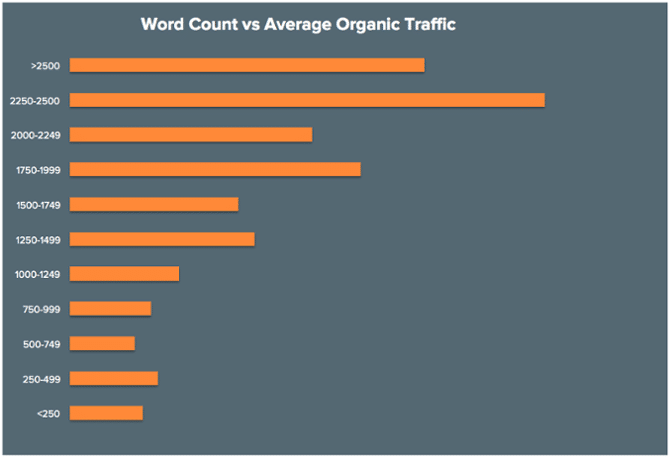
While it’s not likely that search engines put a lot of stock in the length of your content, your visitors will, and there is a documented correlation between content length and how well you show up in search results.
So, when writing content for your website, fully elaborate on the subject at hand to create real value for your visitors, and in return, the value of your website will increase.
2. You’ve chosen the wrong keywords
If the internet had a declaration of independence, it would include the phrase “all keywords are NOT created equal.” It may not be what you want to hear, but it’s the truth.
In the end, there’s not a whole lot of difference in showing up in the #1 spot on Google for a keyword that no one is searching for and not showing up for any keywords at all.
Let’s look at an example of how keyword choice could make or break it for your website traffic metrics.
For this example, consider that you own a book store in the Houston area that carries a range of books from current residents of the New York Times bestsellers list to travel guides and vintage classics.
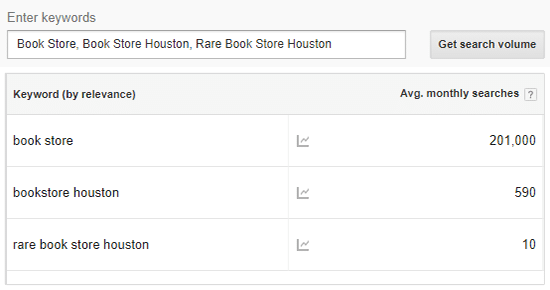
How you approach the keywords that you target online can have a very real-world impact on your business. Look at the table below which shows national search volumes for three keywords that are possible targets for your website:
Clearly “Book Store” has the greatest volume of searches and would be the best choice as your targeted keyword, right? Not necessarily.
The issue with high search volume keywords is that they are much more competitive making it harder to earn high search placements. You may be saying to yourself “But the investment would be worth it.”
Perhaps, but what if I told you that of the 201,000 searches for “Book Store” nationally, only 0.1% were from the Houston area while 66% of the “Book Store Houston” searches were local to your business?
It’s also true that you’d probably have a good chance of earning that top spot in search results for “Rare Book Store Houston”. It’s a long-tail keyword and you’d probably have the easiest time ranking well for it. But what’s the point if no one is searching for it?
If you can capture only 10% of the people who are searching for “Book Store Houston” your website would see 59 visitors for the month. If you capture 100% of the people searching for “Rare Book Store Houston” you still only have 10 visitors for the month.
The best choice for your targeted keyword, in this case, is “Book Store Houston.” It provides the best likelihood of success while still providing a reasonable number of monthly searches.
Keyword research is an important part of creating your website and a major factor in its success. If you optimize your website for the wrong keywords, you’re likely to either show up well for keywords that no one searches for or not show up at all for keywords that are too competitive.
3. Your website is slow
For those of us who remember dial-up modems, a slow website has a different meaning. It may seem to you that in the age of broadband you needn’t worry about the speed of your website. You’d be wrong.
It may be the age of broadband, but it’s also the age of mobile and waiting for a slow website to load on a mobile device is enough reason for most people to abandon a page.
Proper optimization of your website will include image optimization, code optimization, server optimization, and everything in-between. It’s a large undertaking for the non-developers among us, and it is a good idea to work with a professional that you trust to avoid doing more harm than good.
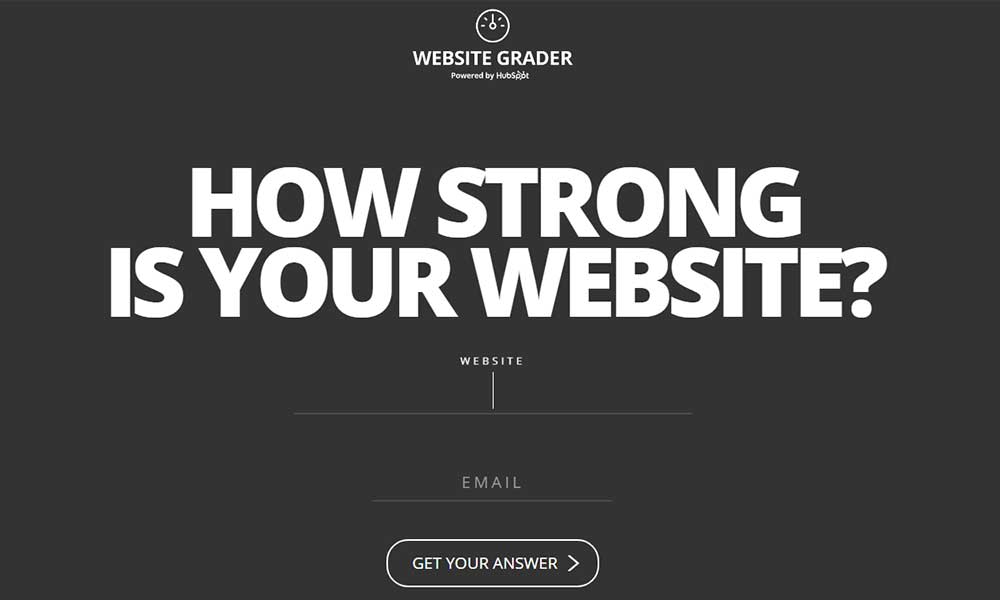
You can check the current health of your website using HubSpot’s Website Grader. It will give you a general idea of your performance from a speed perspective, as well as other important factors like responsiveness and SEO optimization.
4. Google has penalized your website
It may be rare, but there are scenarios where Google will penalize you for trying to manipulate your search rankings.
Manual action penalties are easy to identify. You can log into your Google webmasters account and check for notifications from Google regarding any penalties.
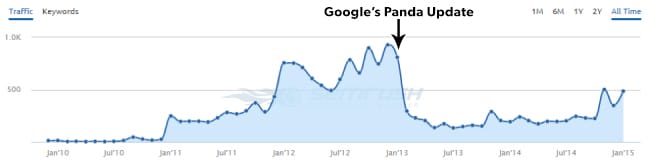
Algorithmic penalties are a much trickier situation. There will not be a helpful notification in your webmaster account. Instead, your website will suffer a sudden, even dramatic, drop in traffic that coincides with the release of an algorithmic update from Google.
It can be tough to diagnose an algorithmic penalty as an algorithm update can also affect your rankings without necessarily being a penalty by boosting your competition, for example.
If you are able to determine that Google has penalized your website, you must address the underlying cause as quickly as possible.
Addressing the cause will obviously be easier with a manual penalty, given that Google will directly tell you what is causing it. With an algorithmic penalty, you will most likely need to work with a credible web design and/or SEO company to identify and address the cause of the penalty.
The Take-Away
The best question to ask yourself when facing poor traffic metrics for your website is “How much am I investing in generating traffic for my website?”
If the answer is little to no investment, then it’s time for an increase. And while monetary investments in areas like digital advertising, social media marketing, and content marketing are fantastic ways to generate more traffic, it’s not always about money.
Invest your time in writing better, longer, and more engaging content; invest your energy in reaching out to the online community to help build relationships and links to your website; invest yourself in your website, and you will see the returns.
Just because you build it, doesn’t mean that anyone will come. If you don’t have the time or energy that it takes to put in the hard work of building website traffic, perhaps it makes sense to work with a Houston digital marketing company to cover the areas that you can’t.
Email marketing plays a major role in the marketing mix of many businesses, both brick-and-mortar and online. And there is a good reason for that. A recent report by the Radicati Group found that:
Half of the world’s population is using email in 2017.
In 2017, the total estimated number of emails sent and received daily is 269 billion.
But that’s just the tip of the iceberg when it comes to why you should be using email marketing. Email marketing is more widely used and accepted for marketing purposes than almost any other modern marketing channel.
However you look at it, there are a lot of compelling reasons why you should be using email marketing services in your marketing mix.
With 269 billion emails flying around every day, most people will be filtering the emails coming at them. How can you make certain your emails aren’t languishing unopened in an inbox somewhere, or worse – moved to the deleted folder?
Email Marketing Best Practices
There is and will continue to be an enormous volume of email flying around on any given day. Your email marketing strategy must take this into account to make certain your emails get opened, read and acted on. The last thing you want is your emails wasting away in an inbox somewhere.
To that end, here are the six suggestions for increasing and maintaining your email marketing open rate:
1. Be engaging.
Luckily for you, research shows that 72 percent of consumers prefer their communication with companies to come via email. It’s important that you don’t squander this opportunity by always and only selling to them.
Give your readers something visual, something moving in a video, or a compelling piece of content that prompts them to click through to your website where you can engage them and further nurture through the conversion process.
2. Be genuine.
It’s very common to begin emails with “Dear [insert name here].” That seems like a good idea, and it may be if that fits your brand. However, consider being more personal with your greeting. “Howdy [insert name here]” may be a more effective greeting for you, especially if your greeting is previewed in their inbox.
On the other hand, sometimes it is not appropriate to use a greeting line. Research by Temple University’s Fox School of Business discovered that this unsolicited personalization might sometimes harm your email campaigns. If you have not established a relationship with the individual, a greeting line may not be appropriate.
3. Be concise.
Effective subject lines are vital to the success of any email campaign. A survey by Adrestra in July 2012 found subject lines utilizing less than 10 characters had an open rate of 58 percent. An opened email is more likely to produce results than one that goes straight to the delete pile.
4. Be clear.
To make certain your emails rise to the top of the heap and immediately catch your readers’ attention, make your email easy to read. If you’ve got a compelling subject line, people will usually at least give your email a cursory scan.
It’s critical that important information jumps off the screen and grabs their attention. If they see a huge block of text with a lot of flowery bloviating, your email is most likely trash bin bound. If they scan the email and see descriptive and interesting highlights, they’re more likely to read and ideally click through.
5. Be on time.
Experian’s Quarterly Email Benchmark Study found the best time to send emails is between 8 p.m. and 11:59 p.m., and midnight to 4 a.m. Sounds off, right? But in their study, they found these times to have the highest response rates in all areas. Emails sent on Saturdays and Sundays also had the highest opens, click-throughs, transaction rates and revenues per email.
Do you send out a company newsletter? Try sending it on different days of the week and at different times of the day. Every audience is different. You may find that your list also performs best on a weeknight between eight and midnight, or perhaps your list performs better on a Tuesday between eight and eleven in the morning.
6. Be generous!
Give something away. Don’t underestimate the power of “free.” Bluewire Media tested different types of media to gauge the highest rates for opens and clicks. Templates and tools as freebies were the hands-down winners.
The caveat here is that your freebie must hold some sort of value to the recipient. Before you decide on a freebie to try out, consider determining what you can afford as an acquisition cost per customer or purchase. That acquisition cost will give you a budget to work with on your freebie. Alternatively, your knowledge is a great give away, again, just make sure that the knowledge that your sharing hold value to your customers or potential customers.
Do Your Own Email Marketing Testing
The best practices are the ones that work for your specific business. Try running a few small-scale experiments of your own. Do several experiments with different email styles and content, track what works and what doesn’t, then go with what works.
Some email marketing platforms, like MailChimp, even offer A/B testing for subject lines. This feature allows you to choose two subject lines to test. Emails are then sent to a sample of your list using each subject line. The subject line that is opened the most is then used for the remainder of your list.
Us your tests to define your own best practices, then kick it into high gear to compete with those 269 billion daily emails.
The Take-Away
Email is one of the most used and most abused forms of marketing today. The most common mistakes that people make are a result of focusing too much on what their customers or potential customers should do and not enough on what they want.
A strong email marketing program will combine your customer service, promotional, and content marketing messages into one seamless channel of communication between you and your target audience.
The bottom line is that if you are genuine, engaging, clear, concise, and reach out to your target audience with something of value when it is best for them, your email marketing campaigns will be successful.
As a business owner or marketer, you know you must tap a number of resources, implore several strategies, and take advantage of many tools to attract your target audience to your brand and convince them to become customers.
Online marketing became a core consideration in every marketing plan beginning in the mid-2000s and has continued to grow in importance every year. In that time, marketers have learned much about the methodologies used to attract and convert customers successfully.
One tried-and-true methodology that countless small, medium and enterprise businesses have successfully utilized is known as the inbound marketing methodology.
What Is the Inbound Marketing Methodology?
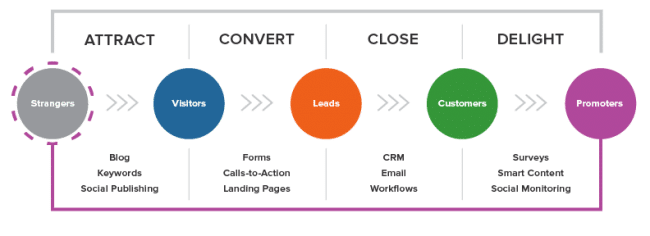
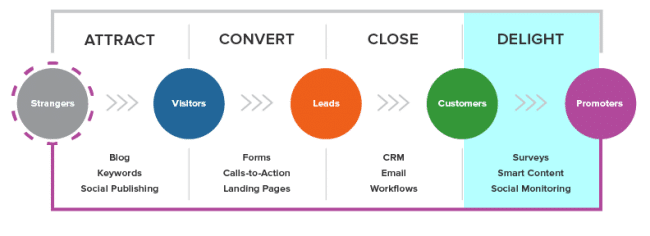
The term “inbound marketing” was coined by HubSpot CEO, Brian Halligan. The inbound marketing methodology refers to the process of bringing customers to you using an attract, convert, close, delight loop instead of pushing your product or services out to them through ads or purchased email lists.
It’s is built on the premise that you create something of value for potential customers, build a relationship with them, and use permission marketing techniques to convert them into paying customers.
The inbound methodology promotes a 5-stage life cycle in which strangers convert into, not only customers but your brand promoters over time.
What Are the Four Stages of the Inbound Methodology?
There are four levels of strategy in the methodology:
Each stage deals specifically with moving an individual from one lifecycle stage to the next.
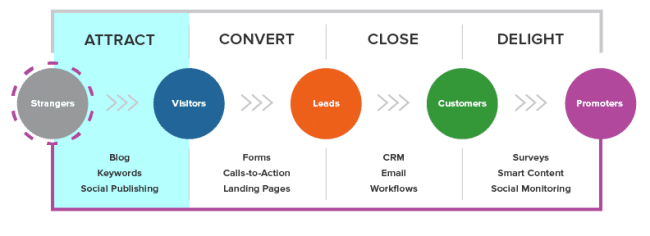
In this post, we are going to address the three core tools used in the all-important “Attract” strategy and how you can implement them to increase the traffic to your website.
The Attract Stage of the Inbound Marketing Methodology
Essentially, the key to attracting visitors to your site is to offer them something of value or to engage with them in a way that encourages them to visit your site, or “attracts” them to your site.
Attracting strangers to your site can be done through a number of means such as blog posts, social media, paid search advertising, and videos. The bottom line is that all content created and designed for inbound marketing should provide value to your target audience.
You can provide value by creating content that serves to answer a customer’s questions, describes the benefits of a product or service, provides helpful instruction, or otherwise engages the customer.
Inbound Marketing with Keyword Targeting
Generating traffic, in and of itself will hold no value for your business. Ideally, you want to attract customers in your target market, those who are most inclined to purchase your products or services.
To attract the right people, you need to identify the keywords and key phrases most likely to be used by your target audience in conjunction with your product or service.
Start by imagining what your target market will be searching for when they seek information about those products or services on a search engine.
Some keywords will be obvious, but the problem is they will be obvious to competitors, who are probably also using them. You need to think of alternatives and other niche keywords that will still be a likely search query and, hopefully, something your competitors haven’t yet thought of.
But even if they have, you can still maintain your edge by using keywords better and smarter, through a variety of inbound marketing techniques.
Keep in mind, your customer may not even know that your product or service exists. Try focusing on identifying common questions that may lead an induvial to the realization that your product or service solves a problem that they have.
If you are struggling with your keyword research, or whether keyword research is even important for your online marketing, have a look at our recent post, Do Keywords Still Matter?
Inbound Marketing with Your Blog
Once you know what keywords might work best, you can develop content that’s informative, interesting and beneficial to the consumer. Start with blog posts, but don’t limit yourself to just a blog. These are some ideas for you to consider when developing inbound marketing content:
Blog posts showcasing new products or describing services
Blog posts discussing industry information or product development
Blog posts answering questions consumers in your target might have
How-to instructional posts
How-to videos, or videos showcasing products in action
Webinars
E-books
Slideshare presentations
Podcasts
Infographics
You can usually easily repurpose one piece of content to encompass many of the above ideas.
Creating the necessary content to attract your visitors effectively is one of the most time consuming and difficult strategies in inbound marketing. If you are struggling to create your content, consider enlisting a professional copywriter or content marketing service.
Inbound Marketing with your Social Media
You may have noticed by now, that it’s called a methodology for a reason. Inbound marketing takes a very methodical approach to converting from strangers into promoters.
We’ve discussed how you should approach establishing targeted keywords and how to create valuable content around those keywords. The next step is to get that content out in front of your target audience.
One of the most effective ways to get your content seen by as many eyes as possible is to promote everything you create across various social media platforms such as Facebook, Twitter, LinkedIn, and Pinterest.
Additionally, your blog should have a subscribe feature, and you should take full advantage of this permission to share as much content with subscribers as possible.
Your Take-Away from the Attract Inbound Methodology Stage
Attracting visitors to your site is the very first, and possibly most important step in converting strangers into your brand promoters, but it’s often easier said than done.
Planning your inbound marketing campaign doesn’t have to be overly difficult, but it isn’t something you can quickly put together either. Executing a truly successful inbound marketing strategy will require you to invest, whether with your time, energy, or capital in your online marketing.
The long game is the best game to play in online marketing, and if you stick with your inbound strategy, you will be glad that you did.
If you don’t have a dedicated marketing and creative team at your disposal, you might consider retaining the services of a professional digital advertising, web design and SEO company to develop a customized campaign that best suits your needs and helps you achieve your marketing goals.
The Convert Stage of the Inbound Marketing Methodology
Developing and running a successful inbound marketing campaign entails much more than attracting visitors to your site – you also need to turn those leads into customers and clients. In other words, “convert” them.
Developing a marketing strategy designed to convert leads, along with having the right content on your site, is key to turning those leads into customers and achieving an optimal ROI.
In the first section in our inbound marketing methodology post, we addressed the three core tools used in the all-important “Attract” strategy of inbound marketing and how you can implement them to increase the traffic to your website.
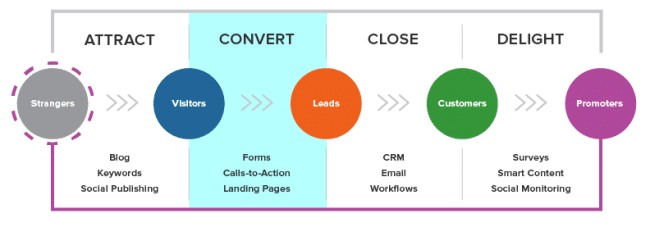
In this section, we will cover the “Convert” strategy and the most effective ways that you can convert visitors on your website into leads.
Using Persuasive Content to Convert Visitors into Leads
First and foremost, you must present website visitors with quality content that offers visitors the information they seek. Relevant content that not only serves an informational purpose but also explains how visitors might benefit from purchasing your products or utilizing your services piques consumer interest.
It can be hard to find the right balance between educating readers and selling your products in your content marketing strategy, but once you do, you’ll likely find your conversion rate increasing. Always remember to omit meaningless marketing words and focus on the content mantra “clear, not clever.”
Use Calls-To-Action to Trade Value for Info
An important aspect of the inbound marketing methodology is the use of targeted and specific calls-to-action. A call-to-action targets the very moment when many visitors will decide whether to become a lead or not.
Always offer something of value with your calls-to-action. The user needs to feel that they are getting something in return for giving you their coveted contact information. Be specific about it.
While a call-to-action can come in many forms, there are generally four parts to an effective call-to-action.
A visual element – This makes the call-to-action stand apart from other content and draw a user into it.
An initial value proposition, offer, or headline – This makes clear the focus of the call-to-action. For example, “Building a Better ”
An offer description – This elaborates on the initial heading. For example, “Download our four-step process for building brands that ”
An action button/link – This is the actionable item and should reinforce the offer one last time. For example, “Download our free ebook.”
You can see the bottom of this post for an example of one of our calls-to-action working hard to convert visitors into leads.
Send Calls-To-Action to Specific Landing Pages
Once a visitor clicks on a call to action, they should be taken to specially designed landing pages that convert. While it may seem counter-intuitive, these landing pages should contain no top-level navigation menu. All efforts are geared at focusing the visitor on completing your form and becoming a lead.
Your landing pages should contain enough interesting and informative content to peak a consumers’ interest. Using a balance of text, bullets, images, and even videos will serve to increase consumer retention and promote brand awareness.
Alongside the content should be a prominent conversion form. Conversion forms provide visitors with an instructional cue to provide you with contact information, make a purchase, or otherwise convert.
Once an initial conversion has taken place, the pump is primed for further conversions. Don’t be afraid to place another, more in-depth, conversion opportunity directly on the page a visitor hits when they initially convert. These secondary conversion opportunities can often see even higher conversion rates.
Use Optimized Conversion Forms
One of the most important factors in converting your website visitors into leads are your conversion forms.
There are three elements to an effective form:
The form title – This should reinforce the call-to-action that brought the user to the form. For example, “Download your free ”
The form fields – These are the fields, both required and not required, that make up the bulk and complexity of the form
The submit button – The button that completes that conversion process
Don’t make the mistake of thinking that any of these three elements are trivial and ineffectual. The conversion rate for a well-designed form will be drastically better than a form that made without consideration to detail.
First and foremost, make the form title enticing. Except for the contact page on your website, avoid titles like “Send us a message” or “Email [Company Name].” These are not engaging form titles. Instead, opt for action-oriented form titles. If there is not a specific offer use more generic action-oriented titles like “Get started today” or “Schedule your consultation today.”
Form fields should always be equitable to what you are offering and where in the sales cycle the visitor is. For a free give away, like an ebook, don’t ask for the moon, you won’t get the moon, and all you will end up with is a high abandon rate for your landing page.
The rule of thumb with form fields is, ask for the least amount of information that you can to move them into the next stage of the sales process.
Finally, don’t use “submit” for your form’s action button. Be specific. For example, “download our ebook” or even simply “get started.” This small change can have big impacts on your conversion rate.
Your Take-Away from the Convert Inbound Methodology Stage
Converting visitors into leads is not always any easy task. It takes time, patience, and a lot of trial and error to hone in on the factors that will improve your conversion rate.
If you take the time and put in the effort to write informative yet persuasive content, create enticing calls-to-action, and use effective landing pages with optimized conversion forms, you will see your website turn into a lead generation machine.
Many of people that we work with understand that these are areas that they need to focus on, but simply don’t know where or how to begin. If you are unsure where to begin, contact us, and we can work with you to put an effective inbound strategy in place.
The Close Stage of the Inbound Marketing Methodology
Developing and running a successful inbound marketing campaign starts with attracting visitors to your site and converting those visitors into leads, but leads aren’t worth anything if they don’t turn into customers. In other words, you must close the deal.
Closing leads is often overlooked as we plan and evaluate our marketing efforts. We often lay this burden solely on the shoulders of our sales staff, and with good reason, that’s their job. But if you aren’t considering how your marketing efforts can assist your sales staff and increase your close rate, then you are most likely leaving deals on the table.
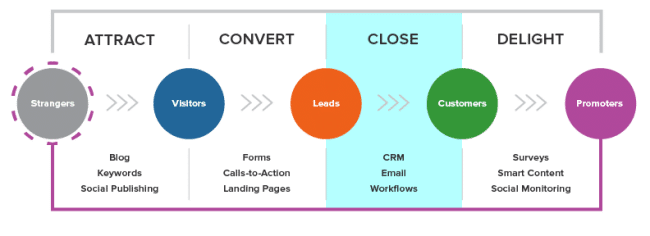
In the close step of the inbound methodology, we’ll cover how closing deals fits into the inbound marketing methodology and how your marketing can assist your sales staff in turning leads into customers.
Qualify leads better with lead scoring
All leads are not created equal; you and your sales staff are painfully aware of this fact. Your response to all leads should not be equal either.
One of the most important pieces of your marketing plan, whether inbound or outbound, is determining at which point a lead should be handed off from marketing to sales. It may be easier in the early days when leads are scarce, and your sales staff is itching to run down every deal they can. But as your marketing gains traction, prioritizing leads and managing the time of your sales staff will become a greater concern.
Implementing a lead scoring system for qualifying leads is an ideal way to more thoroughly qualify leads and set realistic expectations for both your marketing and sales team.
Just because an individual has filled out a form on your website does not mean that they are ready to become a customer. Especially as you more fully implement an inbound marketing system, individuals should have multiple opportunities to convert on your website, and in many ways.
Determining at which level of engagement they are ready to speak with a member of your sales team and assigning a value to interactions that indicate points along this path is the basis of lead scoring.
Use your content library to nurture leads
If you’re running an inbound marketing strategy correctly, then you are creating a lot of content. Ideally, this content was created specifically with your buyer personas in mind. On top of using this content to attract website visitors to your website initially, it’s time to give it double duty.
Creating nurture campaigns that keep your newly acquired leads engaged with highly relevant content is one of the best ways to build credibility, stay top of mind, and nudge your leads ever closer to becoming your customers.
Nurture campaigns can be designed to more fully qualify leads before your sales team makes contact or as part of your sales process.
Automate emails for better communication
While there is no denying that human to human interaction is extremely important in the sales process, don’t underestimate the advantages that creating automated workflows for your email communications can provide.
Having email workflows allows your sales staff to manage larger funnels by turning over many of the common or necessary communications to an automated system.
Also, creating sales integrated email workflows allows you to have more consistency in the language that you use providing better sales and marketing alignment and ultimately more realistic expectations for incoming customers.
Don’t just close the deal, close the loop
Finally, and possibly most importantly, analyzing and adjusting is a key step in not only closing deals but closing the loop on your marketing effectiveness.
All too often small to mid-sized business owners rely on nothing but their gut instinct in determining which marketing efforts are working and which are falling short. Gut instinct is a powerful tool, and no one is more plugged into what is working and not working that sales staff and business owners, but there are often preconceived notions and beliefs at play that can cloud the true effectiveness of your efforts.
For example, when you close the loop fully, you may find that while social media is generating a larger number of leads, those leads are far less likely to close than the leads generated by your search engine marketing campaigns.
From a gut level you may feel that social media is one of the more effective ways to generate leads for your business because it produces a higher lead quantity. In reality, your search engine marketing is more deserving of future attention and increases in investment.
Getting a truly complete picture of your marketing performance is one of the most powerful and growth-focused investments that you can make in your business.
Your Take-Away from the Close Stage of the Inbound Methodology
The inbound marketing methodology places emphasis on the marketing components of converting leads into customers for a good reason. Too often small to mid-sized businesses hand leads off from marketing to sales only to see the chain of data and alignment broken.
The same online marketing tools that you use to generate traffic and convert those visitors into leads can and should be integrated into your sales process. If you are successful in this endeavor, you will close more deals, increase your revenue, and grow your business.
The Delight Stage of the Inbound Marketing Methodology
We’ve made it! We’ve reached the fourth and final section of our journey through inbound marketing methodology. Since we started, we’ve looked at how to attract your target audience to your brand, how to convert those leads into customers and clients, and how to close the deal, turning those leads into paying customers.
In our final stage of the Inbound Marketing Methodology guide, we’re going to explore ways to “Delight” your new customers and the most effective strategies for turning them into lifelong fans.
Continue to Engage Your Newly Converted Sales
Just because you’ve closed the deal and converted a lead into a customer doesn’t mean you should forget about them and move on to the next hot prospect. Quite the contrary: this is merely the start of a new chapter.
Use Surveys to Obtain Customer Feedback
The best way to find out exactly what your customers want is to simply ask them. Surveys and feedback solicited via tools such as Poll Daddy or Survey Monkey are great ways of finding out what your customers actually think of your product or service.
Before creating a survey, think about your goals. For example, if you’re looking for feedback on your products or service, a customer satisfaction survey may work best for you. Along with the typical, “Are you happy with ‘X’,” type questions, try to include questions that solicit more feedback. Some examples include:
How helpful do you find our website?
What subjects would you like to see covered in our newsletter/blog?
What products/services would you like to see added to our current offerings?
The market research survey is useful if you’re planning to launch a new product or service. Some questions to include are:
What do you like most about our new product/service?
What do you like least about our new product/service?
How would you improve our new product/service?
Feedback from a market research survey may even help you discover new keywords for your marketing strategy. Say, for example, that a large number of respondents report that they would appreciate a training class to go along with your new software offering. If you choose to offer this service based on the feedback, you should also incorporate “software training” into your list of keywords to focus on.
Incorporate Smart Calls-to-Action
We discussed calls-to-action (CTAs) in the ‘Convert’ installment of this series, using them to convert new website visitors into leads. Here, we’re not using just calls-to-action but ‘smart’ calls-to-action.
So what is the difference between a ‘standard’ call-to-action and a ‘smart’ call-to-action? The standard discussed previously simply encourages visitors to click it. Everyone sees the same CTA and gets the same result. A smart CTA, however, takes things a step further. Each customer sees a different CTA based on buyer persona or lifecycle stage. This level of customization allows you to deliver both relevant and effective CTAS timed to help potential customers with their challenges at the point when they are ready to buy.
Utilize Smart Text
Smart text is another way to customize your website messaging to tailor the experience to each user group. This helps provide your existing customers with engaging content personalized to match their specific interests and needs. If, for example, a visitor to your site is a potential buyer, they will be shown content designed to entice them into making an initial purchase.
Alternately, if they are an established customer, they will see different content focused on upgrades, or ongoing support. You can target your content based on anything that you already know about your leads. As you learn more about them and your buying personas become more detailed, the possibilities get even smarter.
Harness the Power of Social Monitoring
Social monitoring should be a regular part of your engagement strategy throughout the buyer’s journey. Social monitoring helps you keep track of the social conversations that are relevant to your business. It also enables you to reach out to your customers with relevant content.
Your social monitoring strategy should go beyond just posting great content. You also need to observe and analyze your efforts. For example, pay attention to which posts are engaging your customers. Look over the posts that received lots of comments and shares. Pay equal attention to the posts that no one seemed to notice. What do they have in common? Do the posts with the most interaction answer frequently asked questions, or include a free offer? Careful analysis will help you determine what type of content to offer your customers in the future.
Another question to ask is “which channels are driving the most traffic?” Although it’s true that a balanced social media strategy integrates multiple platforms, most businesses don’t have time to post to every social media channel available. If you learn that 90% of your traffic is coming from LinkedIn, it will be well worth your time to dedicate more energy to that channel and less to the others. If you’re watching people share your Instagram posts on a regular basis but they don’t turn into conversions, you may want to consider letting go of that channel in order to focus your efforts elsewhere.
Above all, make sure to check your analytics on a weekly basis. By checking your analytics regularly, you can get a better understanding of what your customers want, how to reach them more effectively, and how to make the most of your social media accounts.
Your Take-Away from the Inbound Marketing Methodology
The inbound marketing methodology covers every step traveled on the road from stranger to established customer. It empowers businesses to attract visitors, convert leads, close customers, and keep them delighted and engaged with your business. However, mastering the art of inbound marketing takes a lot of work.
If you are unsure where to begin, contact MARION marketing today and we can guide you through the process necessary to implement an effective inbound strategy for your business.
Collecting email addresses should be a foundational part of your online marketing strategy. Email marketing services remain a very effective way to build brand equity, engage your target audience, and increase revenue.
Every day, clever marketers and developers are devising new ways in which you can leverage the email addresses of your customers and potentials customers for your marketing purposes. Stories about how to succeed in email marketing can be found all over the web!
Some reasons for collecting email addresses are more obvious than others. We’ll highlight what we think are three of the most compelling reasons for collecting email addresses in the current online marketing landscape.
1. There’s a Huge ROI on Email Marketing
There was a time when the many in the marketing industry prophesized that, in the new age of social media, PPC, and remarketing, email marketing would become obsolete. Boy, were they wrong.
Email marketing still has a staggering and unmatched ROI among online marketing techniques, returning $38 for every $1 spent. According to Pew Research – as of 2011, 92% of online adults use email, and 62% use it on a daily basis. Don’t fall into the trap of making excuses not to use email marketing for your business – it’s one among the oldest small business marketing strategies that work!
If you’re not in the eCommerce industry, you may struggle with how to best use email marketing in a way that drives revenue. One of the best tools at your disposal is often establishing email automation workflows.
For example, if you operate a professional services business that offers a solution to a seasonal or recurring need, like a pest control service, then creating a workflow to remind customers to schedule an appointment can have a drastic impact on your booking calendar. The power of automated reminders holds true for certain fields in the medical industry, like dentistry, as well.
2. Better Communication
Whether you’re an eCommerce startup, or a professional services firm with an established client base, communicating with your customers and potential customers in a meaningful way is paramount to your success.
While email is a great tool for selling, it’s also a great vehicle for communication. It’s true, social media has become probably the most powerful way to engage with your target audience, but email is still a great way to start a conversation, share valuable content, and stay top of mind. And what many don’t realize is that having email addresses can even improve your social media marketing as well (more on this later).
Consider your customer service outreach. Using email is a very effective means for implementing or improving your existing customer feedback loop and should play a major role in your reputation management strategy.
3. Improved Engagement on Social Media
Perhaps the most powerful use of email address collection that has emerged in the last couple of years is the ability to build custom audiences using them on social media platforms.
Let me ask you this, how many of your email subscribers follow you on social media? Do you know? You can find out by creating a custom audience from your subscriber list.
Once you’ve created a customer audience, there are two very effective approaches to using it. The first is by targeting the people on your subscriber list that do not already like or follow your profile. These individuals represent that perfect target audience for you. They’re familiar with your brand and have already interacted with it to some extent. You should see better results in marketing to this group on social media than you would see marketing to a broad or even fairly customized audience that you create.
The second and perhaps even more powerful way to leverage this list is to create a lookalike audience. Lookalike audiences are pretty much exactly what you would expect. They are new audiences based on traits gathered from your custom audiences, like the one you created from your email list. You can imagine the power of using the traits of your actual target audience versus making your best guess as to what traits you believe them to have.
Creating, managing, and successfully marketing to your audiences on various social media platforms is a very time-consuming endeavor. So, unless you have a lot of free time on your hands or a social media manager, we would recommend working with a Houston social media marketing company to help you effectively employ this method of advertising.
How to Collect Email Addresses for Marketing
If you’re not currently collecting email addresses, we’re not going to sugar coat it, you’re behind, but you haven’t missed the boat entirely.
It’s never too late to start collecting email addresses from your customers and website visitors. Here are five tried and true methods for building your email list:
The Blog Subscription – there are many benefits of blogging for your business, and making it easy and obvious for your users to subscribe to your blog has long been a very successful approach for collecting email addresses.
Offer Something of Value – the value based proposition approach is another tool for collecting emails that has a strong history of generating results. Create something of value to give to your target audience, create an eye-catching call-to-action, and watch the emails flow in.
Collect Emails on Social Media – almost every social platform now has a way for you to collect email addresses from your profile. If you post appealing content to your social accounts and often engage with other users, this can be a great way to collect emails.
The Exit Motion Pop-Up – you may have noticed this technique growing in popularity lately, that’s because it works. Include a script on your website that tracks if a user makes a motion to leave your site and pops up a “Wait, sign up before you go” style pop-up.
The Old School Event Signup Sheet – for many in the brick and mortar or B2B marketing space, personal interaction is still a very real aspect of their business. Having a signup sheet or “business card bowl” still holds the potential to collect a surprisingly large number of email addresses.
The Take-Away
There are compelling reasons why maintaining an email list is a valuable marketing tool for your company.
Some reasons may be beyond your current level of marketing sophistication, or not relevant at this time for your business. Whatever you do, don’t make the mistake of dismissing the value of an email list if this is the case for you. As your business grows and your marketing with it, you will be glad that you spent the time now to ensure you collected emails.
Who knows what the marketing industry will be capable of using emails for in the future, but one thing seems fairly certain, the MARION marketing firm will still be encouraging people to collect emails as a fundamental piece of their overall marketing strategy.
Quick Response (QR) codes are two-dimensional bar codes that consist of black modules
This customized QR code appears in the Total Safety Services & Products Catalog
arranged in a square pattern on a white background. Smartphone users can scan the image of the QR code to display text, contact information, or open a web page in the phone’s browser using a QR code app. This allows physical items, such as print ads, to become interactive by providing a shortcut to additional information.
One of the best features of QR codes is that scan-through traffic can be easily analyzed to track the effectiveness of your online digital marketing services. Marketers receive enhanced real-time analytics, including who scanned your QR code, where it was scanned, when it was scanned, and which media it was scanned from. QR codes are a great way to track print marketing.
Though typically QR codes identify URLs, it can be used to represent any piece of information you like…the possibilities are endless! Here are some examples:
Popular techno-toy retailer, Best Buy implemented QR codes in their retail marketing strategy this September. Although American consumers have yet to fully adapt to QR codes it seems like a smart choice to be the first-mover given current technological and consumer trends.
Based on a June consumer survey, Insight Express (IE) reported 82% of the 1300 adult mobile user surveyed used mobile phones while shopping. Studies also suggest a majority of consumers are doing online research before making purchases in store and most mobile usage will soon be through mobile devices rather than the computer.
Now, Best Buy improves their product fact tags (found beneath their corresponding product) with QR codes for their smartphone-equipped customers. The QR code links customers to detailed information about the product they are considering, such as reviews, feature comparisons with similar products, and the option of emailing product details to a friend. With the implementation of QR codes, Best Buy intends to create a complete customer experience.
MARION agrees. Mobile internet usage is frequent and growing exponentially. Whether or not you choose to implement QR codes in your marketing strategy, be sure to equip your website with a mobile-friendly web design so you too can give your customers the complete mobile-user experience. Contact MARION to get started.
Ever used the terms “Web” and “Internet” interchangeably? Like “Surf the Web” or “Browse the internet”? Most of us have. But the truth is that the Web and Internet are different.
The Internet is a huge network of networks- it connects computers together, so that they can communicate and trade information. If a computer is connected to the Internet, it can exchange information with any other computers that are also connected.
The Web (aka World Wide Web) is just one way of accessing the Internet. The Web is an information-sharing application that is built on top of the Internet. The Web cannot work unless the Internet is connected. Simply put, the Web runs on top of the Internet the way a train runs on tracks.
When you are shopping on Amazon or watching videos on YouTube, you are using the Web. However, when you send an email, you are using the Internet, not the Web. The Web is by far the largest and most widely used subnetwork of the internet.
Here, at MARION, we provide a wide range of Internet and Web marketing services. For the Web, we can increase traffic to your page through our Houston SEO marketing and Search Engine Marketing. For the Internet, MARION can create and broadcast e-newsletters, so that you can stay in constant contact with your customers. Check out our full range of online marketing services or contact us today at (713)-623-6444.