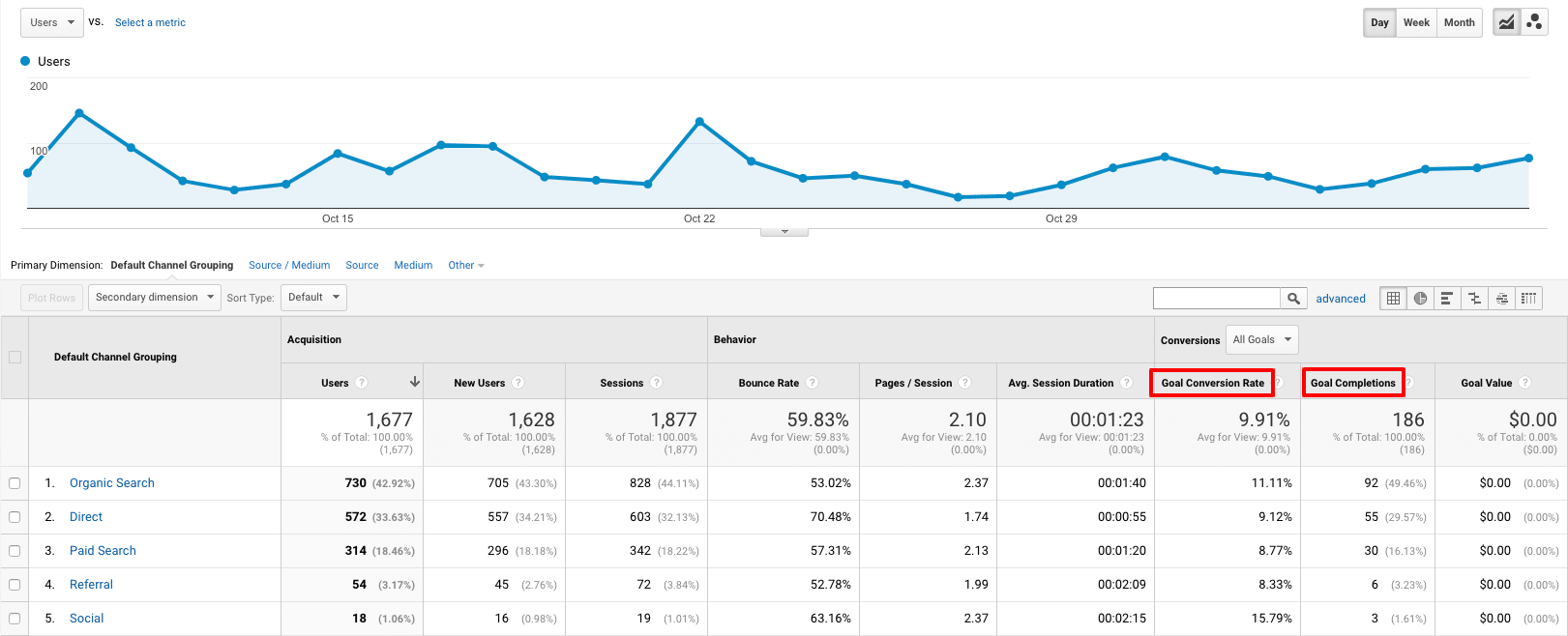
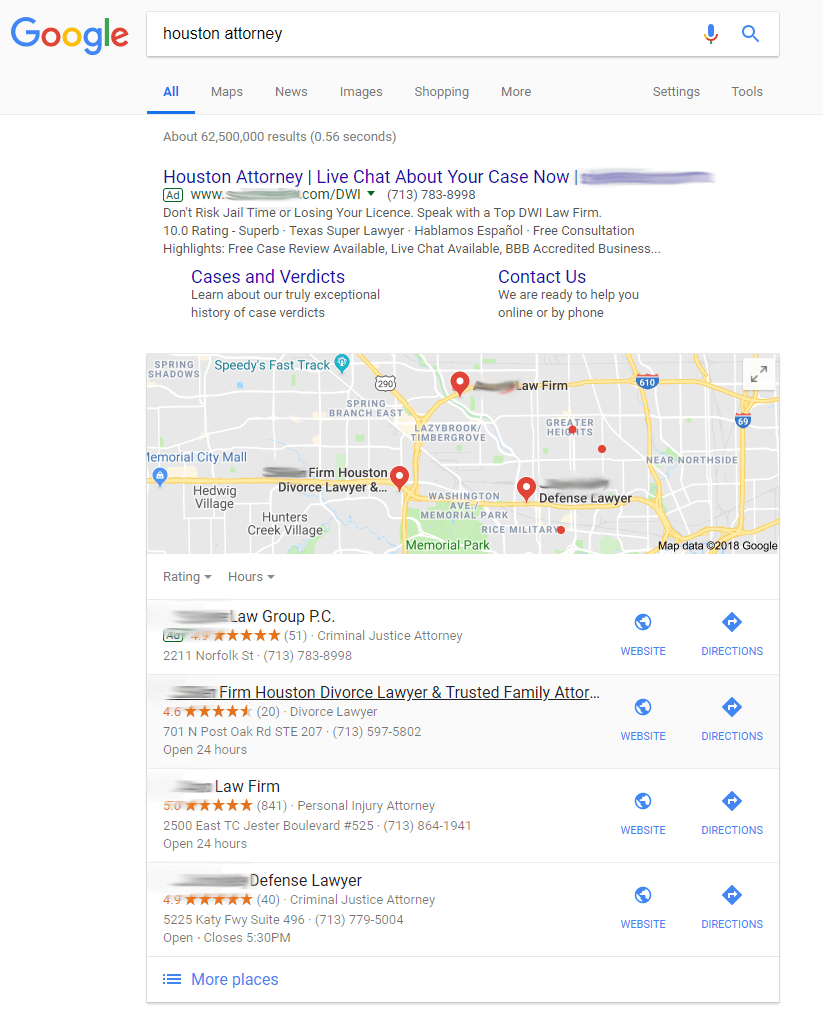
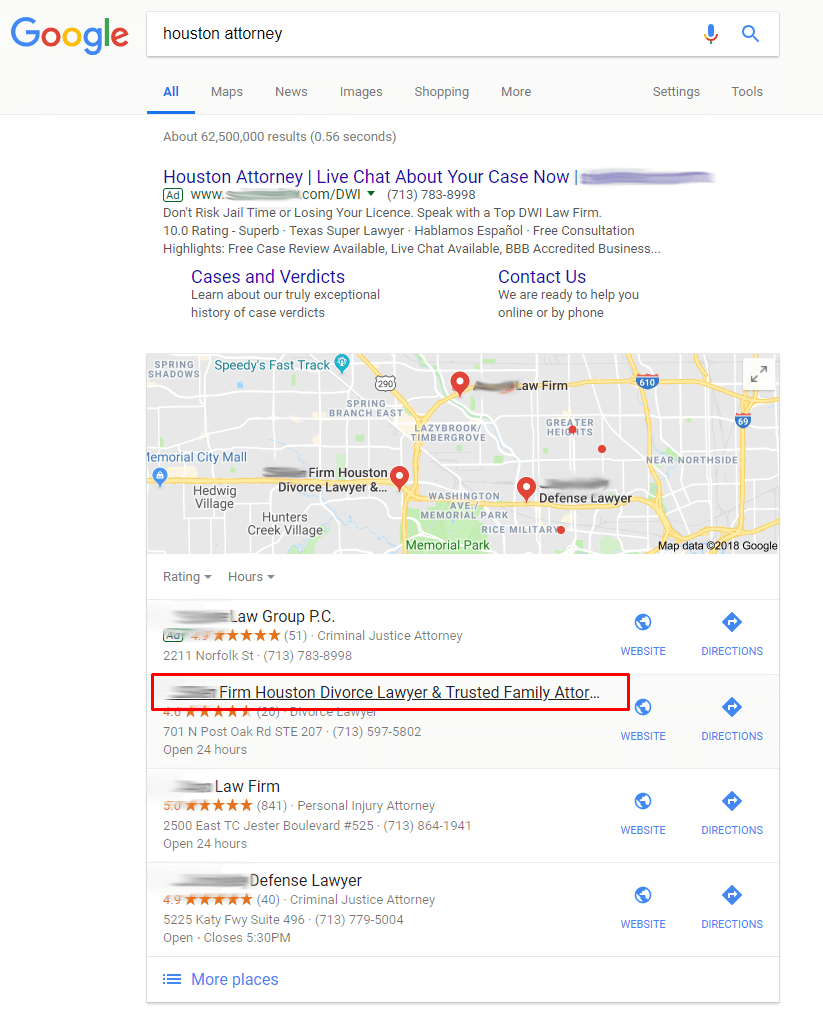
Conversion rate optimization (CRO) is the continuous effort to improve the website visitor experience in a way that the visitor converts to a lead and eventually a customer… my definition. Unbounce defines it as “the practice of continually improving your website or landing page’s capacity to convert visitors into leads or customers.” We believe that engagement data drives CRO. Understanding where your website visitors come from and the level of engagement they have guides you to making the appropriate changes to improve usability and lead generation.
Before you can begin improving your conversion rate, be sure to understand what your objectives are (and the difference between marketing goals vs. objectives). Once the objectives are determined, you can create what Google Analytics refers to as goal completions. These goal completions should track the objectives you want website visitors to accomplish, and can be used as marketing KPIs.
B2B marketing strategies will have different objectives and goals from those of B2C companies. Each objective should have a corresponding Call To Action that leads to the Goal Completion. Most companies, regardless of type, will have at least 2 of the following five goal completions.
5 Main Types of Goal Completions
1. Phone Calls
Getting website visitors to make contact via phone call is a primary objective for most businesses. Depending on your business, you may accept different types of calls. A B2B company like GoDaddy will have phone call options for sales, support, and billing. Alternatively, B2C companies may have options to call for an appointment or a quote. Either way, talking to the website visitor is the objective, and a successful phone call is the goal completion.
2. Contact Form Submissions
Form submissions are used all over the internet. Everything from quotes, credit applications, surveys, questionnaires, and even polls allow users to input and submit information through a form. The objective is to gather contact and other desirable information. A successfully submitted form is the goal completion.
3. Online Purchasing
E-commerce is a huge endeavor and is constantly growing. The objective is rather simple – sell products and receive payment for those products. With so many options for selling items online, there could be countless paths to accomplish the objective. Is this a tangible item? Does this item require shipping? Is it downloadable? Will it be picked up? Is this a subscription service? Regardless of how you get to the objective, the goal completion should be triggered at the point of successful payment.
4. Email Subscriptions
Email marketing is still a very effective way to nurture generated leads into paying customers. This requires a constant effort to increase the size of your mailing list. Getting website visitors to subscribe to your mailing list is the objective. The goal completion should be triggered after successful opt-in.
5. Get Directions
All brick and mortar businesses should offer an easy way to get directions to the location. Usually, the objective is to increase foot traffic and visitors to the physical location. As the website visitor, the goal completion is triggered when the user clicks “get directions” or a link to a map listing.
A familiar understanding of the sales process will help determine what objectives should actually be goals.
What Is Needed to Improve the Conversion Rate?
For businesses with a lower value product offering, it may not take much to improve the rate at which website visitors convert. It could be as easy as having a better-looking website. However, in more competitive industries, selling products with more value requires constant optimization of the website to improve the conversion rate.
First, determine what factor has the most influence on the purchasing decision. If your company provides a specific service, it could be the locality of your business is the main selling point. Are your prices competitive? Do you offer any incentives or guarantees? Are you aware of any advantages of your product compared to the competitors? What sets your company apart from the other online competition?
Second, analyze the current level of engagement happening on the website. It’s imperative to the success of the marketing campaign to know the source of your website visitors and what they did while visiting the website. Are they coming directly, organic search, paid search, email, social media activity or referrals from other websites? Are they using a desktop or mobile device? What area of town were they located when visiting the website? What other pages did they view? How long did they stay on the website? All of these questions help you determine how best to present your information.
Depending on your objectives and goals, you’ll need to make adjustments to the website. It’s the answers to these questions, along with analytical website data, that allows for effective conversion rate optimization.
What Adjustments Help Improve the Conversion Rate?
There are several items, both on-page and off-page, that should be done to provide some immediate improvements to the conversion rate. The most important thing to remember is that there must be continuity. The experience the user has from search, ad-click, and landing page should be consistent.
The keyword or phrase searched should appear in the ad text. The ad text should also reference the objective. After the click, the landing page should reinforce what they searched. The Call To Action on the landing page should compliment the objective mentioned in the ad.
Perhaps you’re a car dealership who wants more foot traffic or a construction company who wants more phone calls. You have available sales reps who need leads. Your dealership is targeting internet users looking for “small SUVs.” The construction company is targeting internet users searching for “commercial office build-outs.”
In these examples, the dealership writes ads that include the phrase, “small SUVs.” The ads also include the CTA, “Come Test Drive Today.” The construction company created ads that include the phrase “office build-outs,” and the CTA was “Get A Quote.”
The car dealership spent lots of money on pay per click ads driving traffic to their website. The traffic didn’t convert, and there were no goal completions. After reviewing Google Analytics, they learned most of the paid traffic “bounced” after landing on the homepage. There was not an increase in foot traffic.
The construction company invested in social media marketing ads. The campaigns received lots of views and likes. However, they didn’t receive any quote form submissions. A review of their Analytics highlighted that landing page had a high bounce rate and most of their social media traffic doesn’t convert well. Their email traffic had a much higher conversion rate.
This is why data drives conversion rate optimization. With this analytic data, the car dealership was able to make key adjustments to the website that would improve the conversion rate. The home page was designed to present more information about the dealership. They assumed it would be the best landing experience until data proved otherwise. They changed the ads to land on a sub-page exclusive to small SUVs. A button that said, “Schedule Your Test Drive” was added to the new landing page. They also adjusted the ads to only show during the available test drive times. After 30 days of paid traffic, the dealership had much more online engagement, but more importantly, website visitors began scheduling appointments for test drives. Goals completed.
The construction company made viable changes also. They created a page dedicated to office build-outs and embedded the quote form on that page. They also repurposed the social media ads and formatted them to be sent in a mass email. The email was sent biweekly, and the construction company quickly noticed the improvement. The first three days after each email send generated several online quote form submissions. Goals completed.
Other Conversion Rate Improvement Opportunities
Whether you sell products or provide a service, there are certain elements that increase the users level of trust, which leads to more conversions. In online advertising, trusting the brand plays a huge role in lead generation and client acquisition.
Building that trust quickly and establishing credibility is key to company growth. Take advantage of other chances to build credibility and improve conversions. This can be done by adding the right graphics and messaging to the website and landing pages. Add elements like Google Reviews, Yelp & Angi (previously AngiesList) badges, secure website seals, relevant certifications (license #, Bar Certification, Master Electrician, etc…). Phrases like “free shipping” and “limited quantities available” help to improve the conversion rate on e-commerce websites.
Optimization is constantly and strategically adjusting something to make it better. Therefore, proper optimization of your website conversions should yield not only more goal completions but also better quality goal completions.
Do you have a website that gets traffic? Does that traffic become quality leads? Do you know the percentage of website visitors that actually complete goals? If you don’t know or are unsure of how effective your website is at converting visitors to leads, contact MARION today. A member from our marketing company in Houston will be happy to speak with you.
The fight for online traffic has come down to two primary strategies — Search engine optimization (SEO) and social media marketing (SMM). SEO and SMM are both inbound channels, and they’re both used for content marketing purposes. So what’s the big difference between them and which should you use for your business?
SEO vs. SMM
SEO draws in traffic from search engine rankings and excels at creating awareness of your brand. On the other hand, social media marketing is all about building deeper relationships with your audience and drawing in traffic from social media platforms such as Facebook, Twitter, and Instagram (to name a few).
Though they’re both used to draw in traffic, SEO and social media marketing have their differences. Examine the strengths and weaknesses of search and social to help you decide which strategy to spend the most time on, where you should invest your marketing funds, and how to set your expectations.
1. Which Topics Perform Well?
Which topic performs the best for SMM/SEO? As you become a better marketer, you’ll be able to “sense” the best place to promote your content.
SEO
Evergreen topics that are continually useful no matter how much time has passed tend to rank well on search engines. How-to guides and other researched-based content that address common questions also tend to rank well.
Want to generate new business? Download this free eBook to learn about 26 lead generation techniques you can’t afford to overlook!
Social Media Marketing
Posts that stir up emotions such as anger, anxiety, sadness, or awe tends to get the most likes and shares overall. Trending topics also get a lot of engagement on social media platforms.
2. Which Format Performs Best?
Whether it’s text, audio, images, or videos you need to know what format of content performs best on each channel. Note that performance depends on context and what your business goals are.
SEO
Search engines love long-form text. The longer and more informative the post (with well-placed keywords) the better. On average, pages that have 1,500+ words rank well on Google and Bing. Search engines also love keyword-inclusive headlines that are long and descriptive.
Social Media Marketing
Social media is a vastly visual platform. Video and images are shared far more frequently than posts purely composed of text. Frankly, the likelihood of receiving shares and likes are exponentially higher when a visual is attached. Emotional, concise headlines will serve you well here.
Does one channel convert better than the other? Make sure you set marketing goals and objectives and define what a conversion looks like for your company. Put a measurement system in place so that you can assess results and make improvements.
SEO
You can only drive in so much traffic before you hit the ceiling with SEO. You will never exceed more traffic than the number of people who are searching for a specific keyword every day.
Social Media Marketing
The number of conversions you can generate on social media is practically limitless. As long as you’re running an active campaign, your conversions will continue to flow without interruption.
4. Can You Grow an Audience Faster with SEO or Social Media?
Between search and social, how long will you have to wait to see the fruits of your labor? Which of the two is faster?
SEO
When it comes to SEO slow and steady wins the race. Competing for the most valuable keywords takes time and patience. It can take a year or more before you learn how to generate business leads through your SEO efforts.
Social Media Marketing
Where SEO is slow, social media marketing is practically instantaneous. Sure, it takes time to grow an audience, but social media posts can garner likes and shares right away and start generating results instantly.
5. How Long Do Results Last?
Just like everything else for search & social, the duration of results between the two is vastly different.
SEO
SEO requires a significant upfront investment which can be scary for many business owners because the results aren’t immediate. Once a page is ranked, it has lasting effects that can span for weeks, months, or even years.
Contact MARION if you’re in need of an SEO company in Houston or Austin that can provide lasting results from organic search.
Social Media Marketing
The investment for SMM is small when compared to SEO. Traffic generation begins the moment your ad becomes live. Despite this quick response rate, the moment your effort stops, the results instantly die away.
6. How to Measure Success for Search and Social
Measuring your analytics is the only way you can determine whether your current strategy is working, but how do you go about correctly measuring search outcomes?
SEO
Reach is easy to measure for SEO, but it’s much more difficult to measure engagement. There are plenty of tools out there, such as Google Analytics, that can help you identify the number of clicks and impressions you receive for a specific key phrase.
Unfortunately, Google Analytics does not measure behavior metrics per keyword, which means you’ll never truly know which keyword led to which action on your website without using advanced analytics.
If you don’t know how to gauge your efficacy, speak with a Houston or Austin SEO company for help.
Social Media Marketing
Social engagement is simple to measure on social media, but it’s more challenging to measure reach and impressions accurately. Most social media platforms provide users with their reporting, allowing them to view analytics such as likes, shares, and comments.
Measuring reach (the total traffic of social activity) is a more difficult task when compared to the simplicity of measuring other analytics. The right tool will do the job, but specific familiar tools like Google Analytics are known to provide inaccurate results when measuring social media reach.
7. Social Media and Search Engine Optimization are Interdependent
Despite their significant differences, social media marketing and search engine optimization often rely on each other in a variety of ways. Here are a few ways SEO and SMM are connected:
SEO
One vital aspect of SEO is building relationships (a chiefly social activity) which can lead to mentions, links, and ultimately better rankings. Reaching out to bloggers and online news outlets for PR often takes place on social media. Some of the most crucial skill sets for SEO success are outreach, backlink pitching, and list building — all of which can be done through social media marketing.
Social Media Marketing
Content that ranks well has the potential to swell your social media followers who will in turn like, comment, and share your content. SEO benefits social media growth over the long term which ultimately helps to build a lasting growth strategy.
As it turns out, learning how social media helps SEO (and vice versa) can significantly boost your marketing results.
Using the Right Strategies for Your Business
Social media marketing and search engine optimization have their differences. Knowing how to incorporate the strengths of both strategies into your marketing plan will benefit your business the most.
It takes expertise to leverage social media and SEO for your business successfully. That’s where we come into the picture. MARION is a full-service marketing firm that excels in growing small businesses through strategic SEO improvements and social media marketing. We’ll develop sound strategies that will drive traffic where you need it, allowing you to focus on what’s most important — running your business.
Social media is cost-friendly, ubiquitous, and effective. So why aren’t you using it?
Many old-school business owners make claims that their audience isn’t on social media. Why? Because those business owners aren’t on social media, and assume that their target audience is just like them. The idea that at least part of your target audience isn’t using social media is high unlikely, considering that nearly 70% of U.S. adults use Facebook alone.
This is a frequent issue in homegrown or bootstrapped businesses. At some point, either because of business growth or the passage of time, business owners diverge from their target audience. There are several huge advantages of using social media for your business.
11 Social Media Stats for Business
Here are 11 benefits of using social media for business backed up with several statistics that show why you should be taking advantage of social media marketing starting yesterday.
1. Receive High Return for Low Effort
79% of marketers participating in a study reported increased traffic using social media marketing.
Spending as little as 6 hours a week on social media marketing, 92% of the same marketers reported that social media also increased exposure for their business. Simply having a Facebook or Twitter page that posts once in a while puts your business on the digital map and adds legitimacy to your operation.
SEO vs. social media marketing are very different in this respect, as SEO has a reputation for using a significant amount of marketing resources.
Reports predict around $357.3 billion will be spent on digital media advertising, a significant portion of which will be invested into social media. More than half of marketers participating in a study reported reduced marketing expenses due to social media. Using social media to advertise your business is extremely cost-effective, and you can’t afford to miss out on this trend that clearly won’t stop anytime soon.
Want to learn how to monitor social media in only 10 minutes per day? Download this free eBook now for our social monitoring tips.
79% of the same consumers said they have shared a life milestone on social media. Consumers primarily mention brands in the hopes of interaction with the business, whether it be acknowledgment or a discount. An easy way to interact with consumers is to share their post on your business’s social media. Considering that people tend to trust family, friends, and even acquaintances more than they trust businesses, this is a great way to convert more potential customers.
4. Reach a Diverse Audience Easily
52% of millennials credit social media advertising as influences when deciding to purchase a product.
Social media plays a big part in the younger generations’ shopping habits but the same study shows that baby boomers are not as digitally illiterate as you might think. 32% of baby boomers also credit social media advertising as influences when shopping. Your small business marketing strategy can reach different demographics online if you keep these statistics in mind.
Make your business a part of the conversation to increase visibility. If your business has no social media presence, they might as well not exist in the eyes of digitally-savvy generations.
71% of customers stated that they were more likely to buy from a company after having a positive social media experience. This can be as easy as acknowledging the customer- 77% of Twitter users felt more positively about a brand when the brand responded to their tweet.
Good customer service via social media makes customers likely to spend 21% more. Not to mention, social signals for SEO can be very effective for improving your brand visibility.
7. Take Advantage of Other Businesses’ Missed Opportunities
Only 5 out of 65 million businesses on Facebook actually advertise on Facebook.
Facebook is one of the most popular social media platforms with over 2 billion active users. With such a small fraction of businesses actually using Facebook advertising, it can be easier for your small business to cut through the noise and gain more visibility than your competition. Just using this one platform can easily put you a step ahead of another business that doesn’t.
Chatbots can be another way your small business can cut expenses while still delivering quick customer service. With automatic replies to frequently asked questions and concerns, chatbots can provide on-demand information without hiring someone to be monitoring messages 24/7. If you or your customers prefer an actual human being, a chatbot can still be an excellent way to let them know when they can expect to be in contact with a live person.
Internet users have 7.6 social media accounts on average. With over 4.2 billion and growing internet users (more than half the world’s population of 7.6 billion people), social media is an incredibly powerful tool to reach a wide audience. Establishing a space of your own in the social media landscape allows your business to dictate public perception of your brand. Over time (when utilized effectively) social media marketing can also increase engagement and help you win new consumers.
9. Higher Brand Loyalty
Studies show that 53 percent of all Americans and 66 percent of Americans age 18 to 24 who follow brands on social media are more loyal to those brands.
So yes, social media management IS a key piece in building brand loyalty. We’ve all heard the statistic: It’s five times more expensive to attract a new customer than to keep an existing one. In today’s market, where customers are bombarded with a variety of options, this adage has never been truer.
Back in the good old days, brand loyalty blossomed when a customer loved a product. Present day, things are not so black and white.
Customers today hold all of the buying power, and they know it. Now, brand loyalty is a two-way street, with customers expecting brands to provide them with something in return for their dedication. And this, my friends, is where social media lends a helping hand.
10. Humanize your company
Global PR firm Cohn & Wolf conducted a study of more than 12,000 people and found that the top qualities customers want to see from a brand are “communicating honestly about products and services” and “acting with integrity at all times.”
In addition, a separate study found that more than half of adults don’t trust a brand until they have seen “real-world proof” that the brand is keeping its promises.
Done correctly, social media can help humanize your brand and make it more authentic in the minds of consumers. And as it turns out, today’s consumers place a high value on authentic and honest brands.
So how are you to prove to wary consumers that your brand is trustworthy? Use social media to show the human side of your brand!
Pull back the curtain and allow users to see what your brand is really about. Show your audience how you are adhering to your brand’s mission and values, show the people behind your brand, show your regular day-to-day. This is one of the key advantages of using social media for business.
Social also helps humanize your brand by allowing you to form real relationships with users by engaging with them, starting conversations, and responding to their concerns.
11. Establish credibility
When it comes down to it, having established and active social media accounts is a huge part of creating a brand, and makes your company look more professional, legit and in the know.
It’s not uncommon for prospects to look your company up on social media to see how active you are. They use your social profiles as a way of validating your authority—Because let’s be honest, a company with 5,000 followers seems a lot more credible than a company with only 50 followers.
At the end of the day, it really doesn’t matter if you’re selling hamburgers or multi-million-dollar equipment—Your brand belongs on at least one, if not more, social platforms.
Tracking the effectiveness of your marketing is important, but many small and mid-sized businesses don’t know where to begin. Which marketing campaign effectiveness metrics are a true indicator of your marketing performance?
To begin improving your business marketing, you need to identify and track the right marketing metrics and KPIs. These will vary depending upon your business type, your marketing goals, and the strategy and marketing activities you put in place.
What Are Key Performance Indicators in Marketing?
Marketing Key Performance Indicators (KPIs) are quantifiable metrics used to measure marketing effectiveness across all channels. Marketing metrics are numbers that help you track performance and progress of certain marketing and business initiatives. Not all marketing metrics are key performance indicators for your business.
Marketing KPIs Vs. Marketing Metrics
It can be a bit confusing to differentiate the two, but KPIs are distinct in that you select certain measures that indicate the success or shortcomings of your marketing efforts. Each KPI should measure a specific objective over a predetermined period. Marketing metrics do not possess any specific characteristics and are not specific to a given amount of time.
You could say every KPI is a metric, but not every marketing metric is a KPI.
How to Choose the Right Metrics
Naturally, most marketing teams would like to measure as many key marketing metrics as they possibly can, but sometimes tracking too many can be a bad thing.
A dilemma that many marketing teams face isn’t so much which marketing performance indicators they need to track, but more so what they need to eliminate from the equation altogether. Tracking everything can waste time and cloud the real goals and objectives of your marketing campaigns.
Selecting the most vital marketing campaign metrics for your business can be a real challenge. Ultimately, the right marketing metrics are those that bridge the gap between marketing and the goals of the company.
You need to keep these three core considerations in mind as you’re selecting the right metrics to track for your business:
What is the purpose of the metrics you’ve selected?
Who will see and use that information?
What decisions will be made based on the information you’re tracking?
There are also considerations you need to consider at the executive level:
Does the information presented provide an insight into what works and what doesn’t work?
Do the metrics display how marketing is impacting business outcomes?
Do the metrics display the financial value and effectiveness of marketing?
Before deciding on the marketing campaign measurement metrics that you need to track, you must first understand your company’s most critical business outcomes. If you’re focusing on rapid growth, you’ll need metrics that accurately display customer acquisition and growth. If one of your critical outcomes is increasing revenue, then your marketing department needs to focus on metrics that measure qualified leads.
In addition to focusing on the true needs of your business, each of your metrics should be significant and meaningful. As you’re choosing the metrics to measure marketing performance at your business, you may be tempted to focus on what’s most comfortable to measure. However, it isn’t about what’s easy — it’s about what’s best for your business.
Choosing Marketing KPIs and Metrics that Affect Decision Making
Key performance indicators for marketing departments should always be selected based on the impact they will have on your business objectives and should never be dismissed due to emotional decisions.
Let’s say you’re tracking return on marketing investment (ROMI) and you realize the company can save money by reducing the size of a bloated marketing department or advertising budget. That may be the best decision for the business, but the actual act of discontinuing certain employee or vendor relationships can be very hard. Some people may decide to omit or devalue marketing efficiency metrics like this to avoid making difficult decisions.
However, all metrics should be used as a tool for decision making. You should look at your metrics objectively. Select marketing performance metrics that will drive action and ultimately help your company succeed.
6 Marketing Metrics Examples Your Business Should Be Using
Every business is different, but you’ll find there are certain KPIs for sales and marketing that are universal. Let’s look at the following marketing KPIs list for a better idea of what you should be tracking at your organization.
1. Customer Lifetime Value (LTV)
Customer lifetime value should be one of the core metrics for any marketing plan. Understanding the total value a new customer is expected to bring to the company throughout their relationship with you is crucial information and helps guide appropriate sales and marketing investments decisions.
LTV measures the amount of gross profit generated by a customer over the entire time that they do business with you. You can calculate this using one of the following equations:
Revenue per transaction x Gross Margin % x expected number of transactions over the course of their relationship
Revenue per subscription period x Gross Margin % x average length of retention (subscription periods) for a typical customer
Reaching out to your current customers is one of the best ways to enhance customer value, and it has a variety of beneficial effects for your business:
It will keep your customers happy
It can help to reduce churn
It can increase the lifetime value of your customers
2. Customer Acquisition Cost (CAC)
This metric gives you insight into how much it costs your company to acquire a new customer. You can easily calculate this using the following formula:
Total marketing dollars spent on customer acquisition / Total new customers acquired, calculated over a given period (e.g., monthly, quarterly).
Depending on how deep you want to go in assessing your client acquisition costs, you can include all sales and marketing costs, both fixed and variable inclusive of payroll, or subsegments of these such as limited to all marketing expenditures (see # 5 below). Either way, set yourself a target such as having a CAC of $450.
Understanding the relationship between LTV and CAC (e.g., LTV divided by CAC) is one of the most important metrics for your business, providing not only insight into how effective your spending is, but giving you information to determine how much you can afford to spend on customer acquisition.
3. Web Traffic
If you’re utilizing an inbound marketing strategy, you need to measure the number of users that have visited your site. There are several KPIs you can decide to use, from Total Visits by unique users to your website or specific page, to the specific traffic sources that are driving them there: Direct (typed your URL into their browser), Organic, Referral traffic, and Campaign, such as pay-per-click advertising or email links.
There’s a good chance you’ll be focusing heavily on acquiring organic traffic, which is the free traffic that you acquire through good SEO (search engine optimization) practices. There’s no specific equation to measure organic traffic, though you can look at absolute numbers, the percentage of total visitors, and page views or rankings.
Learn how to run an online marketing campaign more effectively today. Download this eBook to improve your marketing now!
Whether you use a KPI or metric for your marketing team, make sure to keep track of the effectiveness of your SEO strategy, as well as the keywords you’re using to draw in customers.
For help from an expert SEO agency, contact MARION today.
4. Lead Conversion Rates
It’s one thing to attract prospects via your marketing team — it’s another to close them with your sales team. Ultimately, you will want to measure the number of leads that are converted into sales; as a KPI, the Lead Conversion Rate can be calculated as:
(# Leads converted to Sales/Total # of Leads) * 100
In doing so, you’ll want to look at marketing qualified leads (MQL), and Sales Qualified Leads (SQL) and the conversion rates between the categories
A marketing qualified lead (MQL) are individuals who have been deemed ready for the next step of the sales process or more likely to convert to a customer compared to other leads. This is based on what pages they have visited and what actions they have taken. For example, someone filling out a form download an e-book, signed up for your newsletter or engaged with your business content in another way might qualify as an MQL.
Sales Qualified Leads (SQL) are leads that someone has vetted, perhaps members of your marketing and sales teams, and deemed ready for the next stage. These could also be someone who requests a meeting while providing certain qualifying criteria or that your sales team has already contacted or has scheduled for an appointment.
5. Inbound Marketing ROI
As far as management is concerned, this is likely one of the most important metrics for your business. Inbound marketing ROI is significant because it helps you to ascertain whether your current inbound marketing methodology is making or losing money.
No one wants to continue feeding money to a marketing campaign or activity that’s losing your business money. Therefore, return on investment is a fundamental metric to measure, because it can determine whether you move forward with a particular marketing activity or completely shut it down.
Calculate your inbound marketing ROI with the following equation:
There are a variety of metrics you can measure when it comes to determining the effectiveness of your social media marketing strategy. For most companies, it’s best to avoid becoming fixated on vanity metrics such as new followers, and instead track Key Social Metrics that measure the impact of your social media efforts on other marketing channels. This can include referrals to your website, the number of referred visitors who convert after they get to your site, or events users take to interact and engage with your company.
Breaking down the specific role the various social media channels can play for your business will help you focus your efforts while helping to determine metrics or KPIs that can help drive improvements when needed.
What Marketing KPIs will you track for your business?
This list is by no means all-inclusive, but it should give you a general idea of some of the most important marketing metrics and KPIs you should be tracking for your business.
If you’re not sure how to monitor marketing performance by keeping track of top marketing metrics, we’re here to help. MARION is an integrated marketing agency dedicated to helping small to medium businesses grow their influence online. Our team of internet marketing strategists and graphic design experts is ready to help you every step of the way and ensure you’re tracking of the right metrics to improve your marketing campaigns.
Contact us today for more information about our marketing services.
With so much competition out there, staying on top of SEO statistics for your business can mean the difference between being seen by your ideal customers or falling into search engine obscurity.
Google claims to make an average of three updates per day. If you don’t keep up with search engine statistics you may end up irrelevant.
Thankfully, our team at MARION has assembled a list of the most recent SEO stats for 2020. We’ve found stats that range from organic search statistics to search engine optimization facts. Let’s take a closer look at 12 SEO statistics for your business and why they matter.
The Effect of Page Length on SEO
The following SEO facts about web page length tells us that bigger really is better for search engine optimization.
A study found that long-form content received more shares than shorter form content
Buzzsumo and Moz examined more than 1 million articles and identified the trend that all articles that spanned 1,000 words or more received more likes and shares overall. That means one thing for your business — if you create longer posts filled with valuable information, you will likely be rewarded with likes and shares.
The average first-page result on Google contains 1,890 words according to Backlinko
In other words, quality matters more than quantity. The longer your content, the more likely it will rank well. That means providing as much value as you can for your visitors. Remember that your visitors are almost always looking for something specific. Go above and beyond when it comes to addressing searcher intent, and giving your customers what they’re searching for.
How Your Competition Is Approaching SEO
These two statistics will give you some insight into how your competitors are using SEO in their overall marketing execution.
61% of marketers say improving SEO and growing their organic presence is their top inbound marketing priority according to HubSpot
Marketers have been refocusing their efforts on improving their search engine rankings as opposed to focusing on other digital marketing strategies. There’s a good chance your competitors are focusing on improving their rankings as well. That means you need to refocus your efforts if you don’t want to be outranked (and outgrown) by your competitors.
In a survey by MarketingDive, more than 82% of internet marketers say that SEO effectiveness is on the rise while 42% say that SEO is significantly on the rise
Digital marketing is no longer as shiny and new as it used to be just a few years ago. Now, companies are getting better at SEO. That means if you want to stay competitive in 2020, your SEO strategy needs to be better than your competitor’s. Start with an SEO site analysis, and take it from there.
The Importance of Local Search
Do you know how many people search for businesses online right before making a local purchase? These local online search statistics may motivate you to implement local SEO best practices as soon as possible.
Google searches ending in the phrase “near me” have increased twofold over the past year according to Search Engine Watch
Local search statistics should mean a lot to local business owners. With an ever-increasing number of people searching for local services everyday business owners need to refocus their efforts on strengthening their local SEO tactics to make sure they’re at the top of the search engines when customers search for local services.
72% of consumers who performed local searches visited a store within five miles according to WordStream
As far as local SEO stats are concerned, this is especially important. That’s because an overwhelmingly large number of people are taking action after searching for local services. Once again, if you have a local business you should focus heavily on local SEO.
According to Web Strategies, the average firm is projected to spend 41% of their marketing budget on digital marketing. By 2020 this rate is expected to grow to 45%.
Digital marketing has proven time and again that it has become the undisputed king of marketing overall. With online ad banners and search engine marketing on the rise, it’s no wonder that so many businesses are expanding their marketing budgets significantly.
Updating old blog posts with new updated information (and images) and republishing them can increase organic traffic by as much as 111% according to Backlinko
If you have a blog full of archived blog posts with outdated information, a great tactical move would be to update your old posts with new content and images. It’s a great way to drive organic traffic, and it’ll give your SEO a boost.
Trends That Will Affect Search Rankings
Take a look at the following four trends that will have a huge impact on your organic rankings.
50% of search queries are four words or longer according to a study by WordStream
Users rarely type in single keywords when they’re running a query on Google. Most users are searching for long-tail keywords. For example, “SEO services in Houston” would be considered a long-tail keyword whereas “SEO” would be considered a head keyword. Keep this in mind during your keyword research and optimization endeavors.
Google receives over 63,000 searches per second on a daily basis according to Internet Live Stats
Typically, your ideal customer likes to feel that they’re in control of the entire buying process. Therefore, when you rank well you make it easier for them to perform research on your business. With so many people running searches on Google you can rest assured there are plenty of people looking for the services you specifically provide. Now it’s your job to make it easy for them to find you.
In 10 countries, more people perform Google searches on their handheld devices than they do on computers (according to HubSpot)
It’s no big surprise that the world is going mobile. Practically everyone has a cell phone or tablet, so if you want to stay competitive, you need to make sure your website is mobile friendly. Contact MARION for more information on how our responsive web design in Houston can help you!
Keep in mind that mobile devices vary in size which means your website needs to be able to adapt to various screen sizes. Lastly, paying attention to mobile SEO stats will allow you to spot trends and jump on opportunities when they present themselves.
According to NetMarketShare, more than 79% of all global desktop search traffic was run through Google. The remaining search traffic went through Bing at 7.27%, Baidu at 6.55% and Yahoo at 5.06%
It’s one thing to rank well on search engines such as Bing or Yahoo, but if you don’t rank well on Google, your target customers might never hear of your brand. Therefore, staying aware of search engine stats will allow you to stay ahead of your competitors.
Lessons to be learned
There are a few principal takeaways you can glean from the various SEO facts and figures in this article.
For one, when it comes to content marketing, long-form posts tend to rank better in search engines than shorter posts. That means you should focus on creating beneficial information for your audience that’s full of useful information! Make sure your content planning calendar is consistent enough to build a loyal following.
Marketers are also substantially increasing their marketing budgets. If you want to stay competitive, you’ll likely have to do the same. Finally, mastering keyword research and optimizing your business blogs will help you rank better.
If you’re looking to improve your SEO to stay competitive, you’re going to need a top-notch team that knows what they’re doing to help you get the job done. MARION is a full-service marketing company that has an experienced team of SEO professionals on hand to help you significantly improve your search engine ranking.
We understand what it takes to rank on the top, and we offer SEO services that reflect our expertise. If you’re tired of lagging behind your competition and you’re ready to get to work contact us today.
Redesigning a website can be a huge struggle for any business. It takes a lot of resources to redesign a website, and with the amount of work involved your marketing team will likely be pushed to their limits.
Typically, a website redesign will require around three months of concentrated effort. That’s three months of your marketing team focusing their attention away from your brand’s recurring marketing efforts. Pulling away the main focus of your marketing team for such large stretches can be potentially harmful for your business.
Thankfully there’s a faster more efficient method that can be used. This method is called growth driven design and it can truly transform the way you approach website design for your business forever.
What is Growth Driven Design?
Growth driven design (GDD) is an adaptive web design and digital marketing model. The core components of GDD are test, learn and adapt. The growth driven design methodology minimizes various risks commonly associated with traditional website design by focusing on meaningful data that reduces the time it takes to launch your site.
In essence, GDD is a combination of marketing and design where the two goals are fused together to become one.
How Does the Growth Driven Design Methodology Work?
Growth driven website design is an ongoing process that leverages collected data (such as customer behavior on your website) in concert with continuous learning and constant testing to make strategic and impactful performance improvements to your website.
Data driven web design calls for shorter planning which allows it to be accomplished in shorter amounts of time. This is a safer and more effective method of web design, and it ultimately saves the user money.
The problem with traditional web redesign is that it can take three months or more to gather the data needed to make the proper design changes. This data includes usability testing, content audits, consideration of budget and so on.
The beauty of data driven website design is it doesn’t take up all the time and collective effort of your marketing team because it integrates itself with both marketing and sales.
Analyzing the behaviors of site traffic can help both your marketing and sales team improve the way they go about accomplishing their goals and can help them improve the tactics and strategies they need to be successful.
How to Implement Data-Driven Website Design at Your Own Business
You could say it takes two phases to build a data driven website. The first phase is the strategy and launching phase. This will last around one month. The second phase is the development and continuous improvement phase. This phase will be continuously in use for the following eleven months.
Getting started with the first phase of GDD
The following three steps will help you execute the first phase of data driven website design.
Strategy and buyer personas
To begin, you should formulate your strategy and form goals so you have an idea of what you’re trying to accomplish. Next, create buyer personas to find out who your ideal client base is. This will also help you identify what customers care about and what they like, which will allow you to create an effective marketing strategy.
Auditing your website
Once you’ve finished the above step, you will move on to a detailed website audit. You’ll analyze where your customers are coming from, your average bounce rate and how users interact with your site (amongst other analytics).
Analyzing the above data should ultimately allow you to discover the pain points of your visitors which in turn will allow you to improve the overall user experience on your website. The goal of your website audit is to learn the behaviors of your visitors and why they perform specific actions. You can then act on that information and make improvements.
Create a wish list
The final part of the first phase is to create a wish list of everything you would like on your website that would improve the overall user experience. This can include an updated home page menu, implementing SEO for your About Us page, simplified navigation, additional pages, new calls to action, etc.
Create a list where you gather both the changes you absolutely need for your website and the changes you’d like to make onto your website. As you proceed, you can begin moving the less pressing items further down the list which you’ll eventually target later in the 11-month cycle. Through this process of elimination, you’ll eventually figure out where your website’s true strengths and weaknesses lie.
Phase Two of Growth Driven Design: Development and ongoing improvement
The first stage takes place over the course of a month. The second phase will continuously be in use for the next 11 months.
As opposed to redesigning a traditional website your full attention should be on the actions of your visitors. Your visitors should be at the forefront of your mind with every update, new feature, and new strategy you implement on your data driven website.
With that being said, there are four steps to the development and ongoing improvement phase:
1. Planning
During this phase, you’ll constantly be analyzing your site’s performance on a month to month basis and comparing it to your overall goals for the site redesign. From the data you obtain, you can determine the goal’s that need to be accomplished in the future.
2. Developing
Working with the appropriate business units in your business (marketing, sales, etc.) you will create the tasks needed to improve your site based on user feedback. You will then create a marketing campaign to direct targeted traffic to your new and improved pages. Implement validation tracking codes to continuously track the metrics on your site so you can continue to make improvements by gathering additional data.
3. Learning
As you split test and experiment with improvements you’ll find that certain assumptions you’ve made, such as adding “more intuitive” navigation to your site to improve user experience, may not be what your data driven website needs after all.
Therefore, you can throw that idea out and replace it with something that directly benefits your users. Perhaps you’ve identified that your website redesign SEO strategy will be more beneficial to focus on in the immediate future.
4. Transfer
The final step is to transfer the data you’ve gathered to your marketing team. Your team can then proceed to use that data to improve their ability to locate and attract your ideal customer.
Implementing growth driven design for your website
There are numerous data driven website advantages you can enjoy if you go about the process correctly. Data driven web design is all about improving your website in small, meaningful chunks until you create the ultimate user experience. You should always be analyzing data to make future improvements.
At MARION, we know what it takes to build and continuously manage a growth driven website. Marion is a full-service marketing firm that offers highly rated custom website design services. We build every website with the client’s brand and bottom line in mind. Our experienced team has helped hundreds of industry-leading brands build effective websites that have grown their businesses, and we can do the same for you.
Contact MARION today for help with building a data driven website for your business.
Marketing has always been an integral part of a business’ success. Therefore, it’s no surprise when we witness the continuous changes and developments that are taking place in the world of marketing. For a business owner or small business marketing manager, it’s important to ensure that sufficient attention is paid to the response generated from different advertising efforts.
To make things easier, Google has come up with different benchmarks that you can keep track of to measure the quality score for your paid search engine marketing efforts. Many companies today use these benchmarks to gain clarity about their position in the market as compared to that of the competitors’.
Google Ads Benchmarks & Their Significance
Google uses a Quality Score Formula to determine the ranking of each ad. Keeping track of your quality score can help you improve your overall marketing efforts and focus them on areas that are generating conversions.
Knowing the key performance indicators in the form of benchmarks provided by Google can help businesses compare their standing in the market and spend both money and effort on marketing techniques that are working.
Some of the most important benchmarks that you should be keeping track of are:
Average Cost Per Click (CPC)
Average Cost Per Action (CPA)
Average Conversion Rate (CVR)
Click-through Rate (CTR)
You can use the information derived from monitoring these benchmarks to devise a Google Ads Strategy which will significantly improve your overall marketing performance. It’s strongly recommended to seek the help of professional marketing agencies like MARION. With so many metrics to keep track of, many businesses fail to identify the exact cause of their less than average benchmark performance without the help of pay per click services expertise.
What is an Average CTR?
One of the important benchmarks requiring your attention is the Average Click-Through Rate (CTR). The click-through rate on Google Ads reveals exactly how many of the people that see your ad actually end up clicking it.
CTR is an important benchmark since it gives your business a clear idea about the performance of your ad’s positioning, use of keywords, and imagery. Moreover, while a basic CTR only tells you about the number of clicks for every ad, Average CTR calculates for you the number of clicks as opposed to the impressions of your campaigns.
What is a Good CTR for Google Ads?
There is no single click-through rate that you can regard as ideal for every type of business. That’s because a good CTR varies depending on the industry you belong to, the type of business you have, and your future goals. However, you can find out how good your Google Ads click-through rate is compared to that of your competitors with the help of free tools.
Average CTR Across Industries
As mentioned earlier, the average CTR will vary for a particular business on the basis of the industry it belongs to. However, the average CTR is generally around 1.91% for a search ad, and 0.35% for a display ad. Recent figures shared by WordStream show the following:
Industry
Google Display Network (%)
Search (%)
Auto
0.41
2.14
B2B
>0.22
>2.55
Consumer Services
>0.20
>2.40
Dating & Personals
0.52
3.40
Education
0.22
2.20
Finance & Insurance
0.33
2.65
Health & Medical
0.31
1.79
Legal
0.45
1.35
Real Estate
0.24
2.03
Technology
0.84
2.38
How to Improve Click-through Rate in Google Ads
To improve the response that your ad gets from the audience, you need to incorporate some of the techniques that help gain more attention from your target audience. These include:
Making sure that the ad copy is relevant to the interests of the target audience. To come up with such a message, you will need to get to know your target audience first. Identifying who you are targeting and formulating a message according to their needs will help your ad gain more attention.
Adding the review extension to your ad can also boost response. This is because most of the customers today make purchase decisions based on the reviews they find online. Incorporating a review extension will not only increase the trust factor but also generate a higher response.
Coming up with a message that does not only focus on making a sale but rather uses softer communication methods goes a long way in boosting your average CTR. It has been witnessed that ad copy that “talks to the customer” is more likely to get a response than one that clearly states the importance of making a sale.
Keywords hold immense importance in the creation of a compelling ad copy. Simply stuffing keywords into your ad will not do the trick. Instead, you will need to creatively use one strong keyword that will help you get the right attention. Attracting the right traffic will increase the likelihood of a response as well.
The importance of a good average CTR cannot be doubted, but there is a possibility you achieve a high click-through rate with an incredibly low number of conversions. The main goal of every business is to increase the number of customer conversions, so it’s essential to focus on the overall ability of your ad to generate the right response through these clicks as well. A good average CTR is only achieved through improving the quality of your message.
Bottom Line for Your Average CTR in Google Ads
The easiest way to improve your average CTR is to increase the quality of your ad. Rather than focusing too much on the CTR that you are getting, it’s more productive to spend time looking for ways to improve the performance of your ad. For this purpose, get help from companies that provide specialized digital marketing services, like our team here at MARION.
MARION helps you boost your performance and improve your overall Quality Score by investing in the right online marketing efforts.
Houston, Texas is a big city, and it’s one of the most competitive markets in the country to run a small business. Houston is home to more than 100,000 small businesses. With so much competition, finding loyal customers can be a real challenge.
If you’re looking for marketing strategy help in Houston, this advice from the MARION team will come in handy. We’ve been providing marketing strategy in Houston for 40 years, and we’re sure you’ll find the following six methods helpful.
6 Marketing Methods for Small Businesses in Houston, TX
Let’s look at small business marketing strategies that work in Houston, TX, and how you can implement them for your own company.
If you’re operating a small business, you’re going to need a significant digital presence to promote your services and let people know you can solve their problems. Once upon a time, businesses could pick and choose whether to maintain a business web presence. Today, it’s a necessity.
Social media marketing is one of the most popular marketing strategy examples in Houston, TX, because of its usage rates. Due to the sheer number of people who use social platforms such as Facebook, Twitter, and Instagram (amongst others), implementing a digital marketing strategy is more important than ever. There are several examples of the benefits of social media for business.
Facebook’s hyper targeted ad platform is one great example why your Houston small business marketing should include social media. These ads allow you to target your ideal customer based on city, income, interests and more.
For example, you can create a Facebook ad that targets “seniors who live in the Houston area who make more than $100,000 a year.”
Once your ad has been accepted and approved, the only people who will see your ad will be the customers who fall within the above parameters.
No matter what social media platform you use, there are potentially millions of customers who live in Houston who can be reached through the power of social media marketing.
2. Traditional marketing
Though online marketing has certainly taken the limelight in today’s digital world, traditional marketing is still a viable option for many small businesses. Local marketing methods such as billboards, newspapers, television, and magazine ads are still great ways to reach out to the local community. With that being said, let’s touch on a few of the pitfalls of traditional marketing.
For one, traditional marketing can be costly. Facebook ads can be as cheap as $5 or less but are still capable of reaching thousands of people. In comparison, TV and billboard ads can run you thousands of dollars.
Furthermore, traditional ads run on cycles. Once your ad cycle has run its course, you’ll no longer be able to promote your business, and the good people of Houston will simply move on to one of your competitors. As they say, out of sight, out of mind. You’ll have to run an entirely new cycle to put your business back on the map.
Despite its pitfalls, traditional marketing is still used effectively by many Houston-based small businesses. When it comes to your business, do your homework and experiment to see which traditional marketing strategies work, and which don’t.
3. Content Strategy
If there’s one thing people want today more than anything else, its fresh content. We’ve been so inundated with a nonstop barrage of articles, videos, and pictures on social media that people have become addicted to a non-stop flow of new content. This is why a good content strategy is one of the best marketing methods for any small business in Houston, TX.
To market your business online in Houston, TX, you really should have a website. Starting a website blog that provides value to your customers is a great way to grab customer interest and establish yourself as an expert in your space. Even if you don’t have the bandwidth to manage your own blog, you can leverage content marketing services to help grow your digital presence.
Furthermore, if you employ a proper SEO strategy and put out engaging content while blogging for business, you’ll create a bond between your business and your customers which ultimately leads to more conversions down the road.
When it comes to email marketing, every guru out there is saying the same thing — there’s money in the list. A great digital marketing strategy in Houston, TX, is to create and grow an email list. It’s an effective tactic that thousands of businesses utilize to convert prospects into paying customers.
You can do this by issuing a newsletter on a regular basis. This may sound like a lot of work, but if you’re new to Houston email marketing, you can start off slowly by sending emails on a quarterly basis. Then you can bump it up to a monthly and even weekly email sequence.
It isn’t difficult to create an email list. If you’re building an email list strictly online, you can funnel prospects to a landing page on your website where you can request their email in exchange for something of value. If you’re not sure how to create the appropriate landing page, learn how to find a web designer that can deliver what you need.
For example: “Enter your email for a free eBook on how to grow your small business in Houston.” In many cases, customers will drop their email in exchange for a valuable piece of information.
If you’re running a brick and mortar shop, you can ask your customers for their email in person. In this instance, holding a raffle is a great way to incentivize their participation. For email marketing strategy help in Houston, contact MARION today.
5. Business Alliances
A great local marketing strategy in Houston, TX, is to build business alliances. Ideally, business alliances will lead to referrals for all businesses involved. Alliances are among the best B2B marketing strategies for companies that offer supplementary or complementary services.
A word of advice — you should never go into a business alliance with a selfish mentality. Try to give as much as you can and expect little in return. As a result, the other businesses in your alliance will likely try to benefit you as much as you benefit them. In the end, everyone wins.
6. Start a referral program
Speaking of referrals, starting a referral program is also a great business marketing plan in Houston, TX. Starting a referral program can be just as simple as handing a customer a business card and asking them to refer their friends.
You can also offer your customers incentives for referring a customer to your business. For example, a customer can receive 10% off of their next purchase if they refer a friend. You could then offer the same discount to the person who was just referred. The goal is to create a chain of customers who refer their family and friends, which translates to a constant flow of traffic for your business.
There are a wide variety of strategies available for marketing your small business in Houston, TX. We understand how difficult it can be to market a business successfully. Even if you possess marketing knowledge, sometimes it’s best to leave the heavy lifting to the professionals.
MARION is a full-service marketing agency that offers a variety of services including branding, web design, SEO, PPC and much more. As a Houston based firm, we know what it takes to make your company stand out from the sea of competition.
If you’re a business owner, you know that it’s tough to reach your intended audience. Without a strategic advertising plan, you will never achieve sustained growth.
Because it’s such a complex and sophisticated industry, many developing businesses are not able to effectively maintain a productive advertising schedule. This is a major roadblock in the highly-competitive advertising space.
The advantages of using advertising agencies are vast, regardless of your company’s size.
Why Do Companies Use Advertising Agencies?
The advantages and disadvantages of advertising agencies are both important to consider before you commit. When you fully understand what an advertising agency brings to the table, you will feel more confident in your decision to move forward despite the associated hard costs.
Are your advertising campaigns generating leads? Download this free eBook with 26 of the best lead generation tips to improve your ROI today!
So, if you’re dragging your feet, wondering “why hire an ad agency?,” it’s time to analyze the pros and cons.
3 Pros of Using Ad Agencies
The advantages of advertising agencies can help kickstart or re-energize your business. By partnering with a credible marketing company, you will not only maximize your company’s exposure, but also enhance the overall productivity and growth of your organization.
Here are some of the main benefits associated with this type of long-term investment.
1. Expertise and Knowledge
There are certain aspects of your business that you should outsource, especially if you are not experienced in them yourself. Since marketing and advertising has the potential to offer a great return on your investment, this is an area that you should consider contracting to an experienced third party. Best of all, you will not need to waste any time training an employee (or yourself).
By contracting an agency’s starting lineup, you will gain instant access to your own team of experts. These teams tend to be made up of a diverse group of skilled specialists, allowing you to utilize various strategies and applications.
Tip: Some agencies may specialize in one key area of expertise, such as online advertising. That is why you should have a clear vision of what type of advertising you require before you select an agency.
Since advertising is such a multifaceted industry, it is best to work with an experienced team that has a track record of success. MARION is marketing agency in Houston offers a full range of services depending on your needs: pay per click services, SEO services, logo design, digital marketing and more. Our team can create and execute a marketing strategy that aligns with your unique goals.
If you’re ready to ramp up your business and optimize your marketing budget, please contact MARION for a quote.
2. Saves Critical Resources
Although you will need to incur third party marketing spend, you will be rewarded in terms of ROI. The truth is that a successful ad campaign takes time and energy — which small to medium-sized business owners don’t generally have.
You will also save money, which may seem counterintuitive. For example, instead of hiring an employee to assist with challenging or even mundane marketing tasks, you can work with an agency. This means that you will avoid hefty payroll taxes and health care costs.
The same cost savings can be realized even if you had previously taken on the role of CMO yourself. You will not need to purchase any software tools. With the time you save, you can focus on what matters most — your business operations.
Tip: Ask the agency you’re working with whether they can optimize your ad space or if they can get a discounted agency rate with your local radio, TV station or a publisher that matches your advertising goals. This can help you stretch your budget, providing an even greater ROI. If not, see if they can help elevate your next industry event (think trade show displays and the types of systems that will wow your target market).
3. Support Brand Development
Advertising agencies have the type of experience required to develop brand awareness. This is one area you don’t want to underestimate, as a clear brand identity and message is what will allow you to connect with your customers. Whether you need help with your logo or identifying your target audience, these are crucial steps that an agency can confidently help you with.
Tip: Although the whole point of hiring a marketing agency is to maximize your time and energy, don’t be shy about inquiring about certain components of your ad campaign. Agencies are unique in that they will likely find new ways to promote your brand. Which channels are most beneficial in terms of your advertising strategies? Your brand development strategy depends on the unique value proposition of your company!
Con of Using an Ad Agency
Of course, the main initial “con” is related to the question on everyone’s mind: How much does it cost to hire an advertising agency?
The answer to this question is not black and white, as there are many variables involved in terms of the scope of your plan. As stated by Forbes, there are three core elements in regards to branding in relation to your marketing strategy.
The visual aspect of your brand (your logo, website and marketing materials).
The messaging component (communicating who you are and what you do).
The positioning of your brand, which works alongside your core business plan and structure.
How Much Does It Cost to Hire an Advertising Agency?
Forbes estimates that an agency could charge anywhere between $10,000 and $50,000 for a full blow campaign. However, this is highly dependent on what you want to achieve. Some agencies will offer select monthly packages, which often range between $2,500 and $4,000 per month.
Although this may seem like a disadvantage in the short-term, this investment will soon transition into a significant ROI when you partner with the right agency.
We work with many law firms and one of the biggest challenges for any new or established law firm is generating a steady stream of website traffic.
While there are countless ways that you can address this need, it should almost go without saying that focusing on your search engine optimization is time and money well spent.
If you’re wondering how important it is for your website to show up in relevant search results, let’s just look at the facts.
96% of people use a search engine while seeking legal advice.
74% of consumers will visit a law firm website to take action while seeking legal advice.
These consumer statistics from The National Law Review make one thing obvious – your law firm needs to be visible online.
Simply creating a website won’t cut it in today’s digital landscape. With 96% of people using search engines to seek out legal advice, your firm’s task is to cut through the noise and rank highly enough to be found when potential customers raise their hand for legal help.
Focusing on SEO for your law firm websites is your ticket to the top of the search results. Unlike a lot of other posts out there on SEO for law firms, I’m not going to claim that domination of the search results is as simple as following a few steps. After all, you’re an expert in legal matters, not attorney search engine marketing.
Outsourcing SEO for Law Firm Websites
You’re a legal expert, not an SEO expert. When you break it down financially, an hour of time spent doing billable work for a client is more valuable to you than doing an hour of SEO. Fortunately, you don’t have to pick one or the other.
MARION’s SEO for Law Firms
Average User Rating: (5 / 5) Based on 4 reviews
When you use MARION Marketing’s SEO Services, we build your organic website presence, so you can stay client focused. Contact us for more information on how our search engine optimization services can grow your bottom line.
This post will cover techniques for improving where your website is showing up in search engines, but if you’re wondering why your site doesn’t show up in search engines at all, you may want to address some bigger issues before diving into this post.
In this post, we will walk you through the most critical components of your law firm’s SEO marketing, including keyword selection, mobile-friendliness, site structure, technical SEO, local SEO strategies, content creation, and more.
You may decide that there are more profits to be had by using a reputable SEO service than doing it yourself. If so, make sure you know what to look for in a reputable SEO company. We have years of experience working with law firms to grow their digital presence and their bottom line, so reach out to us with any questions that you may have.
Organic Traffic Doesn’t Have to Come from Google
One of the first SEO tips that many lawyers may or may not be aware of is that organic traffic doesn’t have to come from Google.
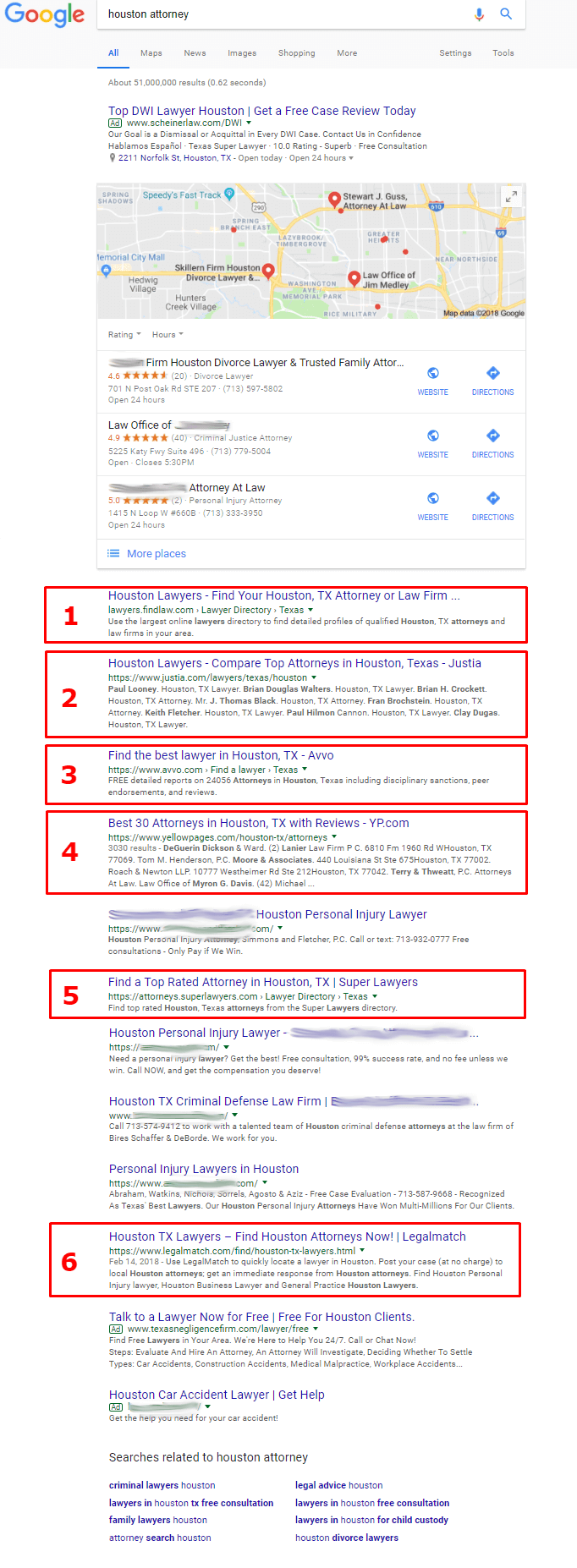
I’ll demonstrate my point with an example. If you own a general practice law firm in Houston, your SEO marketing efforts might focus on ranking for, “Houston lawyer.”
Take a look at the organic search engine results page (SERP) for this keyword. Don’t consider the ads and local results at the top of the page for now, but instead focus on the, “10 blue links.”
As it turns out, six of the ten organic results are listings pages from sites like findlaw.com, justia.com, and avvo.com. Only four of the “10 blue links” are actual law firm websites in the Houston area. The low ratio is because of the sizeable margins on law firm services, and the profitability of selling leads in this industry.
Disadvantages of Purchasing Leads from Listings Sites
For a firm hoping to invest in SEO services, niche business listings sites add an extra layer of competition to the mix.
On top of having to outrank the other lawyers that offer competitive services, you must outrank listings websites that want to outperform you in the organic search arena. Their goal is to collect consistent lead revenues from firms like yours.
The business listings players often have more marketing dollars, and a stronger SEO presence backing them. They use this technique in an attempt to force you to purchase leads on a recurring basis instead of relying on the powerful lead generation tool that you already own – your website.
Advantages of Purchasing Leads from Listings Sites
On the bright side, professional listings websites provide an opportunity to source more business at a fraction of the price that you’d pay to show up in Google searches using Google AdWords.
For example, at the time of writing this article, the suggested AdWords CPC (cost-per-click) bid for the keyword, “Houston attorney,” is $22.05. What this means is that every time someone clicks on your advertisement in Google, you’ll pay an estimated $22.
If you don’t have an optimized ad landing page that converts well, you could quickly blow through thousands of advertising dollars with no new customers to show for it. The value of SEO services could easily outweigh the value of purchase leads in this case.
A site like avvo.com might offer leads at a much lower rate. Additionally, because of the qualifying information on the Avvo website, a purchased lead could end up being higher quality.
Rank for Keywords on All Levels of the Inbound Funnel
One of the main components of your SEO will be identifying keyword groups at each level of the inbound marketing funnel.
I’ve seen it time and time again – law firm websites are composed of a few pages detailing the services they offer, and little else. Unfortunately, that doesn’t demonstrate to users or search engines that you are a subject matter expert.
Keep in mind that your law firm’s search engine optimization plan should be mutually exclusive, and exhaustive.
For example, for a child protective services defense attorney in Fort Worth, Texas, writing three blog posts that focus on keywords related to, “CPS rights in Texas,” would be ill-advised. Your three blog posts would be competing with one another. Instead, create one longer page that is more thorough, and exhausts every relevant angle for the topic at hand.
Good search engine optimization for lawyers starts with creating a plan for identifying keyword groups related to your niche and then developing high-quality content for the top, middle, and bottom of your marketing funnel.
If you’re not familiar with the “marketing funnel” I’m referring to, let me explain.
Top-of-Funnel Content for SEO
Top-of-funnel content is general and mostly information. The goal of top-of-funnel content is rarely to make a direct sale, but rather to provide value for a website visitor so that they come back to your site.
Top-of-funnel content also provides context to search engine algorithms to establish in which areas your firm specializes.
Middle-of-Funnel Content for SEO
Middle-of-funnel content will align with the next step of the buyer’s journey. This content should speak to someone who is probably in the market for services related to the ones that you offer, but still needs more information about the details.
They might be interested in prices, how to shop around for a good or service, and reviews for goods or services that are convenient for their location.
Bottom-of-Funnel Content for SEO
Bottom-of-funnel content is for users who are ready to make a purchase. This content should probably include details about your product or service so that someone on your site knows exactly what they’re about to buy.
Your bottom-of-funnel content will likely take the form of a product or services page that highlights features, pricing, FAQs, and the next steps required for a purchase.
Consider our previous example of the child protective services defense attorney in Fort Worth. You might create a blog post on the topic, “what are my CPS rights in Texas?”
You could include a form on your blog post page that offers a free eBook about “how to select a lawyer.” At the end of the eBook, you could include a call to action that links to a page you created that goes over your experience as a “CPS defense attorney,” and how to contact you.
Mobile-Friendliness
If you were to open your website on a mobile phone right now, would you have a hard time using it?
Out of all global online traffic, mobile online traffic accounted for 52.64% in 2017.
This stat from Statista makes it clear why your website should be mobile-friendly. Your law firm’s search engine optimization is all about supplying when there is demand, or in other words, meeting people where they are. If people are searching from their mobile phones or tablets – meet them there.
This blog post probably isn’t the first time you’ve heard about mobile-friendliness. Even Google says that the majority of your site visitors are probably using a mobile device.
In case you aren’t clear on what mobile-friendliness means, it refers to having a site that fits the user’s screen when they are on mobile devices.
In the past, web developers used to make separate versions of websites that fit certain screen sizes, but that method is outdated. Today, web developers use responsive design to achieve mobile-friendliness.
What Is Responsive Design?
Responsive design is a web design technique that uses one set of HTML (the content and structure of your site), but different CSS (the look and feel of your site) to visually style web pages to fit the device that a visitor is using. Responsive design creates a good user experience for anyone viewing your site, on any device.
Mobile-friendliness and responsive design became very critical to search engine optimization when Google announced that mobile-friendliness would be used as a ranking signal starting in April 2015.
You can use this tool from Google to test the mobile-friendliness of your site.
If you’re finding that your site isn’t mobile-friendly, reach out to us to learn more about our web design service and how we can work to make your site responsive.
Site Structure
As a lawyer, you know that how you say something can be even more important than what you say. The same is true for the SEO efforts of any attorney when it comes to your site structure.
The layout of your pages can tell your users (and search engines) a lot. Your site structure can help make your website more user-friendly and helpful than your competitors’ sites.
A more helpful site aligns with Google’s original mission statement to, “Organize the world’s information and make it universally accessible and useful.”
To explain how important site structure can be, I’ll go over the three scenarios that different sized firms might experience and their corresponding SEO friendly website structures.
One Service – Use an Exact Match Domain
For a law firm that specializes in only one niche, an exact match domain (EMD) will facilitate the best SEO results.
Despite the fact that Google has made several attempts to eliminate the advantages that exact match domains provide, I’ve found that they still tend to rank more easily than a branded domain name.
For example, a lawyer that only focuses the Oil & Gas industry in Houston might opt for the domain name: houstonoilandgaslawfirms.com.
Do your keyword research before choosing an EMD to make sure that your keyword of interest is being searched enough to warrant using it in your domain name.
When search engines and users see your website name, it’s abundantly clear that you are an expert in Houston oil and gas related legal issues. Any sub-pages on your site should be about your actual firm, or about particular components of Houston oil and gas litigation.
Because you only serve one location and offer one service, there is no confusion as to which area of expertise of your law firm. Your home page IS your specialty services page.
For example, your URLs might look something like this:
Your Domain: com/
Services Page URL: com/
Blog Post URL: com/private-equity-best-practices-energy-industry/
Multiple Services – Use a branded domain with sub-services
A firm with several services should use a branded domain, with sub-pages for each specialty you provide.
A branded domain is just the name of the law firm and not a specific keyword. A branded domain will keep your site from becoming inherently associated with one service over another.
Adding sub-pages for each specialty will help keep your related content in silos. For example, when you add blog content (and, yes, your SEO efforts should include business blogging), add it under the corresponding specialty page.
Let’s pretend I own a law firm, and my branded domain is simply tonylawfirm.com. I have two specialties in green energy, and oil and gas.
Your Domain: com/
Services Page URL: com/green-energy-attorney/
Services Page URL: com/oil-gas-attorney/
Blog Post URL: com/green-energy-attorney/renewable-energy-incentives/
Blog Post URL: com/oil-gas-attorney/deepwater-oil-spillage-litigation/
Multiple Location – Use branded domain with sub-locations, then sub-services
For a practice with several locations, either throughout one state or across the country, your site structure should showcase your locations under a branded domain name. The first directory after your domain name should specify each location.
It’s possible that you offer services for several specialties at each location. In that case, your URL structure under each location will look like the layout about one location and multiple services (from the previous section).
Pretend that my law firm has grown, and tonylawfirm.com now has two locations offering oil & gas, and green energy legal services at each location.
Your site structure will have a huge effect on the success of your search engine marketing, so don’t rush through it. Doing it right the first time will make your law firm’s SEO efforts more successful, and make your firm more profitable in the long run.
Technical SEO
Technical SEO refers to the web development-related aspects of SEO. Technical SEO is typically not an area that someone in the legal field excels at or an area in which they should excel.
Mastering the technical side of SEO is often time-consuming, and if done the first time correctly, will only require minimal monthly maintenance.
Because of the time-consuming upfront investment, it makes sense to outsource this matter to a legal SEO expert. That being said, it can be helpful to at least know what you don’t know so that you can effectively shop around for the best SEO for lawyers.
Verify and Submit Sitemap
If you have only 30 seconds to understand what a book is about, I’m betting you’d read the synopsis and then scan through the table of contents.
Search engines also frequently scan the table of contents for your website, called a sitemap, to make sure they know what your site covers.
Instead of crawling through your site page by page to see if there are any additions, search engine bots use the sitemap to account for the layout of your content quickly.
Don’t worry about the details of creating a sitemap – there are a lot of services out there that you can use to create one for free. If your site is built with WordPress, you can use the free version of the Yoast plugin to create and maintain your sitemap automatically.
Once you create your sitemap, you’ll want to submit it to Google Search Console and Bing Webmaster Tools. Google Search Console is more important because of Google’s market share, so we’ll quickly go over how to do that.
Go to your Google Search Console, and select the web property for your law firm’s website.
Click “Sitemaps” in the left-hand navigation.
Click “Add/Test Sitemap” in the top right corner.
You will then be prompted to enter your sitemap’s URL. If you’re using the Yoast plugin, login to your WordPress account, and select “XML Sitemaps” from the left-hand navigation under Yoast SEO.
You will land on a page that contains your XML Sitemap link. Copy this link, navigate back to Search Console, paste it into the field asking for your XML sitemap link, and click submit.
Submitting your sitemap to Google is a big step toward improving your law firm SEO.
Verify Robots.txt
Robots.txt is like the security checkpoint at the courthouse. Your robots.txt file contains directions about which internet bots can or cannot access your site.
Using a robots.txt file is a way to prevent malicious or spammy web crawlers from accessing your web pages, although some robots can ignore these instructions and access your site anyway.
To find your file, type in your domain and append /robots.txt to the URL. For example, if my site is https://www.tonylawfirm.com, then my robots.txt would be found at https://www.tonylawfirm.com/robots.txt.
If your site is built with WordPress, your robots directive should at least include the following:
User-agent: *
Disallow: /wp-admin/
Allow: /wp-admin/admin-ajax.php
For more specific instructions about how the code on robots.txt works, check out the MOZ article about managing your robots directive.
Check Site Speed
The speed of your site is important for several reasons.
Your website should be fast enough that it doesn’t create a negative experience for your users.
Your site should be fast enough to ensure that your search engine marketing efforts aren’t penalized.
Your site should not be too taxing for a mobile device on a 3G network to load.
With more and more visitors using mobile devices to conduct Google searches, your site needs to be accessible on mobile phones. Smartphones frequently use lower bandwidth connections than a device connected to WiFi. If the slower connection on 3G networks requires 10 seconds to load one of your pages, your website users will probably just visit a competitor’s site that loads faster.
To test and troubleshoot your page load times, use the Google PageSpeed Insights tool. By entering your site’s URL, you can see which technical aspects of your pages can be improved for faster load speeds and happier visitors.
When visitors are happy, Google is happy, and your firm’s website will not be penalized for page speed issues.
Set Up SSL and HTTPS
Making sure your site is secure can add value for both users and your SEO performance. Having an SSL installed on your site should provide users with a green lock and the word “Secure” (depending on which browser you use) indicating that your site is safe to use.
In addition to creating an aspect of trust for your visitors, if your site has an SSL certificate and uses the HTTPS secure protocol, you can conduct financial transactions (like credit cards or PayPal exchanges) directly on your pages.
In addition to user-friendliness, Google announced in 2014 that the use of HTTPS encryption provides a small ranking boost for your site.
Contact your website hosting provider for more instruction on how to change HTTP to HTTPS encryption and make an immediate improvement to your lawyer SEO performance.
Local SEO
Local search engine optimization for lawyers is all about being found for potential clients in your area.
When it comes to legal services, your law firm’s proximity to customers has a big effect on your bottom line. Search engines understand this facet of doing business and have implemented local SEO measures to reward firms that have a strong, locally-based web presence.
To see an example of local SEO for attorneys in action, consider our “Houston attorney” search query from earlier in this article.
The local map is typically the first thing a search engine user sees when they conduct a local search. For this reason, search engine optimization for lawyers should include a strategy to gain visibility in the local business results, or map pack, for your locality. Here’s how you make it happen.
GMB
Creating or verifying your firm’s Google My Business (GMB) listing is the first step in capturing traffic from your local map pack. You can follow these detailed instructions from Google, but we’ll go over the critical steps here. If you don’t have a GMB listing, your first step will be to visit https://business.google.com/create and create it.
Verify
Unless you’re a new business, there is a chance that your business already has a GMB listing, and you just need to verify it.
You can verify by having a postcard sent to your business’s physical location in the mail. There are even certain periods of time where Google offers an expedited verification process so that businesses can gain control of their listing without sending a postcard.
These special verification periods allow local businesses to adjust holiday hours – making their search data more accurate and helpful for users.
You can’t show up in the local map packs until your business is verified. Make sure to notify whoever internally manages your law firm’s mail that you are expecting a postcard from Google, then finish the verification process as soon as possible.
Optimize
Once your GMB property is verified, you can begin the editing process.
Start by editing your business name, which will appear directly in the map pack, when you’re listed. As you can see from the “Houston attorney” local map pack above, the business name with “Attorney,” in it outranked the listings without that keyword.
Including keywords in your GMB business name will help your local map pack position, but it may also put you at risk if your registered business name or DBA isn’t exactly what you’ve listed.
Competitors could easily report your listing for spamming and cause your GMB ranking to drop. See Google’s business description guidelines for more on the topic of overly spammy law firm listings.
Be sure to enter a business description as part of the optimization of your GMB account. As of March 2018, Google has begun displaying these descriptions in your GMB listing once you click on it from the search results.
The quality and number of reviews that you get for your GMB listing can have a very big impact on your local rankings. Any Austin law firm SEO expert or law firm SEO expert in Houston will tell you that getting recent 5 star reviews can help you nab the top of a local pack in a matter of days.
There are special guidelines on review spam. For instance, paying someone to leave you a positive review is against Google’s guidelines.
Try to generate reviews by asking happy customers to leave a review on your GMB listing. Incentivizing reviews could get you penalized, so offering a quality product or service with consistently great customer support is the best way to influence this SEO factor.
Local SEO Directory Mangement
AVVO, Justia, Lawyers.com, and NOLO are examples of industry-specific legal SEO directories. Earlier in this article, we discussed how you could leverage paid traffic through these directories, but many times a free listing will be helpful too.
Look for locally specific, or niche directory websites that are relevant to your firm.
For instance, a statewide law services listing site can be both helpful for directly driving leads, and beneficial for your search engine marketing.
When adding listings to local directories, make sure you’re using a consistent name, address, and phone number (NAP) for your business. This NAP should also be listed somewhere on your website and marked up with the appropriate schema.
Adding schema markup to your website is a technical SEO task that can be difficult to perform if you don’t have any web development experience.
Social Media
Social media is helpful for just about every aspect of your digital marketing efforts. Even independent of your website, social media platforms can be great for building a highly engaged audience.
However, you don’t own your social media platforms, and they could be taken away at any point due to factors that are out of your control. That’s why you should always try to leverage the SEO-specific benefits that social media channels offer your site.
Most social media sites allow you to enter a website URL in your company’s profile page. Using this option is a great way to connect your social audience to your website once you’ve demonstrated that you are a subject matter expert in your industry.
Like SEO, you want to meet your potential customers where they’re at, and the popularity of social media is undeniable.
In addition to using social channels to drive organic traffic, you can also run social media ads locally. Advertising on social media won’t necessarily help your search engine marketing efforts, but it will help drive relevant traffic to your site at a more predictable rate.
Content Creation
For lawyers who enjoy writing, it’s tempting to turn your website into a collection of professional musings that you’re positive will attract a crowd.
This type of, “If you build it, they will come,” attitude is common, but you won’t find strategic legal SEO service providers taking this approach.
There are plenty of tools that can help you determine what your target audience is searching for online. Once you collect that data, you can systematically address topics with the highest demand that are the most likely to generate leads.
A good starting point for creating web content that will improve your law firm’s search engine optimization is to analyze the websites of your organics competitors.
There is an important distinction between your competitors and your organic competitors. The firm up the road with a 20-year-old, single page website may very well be your competitor, but if they operate mainly off a referral system and highly developed professional network – researching their website won’t get you anywhere.
Conduct a Google search for some of the search terms that you’d like to rank for, then plug the resulting web pages into an online keyword research tool to see what topics their content covers.
Conducting this research will help you identify what your target audience is demanding before you start publishing your expert insights to your website.
Avoid Press releases
If you must publish a press release by paying an online PR company to syndicate your self-made news, you’re probably wasting your money.
Do-it-yourself online press releases haven’t had an impact on search engine optimization for lawyers in quite a few years. Further, self-produced online press releases are very rarely read and can be very expensive with little or no return.
If your firm has done something that is truly press worthy, have someone from Help a Reporter Out (HARO) vet your story and write up their own, genuine press release. News from a real journalist will be much more credible and impactful to your marketing efforts than a DIY press release marketing strategy.
Avoid Paying for Guest Blogs without traffic
Guest blogging is a common way to share your thought leadership and experiences with another company’s already developed audience.
If you have a good relationship with a relevant website that is interested in publishing your content on their site, it could improve your credibility in the industry and even help you build backlinks to your website.
Unfortunately, if you must pay to have one of your guest blogs published on another site, make sure that any links are being “nofollowed.”
Adding the nofollow HTML property to links is a way for you to identify to search engines that an exchange of money took place that ultimately allowed for the existence of the link.
When a link uses the nofollow property, it no longer contributes SEO value to its destination web page. Thus, if you are paying to publish a guest blog post on another site, make sure that site is relevant and could potentially refer qualified traffic to your site. In other words, if a paid guest blog isn’t improving your law firm’s SEO, then it better be generating quality traffic or leads for your firm.
Link Building
As I alluded to in the previous section, guest blogging is the essential link building strategy in your marketing toolbox. When you contribute your unique insights and expertise to another industry website, you can create link citations to specific pages that already live on your site.
Because of the guest blogging process for link building, it’s important that you already have at least a small core of content assets on your site.
These can be standard HTML pages, PDFs, or landing pages for lead nurturing assets like eBooks or whitepapers. Housing this unique content on your site gives you plenty of backlink options while you’re guest posting.
Outside of guest posting, many of the legal service directories from your local SEO efforts will include links back to your site. These links may or may not pass direct SEO value, but having several listings that refer users back to your site will generally benefit your law firm SEO marketing in addition to generating real leads.
Track Campaigns
Whether you plan to do it yourself or hire a reputable SEO company, you need to be able to measure the effectiveness of your campaigns.
Are your SEO efforts resulting in more traffic?
Which pages are the most popular?
When people visit your site, do they read multiple pages?
Are your marketing efforts generating more leads at the end of the day?
You can find the answer to most of these questions through free tools like Google Analytics, Google Search Console, or Bing Webmaster tools.
If you use WordPress, you can set Google Analytics up even if you aren’t technically savvy. You can search the WP plugin directory for any Google Analytics plugin, create a free Google Analytics account, then copy and paste your JavaScript snippet into your plugin. Going through this process will allow you to track user activity on all your web pages.