Category: Lead Generation

Growing Your Corporate Identity with Integrated Marketing

Corporate brand identity is a key factor in the success of any business. A well-developed corporate identity can help differentiate your business from competitors, create trust and loyalty among customers, and increase brand recognition.

What Is Corporate Identity?

At the root of your corporate identity is your logo, your symbol to the world of what your company stands for. When your customers see your branding, they are reminded of all their experiences with your company; what they have seen, read, heard, and felt about your company.

It is critical, then, that your brand elements reflect the nature and spirit of your company in a positive way from the moment your logo leaves the drawing board and enters the marketplace. As your brand grows, your logo reflects your identity.

Corporate Identity vs. Brand Identity

Corporate identity and brand identity are two terms that are often used interchangeably but have distinct meanings.

  • Corporate identity is the way a company presents itself to the outside world. It includes things like logos, color schemes, fonts, and more.
  • Brand identity is how a company wants to be perceived by its customers. It consists of elements such as mission statements, taglines, core values, and other aspects that help differentiate it from its competitors.

Both corporate identity and brand identity are important for any business to succeed in the long run. They help create a unique image for the company in the minds of consumers and also ensure that all communication with customers is consistent across all channels.

building corporate image and identity

How Do I Improve My Corporate Identity?

While building corporate identity in a healthy way, always include your logo and the other aspects of your organization’s design – colors, tagline, graphical elements – in all your communications and in all media. Your marketing communications messages and value proposition must be consistent in all media. These consistent visual and verbal representations of your company in print collateral, on the Internet, video, and multimedia will nourish your brand and nurture your corporate identity.

Marketing Plan

Following marketing research, the experts at MARION can help you determine your customers’ needs and, with an integrated marketing campaign, attract and retain more and more satisfied customers to grow your business.

Website Design

Your website reflects your corporate brand identity online. Persuasive content, graphics, and navigation all work in harmony to make your site a standout success. Don’t hold back while investing in your corporate custom website design in Houston because it’s often your brand’s first chance to position itself in a potential customer’s mind.

Search Engine Optimization (SEO)

Search engine optimization gets your site ranking highly on search engines and your corporate identity found on the web. Spending time and even money on SEO services is a way to make sure that your brand is showcased to the most relevant audience when they need your expertise the most.

Digital Marketing

Internet marketing boosts your web presence. Spread your brand across search engines, raise your brand visibility, and increase traffic to your site through online website marketing and a sound digital strategy.

Brand Building

MARION offers services in support of your brand management practices and developing a strong brand-building methodology. We can teach and guide or provide turnkey brand-building services depending on your unique needs and business goals.
Discover MARION's style guide template we've built that gets us the best results for our clients. Download Now!

Logo Design

Logo design is at the root of building your corporate identity, image, and brand. Your customers associate the qualities of your company with your logo. Investing in Houston logo design services can amplify your brand in a highly positive way.

Video Production

Enhance your brand, record events, facilitate training, instruct for safety, and promote your products and services with corporate video productions.

3D Animation

3D animations add dimension and life to your corporate identity. A great tool to impress your customers by creating animated images of a proposed reality.

Printed Brochures

Your corporate capabilities brochure expresses your corporate brand identity in print. Improve your brand development strategy with great graphics and persuasive, to-the-point text within your company brochure or catalog design.

3D Graphic Design

3D graphic designs and illustrations add dimension to your corporate identity. A great tool to impress your customers by creating images of a proposed reality.

Public Relations

Media relations, community relations, public affairs, crisis communications, issue management, and public speaking all impact your corporate identity.

Develop Your Corporate Identity with MARION Integrated Marketing

MARION Integrated Marketing provides a comprehensive suite of services to help you develop your corporate brand identity. From logo design to website development, MARION will work with you to create an image that conveys the values and objectives of your company. With our expertise in marketing strategy and creative design, we can help you develop a unique corporate identity that stands out from the crowd!

Contact MARION today to speak with one of our experts about how our marketing agency in Houston can help build your brand and grow your bottom line.

Marketing emails you’ll actually want to read.

Get marketing tips and news sent to 
your inbox.

This field is for validation purposes and should be left unchanged.
Name(Required)

Creating a Social Media Marketing Funnel that Converts

Within the past decade, social media has become the go-to place for people to socialize, find local entertainment, and discover new products to buy. Consider that the average user now spends nearly two and a half hours on various social media sites every day, and a lot of that time is spent shopping.

As social media has grown, so has social shopping. This means that businesses in every niche and of every size must now use social media to target an audience, drive interest in products and services, and convert them into customers.

While countless creative marketing strategies can help optimize your web presence, the social media marketing funnel should be at the top of your list.

This strategy is the one that can take your customer from the beginning of their social media journey to the end, with the goal of converting them into repeat customers and becoming advocates of your brand.

What Is a Social Media Marketing Funnel and Why Is It Important?

Before diving into a detailed social media funnel strategy, you should first understand what makes up the social media funnel.

What Is a Social Media Marketing Funnel?

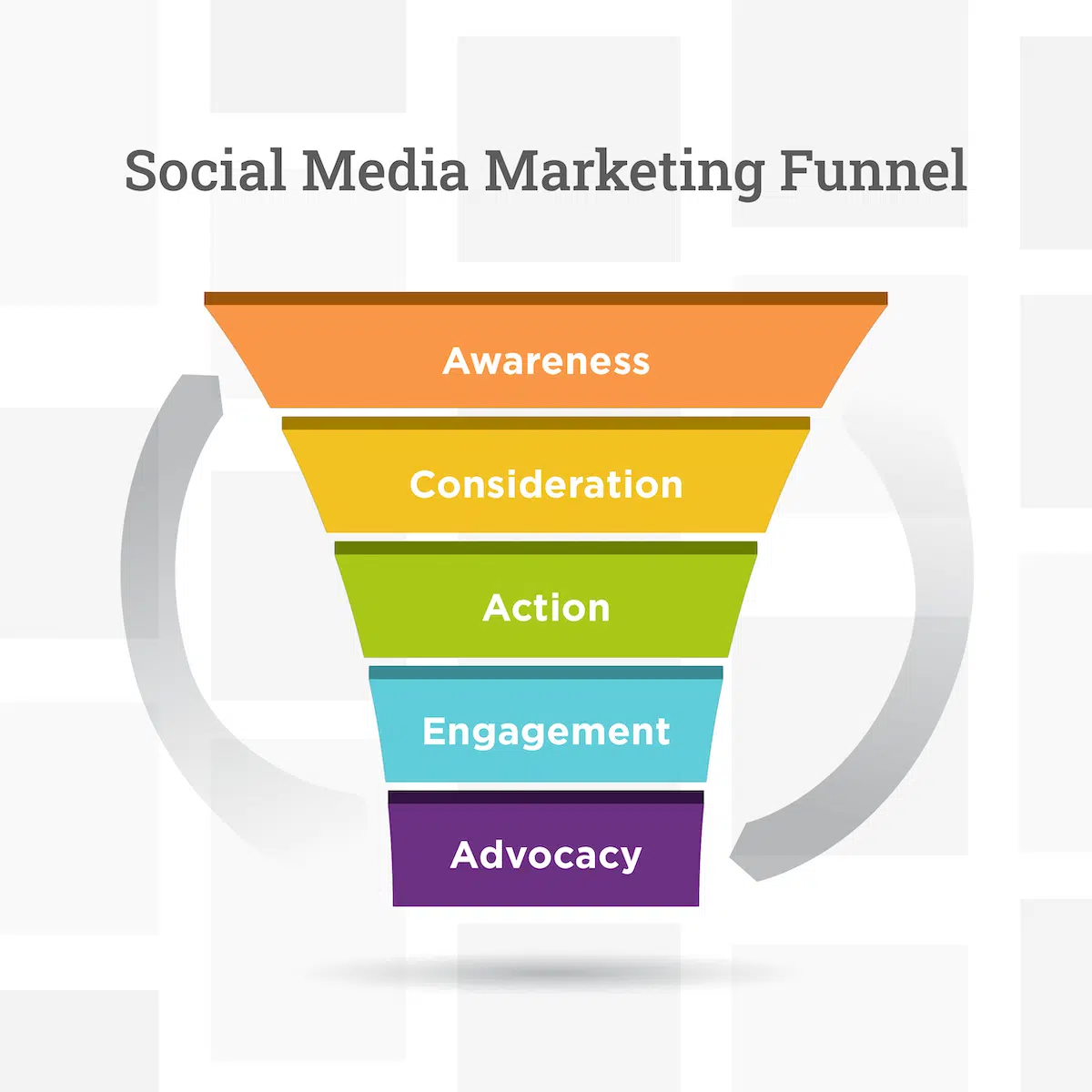
A social media funnel is a specific path your followers travel from the time they discover your brand on a social media platform to the time that they ultimately become fans and/or customers.

There are five stages in the social funnel system:

  1. Awareness
  2. Consideration
  3. Action
  4. Engagement
  5. Advocacy

Creating content that targets each stage is vital, as this is how you gain customer conversions and build brand loyalty.

How Is a Social Media Marketing Funnel Important in a Business’ Social Media Presence?

Social media can be a powerful tool for reaching your target audience, building brand awareness, and driving paid conversions. But if your social media strategy mostly consists of posting random content without a defined strategy, you won’t get the results you’re looking for.

That’s why the social media marketing funnel is key. In fact, a social media sales funnel is perhaps the single most important part of optimizing the social media presence of your business.

By using this digital content strategy, you’ll be able to tailor your content to meet the exact current needs of your audience while drastically increasing the likelihood of conversions. Not only does this create revenue and increase your ROI, but it also helps you build lasting relationships with your online customers.

What Are the 5 Stages of the Social Media Funnel?

Now that you understand why creating your marketing funnel is so important, it’s time to learn the specific stages and what you need to do within them.

Social_Media_Marketing_Funnel

1. Awareness

During this stage, social media users will have the opportunity to learn about your brand, your values, and your products. The awareness stage is when potential buyers evaluate your business to determine whether it aligns with their wants and needs.

This is not the point in the funnel to start pitching your products, however. Start with things that are more simple and offer users plenty of value to ensure that your brand sticks in their minds, and they’ll return later to learn more.

To do this, your content needs to be engaging and eye-catching. Regardless of the specific platform you’re using, begin by creating dazzling visuals. This is important because studies show that over 65% of people are predominantly visual learners.

Remember, visuals need to be more than just images — think photos, carousel posts, GIFs, illustrations, infographics, animations, memes, and videos. According to statistics, social media users will retain 95% of a message watched on video as opposed to only 10% when reading it in text.

2. Consideration

In this stage, leads should see your brand as a good fit for their needs. But it’s important to ensure that your brand stands out from similar businesses so leads remember you.

After reaching the right people in the awareness stage, you can interact with users who are now more likely to purchase from you.

During the consideration stage, users look for specific product information to decide whether your brand is a good fit for them. This stage also includes researching why your product is better than your competition’s.

To begin generating more leads, you want to provide details about what you’re selling. For best results, make it a point to share:

  • Explainer videos
  • Case studies
  • Guides
  • Product reviews
  • Influencer endorsements
  • Testimonials from happy customers

social marketing funnel

3. Action

This is where you want to get your social media audience to take action and become paying customers. When a user reaches this conversion stage, they already have a clear intent to purchase from you. And many will now transition from fans into customers if you direct them correctly.

One of the best social media funnel strategies in the action stage is to optimize each of your profiles with social shopping. By doing this, you make it possible for users to purchase from you without exiting the app.

Turn all your profiles into virtual storefronts, then make it easy for people to purchase your goods within the social media app. Start by:

  • Creating catalogs of your products
  • Including clickable links
  • Adding product stickers
  • Giving your followers exclusive promo codes and discounts

While you may be tempted to skip over the nurturing that needs to be done in the awareness and consideration stages, it will often result in a failure to convert your audience. It’s important to make your audience feel engaged with you before attempting to persuade them to buy.

Avoid jumping to the action stage without first building trust and awareness. Failure to do so will likely cause you to waste valuable time and money.

4. Engagement

The engagement stage is all about building long-term loyalty with customers after they’ve made a purchase from you through your social media sales funnel strategy.

This stage is essential for one simple reason: finding new customers will cost your business five times more than retaining existing ones. Because of this, you should never forget about your existing audience after they’ve made a purchase. Continue to nurture them and provide value in your content to make sure they won’t forget you.

It’s important to understand that your customer’s journey through the sales funnel isn’t linear. When you employ a solid social media funnel strategy, it’s more of a circular journey that they continue to travel with you.

One powerful strategy during the engagement stage is to provide customers with lead magnets. An example of a lead magnet would be offering an informative e-book to your social media customers in return for their email addresses.

5. Advocacy

Once you’ve gained a loyal following, you’ll certainly begin getting repeat buyers. But you should also encourage your customers to share positive recommendations about your brand with their friends, family, and social media followers.

It’s well-known that people trust word-of-mouth recommendations far more than marketing messages. That kind of enthusiasm is exactly what you need to engender during the advocacy stage.

To encourage advocacy, the first thing to do is give your buyers excellent customer service. Always focus on creating a positive experience for your customers that exceeds their expectations.

It’s also smart to incentivize advocacy by offering referral programs to customers who promote your brand to their social media followers.

social media funnel

Perfecting Your Social Funnel System

To increase brand awareness, drive engagement, and turn interested consumers into repeat customers, it’s critically important that you focus on each of the five steps of the social media funnel.

For best results, invest in each step equally rather than putting most of your time, effort, and money into only one or two areas. For example, you wouldn’t want to apply all your resources to the action stage. Your audience is smart enough to know when you’re trying to sell them something rather than offering a solution to their problem.

If your time and resources are limited, start at the beginning of the funnel and invest there to optimize your customers’ entire social media journey.

Start Building Innovative Social Media Campaigns with MARION Today!

So, you’re interested in building innovative and successful social media campaigns for your business — but where do you start?

MARION is a digital marketing agency that offers social media marketing in Houston and Austin, Texas. From creating compelling visuals to writing captivating copy, our experts can help you build campaigns that will engage your followers and grow your business.

Contact MARION today to schedule a free consultation!

Marketing emails you’ll actually want to read.

Get marketing tips and news sent to 
your inbox.
This field is for validation purposes and should be left unchanged.
Name(Required)

How to Build a Successful Word-of-Mouth Marketing Strategy

As a business owner, you know how critical it is to have an effective marketing strategy. Marketing can make or break your organization. It can soar your company to faster growth than your competitors and help you stand out in your industry.

While some businesses turn to digital and traditional marketing to reach new customers, another strategy is often more lucrative: Word-of-mouth marketing can drive your organization to new heights, usually with less expense than other advertising strategies.

What Is Word-of-Mouth Marketing?

Word-of-mouth (WOM) marketing relies on your customer base telling others about their fantastic experiences with your business. Rather than relying on your marketing team to create advertisements about your company’s products or services, you’ll ask your customers to spread the word to their families, friends, and the public.

Some ways to boost WOM marketing efforts include asking for customer testimonials or creating referral programs.

Why Should Marketers Care About Digital Word-of-Mouth?

The benefits of word-of-mouth advertising are clear. Digital word-of-mouth marketing statistics show that 92% of consumers believe brand recommendations when they come from a friend. Similarly, people are four times more likely to purchase a product someone they know endorses.

Distrust among consumers when it comes to company brand advertising is widespread. In fact, 75% of consumers don’t trust a company’s advertisements. They’d rather perform their own research, which often includes checking an organization’s reviews, before buying a product.

word of mouth wom marketing

Word-of-Mouth Marketing Strategies

You have several options when searching for a word-of-mouth strategy that will work for your organization. For example, you can encourage online word-of-mouth marketing through user-generated content or influencer marketing, or directly ask customers to share their opinions of your company.

Take a look at some easy-to-implement marketing WOM strategies.

User-Generated Content

User-generated content occurs when a customer posts about your company on a social media platform. For example, they might rave about the customer service at your restaurant or talk about how your product solved a specific problem they had.

You can grow your web presence and encourage user-generated content by rewarding customers who post positive content about your brand or surprising them with a grateful response from your company’s social media account.

Influencer Marketing

Influencer marketing typically requires a company to form a partnership with a social media influencer whose audience mirrors the demographics and behavior of the organization’s customers.

Usually, the company will pay the influencer to produce an ad or video proclaiming the benefits of an organization’s merchandise. The goal is to generate brand awareness and increase sales among the influencer’s followers.

Referral Programs

Referral programs rank highly among examples of successful word-of-mouth marketing campaigns. A referral program rewards an existing customer with a special bonus when they successfully recommend a friend to sign up for a company’s services or buy a specific product.

Social Media Monitoring

Social media monitoring involves surveying social media platforms for mention of your organization. You can take advantage of social listening tools, which provide real-time data about posts mentioning your company on social media platforms, review sites, or blogs.

Every time your company receives a mention, you can reply to the poster’s comments with your own creative response.

Customer Testimonials

Customer testimonials are reviews of clients’ experiences with your brand, products, or services. You can ask your clients to leave testimonials on your website or popular review platforms like Google and Yelp. Highlight positive reviews on your website and other channels to encourage potential clients to take the next step with your company.

Examples of Successful Word-of-Mouth Marketing Campaigns

Word-of-mouth marketing is a powerful tool to spread the word about your products and services and build trust with your audience. Below, we will look at some examples of successful word-of-mouth marketing campaigns to inspire your own campaign.

Spotify Wrapped

Every year, #SpotifyWrapped trends on social media with massive engagement. Hundreds of millions of users across various platforms share their Wrapped data with friends and followers. This is viral marketing at its finest.

spotify wrapped marketing

Spotify Wrapped 2022

Mint Mobile Refer A Friend

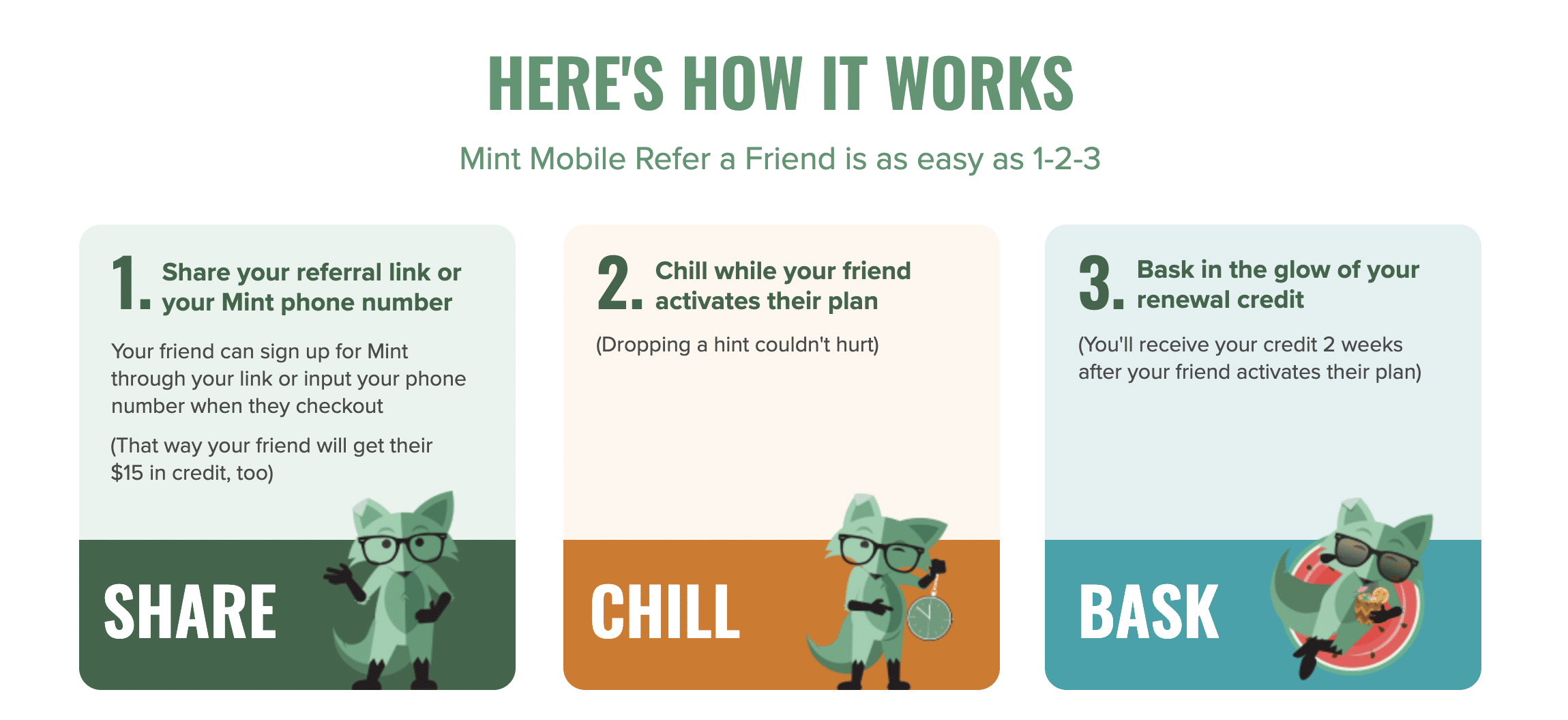
Mint Mobile uses referral programs to broaden its customer base. When a customer’s friend signs up for a phone plan with Mint, it rewards the current customer with credits they can use toward free cell phone service.

mint mobile referral marketing

Mint Mobile Refer A Friend

Canva’s 15 Billionth Design Challenge

Canva invited users to be a part of history in this successful word-of-mouth marketing campaign in 2023. The 15th Billion Designs Challenge encouraged users to participate in the online Canva community by sharing their design entries on social media with #15BillionDesigns.

canva word of mouth marketing

Canva 15 Billion Designs

Marketing Strategies to Complement Your Word-of-Mouth Campaign

Here are a few of the highest ROI marketing channels you can use to supplement your WOM advertising strategies.

  • Buzz Marketing: Bombard online channels with news about your company; the excess information creates word-of-mouth advertising for your brand.
  • Viral Marketing: Create a unique piece of content to spread quickly around the internet and generate free advertising for your business.
  • Social Media Marketing: Post advertisements on social media platforms to reach your target audience and generate brand awareness.
  • Blog Marketing: Develop written content designed to attract interest from consumers; you can post blogs on your website or publish articles on other sites closely followed by your target audience.

These additional strategies can generate word-of-mouth promotion, allowing you to build awareness and generate excitement among your audience.

Build a Business Worth Talking About with MARION

Now that you know how to increase word-of-mouth referrals through practical strategies, consider taking your marketing to the next level with MARION. MARION is a customer-centric digital marketing agency that will develop a holistic advertising program to uncover your brand’s potential. Connect with our team to learn more.

Contact us today for a free marketing consultation.

Marketing emails you’ll actually want to read.

Get marketing tips and news sent to 
your inbox.

This field is for validation purposes and should be left unchanged.
Name(Required)

The Importance of Print Marketing in a Digital World

In the digital age, it can be easy to forget about traditional marketing tactics such as print. However, print marketing remains an essential tool for businesses of all sizes. Print materials like flyers, brochures, and posters are still effective in communicating a company’s message to its target audience. So, if you want your business to stand out from the competition and reach more customers, don’t turn your back on print marketing!

Print Marketing Helps You Stand Out in the Digital Age

Is print media still useful? In an increasingly digital world, it is becoming more and more difficult to stand out from the competition. But print marketing services can be a powerful tool to help you do just that. By utilizing print materials such as business cards, brochures, flyers, postcards, and other physical media, you can reach potential customers in a way that digital marketing simply cannot.

Our Houston graphic design firm will work with you to create unique and effective print campaigns that will help you reach your target audience. Contact MARION today!

What Are the Benefits of Print Marketing?

  • Printed ads are often more trusted than digital ads. With an increased volume of scams on the internet, print media marketing creates a sense of trust and credibility that digital marketing alone cannot provide.
  • Reading print works better for retention. Studies show that people read slower when reading text on paper instead of on a screen. This achieves higher retention rates compared to digital.
  • Print materials are tangible and memorable. In a world of endless scrolling and pop-up ads, print collateral makes it easier for people to remember and recall when making purchasing decisions.

How Print Media Can Complement Your Digital Marketing Strategy

There’s no question that digital marketing campaigns are key to growing your business, but print still plays an important role in any successful digital content strategy. Print advertising can be used to supplement your digital campaigns, providing a tangible reminder of your message and helping to build brand recognition. By combining the power of print and digital marketing, you can create an effective campaign that reaches a wider audience and generates more leads.

Below are some examples of digital content you can feature on your printed materials.

  • Specific calls-to-action prompting readers to visit your website or social media profiles
  • Positive customer reviews from social media or Google
  • QR codes and personalized tracking URLs to help you connect online and offline activity
  • Calls-to-action to share campaign hashtags on social media

By using print to complement your digital marketing strategy, you can ensure that your message is seen by both online and offline audiences.

Types of Printed Marketing Materials

Custom printed marketing materials are an essential part of any business’s marketing strategy. It can be used to promote your website or other digital content while also reinforcing your brand identity.

  • Brochures
  • Business cards
  • Direct mail
  • Catalogs
  • Letterhead & envelopes
  • Presentation folders
  • Promotional products
  • Banners
  • Wall decals
  • Posters
  • Logos
  • Newsletters
  • Postcards
  • Tradeshow displays
  • Thank you cards

With the right strategy and creative execution, print marketing collateral can help you stand out in today’s digital world. Whether you need Houston logo design, print finishing services, or award-winning brochure design, MARION can help you reach out to potential customers and build brand awareness.

print marketing collateral

Partnering with the Best Print Marketing Agency in Houston, TX

Are you looking to partner with the best print marketing agency in Houston, TX? Look no further! MARION offers comprehensive printing solutions tailored to your specific marketing objectives and goals.

With our extensive knowledge of the industry, we can help you create campaigns that are both visually appealing and effective in reaching your desired results. We understand the importance of creating a solid brand identity and strive to provide our clients with the highest quality marketing materials and services. Partnering with MARION is a great way to ensure success for your business!

Contact us today to learn more about our print and digital marketing services.

Marketing emails you’ll actually want to read.

Get marketing tips and news sent to 
your inbox.

This field is for validation purposes and should be left unchanged.
Name(Required)

How to Nail Your Email Marketing Strategy in 2023

Email marketing is one of the best B2C and B2B marketing strategies for 2023. With the power of an effective email marketing strategy, you can create more revenue for your brand, attract new customers, and build solid relationships with them.

Having a high return on investment makes it one of the most rewarding marketing strategies in the market. To get ahead of the game, take advantage of the email marketing steps below and watch your brand skyrocket in 2023.

It can be hard, but with the correct guidance, we can build a strong foundation from the beginning. So, let’s explore how to succeed in email marketing in 2023.

9 Email Marketing Tips to Drive Conversions

Every marketing campaign is different and has some unique elements that need to be implemented to be successful. For performance-based email marketing, these are the most crucial tips that every marketer should know.

  1. Create an Email Marketing Strategy
  2. Write a Compelling Subject Line
  3. Be Persistent
  4. Pay Attention to Preheader
  5. Make Contextual CTAs
  6. Write for the Web
  7. Don’t Spam
  8. Use Personalization
  9. Use A/B Testing

These nine steps will help you learn how to email market effectively in no time.

1. Create an Email Marketing Strategy

effective email marketing tips

Successful email marketing strategies can only be built after identifying the goals and objectives that your brand wants to achieve. Email marketing in digital marketing is just one piece of the overall puzzle, so it cannot act in a silo.

Define your audience and segment them into potential and existing customers. You will send different emails to each group, so it is a crucial part of the process.

When you have your target audience, you’ll need to build your list. You can do it from your social media channels, with opt-in forms on your website, or even by using an existing customer list.

The last step for building an effective email marketing strategy is to craft a content marketing strategy to drive conversions. It can be a newsletter, a welcome sequence, or a cart abandonment email.

The moral of the story is, to create your plan, and set your goals with corresponding content in mind.

2. Write a Compelling Subject Line

email strategy - subject line

The subject line is the number one element your recipient will see in their inboxes. Having a weak (or spammy) subject line will immediately move your email to the trash.

What you put in that 60-character space could be the difference between someone opening your message, deleting it, and even reporting it as spam. If too many receivers mark your message as spam, it can have lasting negative effects on your email strategy.

A consumer will open your email if they:

  1. Find value in your title
  2. Have the fear that they will miss out on something important (FOMO)
  3. See their favorite emojis

These three elements are probably the most important elements when it comes to subject lines.


3. Be Persistent

The more people who open your emails, the more potential conversions your business will generate. A great way to ensure this outcome is by leveraging the “double opens strategy”.

Use your email automation service to track which emails didn’t open and send the exact same email with a different subject line.

People receive many emails every day, so it can be that they didn’t catch their attention or they were just busy. Make some small changes to change the outcome.

  • Use a different subject line and preheader
  • Change your send time
  • Wait 3-5 days before resending your message

Adding this little-known trick to your email campaign strategy can foster engagement at a level you’ve never experienced.

4. Pay Attention to Your Preheader

email campaign strategy - preheader

The subject line is vital, but don’t forget the preheader text! This is the preview text that a recipient can see before deciding whether or not to click your email. Using this space to increase your open rate and engagement numbers is one of the most effective email marketing techniques.

Craft your message in a way that will maximize the chances of a click while keeping in mind that you can have 35 to 150 characters of preview text.

5. Make CTA Buttons Contextual

Every part of an email is equally crucial for the success of your campaign. Without a strong CTA in your email marketing approach, you will have significantly fewer conversions. That’s because a CTA helps your reader take action.

The best email marketing strategies use calls-to-action that guide the subscriber to take the desired action. Focus on making CTAs as creative and descriptive as possible, and avoid generic text.

Remember to combine active verbs with the sense of time. A great example would be “Get This Ebook Now”.

6. Write for the Web

Most digital marketers create complicated email messages. Craft your copy for emails similar to the tone of articles for the web. It should be engaging, conversational, and organized. Email strategies that work generally avoid sophisticated business jargon and use an appropriate opening line for your audience.

To make your life easier, most email marketing services provide you with email templates. These email marketing strategy examples can be a great starting point.

Your email should:

  • Have short paragraphs (plenty of white space)
  • Follow a clear structure
  • Use visuals whenever appropriate
  • Implement bullets and subheadings to make emails scannable

Focus on providing the most value possible and answer the questions of your audience.

7. Don’t Be Spammy

performance-based email marketing - spam

There are people out there that will tell you that email marketing is sales-y and can be annoying for the recipient. Like every marketing tool, it depends on the professional that uses it.

To avoid being a spammer and building a bad reputation for your brand, avoid exclamation points and writing with caps, and try to express the values of your brand as you would do in a normal conversation. Using a brand development strategy that isn’t overly aggressive will set your emails up for long-term success.

8. Use Personalization

If you have to implement one of the tips in this article, this should be hands-down personalization. It is the most effective way to upgrade your email marketing strategy.

Leverage your high-converting landing pages, opt-in forms, and gather as much information for your users. Create segments of your list and send personalized content to each potential client.

You can take it one step further and use dynamic personalization, which is and will continue to be a trend in 2023.

Dynamic personalization adapts to each customer and understands their buying habits and customer journey. It modifies their experience appropriately so that you can generate more business leads.

9. Leverage A/B Testing

how to email market effectively - a/b test

Hitting “send” and hoping that your email will convert will not work effectively in the long run. The best email strategies are those that test emails by using all the features that email providers offer. 

Use analytics to collect data on the performance of different variations of your message and landing pages to identify your best-performing combination. Multivariate testing is a valuable technique.

Elevate Your Email Marketing Campaigns in 2023

Email marketing is not simply another strategy to add to your arsenal. It is one of the most rewarding marketing tools out there and has the potential to increase your revenue to unprecedented levels.

Take advantage of all the tips we discussed in this article, and if some of them sound too basic, it’s because most mistakes happen to the things we think we know. Track your records and pivot towards the best-performing tactics.

Trust the MARION team if you need help with your email marketing in Houston, Austin, or DFW. MARION Integrated Marketing has been serving Texas businesses for 40 years. We have evolved to provide your business with effective marketing regardless of industry.

Marketing emails you’ll actually want to read.

Get marketing tips and news sent to 
your inbox.

This field is for validation purposes and should be left unchanged.
Name(Required)

5 Ways to Wow Your Customers with B2B Marketing

Outshine the competition, gain market share and make a name for yourself. A strong brand and marketing strategy helps your B2B business do all three — and then some. Especially when roughly 90% of business decision makers ignore cold outreach, having a solid multi-faceted marketing strategy can open the door to new connections. B2B marketing, or business-to-business marketing, is unique…

GA4 Metrics: Bounce Rate is Out & Engagement Rate is In

Google Analytics 4 is officially here! You might be confused with all the talk about bounce rate in GA4. Is it gone? Is it here to stay? Keep reading, and we’ll cover everything you need to know about bounce rate, engagement rate, and other GA4 metrics.

Bounce Rate in Google Analytics 4: What’s New?

Google is changing the way bounce rate is calculated in GA4. As a result, the new metric is a far more helpful way of measuring visitor engagement with your site or app. But what changed, exactly? Let’s start by looking at the way bounce rate works.

What is Bounce Rate?

Bounce rate is best described as the percentage of sessions containing a single page view on your website.

BOUNCE RATE = NUMBER OF BOUNCES / NUMBER OF SESSIONS

A bounce occurs when a visitor lands on your website and leaves without interacting with or navigating to another page. It’s important to note that bounce rate does not take into consideration how much time was spent on the page.

Why Did Google Change Bounce Rate in GA4?

In Universal Analytics, bounce rate was an adequate measure of site engagement, but it has become less practical as websites and apps have evolved. Unfortunately, the metric just doesn’t make sense in a mobile or single-page application.

For example, users don’t always generate multiple page views during a session—but that doesn’t necessarily mean it wasn’t a successful visit. Consider the way we interact with blogs or news articles. Viewers visit your site to read an article and then leave. Bounce rate wouldn’t really help you out in this scenario. Instead, you would probably rather know the number of people who visit your page and quickly leave when they don’t find what they were looking for.

However, Google Analytics 4 takes a new approach. It uses data from both websites and mobile apps in a simple interface, providing you with metrics to measure various types of user experiences. As a result, the old bounce rate had to go.

GA4 bounce rate is the percentage of sessions that were not considered engaged sessions. As we mentioned, bounce rate in Universal Analytics is the percentage of sessions in which users viewed only one page and triggered only one event.

Bounce Rate vs. Engagement Rate

Engagement rate is simply the percentage of “engaged sessions.”

ENGAGEMENT RATE = NUMBER OF ENGAGED SESSIONS / TOTAL NUMBER OF SESSIONS

An engaged session is one that either:

  • Lasts longer than 10 seconds
  • Has at least two page views or screen views
  • Has a conversion event

Like the new bounce rate, GA4 engagement rate is helpful in answering the question, “are visitors engaged with my site?”. Furthermore, engagement rate in Google Analytics 4 can be a useful metric for single-page apps, mobile apps, and content sites such as news outlets and blogs.

Why Bounce Rate Won’t Be Missed by Digital Marketing Pros

For a while, there has been some controversy surrounding bounce rate in Google Analytics. Many digital marketers argue that the bounce rate calculation in Universal Analytics is an outdated metric. Only time will tell if the new GA4 metrics pass the test!

Learn more about Google Analytics 4.

Let MARION Handle the GA4 Metrics & Reporting for Your Business

There’s a good chance that you weren’t aware of these metrics and measurements until now. Keeping up with the latest Google Analytics updates can be exhausting, so let our team at MARION take it off your busy schedule!

Our SEO agency takes care of all your web analytics so you don’t have to. We have years of digital marketing experience in Houston, Austin, and DFW and are eager to help your business get better results!

Schedule a free marketing consultation with MARION today!

Marketing emails you’ll actually want to read.

Get marketing tips and news sent to 
your inbox.

This field is for validation purposes and should be left unchanged.
Name(Required)

How To Create Content with Google Algorithm Updates in Mind

Google releases several algorithm updates every year, and these changes can have a significant impact on your SEO efforts. In other words, it affects how many eyes will reach your content.

So, how do you keep up with the ever-changing algorithm? Let’s go over some general best practices for ensuring your content stands up to any and all future changes.

How Often Does Google Update Its Algorithm?

Google is well-known for rolling out algorithm updates left and right. On average, there are upwards of 3,000 changes made per year. That being said, the majority of updates are minor improvements that may not be of interest to most content creators and typically go unnoticed.

However, Google also launches several significant changes every year, referred to as “core updates.” Often planned months in advance, these critical components of Google’s ranking algorithm are designed to enhance the quality and relevance of overall search results. As many digital marketing experts know, these updates are notorious for drastically affecting SEO, for better or for worse.

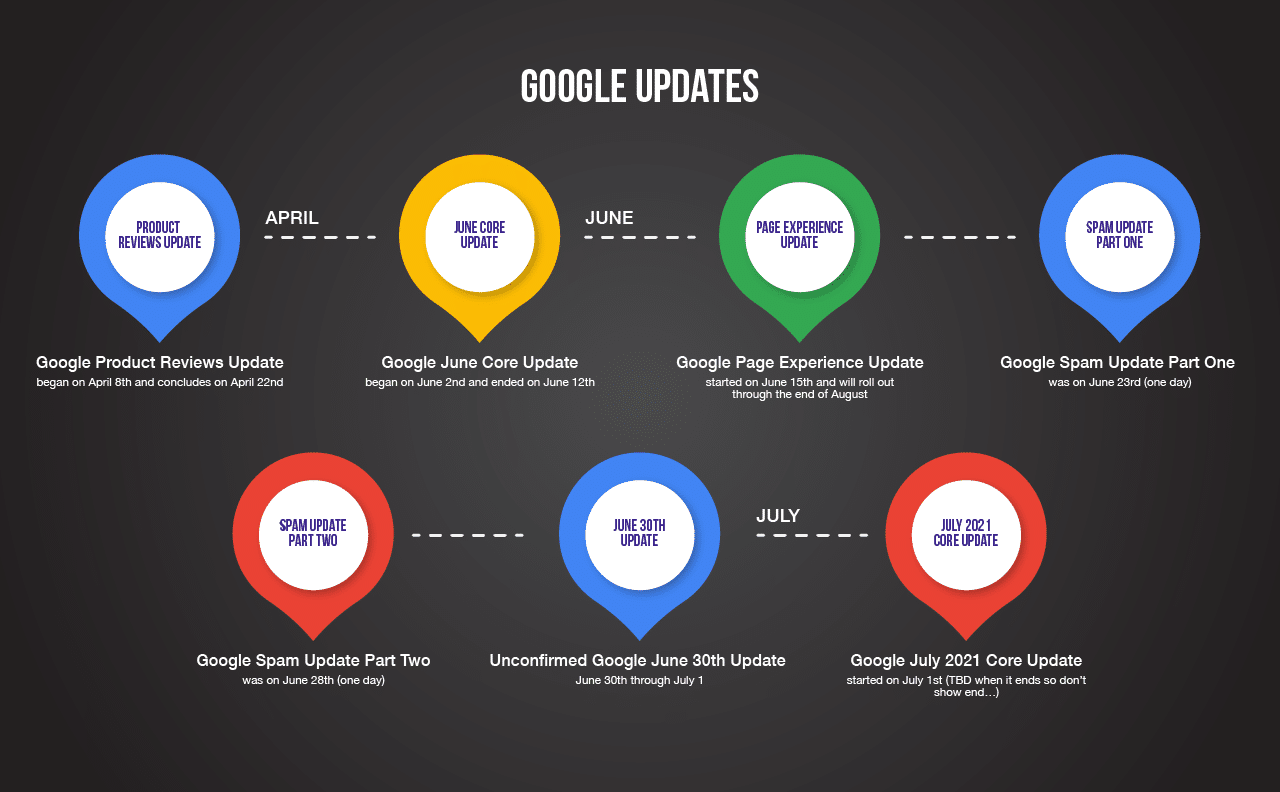
google-algorithm-updates-graphic

image source

Check out our ultimate timeline of Google algorithm updates >

Content Creation Best Practices

Simply put, it’s not enough to just produce high-quality content nowadays. Many businesses succeed at creating engaging and valuable content for their target audience—but that doesn’t automatically make it long-lasting, high-ranking content in the eyes of the algorithm.

To ensure your content outlasts future algorithm updates, you’ll need to play by Google’s rules. Follow these best practices and learn how to create the content you need for ongoing success.

Focus on Quality

Regardless of Google algorithm updates over the years, quality is the key to generating inbound traffic. To create truly valuable content, you must have subject matter that is beneficial to the user—whether that be educational information, unique insights, proven research, new ideas, etc.

Additionally, if your content is presented neatly and accurately, your message is far more likely to get across. Avoid any errors that might make visitors click away. The top reasons that users are likely to leave a webpage include:

  • Broken links and forms
  • Spelling and grammar mistakes
  • Outdated information
  • Misleading/irrelevant title
  • Poor format, design, or usability
  • Not mobile-friendly (bad UX design)
  • Overwhelming ads or pop-ups

But more importantly, you must have high-quality content by the algorithm’s standards in order to climb the ranks and beat your competitors. Here are three few red flags Google looks for when ranking websites.

1.     Poor On-Page Optimization

Elements like keywords and page titles play an important role in helping the algorithm determine what your content is about. Fortunately, it doesn’t take long to optimize title tags, image tags, meta descriptions, URLs, and XML sitemaps.

2.     Thin Content

Simply put, thin content is on-page content that is not useful to visitors. This includes doorway pages, affiliate pages, irrelevant guest posts, and content that is automatically generated or stolen from another online source.

3.     Insufficient Links

Not only do you need great content to gain Google’s approval and achieve high ranks, but you also need great links. The more high-value links your site has, the better your web presence. You’ll also want to avoid bad link-building practices to stay on Google’s good side.

Overall, Google favors meaningful, quality content related to the keywords you’re ranking for.

Understand the E-A-T Perspective

Ultimately, Google wants to give its users the best search engine experience possible, which is why it takes careful precautions to only promote trustworthy domains. As a result, Google’s perception of a business often correlates with the impression left on its target audience. So, how can you tailor your content to meet Google’s standards?

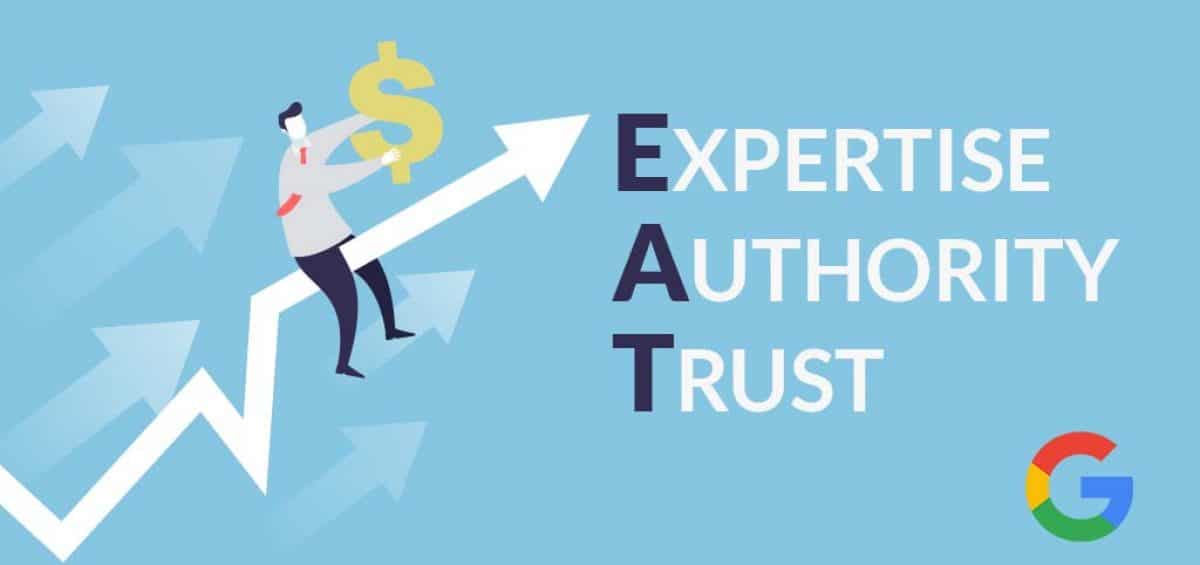
Google measures three main factors when determining how much trust should be placed in a particular brand or website—ExpertiseAuthority, and Trust—also known as E-A-T. The concept of E-A-T has been around for nearly a decade, yet many industry experts still struggle with it today.

Google-E-A-T

image source

  • Expertise – Expertise means to have exceptional knowledge or skill in a particular subject. Google tends to favor content created by subject matter experts. Simply put, the content on your site must demonstrate a higher level of expertise than the competition.
  • Authority – Authority is all about reputation, typically among industry experts and influencers. When people see an individual or website as the go-to source of reliable information on a subject, that constitutes authority.
  • Trust – Trust is about the accuracy, legitimacy, and transparency of a webpage’s content. Citing trustworthy sources is a big part of building trust with Google. Including publisher contact information is also helpful.

What exactly determines E-A-T? Google typically looks at a combination of the content, creator, and website. Therefore, the algorithm is constantly being trained to look for these variables when deciding which web pages to promote in search results.

Keep Reader Intention in Mind

Unlike Google, people don’t generally care about links and tags. They’re just searching for content that meets their needs. Therefore, you must tailor your content to your specific audience to achieve the best results. Ask yourself these questions to better understand Google audience targeting.

  • Who is your target audience?
  • What problems are they trying to solve?
  • What writing style appeals to them most?
  • How can you earn their trust?

Once you know your audience, all you have to do is create content they are specifically searching for. The best content creators know what strategies to use to boost reader engagement and drive traffic. 

For example, you can incorporate descriptive language into your writing to create an image in the reader’s mind and fully immerse them in your work. Likewise, using figurative language can transform ordinary content into an enhanced experience.

Follow these steps successfully, and the algorithm will reward your efforts with high ranks and leads for your business!

marion integrated marketing - contact us

What About Future Google Algorithm Updates?

At this rate, it’s clear that Google won’t be slowing down on the updates anytime soon. And with thousands of algorithm changes per year, it’s impossible to keep up with all of them. It’s true that most updates won’t affect you, but it’s a mistake to ignore them entirely—especially the big ones.

Ultimately, it’s crucial that marketers and content creators know when major changes in the algorithm happen. It’s the only way to understand whether rankings shifted because of an internal change or a Google update.

So, do you have a proactive or reactive digital content strategy when it comes to Google algorithm changes? To ensure your content survives future search updates, you’ll need to raise the bar.

Get ahead of the algorithm and put your best foot forward with the content optimization tips mentioned in this article. Or if you’re not ready to take on that challenge, you can always recruit the help of an outsourced marketing agency that knows its way around the algorithm.

Contact us today to learn more about our SEO services in Houston and Austin, TX.

Marketing emails you’ll actually want to read.

Get marketing tips and news sent to 
your inbox.

This field is for validation purposes and should be left unchanged.
Name(Required)

Why Outsourcing Is A Cost-Effective Way of Marketing Your Business

Outsourcing your marketing tasks can be a cost-effective way to market your business.

Outsourcing has the potential to save you time, money, and resources when it comes to marketing. Oftentimes you will need outside help when it comes to marketing your business, but sometimes the best thing for you is if you outsource part of your marketing process.

This article will explore some of the most important benefits that come with outsourcing your marketing tasks.

Why You Need to Outsource Your Marketing Tasks

In today’s market, companies have to be on their toes from the moment they start operations. They have to be competitive and innovative in order to stay afloat. In previous times, marketing was confined to a company’s four walls. Today, marketing has become a top concern for business owners who want their brands to reach a wider audience and achieve greater success.

The best way for a company to grow is by outsourcing some or all of its marketing tasks – starting with tasks that can be outsourced – such as data analysis, social media management, content management, and virtual assistant services.

3 Best Ways to Outsource Your Marketing Tasks for Less Time & Money

Marketing is a time-consuming and expensive endeavor for most small business owners. You can outsource the marketing tasks to other specialists, but you need to know how to go about it.

Here are three ways you can outsource your marketing tasks and save time and money in the process:

1. Hire a Marketing Agency: You can hire a full-service marketing agency that specializes in services such as content writing, SEO optimization, etc. They would take care of all your marketing needs at a fixed monthly cost which is much lower than hiring an employee for each task or paying hourly rates for freelancers.

2. Hire Freelancers: The other way to outsource your marketing tasks is by hiring freelancers who specialize in specific areas of work.

3. Do a Hybrid Approach: This might be the best option, as you can enjoy the benefits of both freelancers and a marketing agency.

Why Outsourcing Your Marketing Work is the Key to a Productive Workflow

Outsourcing marketing work can help you to create a better, more productive workflow.

The conventional way of marketing is no longer as effective as it once was. Technology has changed the world and the way people view things. In the olden days, advertisers only had to make sure that they were reaching their target audience by broadcasting their message through on-air media and print advertisements. Nowadays, it becomes a challenge for marketers to reach out to people who can be interested in their products or services due to the change in communication habits and platform use.

Outsourcing your marketing work can help you with a variety of things: from creating a content calendargenerating more leads, improving customer engagement rates, increasing organic traffic from search engines, managing social media campaigns and so much more!

Other Advantages of Outsourcing Your Marketing Tasks

Marketing outsourcing can provide a unique solution to many of the problems faced by marketing teams, such as time and labor constraints, lack of in-house expertise, and lack of budgets.

As an example, you might outsource your advertising campaigns to an agency that specializes in that area. This ensures that you’re not wasting time with skillsets that you don’t have and instead focusing on what you’re best at – creativity, emotions, and your brand.

To learn more about outsourced marketing servicescontact us today.

Marketing emails you’ll actually want to read.

Get marketing tips and news sent to 
your inbox.
This field is for validation purposes and should be left unchanged.
Name(Required)

Why Your Business Needs A Lead Scoring Strategy

  • Every business has leads. It doesn’t matter what type of industry you’re in, whether you sell online or at a physical location, or whether your sales cycle is four months or a year… you have potential customers out there. What you do with those leads is another story, however.

You can identify improper usage of leads by asking yourself a few questions.

  • Are you treating all your leads the same?
  • Do you have a defined, documented strategy for scoring prospects?
  • Does your sales team get frustrated with the leads that marketing provides?
  • Are you spending too much time manually evaluating leads?

If so, you need a lead scoring strategy. Before we get into developing a strategy however, it’s helpful to know what lead scoring is in the first place. This video from HubSpot has you covered:

The Importance of Proper Lead Scoring Strategy Development

Yes, lead scoring sounds great… in theory. But many businesses struggle to actually implement it. That’s because it requires coordination from leadership, sales and marketing to pull off. You can’t just have one of them handle it because they have different mindsets and skills.

These three departments do each have a valuable part to play in a lead scoring strategy development session, however. Here’s what each brings to the table:

  • Executive/leadership: provides a high-level view of company goals, what types of leads the company would like to go after and the realistic goals marketing and sales should have.
  • Marketing: provides the messaging and automated tactics that would be involved in nurturing leads to higher scores; provides qualified leads to sales.
  • Sales: provides the values for certain demographics and actions that best indicate a lead or prospect is a good fit with the company. Converts well-qualified leads into customers.

Example Lead Scoring Categories

The beauty of lead scoring is that each company’s strategy can be different. There’s no one-size-fits-all approach. As with any area of marketing, it’s helpful to see what has worked for other companies, what is considered best practice and what will actually work for you and your company. That being said, here are some good lead scoring categories and sub-categories that other businesses have used successfully:

  • Demographics:
    • Age
    • Income
    • Location
    • Children
  • Company/industry:
    • B2B or B2C
    • Company Size
    • Company Type
    • Industry
  • Online actions:
  • Engagement:
    • Emails opened/clicked
    • Social media posts liked/shared
    • Reviews

What A Good Lead Scoring Strategy Process Looks Like

The two most important elements in a lead scoring strategy are fit and interest. You have control over the former; you likely know what clients are easy to work with and what clients are not. You also know what types of clients fit with the solutions you provide. For interest, however, that is up to the lead.

Your lead scoring strategy helps with both fit and interest, as the criteria you set up help determine the leads who are the best fit, while scores for other actions and engagement can signal a prospect is interested and ready to talk to sales.

There are a few steps required to accomplishing this and here’s an example of what a good lead scoring strategy development process looks like:

  1. Determine the most important fit characteristics of your ideal lead.
    • Example: you may offer a high-end product and aren’t interested in people who make less than $100,000 per year.
  2. Determine the most important interest characteristics of your ideal lead.
    • Example: you may only want to follow up on leads who fill out a contact form.
  3. Choose lead score thresholds.
    • Example: you can qualify any lead with a score of 70 or more as an MQL.
  4. Document responsibilities.
    • Example: marketing handles all communication with customer until they reach a score of 70, then sales takes over.
  5. Set goals.
    • Example: marketing has a goal of providing 5 MQLs per month; sales has a goal of closing 1-2 customers per month.
  6. Reevaluate your strategy.
    • Example: take a look at your processes and criteria every few months.

Contact vs. Company Scoring

One last thing to bring up for your lead scoring strategy is the difference between contact and company lead scoring. This could very well change your whole approach to lead scoring. Here are the differences between the two:

  • Contact scoring: lead scores for individual contacts. Scores are adjusted on an individual level, not at a company level.
  • Company scoring: the cumulative lead score for all contacts at a company. Scores are adjusted on a company level based on individual scores.

This is ideal for businesses targeting certain companies instead of individuals. For example, perhaps you think your product or service is a great fit for a particular local business, but you don’t have influence or contact information for any of the roles with decision-making responsibilities. You can start measuring the fit and interest of the other employees of the company and determine whether there is potential or not. Finally, company scoring can help with prioritizing your list of leads.

Partnering with An Agency for Your Lead Scoring Strategy

Implementing a lead scoring strategy requires a marketing team with the knowledge and experience required to develop the lead scoring strategy, as well as a way to calculate scores and empower the sales team for success. Calculating scores is where many companies get tripped up, as it requires powerful software or lots of data entry and evaluation by employees. Overall, lead scoring can be overwhelming if you don’t know what you’re doing.

Partnering with a marketing agency, however, is another option. Whether you need a lead-scoring strategy developed as part of an ongoing retainer or you’re interested in a one-off lead-scoring strategy consultation, an agency can give you the resources and talent needed to pull of an exceptional lead scoring for your business.

MARION can be that agency. If you’re interested in learning more about lead scoring or any other area of digital marketing, contact us today.

Marketing emails you’ll actually want to read.

Get marketing tips and news sent to 
your inbox.

This field is for validation purposes and should be left unchanged.
Name(Required)