Category: Lead Generation

How to Plan Your Social Media Strategy 

Whether you’re a B2B or B2C company,
a thoughtful approach to social media
can build awareness and generate leads. 

A little more than a decade ago, spreading the word about your business involved press releases, advertisements and word-of-mouth marketing. While these channels remain important, social media has evolved into an equally critical marketing tool. Knowing how to plan your social media marketing strategy is essential to making the most of its potential. 

 
With a carefully considered plan, you can relate to new audiences in different and more targeted ways. Facebook users, for example, tend to be methodical shoppers who skew older, while Instagram remains a haven for aesthetically motivated consumers between the ages of 18 and 24. Determining where your audiences spend their time — and what types of content encourage them to stop scrolling — will allow you to connect with key segments, develop brand awareness and build a loyal following. 


Social media demographics and usage by platform.
To determine which platforms offer the most engagement potential for your business, start by
understanding the audience profiles of each.

 
In this article, we’ll help you determine which social media platforms are best for your business — and how to create content that delights and engages audiences. 

How to Choose the Right Social Media Platforms. 

When choosing which social networks are best suited to your business, it’s important to remember that not all platforms are created equal. Different platforms appeal to different demographics, and the same message might not resonate across all social media channels. Make sure you consider the following:

Your Target Audience. 

Understand who your target audiences are and find out which platforms they use most. For instance, younger demographics gravitate towards Instagram, Snapchat and TikTok, whereas professional audiences spend their time on LinkedIn. Facebook, Instagram and X (formerly known as Twitter) have a broad user base and can cater to most demographics — but each is geared toward particular types of content. 

Your Content Mediums.

Different platforms are better suited for different types of content. For example, Instagram and Pinterest are designed to highlight photos and videos, whereas LinkedIn is a great place to share insightful, long-form content. Keep in mind that the capabilities of each network are constantly changing, so it’s important to stay up-to-date as new mediums emerge. 

Your Business Type. 

B2C companies may find more success on Instagram or Facebook, which allow for a more personal connection with customers. Conversely, B2B companies may be better served by LinkedIn or X, which are more conducive to sharing industry news and professional content. 

Your Resources. 

Whichever platforms you choose, all social channels require a significant investment of time and effort to achieve a significant ROI. Be realistic about how much time you can devote to social media. It’s better to share incredible content on one channel than mediocre posts on several. 

Crafting Your
Content Strategy.

Once you’ve chosen the right platforms, it’s time to think about content. Your content strategy should be informed by your overall business goals. Are you looking to drive sales, increase brand awareness, engage with customers or position your brand as a thought leader? No matter your objectives, the following best practices are foundational to most successful strategies. 

Share Valuable Content. 

Share content that’s genuinely useful or interesting to your audience. This could be information or entertainment in the form of blog posts, infographics, how-to videos, industry news or thought leadership articles. Just make sure every piece of content you share aligns with your overall brand storytelling strategy.


Screenshot of blog posts shared on Design At Work’s Google Business Profile.
Your Google Business Profile is a great place to share informative content, such as recent blog posts.

Engage with Your Audience. 

Social media isn’t just about broadcasting your message; it’s about fostering a two-way conversation. Ask questions, seek feedback, respond to comments and engage with your audience in a meaningful way. 

Promote Your Products or Services
(In Moderation). 

While it’s okay to promote your products or services, make sure it’s balanced with other content. A good rule of thumb is the 80/20 rule — 80% of your content should inform, educate or entertain your audience, while only 20% should directly promote your business.


Design At Work Facebook post promoting the marketing agency’s services.
As long as you follow the 80/20 rule, promotional content like this Facebook post can generate leads
without overwhelming your audience with salesy messaging.

Leverage User-Generated Content. 

Encourage your customers to share their experiences with your brand or products. This not only allows you to aggregate free content, but also fosters a sense of community and trust around your brand.

Use Visuals. 

Humans are visual creatures, so it’s no surprise that visual content tends to outperform text-based content on social media. Try to incorporate photos, infographics, animation and videos into your content. 


Video and animated graphics like this stop viewers from scrolling past your content and encourage engagement.

Consistency is Key. 

Posting consistently not only keeps your audience engaged but also helps to improve your visibility and reach on social media. Create a content calendar to ensure regular posting and plan your content in advance. 


Social media content management platform.
Social media content management platforms such as Sendible and Sprout Social can help you keep track of when and what you post.

If you’re feeling overwhelmed by the prospect of deploying a social media game plan, let’s talk! Design At Work can help you develop an approach that will generate awareness and drive sales. 


Sources:

  1. Social media demographics to inform your strategy in 2023 | Sprout Social

The Pros and Cons of Fractional CMOs 

A close look at this budget-friendly
marketing solution. 

Henry Ford famously said that “a man who stops advertising to save money is like a man who stops a clock to save time.” It’s true — whether you’re a small start-up or an established mid-size business, your company needs marketing to thrive and meet its goals. But when the budget is limited, it can be difficult to know how best to allocate your marketing funds. Rather than hiring an in-house team or a marketing agency, some are turning to part-time Chief Marketing Officers, or fractional CMOs. 

In this blog post, we explore the pros and cons of hiring a fractional CMO — and explain why, in our humble, unbiased opinion, an agency can be your marketing partner and more. 

What is a fractional CMO? 

A fractional CMO is a seasoned marketing executive who provides strategic marketing leadership to companies on a part-time, or contractual basis. Unlike a traditional full-time CMO, a fractional CMO works with multiple companies simultaneously, offering them a “fraction” of their time. The arrangement is akin to a time-share: you enjoy access to all the amenities of an experienced leader, but you have to share them with other “investors,” so you can’t guarantee they’ll be available when you need them.

The pros of fractional CMOs. 

There’s a reason why some businesses choose this option — fractional CMOs offer some of the benefits of an in-house marketing team lead without the costs associated with a full-time employee. Here are some of the upsides of fractional CMOS.  

A budget-friendly solution. 

If your budget is limited and you’re looking for someone to develop a high-level strategy for your in-house marketing team, the idea of a fractional CMO might be appealing. For a much lower cost, you’re essentially hiring a contractor to propose a strategy and provide leadership for your team.


Bar graph comparing average monthly salaries of Fractional CMOs and full-time marketing executives.
This graph illustrates the primary appeal of fractional CMOs — they’re much less expensive than salaried employees.1

A range of experience.

Since fractional CMOs often work with various industries and business models, they can leverage cross-sector expertise and propose ideas that may be less well-known in your corner of the market. In theory, at least, this can introduce an out-of-the-box approach.

Rapid recruitment and onboarding.

Full-time roles typically require a lengthy recruitment and onboarding process, as they carry greater financial and legal commitments for your company than a contractor. With a consultant such as a fractional CMO, you can skip the protracted head hunting, salary negotiations and learning curve necessary for internal hires. In the cons section, however, we’ll explain why the time you save during onboarding may be nullified by the time it takes a part-time team member to learn your business.  

A low-commitment relationship.

As contractors, fractional CMOs can be let go at any time. Businesses who only need strategy and leadership for a season — during a period of expansion, for example, or for a critical project or product launch — may bring in a contractor, rather than recruit an internal hire who won’t be necessary long-term.

The cons of fractional CMOs. 

As we have seen, fractional CMOs offer some benefits — but the relationship isn’t without drawbacks. Let’s look at some of the reasons why this setup is sometimes unsuccessful.

Divided attention.

The number one drawback of a fractional CMO is in the title — they’re only able to give you a fraction of their time and professional investment. Since these contractors are part-time leaders for multiple teams, you run the risk of paying someone who isn’t available when you need them. Perhaps more importantly — they’re tasked with the challenge of leading a team to which they don’t fully belong. Your team is less likely to feel fully supported by and committed to a leader who isn’t fully bought into the company.

Cultural misalignment.

With divided attention comes less time spent engaging with your in-house team — hearing their ideas and struggles firsthand, understanding how they work individually and together, learning their unique personalities and communication styles. It takes time for new in-house executives to learn about the people and culture of a company. For someone who devotes only part of their attention to a team, it can take much longer. For this reason, the time you save onboarding a contractor may be offset by the time it takes your fractional CMO to learn how to lead your employees.  


“To me, teamwork is a lot like being part of a family. It comes with obligations, entanglements, headaches, and quarrels. But the rewards are worth the cost.”

— Pat Summit 

The best leaders are fully invested in those they lead. 


The challenge of knowledge transfer.

As with any outsourced marketing solution, making sure a contractor stays up-to-date on the ins and outs of your business can be a challenge. What a full-time CMO would pick up simply by being part of internal conversations, a fractional CMO must learn through additional emails, phone calls and meetings. For the arrangement to work, the contractor has to be flexible and readily available for time-sensitive conversations.

When to choose a marketing agency over a fractional CMO. 

In many cases, a marketing agency can offer all the benefits of a fractional CMO — and more. The average monthly cost of an integrated agency is on par with the salary of a fractional CMO, but rather than gaining one outside perspective, you gain the insight of a whole team of specialists. An agency can not only provide strategic recommendations, but also implement the strategies it suggests. It can also work with your team, either directly with leadership or an in-house marketing team, rather than awkwardly leading on a part-time, outside basis. You can learn more about the benefits of hiring a marketing agency in our recent blog post.

At Design At Work, we pride ourselves on being forthright with prospective clients. If we don’t feel confident we can meet your needs, we’ll tell you. Contact us if you’re looking for outsourced marketing and need someone to guide you through the process of choosing the best option for your business.  


Sources:

  1. Fractional Chief Marketing Officer for Your Business | Echelon5

How Home Depot’s Marketing Wins Halloween Year After Year

Each year, as Halloween approaches, Home Depot unveils its new line of seasonal decorations. At the center of this retail Halloween extravaganza is the legendary Skelly the Skeleton, an icon that has become synonymous with Home Depot’s Halloween marketing success.

Meet Skelly, Home Depot’s Viral 12-foot Giant Skeleton

Home Depot Skeleton Marketing

A towering 12-foot skeleton known as Skelly became a viral sensation from the moment it was first released in the summer of 2020.

Home Depot (where Skelly is exclusively sold) leveraged social media platforms like Instagram, TikTok, and Twitter to showcase Skelly in various humorous and creative scenarios.

Customers and influencers across the country enthusiastically embraced the trend, sharing their own humorous takes on Skelly’s escapades (free advertising!). The larger-than-life skeleton became an internet sensation, creating buzz and fueling its rapid popularity as it went viral year after year.

This viral success demonstrated how inventive marketing and user-generated content can turn a simple Halloween decoration into a cultural phenomenon.

The Secret Behind Home Depot’s Halloween Marketing Success

In a nutshell, here’s why this colossal skeleton is a standout success:

Scale and Impression

The sheer size of a 12-foot-tall skeleton is impressionable, to say the least. It grabs attention and is rarely forgotten (talk about a killer word-of-mouth marketing strategy!). In a world of ordinary, normal-sized Halloween decorations, this giant skeleton stands out as a bold and unique choice.

Memorable Iconography

The 12-foot-tall skeleton represents an iconic figure of Halloween, elevated to a grand scale. This creates an association between Home Depot and the Halloween spirit, making it a go-to destination for holiday decorating.

Skelly the skeleton

Limited Availability

The product’s initial scarcity added an element of exclusivity. When people heard that Skelly was selling out quickly, it created a sense of urgency and desire. This further fueled the demand.

Social Media Buzz

The massive skeleton quickly became a viral sensation on social media. Homeowners and Halloween enthusiasts across the country showcased their creativity by incorporating it into their decor. Home Depot’s social media team even tapped into a little Barbie movie marketing on TikTok.

Customer Engagement

Home Depot’s marketing strategy involved actively engaging with customers on social media. Responding to comments, sharing user-generated content, and joining the online fun further solidified the brand’s popularity.

So, what can we learn from Home Depot’s marketing strategy? Skelly the Skeleton captured the imagination of consumers and leveraged successful social media campaigns to go viral (and keep going viral every year). This marketing genius turned a giant skeleton into a cultural phenomenon and a symbol of Halloween, helping Home Depot maintain its position as a go-to destination for seasonal decorating.

Need Help with A Marketing Campaign? Contact the Pros at MARION

Ready to take your marketing campaign to the next level? Our team of marketing creatives is dedicated to helping your Texas-based business reach its full potential. We’ll craft a customized strategy, design captivating campaigns, and deliver exceptional results that go beyond your expectations.

Contact MARION now and let’s boost your success together!

Marketing emails you’ll actually want to read.

Get marketing tips and news sent to 
your inbox.

This field is for validation purposes and should be left unchanged.
Name(Required)

What Marketing Lessons Can We Learn from the Cotton Bowl?

The historic Cotton Bowl Stadium in Dallas, Texas holds a special place in college football lore. It has been the hallowed ground for the iconic Red River Rivalry since 1929.

Texas Longhorns vs. Oklahoma Sooners

The Red River Rivalry is an annual clash between the University of Texas Longhorns and the University of Oklahoma Sooners. The game is a major highlight of the college football calendar and takes place during the State Fair of Texas, which is hosted at the Cotton Bowl Stadium. The rivalry is marked by intense competition, a sea of burnt orange and crimson, and the iconic Golden Hat trophy awarded to the victor. The Cotton Bowl’s unique atmosphere and its location straddling the Texas-Oklahoma border make it the perfect stage for this legendary showdown.

Beyond its football traditions, the Cotton Bowl Stadium has hosted numerous other sporting events, concerts, and entertainment spectacles over the years. With its classic architecture and capacity to hold thousands of enthusiastic fans, this iconic stadium continues to play a vital role in Texas sports and entertainment history. Whether it’s the roar of the crowd during a touchdown or the cheers of fans enjoying the State Fair, the Cotton Bowl Stadium remains a cherished symbol of Texas hospitality and sporting excellence.

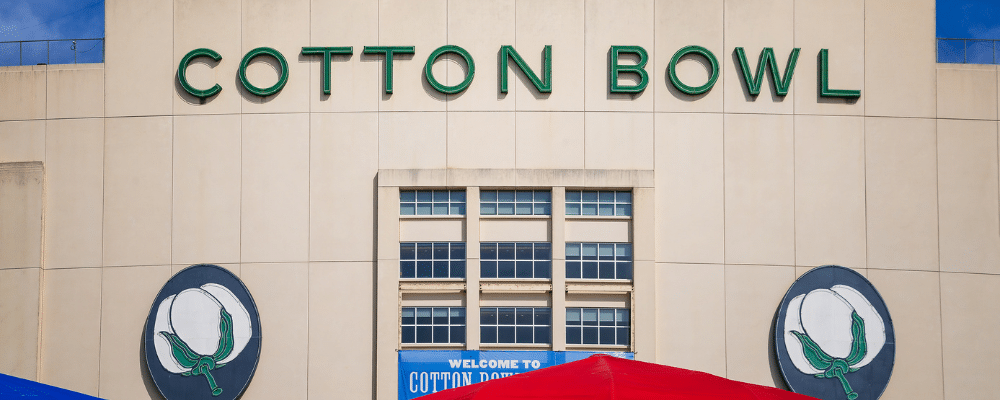
Cotton Bowl

A Closer Look at the Cotton Bowl’s Marketing Success

The Cotton Bowl’s rich history and enduring popularity offer several valuable marketing lessons:

Tradition Matters

The Cotton Bowl’s ability to host iconic events like the Red River Rivalry and the State Fair is a testament to the enduring power of tradition in marketing. People are drawn to familiar and time-tested experiences. Brands that tap into tradition can build strong, lasting connections with their audience.

Much like the Cotton Bowl, brands that skillfully tap into tradition can forge strong and lasting connections with their audience. Statistics reveal the impact: Studies show that 71% of customers are likely to recommend a product or service based on their emotional connection. Tradition acts as a bridge between the past and the present, creating a sense of nostalgia and trust.

Location Is Key

The Cotton Bowl’s location during the State Fair of Texas is no accident. It’s strategically positioned to attract a massive audience. Similarly, businesses need to consider the location and context in which they promote their products or services. Being in the right place at the right time can make a significant impact.

Creating Experiences

The Cotton Bowl offers more than just football; it provides an experience. Businesses should aim to create memorable experiences for their customers. Whether it’s through exceptional customer service, engaging content, or unique events, businesses that prioritize experiences often stand out.

In fact, according to a study by PwC, 73% of consumers cite customer experience as a key factor in their purchasing decisions, and 42% are willing to pay more for a better experience.

Community Engagement

The Cotton Bowl Stadium is deeply ingrained in the Dallas community. Engaging with the locals and being a part of their traditions can build brand loyalty. Companies that actively participate in community events and support local causes can foster strong connections.

Adaptability

Despite its history, the Cotton Bowl has undergone renovations and upgrades to remain competitive. Similarly, businesses must adapt to changing market dynamics and customer preferences. Staying relevant often requires a willingness to evolve and innovate.

Storytelling

The Cotton Bowl has a compelling story that captivates fans year after year. Effective marketing often relies on storytelling to create emotional connections with customers. Sharing a brand’s story, values, and mission can resonate with audiences and build brand loyalty.

In essence, the Cotton Bowl’s enduring success demonstrates that marketing is more than just selling products or services; it’s about building relationships, creating experiences, and staying true to what makes a brand unique.

Discover MARION’s Top-tier Marketing Services in Texas

Ready to take your business to new heights in the Lone Star State? MARION is your trusted partner for results-driven marketing campaigns in Texas. From Dallas to Houston and everywhere in between, we’ve got you covered.

Contact us today — let’s grow your business together.

Marketing emails you’ll actually want to read.

Get marketing tips and news sent to 
your inbox.

This field is for validation purposes and should be left unchanged.
Name(Required)

Marketers’ Newest Power Couple: Taylor Swift and Travis Kelce

In a surprising twist of fate, music sensation Taylor Swift and NFL superstar Travis Kelce have sparked a romantic connection. But their new relationship isn’t just another love story; it’s a marketing powerhouse waiting to be harnessed.

The Taylor Swift Effect

The “Taylor Swift Effect” refers to the significant influence that Taylor Swift, a global pop icon, has on pretty much everything. It’s about how her actions, decisions, and statements can cause substantial ripples. For instance, when she endorses a product, it often sees a surge in sales. When she speaks about political or social issues, it sparks widespread discussion.

So, when it comes to her relationship with Travis Kelce, the “Taylor Swift Effect” could mean that Kelce’s popularity and visibility will most definitely see a significant boost due to his association with Swift. Most recently, his jersey sales spiked nearly 400% after Swift attended a Kansas City Chiefs game to watch him play. Her presence generated significant buzz and excitement, causing a surge in sales of Kelce’s jerseys.

This also drew attention to Kelce’s podcast, resulting in a significant increase in views. His “New Heights” podcast received an additional 1 million views compared to the previous week, jumping to the #1 Top Podcast in the US.

Taylor Swift

Marketing Impact of Taylor Swift’s New RED Era

After attending the Chiefs’ last two games, it’s safe to say Taylor Swift is entering a whole new kind of RED era with Travis Kelce. From a marketing perspective, a relationship between Swift and Kelce could be a powerful tool for both personal branding and cross-promotion. Taylor Swift, a global pop icon, and Travis Kelce, a prominent NFL figure, have substantial fan bases. A relationship between the two could create a unique intersection of music and sports fans, opening up new opportunities for creative marketing and promotion.

Amplified Brand Exposure

Swift and Kelce’s dating news has skyrocketed their individual visibility and created a significant buzz. For brands associated with them, this newfound attention presents a unique opportunity to reach a broader audience and increase brand exposure — one example being the NFL. Compared to the previous week’s game, Chiefs’ viewership earned a 63% increase with women aged 18-49 since the popstar’s public appearance.

Cross-Industry Collaborations

The fusion of music and sports offers a potential goldmine for cross-industry collaborations. Brands in the entertainment, sports, and fashion sectors can leverage Swift and Kelce’s relationship to create exciting joint ventures and captivating marketing campaigns that appeal to fans of both industries.

Memorable Collaborative Campaigns

The creative industry is ripe with opportunities to develop memorable marketing campaigns centered around Swift and Kelce. From product promotions to entertaining ads, brands can strike a chord with consumers by incorporating the couple’s star power into their messaging.

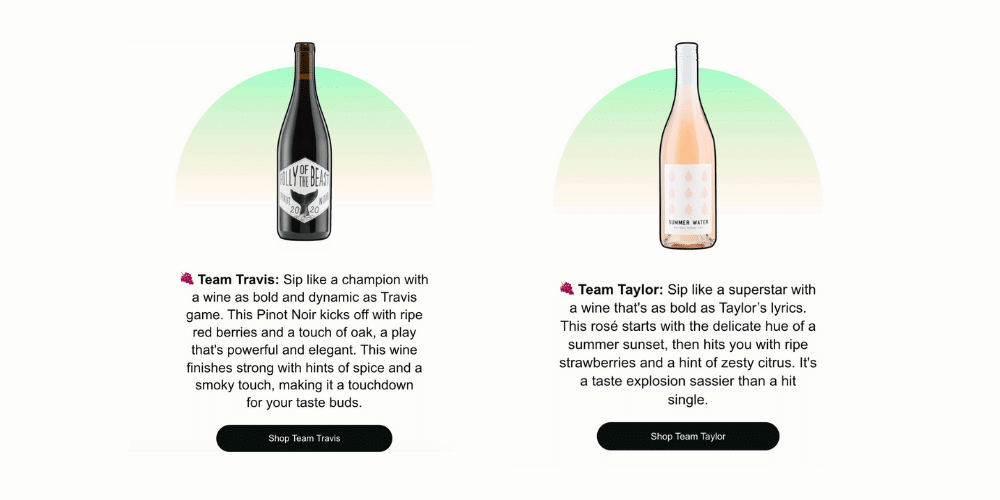
While their relationship is a relatively new development, brands are wasting no time running new marketing campaigns. A US-based wine company, Winc, is already capitalizing on the power couple with a new email campaign promoting their products.

Taylor Swift Travis Kelce Marketing (1)

Source

Social Media Engagement

Swift and Kelce boast massive followings on social media platforms, with Kelce actually gaining over 860,000 Instagram followers since the dating rumors first sparked. Marketers can tap into this vast online presence by engaging with fans through sponsored posts, memes, partnerships, or even launching exclusive content that resonates with their shared interests.

Enhanced Fan Loyalty

The combination of Swift’s devoted Swifties and Kelce’s die-hard football fans provides a unique opportunity to strengthen fan loyalty. Marketers can capitalize on this by offering joint incentives, exclusive merchandise, or VIP experiences that cater to this passionate fan base.

Influencer Marketing Potential

With their influential status, Swift and Kelce can be valuable brand ambassadors. As a couple, they can enhance their individual endorsements and amplify their impact on consumer purchasing decisions. Marketers can leverage their combined influence to promote products/services and tap into their followers’ purchasing power.

What Can Marketers Learn?

What can brands learn from Travis Kelce and Taylor Swift’s marketing success? By capitalizing on their combined influence, marketers can amplify brand exposure, engage fans, foster loyalty, and create memorable campaigns that leave a lasting impression. As the love story of Swift and Kelce unfolds, brands have the chance to ride this marketing wave and seize the incredible opportunities that lie ahead.

Elevate Your Texas-Based Business Through Strategic Marketing

Whether you’re aiming to boost your online presence, reach new customers, or revamp your branding, MARION is your trusted partner for top-notch marketing services. Get in touch to explore how we can tailor our expertise to meet your unique marketing needs and help your business thrive.

Contact our team online or visit our blog for more marketing news and insights.

Marketing emails you’ll actually want to read.

Get marketing tips and news sent to 
your inbox.

This field is for validation purposes and should be left unchanged.
Name(Required)

AI vs. Human Written Content: A Blogging Experiment

With advancements in technology, artificial intelligence (AI) has made significant strides, and its influence is felt across various industries, including content creation.

AI vs. Human Bloggers: Who Will Prevail?

In the world of blogging, AI-powered language models have emerged, capable of generating impressive articles on a wide range of topics. However, despite the convenience and efficiency offered by AI, there are compelling reasons why human bloggers continue to hold the edge.

Which one will be an invaluable asset to your content creation strategy? Below, we delve into the debate of AI vs. human-written blogs and explore the unique qualities of each.

Benefits of Human Bloggers

Human writers possess unique qualities that make them invaluable in the blogging realm.

The Essence of Authenticity

One of the key strengths of human-written blogs lies in the element of authenticity. Humans have emotions, experiences, and a unique voice that they bring to their writing. Readers can connect on a deeper level with the personal touch and genuine storytelling that only a human blogger can provide. AI-generated content may be coherent and informative, but it lacks the emotional depth and unique perspective human writers infuse into their work.

Creativity and Originality

Human bloggers are unparalleled in their ability to innovate, craft original ideas, and present fresh perspectives. While AI can mimic patterns from existing content, it lacks the creative flair to generate truly novel concepts. Human bloggers draw from their knowledge, imagination, and research, producing content that stands out in a sea of generic AI-generated articles.

Adaptability and Empathy

In a dynamic world where trends change rapidly, human bloggers excel at adapting their writing style to suit current events and shifting audience preferences. They can gauge reader reactions, respond to feedback, and empathize with their audience, making content more relatable and engaging.

human blogger

Context and Nuance

Human bloggers possess a nuanced understanding of language, culture, and context. They can incorporate humor, sarcasm, and colloquial expressions that AI models may misinterpret. Human bloggers can tailor content to specific audiences, ensuring relevance and resonance, while AI-generated content may come across as generic and formulaic.

Ethical Considerations

AI-generated content raises ethical concerns regarding plagiarism and copyright violations. Human bloggers adhere to ethical standards, ensuring proper attribution and citing sources when referencing external information. This transparency builds trust with readers and fosters a sense of credibility that AI cannot replicate.

Knowledge and Expertise

Human bloggers often write from a position of expertise, experience, or specialized knowledge. This authority makes their content credible, especially in niche industries or fields. AI lacks the comprehension and practical experience to provide the same level of in-depth analysis and expert insights. Moreover, human bloggers can adapt to changing trends, news, and cultural shifts more swiftly than AI.

Download Now: Free Content Calendar for Bloggers

Benefits of AI Bloggers

On the other hand, AI-powered content generation also offers several advantages.

Increased Efficiency and Speed

AI-powered tools are designed to automate repetitive tasks and can generate content much faster than human writers. This enhanced speed allows businesses to produce a larger quantity of content in a shorter amount of time, which can be beneficial for content marketing strategies that require a high volume of consistent output. Additionally, AI writing tools can help boost productivity by automating certain activities, saving time and effort for content creators.

Consistent and Error-free Writing

In theory, AI-generated content is less likely to contain grammatical errors, spelling mistakes, or formatting inconsistencies that can occur with human writing. AI tools have been trained extensively to ensure accuracy and precision in their writing, resulting in consistently error-free content. This can be particularly useful for businesses that require a high level of quality control in their integrated marketing efforts.

Ability to Generate Large Volumes of Content

AI-powered tools are fast and efficient, making it easy to quickly produce a significant amount of content. AI can handle data analysis, idea generation, and drafting, freeing time for human writers to focus on infusing creativity, emotional depth, and unique perspectives into the blog content.

AI blogger

The Experiment: AI vs. Human Blog Writers

We decided to put these observations to the test, so we conducted a quick experiment. We gave an AI tool and a human writer the same prompt to see who could create the better content.

The Prompt: “Write an introduction paragraph for a blog about email marketing for small businesses.”

AI:
In today’s highly competitive digital landscape, email marketing has become an essential tool for businesses of all sizes to connect with their target audience and drive growth. In this blog, we will explore the benefits of email marketing, provide valuable tips and strategies, and highlight success stories from small businesses that have leveraged this powerful marketing channel. We will also walk you through the fundamentals of creating compelling email marketing campaigns, optimizing deliverability, and measuring success. If you’re a startup or an established small business owner, this blog is an excellent resource for mastering the art of email marketing and taking your business to new heights.
Human:
Hey there, savvy entrepreneurs and small business owners! Want to take your business to the next level? Look no further than the power of email marketing! In today’s digital age, connecting with your customers has never been easier; email campaigns offer an exciting and affordable way to engage, convert, and build lasting relationships with your audience. Whether you’re just starting or looking to revamp your marketing efforts — this is your go-to guide for mastering the art of email marketing for small businesses. Without further ado, let’s dive right in to discover the magic of crafting killer emails that’ll have your customers clicking and converting like never before!

The Differences

Step 1: Comparing SEO

  • The AI writer included the keyword “email marketing4 times — that’s overkill!
  • The human writer included the keyword twice, which is far more beneficial for SEO.

Step 2: Comparing Complexity

  • The AI writer uses unnecessarily complex language such as “highly competitive digital landscape” and “optimizing deliverability” — most people don’t talk like this. And they certainly aren’t going to be hooked enough to read the rest of your article if the beginning sounds boring and robotic.
  • On the other hand, the human writer uses more casual, interesting language such as “discover the magic,” “crafting killer emails,” and “go-to guide.”

Step 3: Comparing Readability

  • The AI writer’s Flesch readability ease score is 28.3, which is considered “very difficult to read.”
  • The human writer received a much higher score of 51.2.

What Does the Future Hold for AI and Human Blogging?

As technology continues to advance, the ideal scenario might be a collaboration between AI and human bloggers. AI can be used to assist with research, fact-checking, and initial content generation, providing a framework for human bloggers to build upon. This symbiotic relationship allows human bloggers to leverage the efficiency and speed of AI while infusing their creativity, personal touch, and unique perspectives into the content.

In conclusion, while AI has undoubtedly made impressive strides in content creation, human bloggers still possess an irreplaceable quality that enables them to connect with readers on a deeper level. It’s likely that a harmonious balance between AI and human bloggers will prevail, with AI supporting and enhancing the work of human bloggers rather than completely replacing them. The future of blogging lies in the collaboration and synergy between AI and human creativity, resulting in a richer and more engaging blogging landscape for both writers and readers.

Level Up Your Blog with MARION Content Marketing Services

Did you know that the experts at MARION can help you enhance your online presence and grow your business? With our expertise in content creation and marketing strategies, we can help you attract more visitors and potential customers. Our team of skilled writers will craft engaging and informative content that resonates with your target audience, driving more traffic to your website. Additionally, we will optimize your content for search engines, ensuring that your blog and website rank higher in search results.

Contact MARION today for a free consultation!

Marketing emails you’ll actually want to read.

Get marketing tips and news sent to 
your inbox.

This field is for validation purposes and should be left unchanged.
Name(Required)

How to Design a Winning Trade Show Booth

Follow These Tips to Wow Prospective Customers at Your Next Trade Show.

Picture this: You’re standing in the middle of a crowded trade show booth. Your signage and lighting positively sparkle as prospective customers eagerly engage with your interactive product displays. You’re fielding questions left and right, seamlessly gathering attendee data and swapping business cards like a networking ninja.

Sounds great, right? With clear objectives, thoughtful planning and savvy design, you can make this dream a reality. Here we’ll outline the fundamentals of effective trade show booth design, from setting achievable goals to crafting a compelling message for your target audience.

How to Plan Your Trade Show Booth.

Before you decide the “how” of your booth, it’s important to understand the “why.” Are you looking to generate leads among a well-known target audience? Or are you seeking to build brand awareness within a new market vertical? The following questions can help you determine your goals for the event.


Trade Show Attendee Statistics
These statistics about attendees suggest the impact a strong trade show presence can have.

Who is your target audience?

As with any marketing initiative, it’s important to define your audience. Will you be targeting prospective customers, industry peers or potential investors? Understanding your audience will help you refine your messaging and visual approach.

Who is your competition?

Information about your competitors’ previous approaches to trade shows can help you differentiate your booth and set achievable goals. What were their goals and objectives? What kind of messaging and visuals did they use? What do you like about their approach and, more importantly, how can you differentiate your own booth to ensure it stands out?

How will your booth align with your overall marketing strategy?

It’s important to set goals that support your business’ overall marketing strategy. Is your company focused on boosting awareness, generating leads or promoting a new product or service? Considering how the trade show fits into your overall marketing strategy can help you refine your objectives for the event.

What are your goals for the trade show?

Once you’ve identified your target audience, studied the competition and reviewed your company’s overall marketing strategy, it’s time to determine specific, measurable goals for your trade show booth. For example, you might want to gather contact information for a certain number of quality leads, or close a certain number of sales. However you define success, make sure your objectives are SMART: specific, measurable, achievable, relevant and time-bound.

How to Design a Trade Show Booth That Stands Out.

Once you’ve defined your goals, you’re ready to make decisions about the look, feel and functionality of your booth. The following best practices will help you to create an on-brand experience that attracts your target audience and keeps them engaged.


Trade Show Booth Mockup
This mockup of a trade show booth demonstrates the importance of on-brand design elements that encourage interaction.

Stay True to Your Brand.

While your objectives may be unique to the trade show in question, your messaging and visuals should align with your branding guidelines. Make sure every aspect of the experience, from physical signage to virtual data-gathering interfaces, reinforces your brand identity while delivering a message that feels specific and relevant to the event at hand.

Keep the content simple.

A tradeshow booth is more often than not meant to be a backdrop for what’s happening inside your booth. With this in mind, it’s important to keep content minimal, embracing large catchy headlines and keeping your company’s logo is front and center. Highlighting a few key points or differentiators is also good if you want to give booth visitors a quick snapshot of what you offer. More than likely, chairs, tables and people will be standing in front of your booth graphics, so small wording or small details will get lost or not seen.

Highlight Key Visual Elements.

As with content, you’ll want to select images carefully and use them smartly. Make sure you’re drawing attention to the specific products and services that reiterate what your company offers. Strategically placed lighting or illumination can further help to guide visitors’ eyes, while also adding to the “vibe” of your booth. When selecting lighting, consider how you want guests to feel – relaxed, energized, solemn, powerful? Once you know how you want booth visitors to feel, you can select visuals and design a lighting scheme that achieves the effect.

Embrace the Power of Play.

It’s not enough to drive traffic to your booth. To achieve measurable results, you have to delight, engage and inspire attendees to take action, whether that means providing their email addresses or making a purchase. Interactive activities, such as live product demonstrations, touch screen displays, games and trivia, photo booths and even virtual reality simulators encourage guests to linger and explore — giving you the opportunity to make one-on-one connections.

Don’t Sleep on the Swag.

Who doesn’t love a free tote bag, t-shirt or travel mug? Treating your attendees to useful, high-quality branded items is well worth the investment. They not only drive traffic to your booth, but also increase the likelihood that visitors will remember your company fondly. Whatever you choose, make sure the items clearly reflect your brand and connect to your product or service. If you’re a fuel carrier with a fleet of delivery trucks, for example, you might offer branded keychains that remind prospects of your professional team of truck drivers.


Designing a trade show booth can be overwhelming, but by keeping these best practices in mind, you’ll be well on your way to a successful event. Better yet — let Design At Work do the heavy lifting! We can help you plan, design and execute a booth that attracts visitors and generates leads. Let’s talk about your next trade show.


Sources:

  1. 150+ Trade Show Stats That Reveal All, Trade Show Labs

Lifecycle Marketing: Building A Strategy That Really Works

Lifecycle marketing is an essential strategy for businesses looking to improve customer retention and drive revenue growth. By tailoring messages and offers to their audience based on their current stage in the buying journey, companies can better engage and convert potential customers.

What is Lifecycle Marketing?

Lifecycle marketing is a strategy that involves understanding and optimizing the entire customer journey, from initial contact to post-purchase support. At its core, lifecycle marketing is about providing customers with the greatest value at each stage of their relationship with a brand.

This approach allows businesses to build and nurture customer relationships, increasing the chances of creating brand advocates and improving the overall corporate image. By studying the whole journey in an integrated way — from first contact to client relationship — businesses can positively influence customer behavior at each touchpoint.

Importance of Lifecycle Marketing in Business

Lifecycle marketing is an important process for businesses to understand and implement to maximize customer engagement and retention. A few of the many benefits include:

  • Helps businesses to better understand their customers and their needs at each stage of the buying journey.
  • Enables businesses to create targeted marketing campaigns tailored to their customers’ needs.
  • Helps businesses to build stronger relationships with their customers by providing them with personalized experiences and relevant content.
  • Increases customer retention rates by providing lasting value and support to customers throughout their journey with the brand.
  • Reduces customer churn rates by identifying and addressing consumer pain points and concerns.
  • Improves customer satisfaction levels by providing customers with a positive experience and meeting their needs at every stage of the buyer’s journey.
  • Increases customer lifetime value by encouraging repeat purchases and customer advocacy.
  • Helps businesses to optimize their marketing spend by focusing on the most effective channels and strategies for each point of the customer journey.
  • Enables businesses to continuously improve their marketing efforts by tracking and analyzing behavior and feedback at each phase of the customer experience.

Key Stages of Lifecycle Marketing

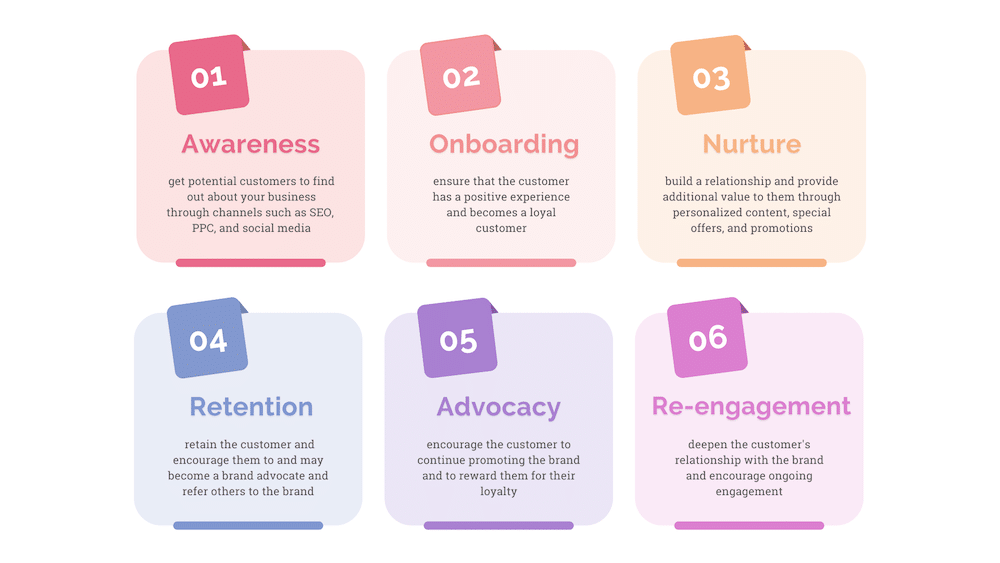
The six primary stages of lifecycle marketing include awareness, onboarding, nurturing, retention, advocacy, and re-engagement. Each step requires a unique set of tactics and messaging to effectively move customers through the process and foster long-lasting relationships.

customer lifecycle marketing graphic 6 stages

1. Awareness

This stage involves attracting new customers to your business through various channels such as advertising, social media, and content marketing.

Lifecycle Marketing Strategies to Use During Awareness:

  • Search engine optimization (SEO)
  • Paid and organic ads
  • Publish informative blog posts

2. Onboarding

Once a new customer has purchased or signed up for your service, the onboarding phase starts, where you welcome and guide them through the initial steps of using your product or service.

Lifecycle Marketing Strategies to Use During Onboarding:

  • Welcome emails
  • Introductory offers

3. Nurture

During this stage, you engage with your customers to build a relationship and provide additional value to them through personalized content, special offers, and promotions.

Lifecycle Marketing Strategies to Use During Nurture:

  • Newsletters
  • Conversational messaging

4. Retention

In this stage, you work to keep your customers happy and loyal to your brand by providing excellent customer support, unique experiences, and exclusive rewards.

Lifecycle Marketing Strategies to Use During Retention:

  • Subscription programs
  • Customer loyalty programs
  • Automated Birthday or anniversary messages
  • Restock notifications via Email/SMS/Push 
lifecycle marketing reviews

5. Advocacy

At this stage, loyal customers become your brand advocates and help you promote your business through word-of-mouth marketing, user-generated content, and positive reviews.

Lifecycle Marketing Strategies to Use During Advocacy:

  • Customer referral programs
  • Loyalty club membership, discounts, and exclusives
  • Incentivize testimonials
  • Events with industry experts or influencers

6. Re-engagement

This phase focuses on re-engaging customers who might have become inactive or lost interest in your brand by offering them special deals, requesting feedback, and reminding them of your value.

Lifecycle Marketing Strategies to Use During Re-Engagement:

  • Win-back email campaigns
  • Special return offers

By understanding the key stages of lifecycle marketing, businesses can create targeted, integrated marketing campaigns tailored to their customers’ needs.

Level Up Your Lifecycle Marketing with MARION

In conclusion, understanding and implementing a lifecycle marketing strategy can significantly impact a business’s success. MARION helps you build and nurture relationships, increase brand advocacy, and drive revenue growth. With our digital marketing agency, you can positively influence customer behavior and create a seamless buying experience.

Contact us today for a free marketing consultation.

Marketing emails you’ll actually want to read.

Get marketing tips and news sent to 
your inbox.

This field is for validation purposes and should be left unchanged.
Name(Required)

How to Clear Browser Cache

Browsers store pages you visit in the browser cache and use it to redisplay them quickly. However, when changes are made to a website, the browser cache may prevent you from seeing the changes immediately. To ensure you see the most up-to-date page version, you must perform a hard refresh, also known as a force refresh. Or, you can clear your browser’s history and cache partially or entirely.

Below are instructions for both.

How to Force Refresh a Single Page (Desktop and Laptop)

Fortunately, there are convenient ways to force refresh pages. Here are the basic steps for the most popular browsers:

  1. SHIFT – REFRESH or Ctrl – REFRESH (Internet Explorer, Edge): All browsers have a refresh button at or near the address bar. The refresh button alone will not necessarily request the page from the server. Hold down the shift key while pressing the refresh button to force the page to refresh from the server. If you’re in Internet Explorer or Microsoft Edge, use the Ctrl key to do the same thing.
  2. Ctrl-F5 (Firefox, Chrome, Opera, Internet Explorer, Edge) will skip the cache and ask the server for the page. To do the same thing on Mac Safari, press Option (⌥) and Command (⌘) together, press the E key, then refresh the page with the refresh button.

How to Clear All or Part of Browser Cache (Desktop and Laptops)

To clear all or selected parts of browsing history, cached data, and cookies, follow the steps below for the browser you’re using:

Google Chrome

Windows: CTRL-SHIFT-DELETE or Mac: CMD (⌘) -SHIFT-DELETE, then fill in values in the popup as required. Works on the Chrome intro screen and webpages.

Non-shortcut method: Click the three dots to the right of the address bar. Select History, then click History at the top of the flyout, then Clear Browsing Data. Alternately, from the main menu, go to History, then Show Full History, then Clear Browsing Data.

Firefox

You must be on a webpage; the shortcut does not work on the Firefox intro screen.

CTRL-SHIFT-DELETE or CMD-SHIFT-DELETE, then fill in the values.

Non-shortcut method: From the main menu, go to History, then Clear Browsing Data.

IE, Edge

CTRL-SHIFT-DELETE, then choose options.

Without the shortcut, it’s a long path to clear the cache:

Edge: Click the three dots to the right of the address bar, then choose History, then click the three dots on the History popup, then select Clear Browsing Data.

IE: Use the gear icon to the right of the Address bar, choose Safety, then “Delete browsing history…”.

Safari

Go to Safari Preferences under Safari in the main menu. Then choose Privacy or type the shortcut CMD (⌘) followed by a comma: “⌘ ,” and select Privacy.

Also worth mentioning: If clearing your cache is inconvenient, try using an alternate browser, one that has not accessed the page before.

Single Page Force Refresh on Mobile Devices

Sorry, that doesn’t exist! You must clear your device’s browser cache. Mobile apps will not be affected by clearing your phone’s browser cache.

How to Clear Browser Cache on Mobile Devices

Safari for iOS

Go to the Settings app, press Safari and scroll down to “Clear History and Website Data,” then verify.

Chrome for iOS

In the Chrome app, click the three dots at the bottom right of the screen. Next, scroll down and click Clear Browsing Data, then choose options and click Clear Browsing Data at the bottom of the screen.

Chrome for Android

Tap the More button (three dots) at the top right of the screen. Next, tap History, then Clear Browsing Data. You can also get there from the Chrome Settings menu, Privacy and Security, then Clear browsing data.

Firefox for Android

Tap the menu icon (three bars, top right in the browser). Next, tap Settings. Go to Privacy and Security from the Settings screen, then Clear Private data. From there, you can select what you want to clear.

Samsung Internet for Android

Tap the menu icon (three bars, bottom of browser). Next, tap Settings (gear icon). Next, tap Personal browsing data, Delete Browsing Data, choose options, and confirm by pressing Delete Data.

Marketing emails you’ll actually want to read.

Get marketing tips and news sent to 
your inbox.

This field is for validation purposes and should be left unchanged.
Name(Required)

Understanding Marketing Goals and Objectives + Examples

When it comes to marketing, goals and objectives are terms that are often used interchangeably. However, understanding the difference between these two is essential for setting up effective marketing strategies and achieving success in any business endeavor.

In a nutshell, goals tell you where you’re going instead of how you’ll get there, and objectives are specific and measurable milestones that must be achieved to reach a goal.

What Are Marketing Goals?

A marketing goal is a broad aim toward which your efforts are directed. Marketing goals don’t have to be specific. Because of their open-ended nature, setting only marketing goals is not ideal for achieving something in your business.

To gain a better understanding, let’s look at a few examples of marketing goals:

  • I want more customers to visit my website.
  • I want to rank on page one of Google.
  • I want a massive social media following.

While these goals tell us what we want to accomplish, they don’t tell us how to get it. Despite this, knowing how to set marketing goals is important because they lay the foundation for your marketing endeavors.

What Are Marketing Objectives?

Where marketing goals are broad statements, marketing objectives are measurable and specific. The best way to describe an objective is with SMART acronym:

SMART acronym marketing goals

An objective is created when you meet the requirements of the SMART acronym. To get a better idea, let’s look at a few examples of marketing objectives:

  • We need to create 50 customers from 5,000 leads within the next six months from our marketing efforts to reach our revenue goals of $200,000.
  • We want to achieve the number one rank for “Big Screen TV” because it drives an estimated 1,000 visitors to our website monthly.
  • We want to grow our Instagram account by 50,000 followers in the next five months to coincide with our new product launch.

Objectives are the stepping stones to reaching your marketing goals. They lay out the specific steps needed so you can take action. Learn how to set marketing objectives.

Understanding Marketing Goals vs. Objectives

A marketing goal is a broad target that you hope to achieve. A marketing objective is an actionable short-term step that you execute. You must design and implement several objectives to achieve your overarching marketing goal.

how to set marketing goals

How to Set Marketing Goals

Before creating your objectives, you need to set your marketing goals. Let’s look at the process of creating goals for your organization so that you can lay the groundwork for your future marketing campaigns.

1. Review Your Mission Statement with Your Team

Do you know your mission statement? Your mission statement defines why you’re in business in the first place, and it should drive your entire marketing strategy. So, as you define your marketing goals, ask yourself whether it helps you to fulfill your mission statement.

2. Set Your Marketing Targets

Ask yourself this one question — “What does my business hope to accomplish?” Essentially, this is the ultimate goal your marketing team strives to accomplish by the end of an upcoming period.

If you’re setting a short-term goal, you might consider the next quarter. A mid-range goal might account for the next year, and a stretch goal might be set for five years from now.

3. Develop a Marketing Strategy

The next step is to set up a marketing strategy. The strategy you put in place should help you achieve your goals. Let’s look at marketing strategy components you could implement to meet your marketing goals and objectives:

  • Generate leads by creating a blog that delivers helpful content.
  • Create social media pages to promote your blog.
  • Use paid advertising to reach out to new customers.
  • Implement a long-term SEO strategy to rank well in Google to drive organic traffic.

From this point, you can go into more detail on how you plan to implement each step.

4. Tie in Your Marketing Objectives

We’ve already discussed the differences between marketing goals and objectives. Now you must tie the two together through the strategy. For example, let’s say your marketing goal is to increase your conversion rates by 50% in 12 months.

One corresponding piece of your marketing strategy is implementing an SEO strategy that helps you rank well in Google and generate organic traffic. A marketing objective you can implement to support your strategy and reach your goal would be to optimize your nine main organic landing pages for specific keywords so that they make it into the top five spots on Google.

Perhaps you want to deliver on this objective by optimizing three pages per month over the first quarter to reach your 12-month goal in time. Remember, where goals are broad, objectives are specific.

5. Measure the Results

The last step is one of the most important. You need to figure out how you intend to measure your results, so your marketing department can present progress reports and learn from the data.

You must also establish how often you intend to receive these reports (weekly, monthly, quarterly). Once you’ve figured out your timetable, you must determine the specific KPIs (key performance indicators) you intend to track.

You may be tempted to track every marketing KPI you can, but try to sort out the metrics most relevant to your business. Once you’ve identified what those are, you’ll be much more focused as you move forward tracking your results.

what are some marketing goals and objectives?

How To Set Marketing Objectives

Once you’ve set up your marketing goals, you’ll have to set up marketing objectives (as mentioned in Step 3 above) to help you accomplish those goals.

1. Learn How Much Revenue You Need from Your Marketing Campaigns

Let’s say your business generated $5,000,000 in sales last year. Next year you set marketing campaign goals to scale up your sales by 50%. Your marketing objectives must be structured to generate $7,500,000 ($5,000,000 x 1.5) in sales over the next 12 months.

2. Identify How Many Sales You Need to Reach Your Revenue Goals

To make this determination, divide your revenue targets by the value of your average sale. Therefore, if you need to generate $7,500,000 and your average sale is $100,000, you will need to close 75 customers over the next year.

3.  Identify How Much Traffic You Need to Achieve Your Goals

To reverse engineer your traffic numbers, you need to determine your traffic-to-lead conversion rate and lead-to-customer conversion rate based on historical data.

Let’s say that data from the previous three years shows that your average traffic-to-lead conversion rate is about 0.5%, and your average lead-to-customer conversion rate is 5%. This means you’ll need 1,500 leads to reach 75 customers and 300,000 visitors to reach 1,500 leads.

At the end of the day, you need to drive approximately 300,000 visitors to your site over the next year if you hope to reach 75 customers.

There are several important assumptions you make while using the above data. Two of which:

  1. You plan to generate traffic in the same manner that you have during the past three years (from which you’ve calculated your averages).
  2. Your pricing and promotions are still set up so that your average sales will be consistent with the previous year’s.

4. Set Up Benchmarks

Keep in mind that the process of setting up marketing goals is not quick. It takes time to build momentum. That’s why you should set up quarterly benchmarks to track your progress. As you build momentum, set your benchmarks higher and higher for each quarter.

Therefore, the second quarter should be set higher than the first, the third should be higher than the second, and the fourth should be the highest of them all. For example, if you intend to drive 70,000 visitors to your website during the first quarter, you should drive 72,500 in the second, 77,500 in the third, and 80,000 in the last.

how do marketers use data to identify goals?

Implementing Marketing Goals vs. Objectives for Your Business

As you set up your marketing goals and your marketing objectives, you’ll find there’s always room for improvement. Your marketing strategy won’t be perfect the first time, but that’s why you track metrics so you can improve as you go along. As you move forward, you’ll identify the strengths and weaknesses of your marketing strategy, and you can make adjustments until you achieve your overarching goal.

Exceed Your Marketing Goals and Objectives with MARION

If you need help achieving your marketing goals and objectives, we can help you. MARION is a full-service marketing agency that offers internet marketing servicesgraphic design firm services, and traditional marketing services.

Looking to take your marketing efforts to the next level? Contact our team today.

Marketing emails you’ll actually want to read.

Get marketing tips and news sent to 
your inbox.

This field is for validation purposes and should be left unchanged.
Name(Required)