**Post Update** I composed a new SEO Rapper song called, #SEOvsSEM that should help drive home the point. Check it out.
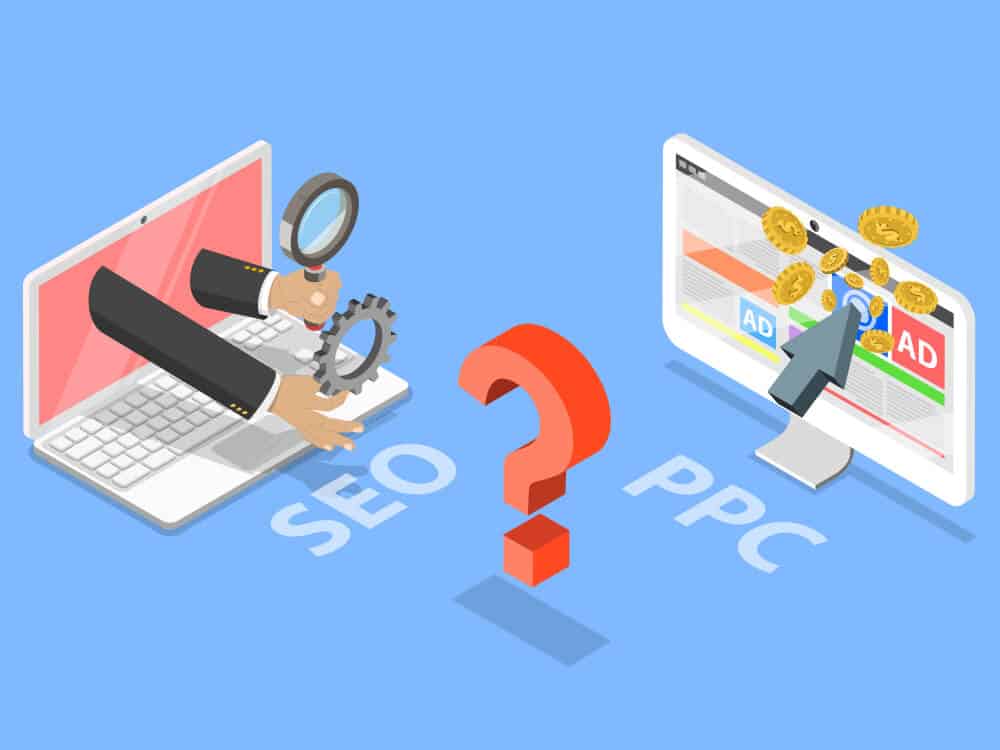
As an SEM specialist, much time is spent doing search engine optimization and managing pay per click ads. Both forms of search engine marketing require a certain level of research, testing, and maintenance. In this article, I aim to highlight the benefits of doing both simultaneously and showcase where they intersect from a research and marketing perspective.
Whether it’s organic search vs. paid search, we are still dealing with search engines and capturing visits from users who search for available services.
Keyword research is typically the first step when preparing to optimize a web page or creating a paid ad campaign in Google Ads or Bing Adcenter. There must be a proper understanding of which keywords and phrases are being searched the most and getting the best engagement.
Google’s Keyword Planner is a free tool that allows you to input keywords and retrieve search data like average monthly searches, the average cost per click, amount of competition and more.
Once you’ve identified the top keywords for your product or service, search them. Pay close attention to the search results page. You should see a series of paid ads at the top and bottom, local listings (if it’s a local search) and natural listings. These listings not only represent your competition, they also provide ad examples and blogging topics you can use.
Review the paid ads for relevance. Are the companies who are actively bidding on the same phrases providing the same or similar service? If so, great. Observe the natural listings on page 1 & 2 of the search results. Are any competitive blogs ranking for similar search terms? If so, consider writing your own post, targeting the same keywords, with your companies point of view on the subject matter.
Ad Text & Meta Descriptions
Ad text and meta descriptions present the first opportunity for you to educate the user about what is on your page, prior to them clicking. Ad text is the title and description used within the Ad. It is configured during the Ads campaign setup. The meta description is the code used on the web page that describes what the page is about. It shows in the natural area of the search results when your site is listed.
One benefit to doing PPC and SEO is the ability to test ads and descriptions. You can write 2-3 different ads and allow Google Ads to randomly display them when searched. Once the paid campaign is active and has been running, analyze the performance. Which ads were shown the most? Which ads had the most clicks? More importantly, which ads led to website conversions? Depending on how much search volume the keywords had, you may have enough data to analyze the same day or in 30 days or less. Whichever ad has the best performance should be used in the meta description. Since search engine optimization takes much time, doing this step ensures that when your website does finally show on page 1 of search engines, your listing has a higher likelihood of getting the click and converting the web visitor into a lead.
Branding & Promotions
Depending on what position your company is in, you may need to leverage search engine marketing for branding and product/service promotion. For example, your website may rank well for a certain product or service, but it doesn’t get great engagement. Consider bidding on the same term in Ads and using the ad text to support your brand and highlight features and benefits of using your company.
The search result page would then have an ad from your company with branding at the top of the page and then your natural listing more focused on the service benefits below. It’s proven that Ads usage can impact organic clicks.
User Engagement & Conversion Optimization
The ability to test user engagement and conversions is another benefit to doing search engine optimization and pay per click management simultaneously. With paid ads, you can create landing pages and test them differently. You may want to test the tone of voice in the content, choice of images, call to actions, form placement, button usage and more. Make improvements to the page and analyze the results to see which version of the page gets the best engagement and ultimately converts at the highest percentage rate.
When you determine what version of the landing page content is engaging and converting the best, update the target optimized page on your website with the same content, CTA’s and information from the landing page. This will help you create a landing page that converts well for both organic and paid traffic.
Timing is the biggest reason you should consider doing SEO and PPC campaigns together. On average, especially for a new website, search engine optimization could take months or years (depending on industry and competition). Most new businesses don’t have that kind of time to wait for website traffic and leads.
Pay Per Click campaigns can be set up in one day with ads running shortly thereafter. True enough, it is budget driven, but the upfront user data and leads generated will make your SEO efforts better and provide a faster return on your investment.
We work with many law firms and one of the biggest challenges for any new or established law firm is generating a steady stream of website traffic.
While there are countless ways that you can address this need, it should almost go without saying that focusing on your search engine optimization is time and money well spent.
If you’re wondering how important it is for your website to show up in relevant search results, let’s just look at the facts.
96% of people use a search engine while seeking legal advice.
74% of consumers will visit a law firm website to take action while seeking legal advice.
These consumer statistics from The National Law Review make one thing obvious – your law firm needs to be visible online.
Simply creating a website won’t cut it in today’s digital landscape. With 96% of people using search engines to seek out legal advice, your firm’s task is to cut through the noise and rank highly enough to be found when potential customers raise their hand for legal help.
Focusing on SEO for your law firm websites is your ticket to the top of the search results. Unlike a lot of other posts out there on SEO for law firms, I’m not going to claim that domination of the search results is as simple as following a few steps. After all, you’re an expert in legal matters, not attorney search engine marketing.
Outsourcing SEO for Law Firm Websites
You’re a legal expert, not an SEO expert. When you break it down financially, an hour of time spent doing billable work for a client is more valuable to you than doing an hour of SEO. Fortunately, you don’t have to pick one or the other.
MARION’s SEO for Law Firms
Average User Rating: (5 / 5) Based on 4 reviews
When you use MARION Marketing’s SEO Services, we build your organic website presence, so you can stay client focused. Contact us for more information on how our search engine optimization services can grow your bottom line.
This post will cover techniques for improving where your website is showing up in search engines, but if you’re wondering why your site doesn’t show up in search engines at all, you may want to address some bigger issues before diving into this post.
In this post, we will walk you through the most critical components of your law firm’s SEO marketing, including keyword selection, mobile-friendliness, site structure, technical SEO, local SEO strategies, content creation, and more.
You may decide that there are more profits to be had by using a reputable SEO service than doing it yourself. If so, make sure you know what to look for in a reputable SEO company. We have years of experience working with law firms to grow their digital presence and their bottom line, so reach out to us with any questions that you may have.
Organic Traffic Doesn’t Have to Come from Google
One of the first SEO tips that many lawyers may or may not be aware of is that organic traffic doesn’t have to come from Google.
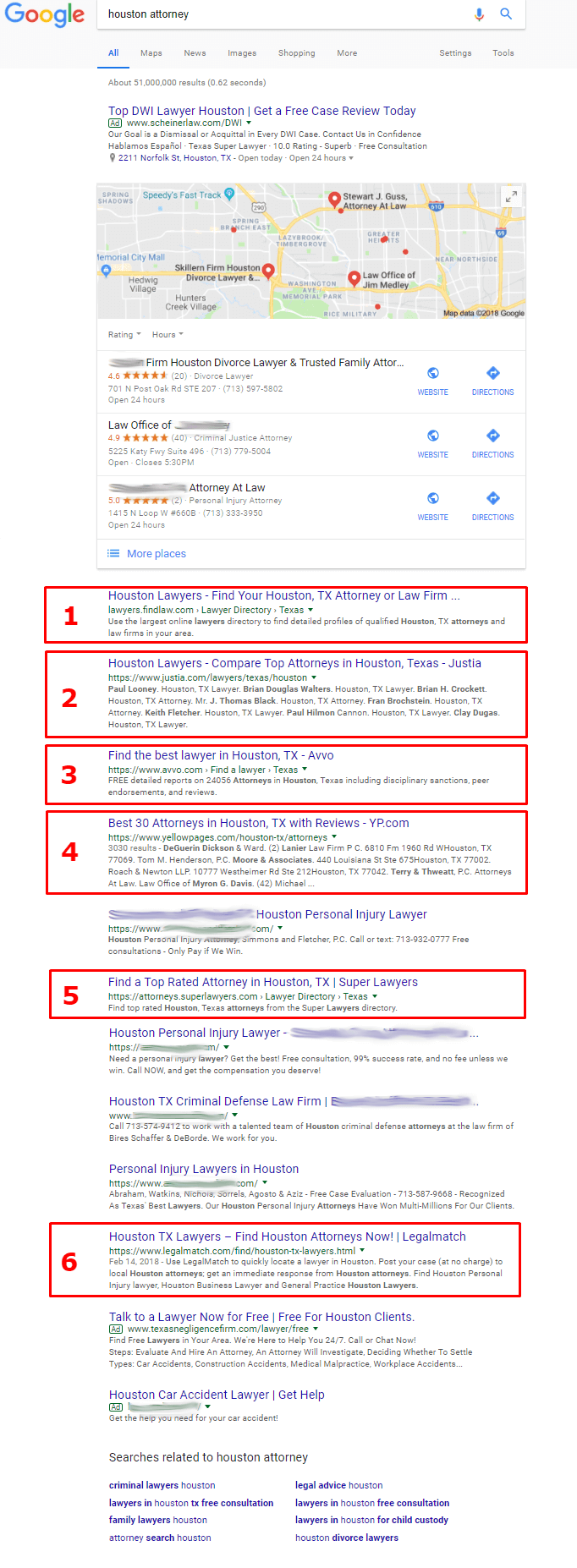
I’ll demonstrate my point with an example. If you own a general practice law firm in Houston, your SEO marketing efforts might focus on ranking for, “Houston lawyer.”
Take a look at the organic search engine results page (SERP) for this keyword. Don’t consider the ads and local results at the top of the page for now, but instead focus on the, “10 blue links.”
As it turns out, six of the ten organic results are listings pages from sites like findlaw.com, justia.com, and avvo.com. Only four of the “10 blue links” are actual law firm websites in the Houston area. The low ratio is because of the sizeable margins on law firm services, and the profitability of selling leads in this industry.
Disadvantages of Purchasing Leads from Listings Sites
For a firm hoping to invest in SEO services, niche business listings sites add an extra layer of competition to the mix.
On top of having to outrank the other lawyers that offer competitive services, you must outrank listings websites that want to outperform you in the organic search arena. Their goal is to collect consistent lead revenues from firms like yours.
The business listings players often have more marketing dollars, and a stronger SEO presence backing them. They use this technique in an attempt to force you to purchase leads on a recurring basis instead of relying on the powerful lead generation tool that you already own – your website.
Advantages of Purchasing Leads from Listings Sites
On the bright side, professional listings websites provide an opportunity to source more business at a fraction of the price that you’d pay to show up in Google searches using Google AdWords.
For example, at the time of writing this article, the suggested AdWords CPC (cost-per-click) bid for the keyword, “Houston attorney,” is $22.05. What this means is that every time someone clicks on your advertisement in Google, you’ll pay an estimated $22.
If you don’t have an optimized ad landing page that converts well, you could quickly blow through thousands of advertising dollars with no new customers to show for it. The value of SEO services could easily outweigh the value of purchase leads in this case.
A site like avvo.com might offer leads at a much lower rate. Additionally, because of the qualifying information on the Avvo website, a purchased lead could end up being higher quality.
Rank for Keywords on All Levels of the Inbound Funnel
One of the main components of your SEO will be identifying keyword groups at each level of the inbound marketing funnel.
I’ve seen it time and time again – law firm websites are composed of a few pages detailing the services they offer, and little else. Unfortunately, that doesn’t demonstrate to users or search engines that you are a subject matter expert.
Keep in mind that your law firm’s search engine optimization plan should be mutually exclusive, and exhaustive.
For example, for a child protective services defense attorney in Fort Worth, Texas, writing three blog posts that focus on keywords related to, “CPS rights in Texas,” would be ill-advised. Your three blog posts would be competing with one another. Instead, create one longer page that is more thorough, and exhausts every relevant angle for the topic at hand.
Good search engine optimization for lawyers starts with creating a plan for identifying keyword groups related to your niche and then developing high-quality content for the top, middle, and bottom of your marketing funnel.
If you’re not familiar with the “marketing funnel” I’m referring to, let me explain.
Top-of-Funnel Content for SEO
Top-of-funnel content is general and mostly information. The goal of top-of-funnel content is rarely to make a direct sale, but rather to provide value for a website visitor so that they come back to your site.
Top-of-funnel content also provides context to search engine algorithms to establish in which areas your firm specializes.
Middle-of-Funnel Content for SEO
Middle-of-funnel content will align with the next step of the buyer’s journey. This content should speak to someone who is probably in the market for services related to the ones that you offer, but still needs more information about the details.
They might be interested in prices, how to shop around for a good or service, and reviews for goods or services that are convenient for their location.
Bottom-of-Funnel Content for SEO
Bottom-of-funnel content is for users who are ready to make a purchase. This content should probably include details about your product or service so that someone on your site knows exactly what they’re about to buy.
Your bottom-of-funnel content will likely take the form of a product or services page that highlights features, pricing, FAQs, and the next steps required for a purchase.
Consider our previous example of the child protective services defense attorney in Fort Worth. You might create a blog post on the topic, “what are my CPS rights in Texas?”
You could include a form on your blog post page that offers a free eBook about “how to select a lawyer.” At the end of the eBook, you could include a call to action that links to a page you created that goes over your experience as a “CPS defense attorney,” and how to contact you.
Mobile-Friendliness
If you were to open your website on a mobile phone right now, would you have a hard time using it?
Out of all global online traffic, mobile online traffic accounted for 52.64% in 2017.
This stat from Statista makes it clear why your website should be mobile-friendly. Your law firm’s search engine optimization is all about supplying when there is demand, or in other words, meeting people where they are. If people are searching from their mobile phones or tablets – meet them there.
This blog post probably isn’t the first time you’ve heard about mobile-friendliness. Even Google says that the majority of your site visitors are probably using a mobile device.
In case you aren’t clear on what mobile-friendliness means, it refers to having a site that fits the user’s screen when they are on mobile devices.
In the past, web developers used to make separate versions of websites that fit certain screen sizes, but that method is outdated. Today, web developers use responsive design to achieve mobile-friendliness.
What Is Responsive Design?
Responsive design is a web design technique that uses one set of HTML (the content and structure of your site), but different CSS (the look and feel of your site) to visually style web pages to fit the device that a visitor is using. Responsive design creates a good user experience for anyone viewing your site, on any device.
Mobile-friendliness and responsive design became very critical to search engine optimization when Google announced that mobile-friendliness would be used as a ranking signal starting in April 2015.
You can use this tool from Google to test the mobile-friendliness of your site.
If you’re finding that your site isn’t mobile-friendly, reach out to us to learn more about our web design service and how we can work to make your site responsive.
Site Structure
As a lawyer, you know that how you say something can be even more important than what you say. The same is true for the SEO efforts of any attorney when it comes to your site structure.
The layout of your pages can tell your users (and search engines) a lot. Your site structure can help make your website more user-friendly and helpful than your competitors’ sites.
A more helpful site aligns with Google’s original mission statement to, “Organize the world’s information and make it universally accessible and useful.”
To explain how important site structure can be, I’ll go over the three scenarios that different sized firms might experience and their corresponding SEO friendly website structures.
One Service – Use an Exact Match Domain
For a law firm that specializes in only one niche, an exact match domain (EMD) will facilitate the best SEO results.
Despite the fact that Google has made several attempts to eliminate the advantages that exact match domains provide, I’ve found that they still tend to rank more easily than a branded domain name.
For example, a lawyer that only focuses the Oil & Gas industry in Houston might opt for the domain name: houstonoilandgaslawfirms.com.
Do your keyword research before choosing an EMD to make sure that your keyword of interest is being searched enough to warrant using it in your domain name.
When search engines and users see your website name, it’s abundantly clear that you are an expert in Houston oil and gas related legal issues. Any sub-pages on your site should be about your actual firm, or about particular components of Houston oil and gas litigation.
Because you only serve one location and offer one service, there is no confusion as to which area of expertise of your law firm. Your home page IS your specialty services page.
For example, your URLs might look something like this:
Your Domain: com/
Services Page URL: com/
Blog Post URL: com/private-equity-best-practices-energy-industry/
Multiple Services – Use a branded domain with sub-services
A firm with several services should use a branded domain, with sub-pages for each specialty you provide.
A branded domain is just the name of the law firm and not a specific keyword. A branded domain will keep your site from becoming inherently associated with one service over another.
Adding sub-pages for each specialty will help keep your related content in silos. For example, when you add blog content (and, yes, your SEO efforts should include business blogging), add it under the corresponding specialty page.
Let’s pretend I own a law firm, and my branded domain is simply tonylawfirm.com. I have two specialties in green energy, and oil and gas.
Your Domain: com/
Services Page URL: com/green-energy-attorney/
Services Page URL: com/oil-gas-attorney/
Blog Post URL: com/green-energy-attorney/renewable-energy-incentives/
Blog Post URL: com/oil-gas-attorney/deepwater-oil-spillage-litigation/
Multiple Location – Use branded domain with sub-locations, then sub-services
For a practice with several locations, either throughout one state or across the country, your site structure should showcase your locations under a branded domain name. The first directory after your domain name should specify each location.
It’s possible that you offer services for several specialties at each location. In that case, your URL structure under each location will look like the layout about one location and multiple services (from the previous section).
Pretend that my law firm has grown, and tonylawfirm.com now has two locations offering oil & gas, and green energy legal services at each location.
Your site structure will have a huge effect on the success of your search engine marketing, so don’t rush through it. Doing it right the first time will make your law firm’s SEO efforts more successful, and make your firm more profitable in the long run.
Technical SEO
Technical SEO refers to the web development-related aspects of SEO. Technical SEO is typically not an area that someone in the legal field excels at or an area in which they should excel.
Mastering the technical side of SEO is often time-consuming, and if done the first time correctly, will only require minimal monthly maintenance.
Because of the time-consuming upfront investment, it makes sense to outsource this matter to a legal SEO expert. That being said, it can be helpful to at least know what you don’t know so that you can effectively shop around for the best SEO for lawyers.
Verify and Submit Sitemap
If you have only 30 seconds to understand what a book is about, I’m betting you’d read the synopsis and then scan through the table of contents.
Search engines also frequently scan the table of contents for your website, called a sitemap, to make sure they know what your site covers.
Instead of crawling through your site page by page to see if there are any additions, search engine bots use the sitemap to account for the layout of your content quickly.
Don’t worry about the details of creating a sitemap – there are a lot of services out there that you can use to create one for free. If your site is built with WordPress, you can use the free version of the Yoast plugin to create and maintain your sitemap automatically.
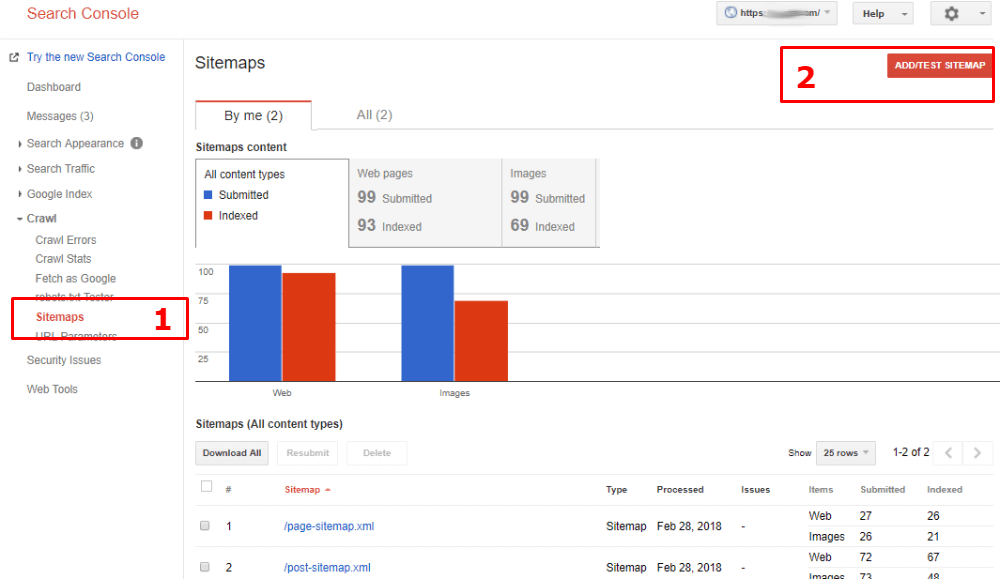
Once you create your sitemap, you’ll want to submit it to Google Search Console and Bing Webmaster Tools. Google Search Console is more important because of Google’s market share, so we’ll quickly go over how to do that.
Go to your Google Search Console, and select the web property for your law firm’s website.
Click “Sitemaps” in the left-hand navigation.
Click “Add/Test Sitemap” in the top right corner.
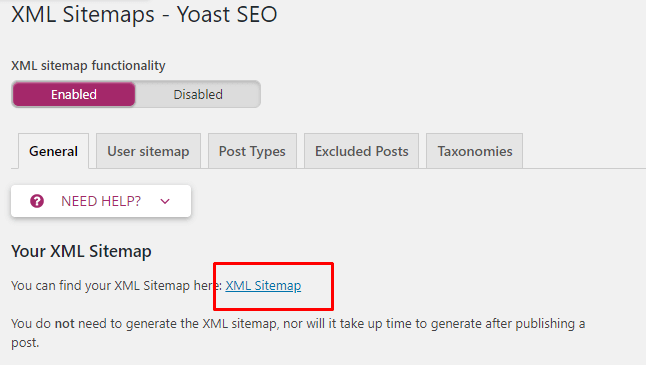
You will then be prompted to enter your sitemap’s URL. If you’re using the Yoast plugin, login to your WordPress account, and select “XML Sitemaps” from the left-hand navigation under Yoast SEO.
You will land on a page that contains your XML Sitemap link. Copy this link, navigate back to Search Console, paste it into the field asking for your XML sitemap link, and click submit.
Submitting your sitemap to Google is a big step toward improving your law firm SEO.
Verify Robots.txt
Robots.txt is like the security checkpoint at the courthouse. Your robots.txt file contains directions about which internet bots can or cannot access your site.
Using a robots.txt file is a way to prevent malicious or spammy web crawlers from accessing your web pages, although some robots can ignore these instructions and access your site anyway.
To find your file, type in your domain and append /robots.txt to the URL. For example, if my site is https://www.tonylawfirm.com, then my robots.txt would be found at https://www.tonylawfirm.com/robots.txt.
If your site is built with WordPress, your robots directive should at least include the following:
User-agent: *
Disallow: /wp-admin/
Allow: /wp-admin/admin-ajax.php
For more specific instructions about how the code on robots.txt works, check out the MOZ article about managing your robots directive.
Check Site Speed
The speed of your site is important for several reasons.
Your website should be fast enough that it doesn’t create a negative experience for your users.
Your site should be fast enough to ensure that your search engine marketing efforts aren’t penalized.
Your site should not be too taxing for a mobile device on a 3G network to load.
With more and more visitors using mobile devices to conduct Google searches, your site needs to be accessible on mobile phones. Smartphones frequently use lower bandwidth connections than a device connected to WiFi. If the slower connection on 3G networks requires 10 seconds to load one of your pages, your website users will probably just visit a competitor’s site that loads faster.
To test and troubleshoot your page load times, use the Google PageSpeed Insights tool. By entering your site’s URL, you can see which technical aspects of your pages can be improved for faster load speeds and happier visitors.
When visitors are happy, Google is happy, and your firm’s website will not be penalized for page speed issues.
Set Up SSL and HTTPS
Making sure your site is secure can add value for both users and your SEO performance. Having an SSL installed on your site should provide users with a green lock and the word “Secure” (depending on which browser you use) indicating that your site is safe to use.
In addition to creating an aspect of trust for your visitors, if your site has an SSL certificate and uses the HTTPS secure protocol, you can conduct financial transactions (like credit cards or PayPal exchanges) directly on your pages.
In addition to user-friendliness, Google announced in 2014 that the use of HTTPS encryption provides a small ranking boost for your site.
Contact your website hosting provider for more instruction on how to change HTTP to HTTPS encryption and make an immediate improvement to your lawyer SEO performance.
Local SEO
Local search engine optimization for lawyers is all about being found for potential clients in your area.
When it comes to legal services, your law firm’s proximity to customers has a big effect on your bottom line. Search engines understand this facet of doing business and have implemented local SEO measures to reward firms that have a strong, locally-based web presence.
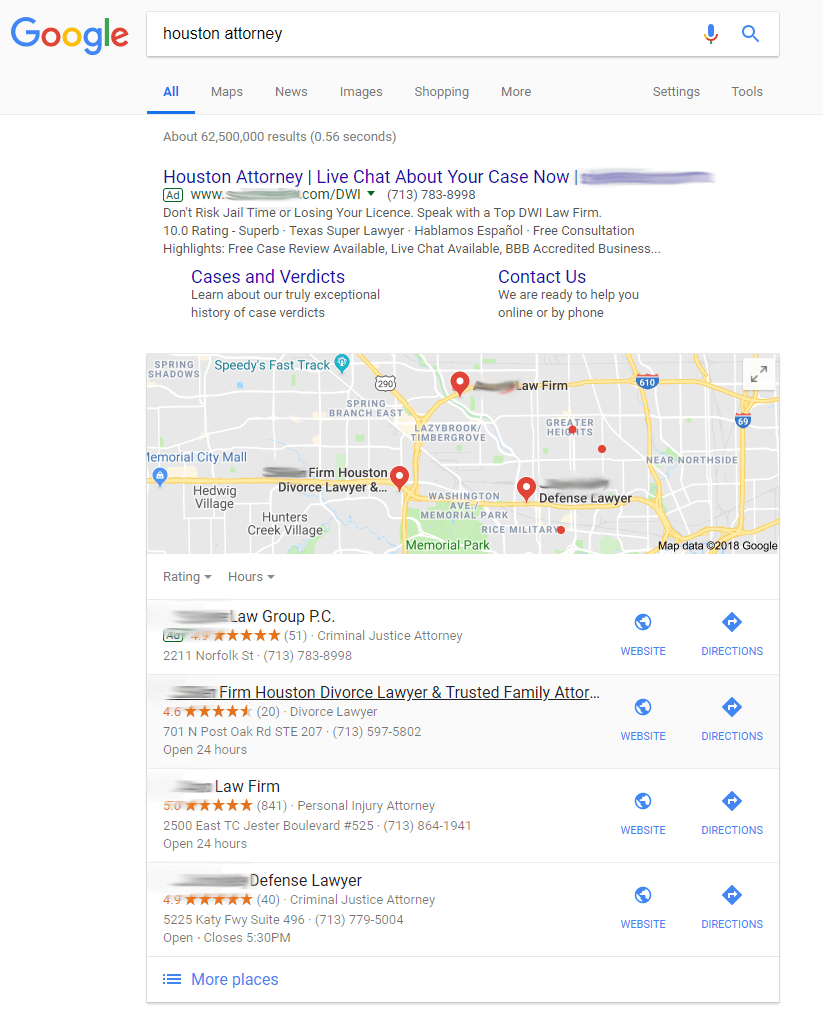
To see an example of local SEO for attorneys in action, consider our “Houston attorney” search query from earlier in this article.
The local map is typically the first thing a search engine user sees when they conduct a local search. For this reason, search engine optimization for lawyers should include a strategy to gain visibility in the local business results, or map pack, for your locality. Here’s how you make it happen.
GMB
Creating or verifying your firm’s Google My Business (GMB) listing is the first step in capturing traffic from your local map pack. You can follow these detailed instructions from Google, but we’ll go over the critical steps here. If you don’t have a GMB listing, your first step will be to visit https://business.google.com/create and create it.
Verify
Unless you’re a new business, there is a chance that your business already has a GMB listing, and you just need to verify it.
You can verify by having a postcard sent to your business’s physical location in the mail. There are even certain periods of time where Google offers an expedited verification process so that businesses can gain control of their listing without sending a postcard.
These special verification periods allow local businesses to adjust holiday hours – making their search data more accurate and helpful for users.
You can’t show up in the local map packs until your business is verified. Make sure to notify whoever internally manages your law firm’s mail that you are expecting a postcard from Google, then finish the verification process as soon as possible.
Optimize
Once your GMB property is verified, you can begin the editing process.
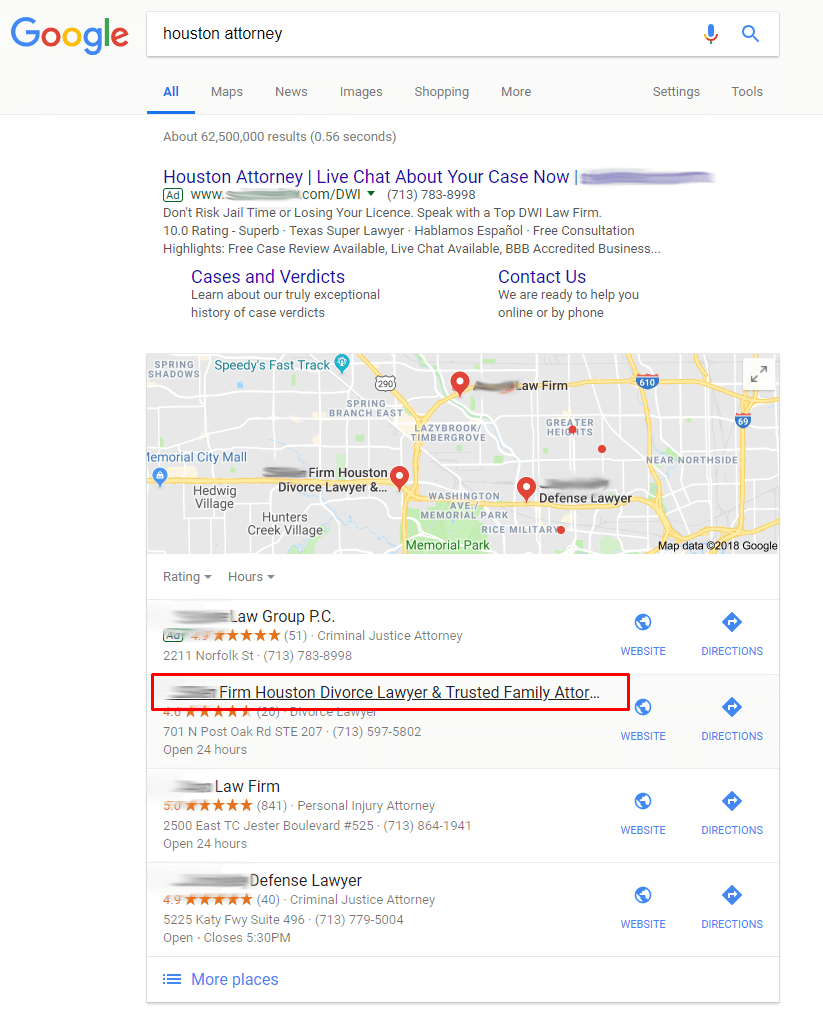
Start by editing your business name, which will appear directly in the map pack, when you’re listed. As you can see from the “Houston attorney” local map pack above, the business name with “Attorney,” in it outranked the listings without that keyword.
Including keywords in your GMB business name will help your local map pack position, but it may also put you at risk if your registered business name or DBA isn’t exactly what you’ve listed.
Competitors could easily report your listing for spamming and cause your GMB ranking to drop. See Google’s business description guidelines for more on the topic of overly spammy law firm listings.
Be sure to enter a business description as part of the optimization of your GMB account. As of March 2018, Google has begun displaying these descriptions in your GMB listing once you click on it from the search results.
The quality and number of reviews that you get for your GMB listing can have a very big impact on your local rankings. Any Austin law firm SEO expert or law firm SEO expert in Houston will tell you that getting recent 5 star reviews can help you nab the top of a local pack in a matter of days.
There are special guidelines on review spam. For instance, paying someone to leave you a positive review is against Google’s guidelines.
Try to generate reviews by asking happy customers to leave a review on your GMB listing. Incentivizing reviews could get you penalized, so offering a quality product or service with consistently great customer support is the best way to influence this SEO factor.
Local SEO Directory Mangement
AVVO, Justia, Lawyers.com, and NOLO are examples of industry-specific legal SEO directories. Earlier in this article, we discussed how you could leverage paid traffic through these directories, but many times a free listing will be helpful too.
Look for locally specific, or niche directory websites that are relevant to your firm.
For instance, a statewide law services listing site can be both helpful for directly driving leads, and beneficial for your search engine marketing.
When adding listings to local directories, make sure you’re using a consistent name, address, and phone number (NAP) for your business. This NAP should also be listed somewhere on your website and marked up with the appropriate schema.
Adding schema markup to your website is a technical SEO task that can be difficult to perform if you don’t have any web development experience.
Social Media
Social media is helpful for just about every aspect of your digital marketing efforts. Even independent of your website, social media platforms can be great for building a highly engaged audience.
However, you don’t own your social media platforms, and they could be taken away at any point due to factors that are out of your control. That’s why you should always try to leverage the SEO-specific benefits that social media channels offer your site.
Most social media sites allow you to enter a website URL in your company’s profile page. Using this option is a great way to connect your social audience to your website once you’ve demonstrated that you are a subject matter expert in your industry.
Like SEO, you want to meet your potential customers where they’re at, and the popularity of social media is undeniable.
In addition to using social channels to drive organic traffic, you can also run social media ads locally. Advertising on social media won’t necessarily help your search engine marketing efforts, but it will help drive relevant traffic to your site at a more predictable rate.
Content Creation
For lawyers who enjoy writing, it’s tempting to turn your website into a collection of professional musings that you’re positive will attract a crowd.
This type of, “If you build it, they will come,” attitude is common, but you won’t find strategic legal SEO service providers taking this approach.
There are plenty of tools that can help you determine what your target audience is searching for online. Once you collect that data, you can systematically address topics with the highest demand that are the most likely to generate leads.
A good starting point for creating web content that will improve your law firm’s search engine optimization is to analyze the websites of your organics competitors.
There is an important distinction between your competitors and your organic competitors. The firm up the road with a 20-year-old, single page website may very well be your competitor, but if they operate mainly off a referral system and highly developed professional network – researching their website won’t get you anywhere.
Conduct a Google search for some of the search terms that you’d like to rank for, then plug the resulting web pages into an online keyword research tool to see what topics their content covers.
Conducting this research will help you identify what your target audience is demanding before you start publishing your expert insights to your website.
Avoid Press releases
If you must publish a press release by paying an online PR company to syndicate your self-made news, you’re probably wasting your money.
Do-it-yourself online press releases haven’t had an impact on search engine optimization for lawyers in quite a few years. Further, self-produced online press releases are very rarely read and can be very expensive with little or no return.
If your firm has done something that is truly press worthy, have someone from Help a Reporter Out (HARO) vet your story and write up their own, genuine press release. News from a real journalist will be much more credible and impactful to your marketing efforts than a DIY press release marketing strategy.
Avoid Paying for Guest Blogs without traffic
Guest blogging is a common way to share your thought leadership and experiences with another company’s already developed audience.
If you have a good relationship with a relevant website that is interested in publishing your content on their site, it could improve your credibility in the industry and even help you build backlinks to your website.
Unfortunately, if you must pay to have one of your guest blogs published on another site, make sure that any links are being “nofollowed.”
Adding the nofollow HTML property to links is a way for you to identify to search engines that an exchange of money took place that ultimately allowed for the existence of the link.
When a link uses the nofollow property, it no longer contributes SEO value to its destination web page. Thus, if you are paying to publish a guest blog post on another site, make sure that site is relevant and could potentially refer qualified traffic to your site. In other words, if a paid guest blog isn’t improving your law firm’s SEO, then it better be generating quality traffic or leads for your firm.
Link Building
As I alluded to in the previous section, guest blogging is the essential link building strategy in your marketing toolbox. When you contribute your unique insights and expertise to another industry website, you can create link citations to specific pages that already live on your site.
Because of the guest blogging process for link building, it’s important that you already have at least a small core of content assets on your site.
These can be standard HTML pages, PDFs, or landing pages for lead nurturing assets like eBooks or whitepapers. Housing this unique content on your site gives you plenty of backlink options while you’re guest posting.
Outside of guest posting, many of the legal service directories from your local SEO efforts will include links back to your site. These links may or may not pass direct SEO value, but having several listings that refer users back to your site will generally benefit your law firm SEO marketing in addition to generating real leads.
Track Campaigns
Whether you plan to do it yourself or hire a reputable SEO company, you need to be able to measure the effectiveness of your campaigns.
Are your SEO efforts resulting in more traffic?
Which pages are the most popular?
When people visit your site, do they read multiple pages?
Are your marketing efforts generating more leads at the end of the day?
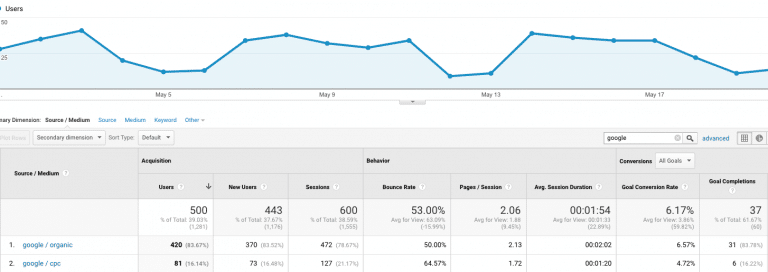
You can find the answer to most of these questions through free tools like Google Analytics, Google Search Console, or Bing Webmaster tools.
If you use WordPress, you can set Google Analytics up even if you aren’t technically savvy. You can search the WP plugin directory for any Google Analytics plugin, create a free Google Analytics account, then copy and paste your JavaScript snippet into your plugin. Going through this process will allow you to track user activity on all your web pages.
One of the often overlooked and under-discussed topics of web design is the amount of time, effort, and money some companies put into building websites that are simply not effective. But, what makes an effective website?
There are many elements that make up a website design. These elements vary in importance. A truly effective website will ensure that the most important aspects are fundamentally solid while allowing for leniency in terms of personal preference or aesthetic choices.
In my previous post on the subject, we discussed the importance of branding for your website. Branding is an important element of your website design but is primarily focused inward on your company and how it is presenting itself. Contact a professional branding company in Houston for more tailored branding guidance.
In this post, we’ll approach your website design from another vantage point and discuss usability. While the result of good branding primarily benefits your company, usability is aimed more directly at the users who are visiting your website.
Of course, when we discuss how users interact with your website it should go without saying that a positive experience is good for your company and a negative experience is bad. So, while we will be discussing concepts in terms of whether they are good for your user, you can assume that if they are good for the user, then they are good for you.
Usable vs useful
Usability is a term that we use in the web design world to discuss the quality of a website in relation to how easy and natural it is for a user to understand, navigate and more broadly use your website.
I think that it’s important to distinguish at this point the difference between a website’s usability versus its usefulness. A useful website can offer terrible usability, and a website that is not terribly useful can offer great usability. The two are not mutually exclusive.
You can tell the difference between the two fairly easily by simply examining the experience you are having. Here are two scenarios to consider:
You frequent a website to gather important information about a topic on a regular basis despite continued frustration in initially finding the information that you are seeking.
You find a website through search that appears to offer information on a topic but after navigating the website in a number of different, but intuitive, ways you determine that the information you are looking for is not on the website.
In scenario one, you have a useful website that offers poor usability. In scenario two you have a usable website that is not useful.
You’d be better off owning the website in scenario one than scenario two, but neither website is optimal.
Ideally, your users would find your website useful and easy to use. It’s that simple.
What makes a website usable?
A number of factors are considered when determining usability. It will vary slightly in the terms used to describe the concepts, but in general, there are five key areas to focus on, which the Norman Neilson Group does a great job of laying out:
Learnability: How easy is it for users to accomplish basic tasks the first time they encounter the design?
Efficiency: Once users have learned the design, how quickly can they perform tasks?
Memorability: When users return to the design after a period of not using it, how easily can they reestablish proficiency?
Errors: How many errors do users make, how severe are these errors, and how easily can they recover from the errors?
Satisfaction: How pleasant is it to use the design?
As you can see, when we examine usability we are looking at a website design from the perspective of the entire lifecycle of a visitor.
We probe into initial interactions, common issues while interacting, the user’s ability to use the site again after leaving it for a period of time, and even how the site makes them feel.
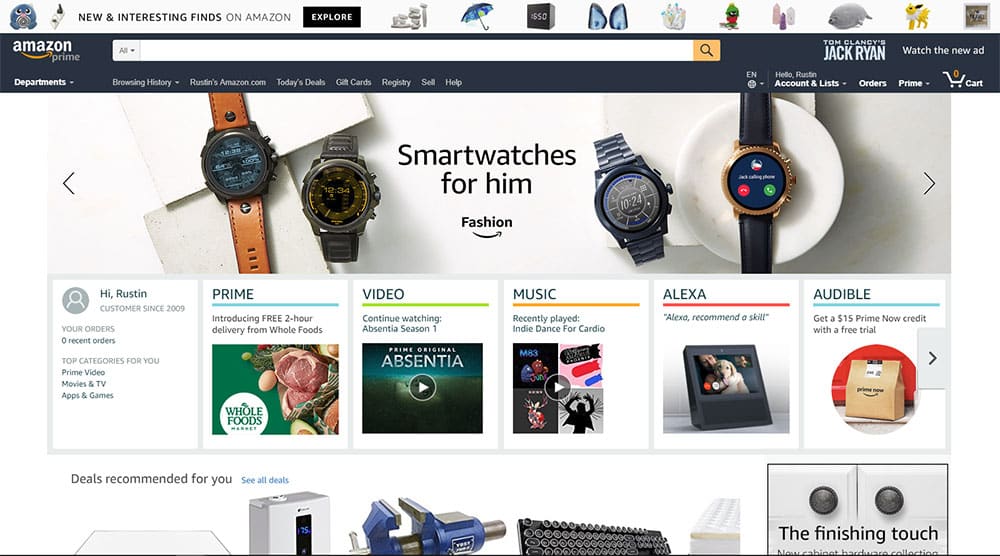
I love Amazon’s website. For me, it is like a beautiful symphony, only one that generates a ton of revenue.
If you look at it from a usability perspective, it’s fantastic. What do most people do on Amazon? They search for a product. So, search is prominently displayed center top and largely at that.
Alternatively, people browse, so we have all sorts of fun ways to browse that cater to every type of person. It is a usability masterpiece.
All of the key concepts of usability are interwoven into the fabric of your website design and affect every aspect of the user’s experience.
For example, if a website is complicated to learn how to use, it can be expected that users will also struggle to remember how to use it the next time they visit, even if they had it figured out the first time.
Struggling to operate a website like this is inevitably going to frustrate the user causing their satisfaction with their website to go down as well.
Luckily for us, the world wide web is no longer in its infancy, at least not from this perspective. We’ve got loads of data and examples of good usability to steal borrow from.
Don’t make me think
If there were a bible for web design, my vote would be for “Don’t Make Me Think!” by Steve Krug. In fact, I’ve already written a post on this simple web design rule if you want to dive a little into the principles he lays out.
For the purposes of this post let’s just discuss it from a high level. It’s pretty simple really, whenever and wherever possible take the opportunity to actively not make a user think about interacting with your website.
Do you have a cool idea about how you could display the navigation section on your website? Well, if you do, I’m sorry to inform you, it’s probably a bad idea.
Users are accustomed to website navigation and making the “cool” change will most likely negatively affect one or all of the five key concepts of usability.
For example, you might think “Let’s put our navigation vertically on the right side of the page. No one does that; it’ll make us stand out.” To be honest, you’d be both right and wrong.
You’d stand out, but not in a good way. Over the years we’ve learned, however subconsciously, that website navigation can be found horizontally at the top of the page or vertically on the left side of the page. Changing that will only frustrate your users.
Let’s look at four common ways that you can ensure that you’re at least covering your usability bases.
1. Keep that navigation top or left
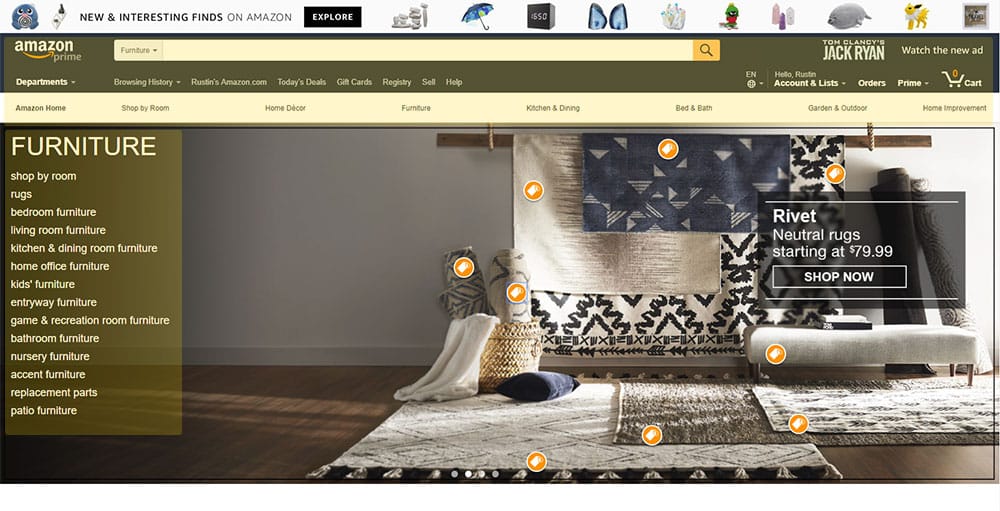
We’ve already touched on this, but let’s reiterate it’s importance. To do so, let’s refer back to that masterpiece of web design, amazon.com. Only this time, let’s look at an interior category page.
Anywhere you want to go on the entire Amazon website can be reached by using only the highlighted areas. Try it out for yourself.
By using the websites that we do, we’ve signed a social contract that says “we agree to look first to top or left of a website for navigational elements.” Don’t overthink this, keep it simple and keep your users happy.
*It should be noted that there is one glaring exception in the case of blogs, which commonly provide post navigation and searching on the right side. There is a reason for this and it’s a long one, so, for now, we will just note this as an exception.
2. Button should look like buttons
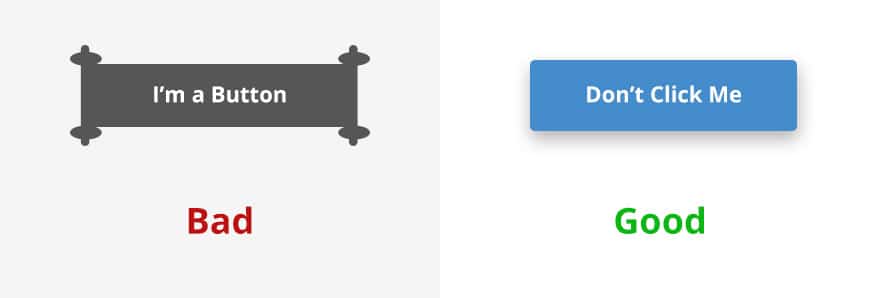
There, I’ve said it. For some reason, people want to get creative with buttons. Buttons are not art projects; they are design elements that are intended to, by their very nature, entice you to click them.
Which of these buttons are you more drawn to click? Yeah, exactly, the one that looks like a button. Extra credit if you noticed that despite what the buttons say, you’re still more inclined to click it, which brings us to our next point.
3. No one is going to read that
There have been studies done trying to understand why more people don’t sign up to be organ donors when they renew their driver’s license. It’s easy; you just check a box that says something to the effect of “Yes, I want to be an organ donor.”
The answer that they found consisted of two things, A) people are inclined to stick with the status quo, and B) people don’t read!
When the question is switched with one that reads something like “No, I do not want to be an organ donor” roughly the same number of people checked the box, and voila, more organ donors.
I see the irony in writing about the fact that people don’t read, but it’s true.
So, if you’re faced with a situation where you have a possibly confusing area or element on your website and your answer is to put instructions there, you’ve pretty much guaranteed a bad user experience.
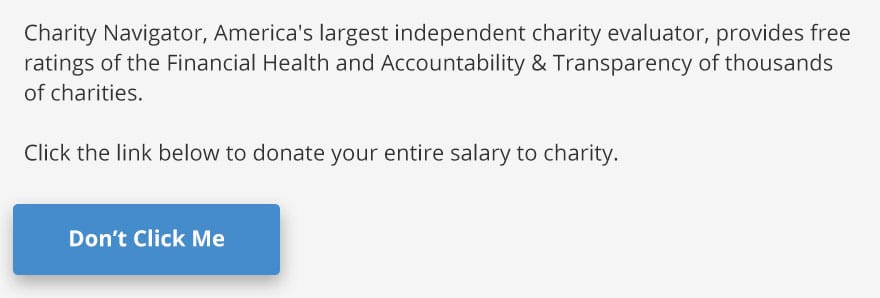
Despite the fact that I have provided instructions that clicking this donate your entire salary to charity, a surprisingly large number of people would click it because they didn’t read the instructions.
The same is true with this example, except now we’ve deprived people of their lottery winnings by not visually representing the button very well and by assuming that they will read the instructions above it or much of anything for that matter.
4. Use headers, lists, and visual cues
Have you read every word of this post to this point? For most of you, the answer is no. As much as I’d like to think my writing is so engaging that you couldn’t bear to skip a single word, I know otherwise.
The fact is that, similar to not reading much at all, when we do read people tend to be skimmers. It’s just how we are wired. We want to get to the meat of the subject without having to go through the pain of reading the surrounding context.
You shouldn’t fight this; you won’t win. Instead, make it easier for a user to find what they are looking for, and they will be more inclined to think that your website is useful… which you will remember from reading earlier in the article… something you definitely read and didn’t skim past, right?
Also, whenever possible, include images, videos, or even gifs. They make your content more visually interesting and engaging.
The Take-Away
Usability may be the most important aspect of your site’s design when determining how effective it will be. The good news is that any reputable Houston web design company will design these elements into your site almost by force of habit.
I hope that the real takeaway from this post is that you have gained a new perspective for judging the quality of the websites that you use.
Sure, a website may not be the most aesthetically pleasing site you’ve ever used, but if it is providing you with useful information in a way that doesn’t make you stop and think about how to use the site, the design is doing an awful lot right.
If you have concerns about the usability of your website, give us a call, and we can discuss it together.
Cosmetic surgery SEO has the potential to attract the right visitors at the right time. Using this proven marketing strategy has the potential to generate significant ROI by attracting only the most relevant audience to your practice.
What Is SEO for Plastic Surgeons?
SEO for cosmetic surgeons stands for “search engine optimization.” All major search engines, like Google and Bing, have organic search results where web pages, like plastic surgery blog posts and videos, are displayed and ranked based on a set of criteria that search engines deem important and relevant to users. If you already know you’re looking for a high-quality SEO company in Houston, then we’ll cut to the chase. Contact MARION today to outline your goals and get a quote for the strategy that will work best for your practice!
How Can Plastic Surgery SEO Help My Clients?
To attract the right visitors, your plastic surgery practice’s web pages must rank well for keywords relevant to your services. To rank well, you must provide the most valuable and relevant information to your users.
Provide relevant and helpful information by addressing frequently asked questions for your clientele. Additionally, you can generate high quality information by providing before and after images of your procedures to demonstrate the effectiveness of your plastic surgery services. You can also improve your plastic surgery SEO by describing in detail the process of each procedure so that clients can form accurate expectations and mentally prepare for their operations.
Benefits of Plastic Surgery Search Engine Optimization
There are several benefits of using SEO for cosmetic surgeons as compared to other marketing strategies.
Higher ROI – Search engine optimization offers recurring returns, if done in a non-deceptive manner. The steady development of authority through blogging, acquiring backlinks and sound website coding can linger if you use white-hat SEO.
Compounding Returns – Because of the lasting rankings that can be had when proper plastic surgery SEO is implemented, your relevant traffic compounds over time. Even as you build backlinks and authority, your web pages will rank for more and more long-tail keywords and be deemed more relevant to more searchers. This drives the right traffic to your site and has a significant effect on the bottom line of your practice.
Visibility Beyond Search Engines – To build backlinks and create social signals, you have to form partnerships with leaders in related industries and develop an engaged audience on social media. Your plastic surgery internet marketing will be developed as a whole during the SEO process.
How Does the Cosmetic Surgery SEO Process Work?
According to research by Brafton, 89% of consumers turn to a search engine before making a purchase. If you want to take your product to market, you now know where to find them.
To build your practice’s SEO strength, you will have to use a mix of the following:
Technical SEO cleanup
On-page SEO improvement for plastic surgery service pages
1. Technical SEO Implementation on Your Practice’s Site
Unless you’re new to the industry, you’ve probably already invested in a website for your practice. It may be very aesthetically pleasing, but unfortunately, many designers don’t know or don’t care to implement the proper coding for plastic surgery search engine optimization.
For instance, your website might be resource heavy. It could include several stunning high-resolution images with an autoplay video on the homepage. If these resources are not optimized correctly, they could be driving your site speed up, destroying your organic rankings and causing a bad experience for visitors to your website.
Technical SEO for plastic surgeons can help reduce your site speed, which will have a positive impact on both your desktop and mobile rankings. Beyond rankings, improving your site speed will help streamline the experience of your users, and keep your prospects and current clients happy.
2. On-page SEO for Your Service Pages
Creating pages that outline each of the cosmetic procedures you offer is a critical part of your plastic surgery digital marketing strategy. To the untrained eye, it may be easy to figure out what you page is about. For search engines, it may be difficult to parse your text and learn why your services are any better than the competitions.
On-page SEO for surgeons can help set you apart from your competitors by making it clear which services your practice offers and why you’re better than the next doctors. Optimizing the message of the copy and images on your service pages is the first step toward improving your rankings in organic search. By incorporating the right keywords in the right places on your pages, you’ll have a leg up on the other cosmetic surgeons in your area.
If you’ve done some of your own SEO research, you might be asking – are keywords still important for SEO? While targeting a single keyword is a thing of the past, focusing your page on a thoroughly researched related group of keywords is the new standard in SEO for plastic surgeons. This allows your service pages to fully serve the intent of users that land on your website.
3. Content Marketing for Plastic Surgeons
For users and search engines to know if you’re truly a leader in your industry, you can’t use every page on your plastic surgery website to promote yourself. Instead, you should demonstrate your expertise by blogging about new industry practices, how your procedures work, and preparation/recovery tips for patients.
This approach is called cosmetic surgery content marketing. Not only will publishing content around these topics help educate your prospects and current customers, but it will also help search engines verify that your website deserves to rank highly in the search results.
Writing and content creation isn’t just a department within your organization’s marketing team; it’s an informational bridge that emotionally connects potential patients to your practice’s bottom line.
[su_spoiler title=”What is Content Marketing for Cosmetic Surgeons?”]
Content marketing is when you create an educational piece of marketing collateral for your target audience. In digital marketing for plastic surgeons, this mainly entails web pages, your blog, eBooks, whitepapers and even informational email campaigns that cover subjects relating to plastic surgery and your individual medical practice.
[/su_spoiler]
[su_spoiler title=”Leverage Plastic Surgery Content Marketing to Become a Thought Leader”]
Content marketing positions you and your practice as an influencer in your market. When your potential customers use search engines to investigate solutions to their cosmetic problems, your content will be there to education them. Potential clients will come to know you as an expert, and trust you to perform their procedure when they are ready to buy. This type of inbound marketing for plastic surgeons can reduce your need for back-office workers.
[/su_spoiler]
[su_spoiler title=”Publishing Content Can Lead to Higher Profit Margins”]
Your content marketing should leverage educational content and persuasive, emotionally stimulating insights to nurture potential patients through their customer journey. This results in quicker and more steady sales cycles, less administrative overhead, informed expectations about cosmetic surgery procedures, and more robust profits for your surgical practice.
[/su_spoiler]
[su_spoiler title=”Content Marketing Helps You Avoid Commoditization”]
Content creation allows you to engineer a more trusting and informed following of potential patients. When you implement the right plastic surgery marketing ideas, you can prequalify your audience, and build trust that allows your practice to charge premium prices.
High quality content lets you position your plastic surgery services as the industry-leading solution to their unique problems. This reduces commoditization of your offerings, and helps you avoid a competitive pricing race to the bottom.
Interested in learning more about content marketing services for your practice? Contact MARION today.
[/su_spoiler]
[su_spoiler title=”Your Content Marketing Converts Visitors into Patients”]
The content marketing on your website and related digital channels helps turn visitors into paying customers. An aesthetically pleasing website paired with compelling and influential content will keep would-be one time visitors coming back for more. Your content is a story-telling vehicle that can help customers realize that your cosmetic procedures are right for them. You then use your trust and thought leadership to motivate visitors to contacting your plastic surgery center.
[/su_spoiler]
The Importance of Blogging for Plastic and Cosmetic Surgeons
Blogging is an important way to tell your story, and inform readers about the advantages and disadvantages that certains procedures offer. Use top-of-funnel subjects to educate visitors about how certain procedures are performed. You can also use middle-of-funnel topics to talk about pricing comparisons, why your experience positions you as the reader’s plastic surgeon of choice, and why certain techniques are safer than others while providing the same outcome.
Make sure you always write or hire a professional content marketing agency to create unique plastic surgery content. Simply curating, or even copying content that has been published elsewhere in the industry can be damaging to your brand, and will not help your website’s SEO.
Search engine optimization guidelines indicate that unique content that highlights your medical practice’s insights is more useful than duplicate content. Create unique content that doesn’t stuff your target keywords into your website, and you’ll be on the right track to plastic surgery SEO and content marketing success.
[/su_spoiler]
[su_spoiler title=”Highlight Your Unique Selling Points”]
Content marketing for plastic surgeons should leverage unique selling points of your services. If you use a less expensive or more effective technique than your competitors, relay that information to your audience. If certain procedures have been proven not to stand the test of time, seize the opportunity to upsell your readers on a more expensive, but higher quality cosmetic operation.
[/su_spoiler]
[su_spoiler title=”Publish Your Content Regularly”]
Content marketing is not a one-and-done tactic. Marketing with content is a long-term strategy that requires a time investment. A regular publishing schedule will indicate to both readers and search engines that you have frequent and meaningful insights to share. This can help position your cosmetic surgery practice as an industry leader.
[/su_spoiler]
[su_spoiler title=”Content Marketing Is the Intersection of SEO, Social Media, and Patient Education”]
Your plastic surgery content marketing ties together strategies for search engine optimization, social media, and educational content for potential and existing patients. You can reduce the burden of frequently asked questions from your existing customer base, and attract new customers with the same set of content. You can also use your educational content assets to build loyalty and trust while promoting your brand to new audiences.
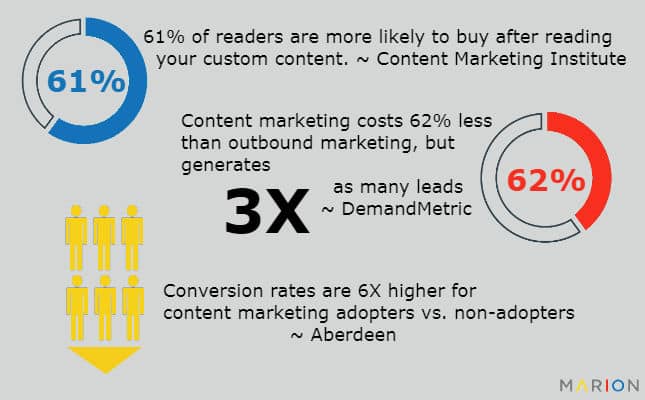
Take a look at the following stats about the effectiveness of cosmetic surgery content marketing.
61% of potential customers are more likely to buy after reading custom-made content ~ Content Marketing Institute
Content marketing costs businesses 62% less than traditional outbound marketing, but generates 3X as many leads ~ DemandMetric
Conversion rates are 6X larger for content marketing adopters vs. content marketing non-adopters ~ Aberdeen
[/su_spoiler]
[su_spoiler title=”Plastic Surgery Patient Personas”]
When you’re creating content for your target audience, make sure you know who you’re speaking to. Create at least one, but potentially two or three personas that embody your ideal potential patient. Include some of the following characteristics to start:
Goals
Frustrations and challenges
Potential objections in the purchasing process
Probable occupation
Income range
Level of education
Creating these personas will help you pin-point who you’re talking to, and better understand how to persuade them that your surgical services are exactly what they need.
[/su_spoiler]
[su_spoiler title=”Content Marketing Audit”]
Content marketing professionals will always start with an audit of your existing content. This could be extensive if you have a broad existing base of cosmetic surgery information on your website. If your digital presence is fairly new, the audit will be quick.
[/su_spoiler]
[su_spoiler title=”Competitive Analysis of Plastic Surgeons in Your Market”]
Your content creation will need to be informed by real data. After a content audit, content marketing services will determine the direction of your strategy by doing a competitive analysis. This may require analysis of competitors in your location, or within your niche (if you have one).
This data can be used to improve the SEO underpinnings of your content marketing strategy, and inform your efforts about the most in-demand topics.
[/su_spoiler]
Why Use Content Marketing at Your Practice?
Content marketing allows you to sell thoughts and expertise that enrich your services and command premium pricing. This is the fastest way to building trust and generating demand for your services.
[su_spoiler title=”How Much Will Content Marketing Cost Me?”]
The cost of content marketing for plastic surgeons will depend on your business goals, location, and your level of involvement. Monthly fees could range between $3,000-$6,000 per month, or less if you are assisting in the content creation process. This typically includes content for SEO on your website, as well as social media and email content creation. The price of cosmetic surgery content marketing will hinge on your unique situation. Contact MARION marketing today for an individual quote on content marketing for your practice.
[/su_spoiler]
[su_spoiler title=”How Is Content Marketing Effectiveness Measured?”]
There are high-level indicators of success such as pageviews, new user count, click-through rates, and time-on-page, but these metrics only tell part of the story. At the end of the day, the effectiveness of plastic surgery content marketing is measured by return on investment.
Which leads were you able to convert, and did you acquire those leads through content marketing? That will determine the success of your content marketing efforts.
[/su_spoiler]
[su_spoiler title=”How Long Does It Take Before I See Results?”]
Content marketing and its SEO benefits are realized over the long term. When done properly, your content marketing strategy is tied to the operation and growth of your business in a highly meaningful way. It will take time to build content assets clustered around a surgical procedure that you offer, and then leverage that content to guide your audience to contact your practice.
Most practices that use content marketing will begin to see real improvement in their bottom line after about 9 months, but your individual content plan and budget could make this happen sooner or later.
[/su_spoiler]
[su_spoiler title=”What to Expect in the First Quarter?”]
During the first three months of implementing content marketing, MARION follows a monthly update pattern that will keep you in the “know,” and help you keep a pulse on your content’s effectiveness.
[/su_spoiler]
[su_spoiler title=”Trust the Content Marketing Experts at MARION”]
Our team is highly experienced in content marketing for plastic surgeons. Let us help drive your content creation, and give you the competitive edge you’ve been waiting for. Contact us today to speak with one of our experts about what content marketing can do for your practice.
[/su_spoiler]
There are many benefits of blogging for business but better search rankings and educated customers who are willing to pay a premium for your expertise are two of the best reasons to start blogging today.
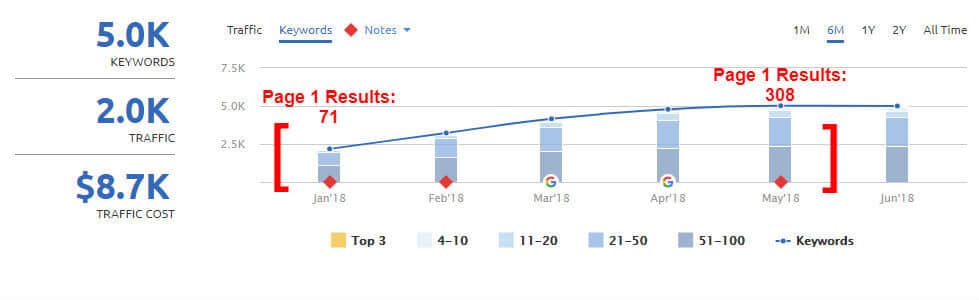
The above is a screenshot of a content marketing campaign that MARION recently led for a Houston plastic surgeon. Through blogging and on-page SEO implementation, the client grew from 71 page one search engine rankings in January to 308 page one rankings in May. That’s a 231% increase in page one rankings in just four months!
4. Building Backlinks for Your Cosmetic Surgery Practice
The final pillar of plastic surgery SEO is building links to your site. Links to your website are the digital equivalent of a new customer referral from a previous patient.
A link building strategy will help speed up the process of acquiring backlinks from relevant websites that find your content useful. Link building is one of the most difficult pieces of plastic surgery internet marketing, because your services or advice have to be truly exceptional for a site owner to endorse you to their digital audience.
The best starting point for link building is to have content worth linking to in the first place. Do competitive research with specialized online tools to learn which types of content garner links for your competitors. Then, create a version of your own that is more valuable and helpful to your target audience. Promote you content through email marketing, social media marketing and even direct email outreach to relevant professionals in the industry.
Don’t Take on SEO for Cosmetic Surgeons Alone
Doing your own cosmetic surgery SEO requires a substantial amount of education on the latest SEO practices and a huge investment of time. Make the best use of your time and money by partnering with an experienced Houston SEO agency. Contact MARION today, and learn what our experts can do to turn your website into a revenue-generating machine.
Today, having a company website is no longer enough to stand out among the thousands of competitors you compete with in the digital space. Blogging isn’t just a place to host your company press releases, it’s about providing valuable content to your future customers.
What is Business Blogging?
Business blogging is a marketing tactic used in a business’s overall marketing strategy. It is a digital publishing channel on a company website that helps support business growth through content marketing and writing insightful, educational articles. Business blogging has been known to improve a website’s SEO.
No matter what kind of business you have, whether you’re a local mom and pop shop, or a giant corporation, there are some serious benefits you could be missing out on if you aren’t keeping an active blog on your website.
5 Benefits of Blogging for Business
Although the benefits are seemingly endless, we’re listing our favorite top 5 benefits of business blogging.
1. Creates Brand Authority
Consistently updating an active blog for your business, allows you to personify your business by giving it a voice. Your blog is a space to discuss industry related topics, market trends, and upcoming products. Focusing on these topics actively builds brand-trust. Trust generates leads. Leads grow sales. Can you see where this is all going?
When you utilize your blog effectively, you are creating a two-way conversation between you and your customers, prospects, and other industry professionals which can be very helpful for gathering insights for future business development.
Having an active blog helps you to stay ahead of the curve when it comes to industry news and competitors. By staying ahead of the curve, you are positioning your company as a leader as opposed to a follower. Your blog also serves the purpose of having a place to share your brand story, although it should be noted that it’s not advised that you blog only about yourself as a company.
2. Business Blogging Fuels Your SEO
There are some pretty obvious SEO benefits blogs can offer, such as viewers spending longer amounts of time on your website, increasing page views, and lowering bounce rates. However, it’s also important to mention that search engines love valuable content and reward it with higher search result placements. Because of the effectiveness of blogs for ranking more highly in search results, most SEO companies will provide content marketing services.
As more people are putting out content to capture the attention of search engines, the algorithms are getting smarter. Your business blogging content should focus on having frequent high-quality content as opposed to having constant poor-quality content.
In addition, your blog should contain a minimum of at least 500 words. However, if you have the capacity to write longer blogs, you should always opt for the latter because Google favors in-depth blog articles.
Having high-quality content helps generate inbound links from other authors, journalists, and bloggers in your field. Not only are these types of links beneficial for your SEO, but they also generate greater amounts of referral traffic linking back to your site.
3. Supports Your Social Media Advertising Efforts
Using blog articles for your sponsored posts campaigns on both LinkedIn and Facebook ad platforms have been proven to be very effective. Depending on the nature of the industry, boosted blog posts typically generate more engagements as opposed to generic click campaigns. This increased engagement impacts your overall organic reach for the post, which essentially means you are getting more viewers and spending less money as you’re running your ad campaigns.
Asides from using blog content for your ads, leveraging your blogs throughout your social media content also increases the chances of gaining extra exposure. When writing your blog topics, you should always have in the back of your mind, “what would make people want to share this content with their followers?” When you can write a blog that is so interesting that others will want to share it, you are ultimately gaining free exposure.
Pro Tip: Always ensure to include a good mix of evergreen content in your blog. Evergreen content allows you to recycle your blogs on social media as you continue to gain new followers, who may not have seen your blog the first time you posted it.
4. Generates a Great ROI
Business blogs are cost-effective marketing investments. Many business owners choose to outsource their blogging to content marketing services because it can be a time-consuming task when you are already wearing multiple hats for your business. While this is perfectly fine, an ideal situation would be to have a mixture of both outsourced and native blogging content.
Blog posts are fairly cheap to create and show proven results over time. According to Hubspot research, B2B marketers who use blogs as part of their content marketing mix get 67% more leads than those that don’t.
5. Blogs Serve as a Lead Generation Tool
Blogging is an integral part of your digital sales funnel. In addition to driving traffic to your website, business blogging is a great opportunity for getting leads for your business. By using non-intrusive lead capturing tools such as lead capture forms and call-to-action buttons at mid-points or the bottom of your blog, you can gather valuable data on the quality of leads your blogs are generating.
How many times have you read a blog, and downloaded a free e-book because you were interested in gaining more insightful information about the topic you were reading? If you recall a moment where you have personally done this, congratulations! You were successfully moved from the inbound marketing stage of attraction to the stage of conversion.
Each blog post you create is an additional page that can be indexed by Google, which can be used with a combination of lead generating call-to-action buttons such as free webinars, fact sheets, and eBooks. Asking for emails isn’t an easy task, but when you offer valuable data in exchange for emails, you can leverage it for better prospecting.
The Takeaway
Although it can be difficult to find the time to write quality blogs, you don’t want to neglect the benefits of blogging for your business has to offer. By utilizing your local outsourced marketing services, your blogs can serve as a central piece for all your other marketing efforts which can include, social media marketing, SEO, email marketing and much more.
Did you know, internet video traffic is expected to be over 80% of all consumer traffic in the next four years? The digital landscape has constantly been changing for the last ten years. If by now you haven’t heard all the rage about video content, and how it can drastically improve your marketing efforts, you might be living under a rock.
Many marketers are referring to the year 2017 as the year of video marketing. Why? Because video content is POWERFUL. Even though video content has some of the best ROI in the industry, less than 60% of business are utilizing it.
Why Should You Be Using Video Content?
As the human population continues to dive deeper into information overload, our attention spans are getting shorter. When you combine shorter attention spans, with people who are always on the go, it shouldn’t come as a surprise that people are four times more likely to watch a video about something than reading about it.
Video content also has a higher recall retention rate than any other content. Facebook and Nielsen teamed up to gather data about Facebook’s video platform and learned that 74% of the total Ad Recall can be achieved within the first 10 seconds of the video.
How Should You Be Using Videos?
There are a number of ways that videos can be used to the benefit of your marketing strategy. Many businesses are ignoring video content because they don’t believe that they have the resources to take advantage of it. Truth is, you don’t need a long professionally produced video by Michael Bay for it to be successful. In fact, over 56% of videos published last year are less than 90 seconds long.
Below we’re listing some of the more common ways you can use videos and what kind of benefits you can expect to reap from using this content medium.
1. Branding
Let’s face it, a traditional “About Us” page on a website rarely ever resonates with people in the year 2017. What can make a tremendous difference is video content that conveys the story of how a unique company got started and the celebrates the company culture.
Video content also sets the overall tone of the brand for the company while delivering important messages you want your consumers to know. Let’s take a look at this great example from Black Rifle Coffee Company
From this 37 second commercial, you can tell that what makes this coffee company completely different than the thousands of other coffee companies that exist, is that they not only have an adventurous and humorous tone, but they are also huge advocates for supporting American veterans.
Video allows viewers to associate emotion with your brand’s message which makes it a very effective medium for branding. Storytelling through video content helps your consumers feel like they relate to your brand which can creates brand preference and authority for your brand.
2. Native Website Content
Did you know 1 out of 4 consumers reported losing interest in a company if they don’t have video? In addition to telling your brands story through video, there are many other ways to use videos for your website content such as explaining how a complicated product or service works.
Another great method of using videos for your native website content is through customer created testimonials videos which can take the load off of some video production while also providing great valuable and emotional content for your website.
Product demonstration videos, testimonials, or even a video of your FAQs could also be incredibly effective at increasing your conversion rates through your landing pages. In fact, multiple studies have shown that adding videos can increase your conversion rates by 80%.
3. SEO
Aside from telling your brand story and creating visually appealing content, video content also has great search engine optimization benefits. While it’s okay to have your video content formatted directly on your website, it’s not a bad idea to link them from your YouTube channel. After all, YouTube is the second largest search engine in the world right under Google.
Speaking of Google, YouTube is owned by Google. It should go without saying that having videos on YouTube and on your website will boost your SEO efforts. However, if you decide to host the video on your website without YouTube, both the video and supporting text will still help the page ranking pages because your website traffic will likely stay on your website longer which dramatically improves your bounce rate.
4. Social Media
Using video content from your website on your social media pages is a great way to give your brand exposure. Every day there are over 500 million people watching videos through social media platforms. On Facebook, videos are currently getting the 135% more organic reach in comparison with all the other types of content.
Not only does the Facebook algorithm love videos, but so do Facebook users. Facebook users generate 1,200% more shares of video content than text and images combined! These statistics ultimately benefit your business by saving you money when you start using Facebook ads.
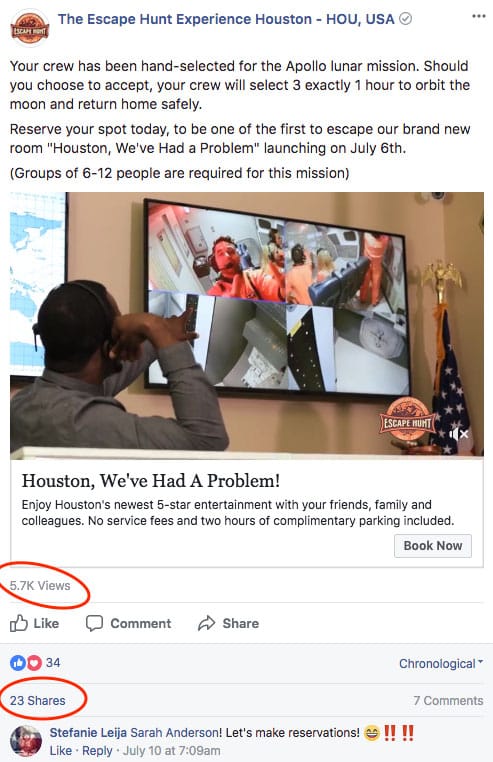
At MARION, we put these reported social media statistics to the test, as we created a Facebook ad campaign for our client Escape Hunt Houston. Both of these Facebook ads were in the same campaign with the same budget, for the same amount of time. Can you tell which one of these was a video versus a still frame photo?
Another great way to take advantage of social media for video content is using the Facebook and Instagram live stories feature. This alerts all your current followers that you are broadcasting live and allows them to directly interact with your brand and see the real roots of your brand. Some great ways to execute live story videos is conducting live interviews with influencers in your field, showing how something is made or conducting a live Q&A with your fans and followers. Once the video is done showing live, it will reappear on your feed and live on your social media forever for your future audience to see.
Pro Tip: Still need some inspiration? Check out this list from HubSpot of major brands who executed their own watch-worthy Facebook Live videos; you’ll notice most of them feel very organic and not as if a scripted production.
5. Email Marketing
Email marketing might not be an obvious place for your video content to live, but did you know that videos inside of an email marketing campaign actually provides a 20% boost in open rates and higher click-through rates? In addition, email subscriber dropout is also reduced by 75% when video is incorporated.
Given that email marketing and video marketing has some of the biggest ROI in the marketing industry, why wouldn’t you combine these two together for explosive results!
The Takeaway
It’s no doubt that video content is worth the investment, regardless of how you plan to use it. If there is one common denominator that we can pull out of these 5 ways to incorporate video in your marketing mix, is that people really love videos whether or not they realize it.
Just like all your other internet marketing materials, if you start using video content and find that it doesn’t start generating better numbers for you, it may require some tweaking. Some examples of ways you can tweak your video content can range from website placement to choosing whether or not to play automatically. If you still need help, you can always contact us to start getting your video campaigns headed in the right direction.
Have you asked yourself recently why you’re not taking advantage of the video marketing revolution?
Influencer marketing is big with companies looking to reach people in new ways. After all, the average consumer is more marketing savvy than ever and it is easy to become “white noise.”
More and more companies are looking for creative ways to reach their potential customers and effectively deliver their marketing message. Going through someone they trust and admire is a great way to make sure their eyes are on your product or service.
Working with influencers can do more than just get your name out on social media though. It can also help boost your search engine optimization so that more people can find you when they use Google.
In this post, we’ll look at what Influencer marketing is, how it works, and the positive impacts it can have on your search engine traffic.
What is Influencer Marketing?
Influencer marketing focuses on using thought leaders, industry leaders, and popular figures to deliver your brand’s message to a broader audience. Rather than delivering your brand’s message through traditional and online advertising channels to your target audience, you instead engage with, partner with, or pay influencers to deliver your message for you.
Most commonly Influencer Marketing is used in conjunction with content and social media marketing. Most Influencer Marketing campaigns involve a company creating content or the influencer creating content which they then spread through their social media channels, which generally have large and often targeted audiences.
Because this content is either created or curated by a trusted figure in the lives of your target audience, many of the barriers that you face in advertising are hurdled, and your message is more likely to be received and accepted.
According to a McKinsey Study, marketing-inspired word-of-mouth generates more than twice the sales of paid advertising, and these customers have a 37% higher retention rate.
If you’re curious about how brands are using Influencer Marketing, HubSpot has recently published a great post highlighting ten fantastic uses of influencer marketing, including this gem featuring Nick Offerman (though it is quite long).
Using Influencer Marketing for SEO
While Influencer Marketing can provide fantastic benefits for your marketing in the short term, it also has the power to effect long-term change.
Given that Influencer marketing is content based and driven by social media, it can have a positive, even dramatic, impact on your visibility in search engines, and should be at the top of your “to-discuss” list with your SEO company.
1. SEO Boost from Engagement
The goal of any good marketing strategy is to have your potential clients engage with your brand, and influencers make this happen more organically.
When they mention your product and send customers your way, those people are likely to do a deeper dive into your website and content – and they’re more likely to read instead of skim, to linger instead of leave.
This increased engagement also helps your SEO, because Google factors in things like time spent on your pages and your bounce rate when determining its rankings. When an influencer steers viable prospects to your site, their engagement boosts your search engine ranking, leading to a better presence and even more hits.
2. SEO Boost from Backlinks
A great influencer will link to your site, your social media, and your blog frequently when they write or make a video about how much they love you.
Search engines take into account the number of backlinks that connect to your site when ranking your pages, so your influencer is doing some great SEO work for you – even if they don’t realize it.
Work with your influencer to connect to particular pages, and encourage them to use all their platforms since backlinks from a range of sources will give you more unique content mentions, which search engines love.
Additionally, good influencers will likely have followers who are influencers themselves, just on a smaller scale. Often these sub-influencers will repurpose content from their influencer icons for their own purposes, generating even more backlinks to your site.
3. SEO Boost from Social Media
Don’t forget that more people than ever are using their favorite social media platforms like search engines.
When your influencer gets your name out on Twitter, Facebook, and Instagram, your brand is ready and waiting to be found when someone searches. Expanding your reach into non-traditional search engines is a great way to make sure that everyone finds you – not just Google.
But beyond the inherent benefits of being found on social media is the idea that as your brand’s reach on social media grows, so will your SEO rankings.
While the jury is still out on just how important social signals are for SEO, it’s fair to say that they are part of the whole picture that search engines look at when determining your ranking.
Having an increased presence on social media is shown to be correlated with higher search engine rankings. A Cognitive SEO report indicates that “on average, presence on social networking sites (which includes likes, shares and comments on Facebook, plus shares on Google+, LinkedIn, and Pinterest) is negatively associated with site rank, and the relationship is close to linear (and perfectly linear for the first 5 ranks). This means that, in general, the smaller the rank number is (so, the higher up the website), the higher the chances are that the average presence on social network is larger.”
The Take-Away
Working with an influencer isn’t just a trendy way to get millennials to like you. It’s also a solid plan for improving your search engine presence and making sure you’re ranking when people are looking for your product or service.
As with all online and offline marketing, it’s important to look at all of the consequences of any marketing endeavor that you may undertake, both good and bad.
Luckily for almost everyone involved, Influencer Marketing, if done well, can be an effective way to build your brand, promote your products or services, and in the process, add to your SEO foundation.
Just pick your influencer wisely and ensure that they stay on message, you don’t want a good thing to go bad.
It’s hard to be number one. It’s hard to get there, and it’s hard to stay there. It’s true whether you are talking about sports, business, or how well your website shows up in search results.
In fact, the better optimized your site is, the harder it becomes to optimize it any further. The highly-trusted SEO resource Moz ranks a website’s optimization on a scale they call Domain Authority. Here’s how they explain it:
Domain Authority (DA) is a score developed by Moz that predicts how well a website will rank on search engine result pages (SERP). Domain Authority scores range from one to 100, with higher scores corresponding to a greater ability to rank.
Most websites rank somewhere between 40 and 50. Anything between 50 and 60 is considered pretty good, and over 60 is considered excellent. The tricky part is that it’s a logarithm, meaning that the higher your score is, the harder it is to improve it.
We score Domain Authority on a 100-point, logarithmic scale. Thus, it’s significantly easier to grow your score from 20 to 30 than it is to grow from 70 to 80.
The point of all this talk about Domain Authority is simple; this article is about the “low hanging fruit” mistakes in SEO. These are mistakes that will keep you from reaching a Domain Authority of 25, not 75.
The 6 Most Common SEO Mistakes
If you have a well-established website with a pretty good Domain Authority, there is nothing that will help you raise your search engine profile outside of the elbow grease necessary to build, maintain, and grow a strong website.
So, with that in mind, let’s make sure you’ve got your SEO basics covered.
1. Not Having Unique Title Tags and Meta Descriptions
Every page on your website should have a unique title and description. These are two important pieces of information that search engines use. The title of a page is an important factor in how search engines determine what a page is about and the description is displayed in search engine results below the page title.
These two items are also nicely aligned with the theme of building a strong website. These two items are used in everything from how the page is displayed on your browser tab, to what is displayed when you share a link on social media.
Make a point to include both the subject of the page and your company name on the title of each page. Most websites use a format similar to “Page Subject – Company Name.”
Be realistic in the keyword phrases that you target. Remember that you are not the only website that wants to be number one for any given keyword or phrase. The likelihood is that there are websites out there competing for the same keywords or phrases as you that have been at this a lot longer than you.
If you operate a flooring company in the Plano suburb of Dallas, Texas don’t try and optimize your site for the keyword “flooring company.” That is a nationally competitive keyword and one that you are likely not going to rank well for, local results withstanding.
Instead, opt for the more appropriate and less competitive localized keyword “flooring company Dallas,” or better yet “flooring company Plano.” These keyword phrases will have significantly less competition giving you a much greater chance of showing up well for relevant searches.
3. Writing Poor Content
There are not many constants when it comes to the internet. Things change quicker than just about any other arena in business. There are two things that have remained the same since early in the days of Google, though.
The first, content is king, has always been king, and will forever be king. Content is the backbone of the internet. The internet, for the most part, is just a giant content delivery machine. Whether it’s informative, entertaining, or somewhere in between, your content must be good to get delivered.
The second, backlinks matter. Since the early days, Google has looked at the number and quality of websites that link back to your website as a factor in determining if your website is good enough to return in their search results. If you want websites to link to yours, you need to create content that’s worthy of a link.
When it comes to content, it’s important to remember that the whole point of SEO is to bring more people to your website, but don’t lose sight of the bigger goals. Don’t neglect to put as much effort into keeping them on your site as you do in getting them to your site.
4. Alt Tags for Images
The internet has become a visually stunning experience in many ways. Our ability to use images to create beautiful websites has come a long way.
Using images in your designs has huge upsides from a human perspective. They engage people, draw them into your content, and often help to convey your message or explain complex concepts with ease.
However, images are virtually non-existent to search engines unless you explain to them what they are. Ensure that all your images have alt tags that contain descriptions of the content of your images and include relevant keywords where appropriate.
5. Not Optimizing for Local Search
One of the lowest hanging fruit on the SEO tree is optimizing your site for local search results. Tying your website to a physical location helps your website show up for searches that are local to your area.
Optimizing locally may not be a high priority for sites that operate nationally, like eCommerce websites, but for most small to mid-sized businesses getting listed in local results is a great way to get on the search results scoreboard early.
We’ve discussed this in our post on how to get your business online in 5 steps, but the most important way to optimize locally is to submit your website to legitimate local business directories and mapping sites like Google My Business.
Once you have a listing on Google, work to build that presence with images and reviews. Adding a reputation management system into your marketing mix is a great way to grow your business’s online reputation effectively.
6. Trying to Get Away with Something or Beat the System
Not working to fool or beat Google’s algorithm is a point that we discuss early and often with our prospects and clients. It’s incredibly important for you to understand that, at the end of the day, Google only cares about one website… Google.
Google’s business is built around providing people who are searching for things with the best results for their searches. There’s a reason we say, “I’ll Google it” and not “I’ll Yahoo it” or “I’ll Ask Jeeves it.” Google won that battle a long time ago, and they did it by returning better search results.
Over the years there have been countless ways to “beat the system.” There have been ways to cut corners and get higher rankings quicker, and sometimes they worked, at least for a little while.
One thing always holds true, these ways of gaining an advantage always stop working. Google will find a way to block or even penalize the loophole that you have found, so just don’t do it.
People expend so much energy and capital chasing down SEO ghosts and myths and never see the kind of results that they want. Imagine if they just spent the same energy and capital building, maintaining, and growing a high-quality website.
If you cut corners you may see gains in the short term, but not the long term. And when it comes to SEO, the most successful websites are the ones that play the long game, not the short.
The Take-Away for Avoiding These Common SEO Mistakes
If you’re just starting out with your SEO strategy or have recently launched a new website, fixing these common marketing mistakes could mean serious gains for your organic reach. SEO for new websites can provide significant short-term results. If you have a solid foundation but haven’t yet seen the SEO results that you hoped for, experienced SEO companies in Houston like MARION Integrated Marketing can help.
Regardless of what stage you are in with your SEO, always remember that if you are imploring an SEO tactic that is counter to building a website that is engaging for its users, you are probably not working with an SEO strategy that will work on the long term.
Your social media account is the most public facing component of your brand. When managed properly, each social media platform can offer endless growth possibilities for your business. However, as anyone who has spent a great deal of time on social media knows, it’s not cute kittens and rainbows all the time. The challenge is, trying to figure out how to balance being the public face of your brand when handling those pesky negative comments.
A single complaint on your social media account is like sparking a match. What you do next will determine if that spark will die out, or turn into a massive fire spiraling out of control.
What Not To Do
1.Don’t Ignore
One of the most common tactics companies will take for responding to negative feedback is ignoring it. A T Kearney reveals that a whopping 70% of complaints on social media get ignored, while Forbes reported 50% of consumers gave brands only 1 week to respond to a question before they ended their business with them.
Unfortunately ignoring complaints is usually done when a business has no idea what to do and hopes that it will eventually become out of sight and out of mind. While sometimes this may work, it’s definitely not best practice and can turn into a viral social media fire until a resolution has been made, like this case from Cracker Barrel. If these customers were to call to complain, you certainly wouldn’t hang up on them, so why would you ignore them on social media?
2. Don’t Block
This is single handedly the worst method you could have for handling social media complaints. Since you can’t delete comments from a Twitter post, the only effective way to remove them is to block the sender.
When you block a person on Twitter, it blatantly notifies them as seen in the picture example. Facebook on the other hand will allow you to hide comments from a post, well.. sort of. When you hide a comment on a Facebook post, the comment will appear to be removed, however it can still be seen by the poster and anyone that they are connected to on Facebook.
Regardless of what platform your negative comments are on, you never want to delete them. By participating in these censorship activities online, you are creating a major lack of trust for your brand and adding fuel to that sparked fire. These negative posters will find out, and they will fight back even harder by getting even more people involved in a negative complaint. Although there is the saying, all publicity is good publicity, the last thing you want to do is feed the internet trolls.
3. Don’t Use a Generic Apology
When people take the time to actually look up your social media handle in order to make a complaint, they don’t want just hear, “We’re sorry you had this experience.” Leaving them with these generic responses will often just make the disgruntled person even more upset due to the fact they know their complaints were heard, and the company didn’t care enough about them to do anything to resolve the issue.
What You Should Do
Now that you know what not to do, lets discuss how to turn these complaints into gold. We’re diving this into a 3 simple step process.
1. Always Respond Publicly.
You should always respond, no matter what the circumstance is. This allows other people to see that you genuinely care about your customers and builds trust in your brand. When dealing with Facebook, keep in mind, the more interactions you get on a post, the more it will be seen by your followers.
By showing the public that you are a responsive brand, you are encouraging even more people to leave their comments since they know you are watching. Wendy’s had recently been catching the public eye, by being great with their quick social media responses. They not only respond to complaints, but reward compliments too!
Bonus points to you, if you can be clever and creative to your public responses while staying true to your brand.
2. Move the Conversation Out of the Public Eye
Depending on the severity of the complaint, you may need to move the conversation out of the public view. Use your best judgement to determine if the person leaving the negative comments is a legitimate person who is disappointed, or just an internet troll trying to spark a fire.
For example, if someone has attached a picture of a defective product, you will want to move this conversation to a private message. Always respond to the original comment publicly, and inform the person that either to reach out to you in a private message or take initiative to send them a private message(PM) immediately after.
Pro tip: When dealing with Twitter, you can’t send direct messages to people who are not already following you. Therefore, you may need to advise them to follow you first so that you can send them a private message regarding their experience.
3. Offer a Solution
It goes without saying that once you have moved a conversation out of the public eye, that you should have some type of resolution ready in your back pocket. Effective solutions can be anything from a discount, credit, free product or repair.
Turning a negative customer into a happy one can be more effective than a single happy customer. Oftentimes, these customers will remove their negative comments and replace them with positive ones in addition to becoming a brand advocate. Creating brand loyalty should be a top priority for every growing company, because the benefits will far outweigh the minor cost over time.
The Take-Away
Social media offers a great way to personify your brand. By now, you’ve probably heard the saying “nobody is perfect” a million times. Just like no single person is perfect, no matter how great your brand is, no single brand is perfect either.
What’s important is that you take the opportunity to learn how to embrace the feedback you receive to build a stronger foundation for your overall brand. That person leaving you negative feedback online is giving you the opportunity to rectify their experience, while there may be dozens of silent unhappy customers who won’t.
With these three steps to handling negative feedback on social media, you now have the secret sauce to turning these social media complaints right back into your bottom line.
Content marketing has become an integral part of many marketing plans, but if there is one thing that we know about content marketing is that it’s easier said than done.
Continuously coming up with content that is relevant and engaging is not an easy task. It takes patience, perseverance and consistency to create the articles, whitepapers, and eBooks that your content marketing strategy runs on.
Here are 7 of the best hacks around for keeping your content engine running at full capacity.
1. Create a Headline Swipe File
As much as we’d like to take credit for this hack, this is one that we picked up from Impulse Creative.
A headline swipe file is a simple document where you can collect content ideas in the form of great headlines and share them with your entire team.
Headlines will generally take the form of fill in the blanks:
[desired result] On A Budget With [blank]
They can also be combined as list fill in the blanks:
[x] Ways To [blank] On A Budget
These headline templates can go a long way in helping you to come up with creative and engaging headlines that will draw in your audience.
2. NewsJack Popular Topics
One part of managing a successful digital advertising campaign is staying relevant on the internet, and your content is no different.
Finding popular threads are a great way to generate content ideas that are relevant, appealing, and current. You may consider creating a dedicated feed on an app like Feedly, specifically for your newsjacking needs.
Once you find an article or a topic that you think is a good fit, there are a number of ways to newsjack the article in an appropriate way:
Approach the topic from another vantage point
Write a response to the article
Compile a list of the best articles on the subject
Elaborate on a single point made in an article
Be creative with how you use the topic, and whatever you do, don’t just rip off the article. It’s ok to reach the same conclusion, make a few of the same points, or reference the original article (especially with a friendly link), just don’t plagiarize.
3. Use All the Tools at Your Disposal
Great content writing is as much about organization and planning as it is about your writing abilities. Use all the tools at your disposal, including the people working around you and even Houston internet marketing services, to generate and organize your ideas.
Create a way for others within your organization to contribute ideas or even the content itself. This space for collaboration can be as simple as a shared document.
There are tools that can make this process even more simple. Evernote is a great solution for Mac users. For those of us working in a Microsoft environment, OneNote is a hidden gem in the Office suite. Both applications allow you to organize your ideas in a virtually infinite number of ways and collect and share easily.
In addition, a content marketing calendar can be an invaluable tool. Microsoft Excel or Google Sheets are fine for maintaining your content marketing calendars. If you aren’t sure how you’d even get started with a content calendar, check out a few of the content calendar templates available out on the web, that’s a good place to start.
4. Create a Writing Environment for Yourself
Once you’ve got a topic in mind and a working title, it’s time to get down to the business of writing. Don’t expect to get much done if you haven’t created the right environment.
Start by closing your office door. If you work in an open office environment, large noise canceling headphones will do. The idea is not to be disturbed while writing and both closing your door and putting on headphones sends the signal that you’re getting down to business and don’t wanna chat.
Regardless of whether you put on your headphones or not, turn on some tunes. Having said that, abandon the Lady Gaga, Chance the Rapper, Beatles or whatever your go-to jam is, and go with a lyric-free alternative.
You may want to go with a nice classical selection, or simply type in the word “ambient” into Pandora and see where it takes you. The point is that music can be a great way to get into the zone, or it can be a great distraction.
Make yourself a drink. Maybe it’s coffee, maybe it’s tea, or maybe it’s something a bit stronger. Having something to sip keeps you from getting up to get something, and your choice of libation, whether caffeine or alcohol, can help you get into the zone.
5. Re-Write Old Articles or Posts
You put a lot of time and effort into the posts that your write. After a couple of years, they can become dated, but that doesn’t mean that they are not still relevant today.
Reading through your past articles and finding posts that can be recycled is a great way to create fresh content from established URLs.
Try completely starting fresh with the title, or post an update overviewing how the subject has evolved since the original post. This type of content can be very engaging for users and often has the added benefit of being good for your SEO.
6. Re-Use Content Across Different Mediums
Like our content marketing hack number five, use your old blogs posts and other content to create new forms of content from it.
For example, you can take several blog posts discussing different aspects of the same topic and combine them into an eBook that you can use as a lead generation tool. Similarly, you can transcribe your last webinar and offer it up as an eBook or whitepaper.
Or, for the enterprising marketer, perhaps you will want to take this approach in reverse and create a marketing video, or podcast from the content you have written for an article or eBook.
7. Write Directly to Your Buyer Persona(s)
Quite often, the easiest way to break through your writer’s block is to remember who you are creating content for. Your buyer persona(s) should be top of mind when you sit down to write every single blog post.
Is this a topic that would interest your buyer persona(s)? What level of knowledge will they have on the subject? How can you best communicate your message to them? These are the types of questions that can inform and enlighten your content topics and writing.
Lastly, use your brand style guide to keep your copy and tone of voice consistent across your various content pieces, especially if you have multiple people within your organization writing.
The Take-Away
Content writing is a time-consuming and creatively draining endeavor. Hopefully, these seven hacks from our marketing firm in Houston can help you generate better content more consistently.
If you find yourself struggling to produce quality content on a regular basis for your website, you may be holding back the potential it has to generate more traffic, more leads, and more customers.
Contact us about our blog and content marketing services to see if it makes sense for you to work with professional writers to generate content for your website.