Category: Search Optimization (SEO)

SEO for Lead Generation: How to Turn Traffic into Real Customers

Most businesses invest in SEO expecting more traffic. What they actually want is more leads and customers…the problem is that traffic alone does not generate revenue.

SEO for lead generation focuses on attracting the right audience, guiding them through your website, and turning visitors into real opportunities. In this guide, you will learn how to generate leads with SEO and turn organic traffic into measurable business growth.

What is SEO for Lead Generation?

SEO for lead generation is the process of using search engine optimization to attract potential customers and convert them into leads. This includes:

  • Targeting high intent keywords
  • Creating content that answers real buyer questions
  • Capturing contact information through forms/offers/etc.

Traffic marks the start of the process. The objective is a pipeline of qualified prospects.

How SEO for Lead Generation Works

1. Attract the Right Audience

Not all traffic is equal. Ranking for broad or irrelevant terms might increase visits but will not generate leads. For one of our clients, shifting focus to high-intent terms grew keyword rankings from 28 to over 1,500 in 18 months.

Focus on:

  • Commercial intent keywords: Terms indicating a readiness to purchase.
  • Problem based searches: Queries seeking solutions for specific failures or needs.
  • Industry specific queries: Terms related to engineered systems or application specific solutions.

2. Match Search Intent

If content does not align with user expectations, they will leave. Your content must match the user’s stage in the funnel or they will leave.

For example:

  • Informational searches require technical documentation or educational guides.
  • Service based searches require optimized landing pages with clear conversion paths.

3. Guide Users Through the Funnel

Users have different needs depending on where they are in the buying process. Your content should guide them step by step:

  1. Problem stage → users search for answers and solutions
  2. Research stage → users compare options and providers
  3. Decision stage → users look for companies to hire

Your job is to move them from one stage to the next. When your content matches each stage, users are more likely to move forward and convert.

4. Capture the Lead

You need a clear next step:

  • Contact forms
  • Downloadable resources
  • Free consultations

Without this, traffic leaves without value.

SEO for Lead Gen

SEO Strategies to Generate Leads Consistently

Target High Intent Keywords

Rankings alone do not drive revenue. To generate leads with SEO, focus on search terms that show buying intent.

  • Informational:what is safety training
  • Commercial Intent:safety consulting Houston” or “industrial safety staffing services” By shifting focus to intent-based terms, page one rankings for competitive phrases increased by 1,343 percent over two years for a consulting client.

Prioritize Lead Capturing Architecture

Each page must serve a specific function in the sales funnel. Service pages should provide technical specifications and clear calls to action.

  • Landing Pages: Build pages for application specific solutions.
  • Internal Linking: Connect technical blog posts to related service pages to guide users toward a consultation. This method increased our client’s goal completions (forms and calls) by 145 percent by removing friction between information and action.

Optimize for Local Lead Generation

For businesses serving specific regions, local SEO is a primary driver of qualified prospects.

  • Local Citations: Maintain accurate data across directories.
  • Geo-Specific Content: Create pages that address the requirements of regional markets.

How to Measure SEO Lead Generation Success

Successful lead generation requires moving beyond Google Search Console. You must track the journey from the first click to a closed contract.

  • Closed Loop Reporting: Integrate your website with a CRM (like HubSpot or Salesforce) to see which organic keywords actually generate revenue, not just form fills.
  • Lead Quality Scoring: Analyze the quality of submissions to separate spam from high value prospects interested in reliability and performance engineering.
  • Attribution Models: Use multitouch attribution to see how many times a user interacted with your content before requesting a consultation.

Measuring the cost per lead (CPL) provides the data needed to scale your marketing budget effectively.

Read now: How To Conduct Keyword Research

what is lead generation in marketing?

SEO for Lead Generation FAQs

How long does SEO take to generate leads?

Most businesses start seeing early traction within 3-6 months, with stronger lead flow building over time.

Can SEO generate leads without ads?

Yes. A strong SEO lead generation strategy can consistently bring in qualified prospects without relying on paid ads.

What type of SEO content generates the most leads?

Service pages, comparison content, and guides tend to drive the highest conversions.

Ready to Turn SEO Traffic into Leads?

If your website is bringing in traffic but not generating leads, something is broken in the process. At MARION, we identify where your SEO is losing opportunities and build a strategy that turns visitors into qualified leads.

Schedule a consultation today and see how your SEO can start generating real customers.

Marketing emails you’ll actually want to read.

Get marketing tips and news sent to 
your inbox.

This field is for validation purposes and should be left unchanged.
Name(Required)

How to Search a Website for a Word (4 Easy Methods)

If you’re trying to search a website for a word or find a specific term on a webpage, there are a few simple methods that work in almost every situation. Whether you need to search a single page or an entire website, this guide walks through the fastest ways to do it.

Why You May Need to Search a Site for a Specific Word

There are some very important reasons why you need to learn how to search for keywords on a webpage.

  • You’ve acquired a new business/website and need to change the brand name everywhere on the site.
  • Your business has moved locations and you need to update it everywhere it’s mentioned.
  • You’ve rebranded a popular product and need to update it across your site.
  • You suspect another website is infringing on your copyrighted material and need to search their website for it.
  • You’ve added a new page to your site and would like to link to it internally from any existing page that mentions the new topic.

Can I Search a Website for a Particular Word?

There are four common methods you can use to search for words on a website. Some of the methods are easy, but others are not. This article will teach you how to search within a website using each of the four techniques.

  1. Search and Find
  2. Website Search Bar
  3. Site Search Google Command
  4. Screaming Frog Custom Search

How to Search Within a Website

Learning how to search for words in a website can be easy. If you have limited technical ability, stick to the first three methods. The fourth method will explore a more difficult option that technical marketers may want to explore.

1. Search a Website for a Word Using ‘Search and Find’

When you need to search within a site for a certain word, use the “Search and Find” keyboard shortcuts on your Mac or PC.

PC: Press CTRL + F

Mac: Press Command + F

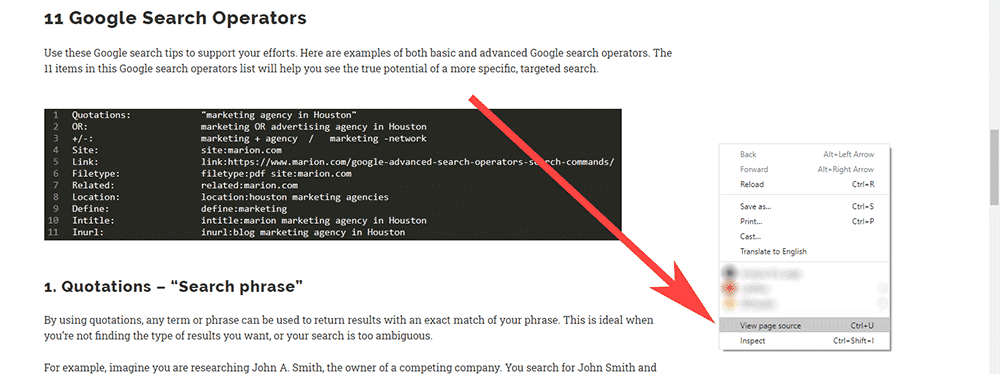
You can search the visible HTML on a page by doing a search and find on the standard page. However, there could be expandable fields on the page that wouldn’t get searched in this instance. To do a search of all visible and invisible HTML on a page, right-click on the page and select “View page source.” This will open the source code for your web page. Use your search and find keyboard shortcut on the source code for a more thorough search.

search for a keyword within a site

The major downside of learning how to search for keywords on a web page with this method is that you can only search one page at a time. If you’re examining a small website, with 10 pages or less, this technique will work. If you’re searching a larger site, check out the other available search methods.

2. Use the Website’s Search Bar

This isn’t always obvious, but most sites have a search bar. It may take a minute of looking around to find it, but you can generally find a search icon in the top right of a web page. Type in your keywords of interest, then hit enter to begin your search.

While this technique can sometimes work, its success largely depends on how the website of interest has configured its search bar. Many standard search bars will only search blog posts and not pages. Other search bars limit their search to page titles and won’t search the body copy of their pages for your keyword.

Also, what if your target site doesn’t have a search bar? You’ve got to learn how to search a site without a search bar in that instance. For a more detailed search that puts the control back in your court, use methods two or three to search for a keyword within a site.

3. Use the Site Search Google Command

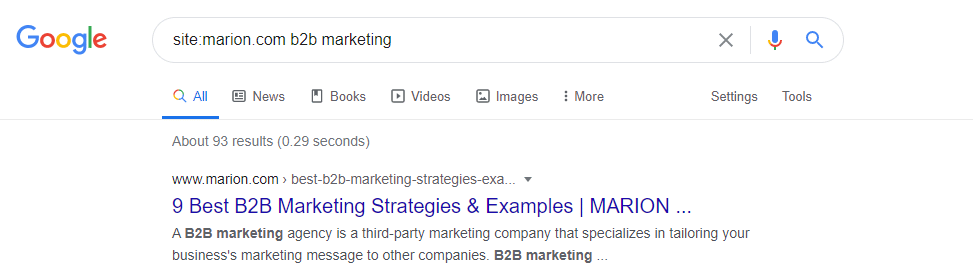
how to search for words in a website

We’ve covered several Google Search commands on the MARION blog before, but the Site Search Google Command is one of the most powerful. This operator lets you Google search a single website at a time.

For example, imagine you need to search marketingwebsite.com for the words “keyword search.” In the Google search bar, you would enter the following:

site:marketingwebsite.com “keyword search”

Notice, there is no space after the colon, and we put quotes around our search term of interest. By using quotations, any search term can be used to return results with an exact match of your phrase. This is great when you’re not getting the results you want, or your search is too ambiguous.

4. Use Screaming Frog to Search for a Keyword within a Site

Screaming Frog is a website crawler that extracts data and allows you to audit a site for common SEO issues. You can download the tool and crawl up to 500 URLs with the free version of the software, but you can also buy a yearly license for about $165 (which is inexpensive as far as valuable SEO tools go).

You can find the detailed Screaming Frog User Guide here, but we’re only interested in one aspect of the tool for this article.

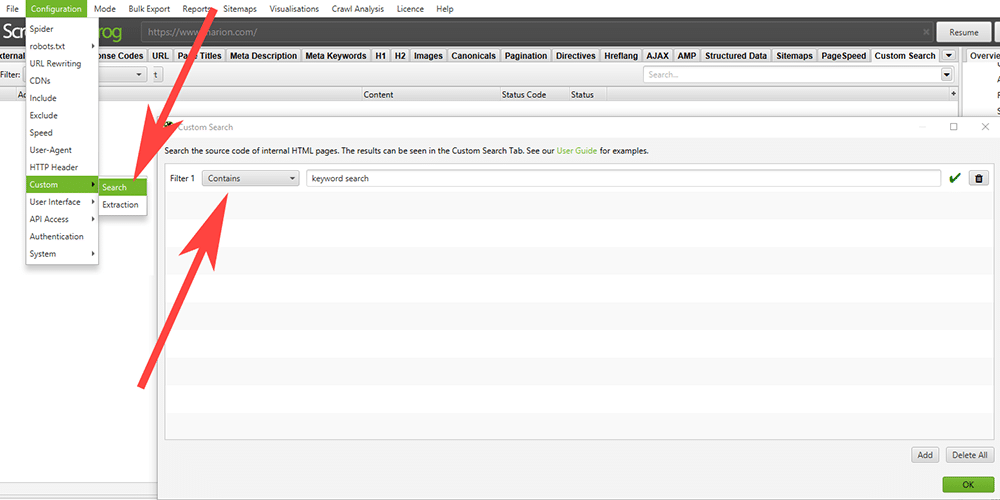
If you navigate to Configuration > Custom > Search, you can set search conditions that will help you find a phrase across the entire site being crawled.

how to search a whole website for a word

In our example above, we specified that we wanted to search every page for the keyword, “keyword search.” Once you start your Screaming Frog crawl, it will analyze every page on the target website for that search term.

After the site has been crawled, one of the columns in the resulting “Custom Search” report will specify how many times each page used your exact phrase.

how to search for keywords on a web page

This is the most detailed example of how to search within a website for a specific word or phrase. The most advanced method would be accessing your server via a secure shell and using commands to search all your files, but most marketers will never need to get that involved.

Contact Design At Work for Advanced Marketing Help

As a highly-acclaimed provider of Texas marketing services for nearly 40 years, Design At Work has the know-how to improve your marketing performance. Our team includes professional designers and marketing strategists that can provide quality SEO services and more.

Contact us today to schedule a free consultation and learn how we can work with your organization!


Marketing emails you’ll actually want to read.

Get marketing tips and news sent to your inbox.
This field is for validation purposes and should be left unchanged.
Name(Required)

Should AI be doing your marketing?

Why AI alone isn’t enough — and where agency expertise comes in.

For many businesses, keeping marketing in-house seems like the practical choice. With AI on the scene, it seems more cost-effective than hiring an agency and promises to keep projects moving quickly. After all, if a tool can write copy, design graphics, manage your social calendar and analyze campaign data in seconds, why wouldn’t you let it handle everything?

The challenge is that marketing isn’t just a series of tasks to check off a list. AI, for all its capabilities, can’t replace the strategy, creativity and cross-channel expertise it takes to grow a brand. Without that guidance, even the fastest, most affordable marketing efforts can fall short.

So should AI be doing your marketing? The answer is yes and no.

The limits of “good enough” marketing.

AI can make marketing look easier, but it doesn’t erase the gaps that come with relying on a single, inexperienced hire or asking a non-marketing employee to juggle tasks. These arrangements may keep projects moving, but they rarely produce the kind of coordinated, impactful marketing that fuels growth.

Here are the top five problems with “good enough,” AI-fueled marketing:

1. No clear strategic direction.

AI can produce content on demand, but it doesn’t decide what your brand should say, when to say it or how to connect the dots between campaigns. Without a strong, guiding strategy, marketing efforts can result in a haphazard mix of posts, emails and ads that don’t support measurable goals. The result? Activity without impact.

2. An inconsistent brand voice.

When messaging is created by a single marketing generalist — especially one without deep branding experience — messaging can drift from one piece to the next. AI can mimic tone in isolated pieces, but it can’t ensure your voice is applied consistently across all channels and touchpoints. This kind of inconsistency can erode customer trust and make your brand forgettable.

3. Limited creative perspective.

“AI tools should complement, not replace human creativity.”

— Chad Gilbert, VP of Content Marketing, NP Digital

A lone marketer (or a non-marketing employee) has limited bandwidth and creative diversity to draw from. AI might churn out endless variations, but without the insight to know which ones will resonate, you risk spending time and budget on campaigns that don’t connect with your audience.

4. Fragmented execution.

Effective marketing forms a cohesive ecosystem. Your campaigns, channels and messages should work together to tell one story. A single person juggling multiple responsibilities, even with AI’s help, can find it difficult to keep that ecosystem in balance. Opportunities to cross-promote, retarget or build momentum between campaigns are easily missed.

5. Reactive rather than proactive marketing.

Without dedicated expertise, marketing often becomes reactive, responding to immediate needs instead of building toward long-term growth. AI can accelerate that reactive cycle, producing more content faster — but without direction, it’s just more noise in an already crowded space.

How experts make AI work harder for you.

The smartest approach isn’t choosing between humans and AI. It’s combining the two.

“AI won’t replace humans, but humans with AI will replace humans without AI.”

— Tom Davenport, AI researcher & author

AI can move faster and process more information than any person, but it needs expert direction to ensure the work it produces supports your goals, reflects your brand and reaches the right audience. When guided by experienced marketers, AI becomes a powerful force multiplier that elevates both the quality and the efficiency of your marketing.

How AI enhances productivity.

AI can handle many of the repetitive, time-consuming tasks that slow down marketing teams. But knowing which tasks to automate and which to handle manually takes experience. Agencies can evaluate your current workflow, identify the most valuable opportunities for automation and select the right AI tools to execute them.

That might mean using AI to generate an outline of a blog post, resize campaign graphics for multiple platforms, create A/B test variations for an ad or segment an email list based on behavior and preferences. By automating these routine processes, agencies free up time for the high-value work AI can’t replicate: strategy, creative concept development and campaign refinement.

Brand consistency across every channel with AI.

AI can produce an impressive amount of content in seconds, but speed without oversight can easily lead to brand drift. Without the guardrails of a clear voice, tone and style, messaging can start to sound generic, disconnected or off-brand.

An agency provides that critical layer of review and refinement, ensuring that every piece of AI-assisted content is not only accurate but also aligned with your brand’s personality, values and messaging framework. This means your social media posts, email campaigns, paid ads, blog articles and landing pages all tell the same story — and reinforce it in a way that builds trust over time.

33% of businesses report that brand consistency increases revenue by at least 20%1

Data turned into action.

AI is excellent at producing dashboards, charts and detailed reports. But more data doesn’t automatically lead to better decisions. Without interpretation, it’s just numbers on a screen.

Experienced marketers know how to dig into AI-generated insights to uncover what’s truly driving performance. They can spot patterns that suggest shifts in customer behavior, diagnose why a campaign is underperforming and identify new opportunities for engagement. Just as importantly, they can translate those insights into clear, actionable next steps — adjusting creative, refining targeting or reallocating budget to maximize ROI.

The Best of Both Worlds.

AI won’t replace skilled marketers, but skilled marketers who know how to use AI can replace outdated, inefficient processes. This combination gives your business faster execution, better insights and more impactful campaigns.

Ready to combine AI with marketing expertise? At Design At Work, we blend forward-thinking strategies with the latest AI tools to help companies market smarter, stay competitive and grow with purpose. Contact our marketing experts to learn how we’re using AI tools differently.

Marketing emails you’ll actually want to read.

Get marketing tips and news sent to 
your inbox.

This field is for validation purposes and should be left unchanged.
Name(Required)


Sources:

  1. Capital One Shopping Research, 2025 Branding Statistics Report

Construction Marketing Ideas to Prioritize in 2026

Is your construction business focused on commercial work and servicing other businesses?  Do you build retail establishments, restaurants, storefronts or office buildings?  Maybe you’re dedicated to building high-end residential homes or home remodeling. Regardless of what type of business you have, the construction marketing ideas listed below will help to promote your brand and generate new clients in 2026.

How to Market a Construction Company

Marketing the construction business online is a step that will grow the company. The challenge is making sure you’re in the best position to capture new leads, regardless of where they may be in the buying cycle.

For example, your potential clients could be starting the process and determining what the home renovations will be. That is called the top of the funnel. Others may have tried remodeling themselves, failed, and now they need help. Some will have a great idea of what they want, how much they would like to spend and a time frame when they want it done. All of these are qualified construction leads, but they are in different stages of the buying cycle.

The right digital marketing strategy might contain the following elements:

Construction Website Design

Website Design for the Construction Industry

Digital marketing starts with a well-structured website. In 2025, mobile responsiveness, accessibility, and speed are necessities. Your site needs to load quickly on any device, adapt to mobile-first indexing, and meet Google’s UX benchmarks like Core Web Vitals. These day, you’re not just competing with other contractors…you’re also competing with user impatience!

For construction companies, the most visited section is almost always the photo gallery. People want to see what you can do before they reach out. But don’t stop at before-and-after shots. Push this further.

Use the gallery to tell the full story of a project:

  • Include timestamps or timelines to show progress
  • Annotate images with product specs and design notes
  • Layer in short-form video walkthroughs or drone footage
  • Add client testimonials next to completed project visuals

Static image dumps don’t cut it anymore. Interactive case studies and documented workflows give visitors what they actually want: proof you can execute and context around how you work.

Also, make sure your site includes:

  • Clear messaging by service type and geography (e.g., “Kitchen Remodeling in Houston”)
  • Click-to-call buttons and quote request forms that actually work on mobile
  • Schema markup for services, locations, and reviews

Before launch, use this 8 point website launch checklist.

SEO for Construction

Along with detailed images, you’ll need informative and relevant content. Write content that solves problems, answers questions gives examples and showcases the expertise of the company.

Start a blog section of your website that can be used to publish articles that support the main services you provide. If one of the main services is kitchen remodeling, a good supporting blog article could be, “The benefits of remodeling your kitchen and bathroom at the same time.”  As the name implies, this type of article would be written to encourage readers to do both at the same time.

One of the main benefits of blogging for marketing is improved business lead generation. But in 2025, content alone won’t carry your SEO.

Here’s what you need to compete:

  • EEAT content – Your content should demonstrate Experience, Expertise, Authority, and Trust. Don’t publish generic tips straight from ChatGPT. Use real examples from past jobs and be specific about materials, pricing, and timelines. This type of content not only helps you rank but also improves your visibility with AI-powered search experiences, which rely on high-quality source content.
  • Google Business Profile – Keep it updated with photos, Q&As, services, and regular posts. This supports visibility in Google’s map pack and AI-enhanced local searches, which are gaining traction.
  • Local landing pages – Create separate service pages for each city or area you serve. For example, “Bathroom Remodeling in The Woodlands” should have its own dedicated page.
  • Schema markup – Add structured data to highlight your reviews, services, business info, and service areas. In 2025, schema markup is not only useful for search engines, but it also feeds structured results to AI assistants and generative search engines that rely on schema to pull trusted business data.
  • Internal linking – Connect blog posts and service pages using anchor text that reflects how people search. This supports SEO and guides site visitors toward conversion points.
  • Technical SEO – Don’t forget the backend work. Link building is still very important in 2025, especially backlinks from credible sources like trade associations, vendor partners, and local directories. Also focus on fixing broken internal links, submitting updated XML sitemaps, using proper redirects, and compressing images for faster load times. These technical elements still influence visibility and crawlability.

Search algorithms continue to evolve, but the core idea hasn’t changed: create helpful, relevant content that demonstrates authority in your field. That’s what earns trust (both from Google and from modern AI-driven search tools).

PPC for Construction

If budget allows, consider a supporting pay per click campaign. This will allow you to strategically target certain areas of town with specific messaging and offers.

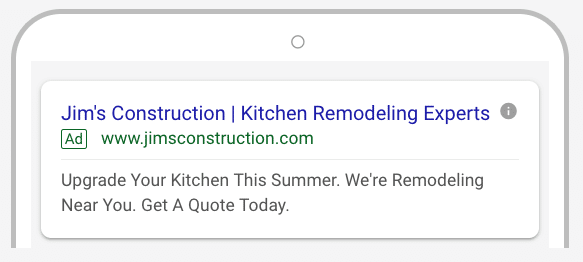
For example, if you have identified a wealthier area of the city that has lots of older homes that need remodeling, you can display ads to people in that area. Using Google Ads, you can select a zip code and compose ads that speak directly to those people and offer the services you have.

sample construction ad

MARION Tip: Enable search ads for the zip code where your current construction job is. The ads will be displayed to people who are in the immediate area where you are working. If they can see your crew, professionalism and realize that you also service their area, you have a higher likelihood of closing the deal. Good news is…you’re already in the area. This may reduce the need to transport equipment and labor across town.

Social Media Marketing for Construction

It’s imperative that your construction business engages in social media marketing. At a minimum, set up profiles on Facebook, X, Instagram & LinkedIn. Use the consistent branding discussed earlier and create posts that showcase the business expertise, videos, images and latest construction jobs. In the captions of these posts, include descriptions about the products and services used. Make sure the social media profile is fully complete with the company biography, website links, and contact information.

But the real opportunity in 2025 is short-form video. Think:

  • 15-30 second walkthroughs of finished remodels
  • “What we would’ve done differently” voiceovers for transparency
  • Time-lapse footage of a kitchen or bath build
  • On-site Q&As or team introductions

MARION Tip: Conduct a search on each platform for your services and follow who is talking about it. For example, search Facebook for the term “kitchen remodeling.”  Follow every result that isn’t a business that is in your locality. If they asked a question, business or not, answer it, then follow them. Repeat for the other social media platforms.

Email Marketing for Construction

Monthly email blasts still have their place, but the more impactful strategy in 2025 is automation and personalization based on real client behavior. Rather than just sending newsletters, build trigger-based sequences tied to your services and the timing of past jobs.

Use your CRM or email marketing tool to segment by past project type, install date, or location. For example, if you installed new floors for a client six months ago, schedule a follow-up email that checks in and recommends a seasonal upgrade.

Hey [first name], how’s the flooring holding up? If your kitchen is next on the list, we’re currently offering a 15% loyalty discount for returning customers.

These automated sequences are far more effective than generic blasts, and so much easier to manage once they’re built!

Email is also a good place to resurface content they may have missed:

  • Case studies with before/after results
  • Video walkthroughs of projects like theirs
  • Seasonal offers tied to weather, school calendars, or tax season
construction marketing ideas

Branding for Construction

It seems so cliché, but it is very true. Develop a company brand that people will understand quickly. While this isn’t a necessity, it’s important to clarify that if the name is abstract, people may initially struggle to understand if your company can do what they are looking for. I believe this also depends on where you service clients. If you provide a nationwide service and have a sizeable advertising budget, then an abstract business name and branding could work. Mainly because you have the service area, as well as the resources (time and money) to manage it and promote the new brand.

However, if you are smaller residential construction business, servicing a certain locality, then you may want to choose a name that closely mirrors your specializations. Service focused business name examples would be;

  • Houston Home Renovations
  • Kitchen’s, Bathroom’s & More
  • Katy Home Additions

These are all fictitious company names. The point is, include the core service in the company name when possible. Include it in the company tagline too, especially if it isn’t in the main business name. You could try something like Jim’s Construction – Home Renovations since 1990.

After the name and tagline are determined, choose colors. For the sake of consistent branding, use these same colors everywhere the brand is displayed. Use it offline (vehicle wraps, business cards, flyers, company clothing, commercial signage) in places where potential clients will see it. Be sure to remain consistent with online advertising too. Use the same branding on the company website, social media, and email signatures.

Consistent use of the same look, feel, and imagery, plus providing a great product/service is how you develop a brand that people will remember and want to use again.

Contact MARION to Improve Your Construction Marketing Today!

Before you wrap up your next campaign, take stock of your current construction marketing strategy. Are you reaching your target audience on the right marketing channels? Are your marketing materials aligned with your digital marketing strategy? Too many construction companies still focus only on physical signage or word-of-mouth, missing the opportunity to connect with potential clients online through tactics like search engine optimization, social media management, and paid advertising.

MARION is a construction marketing agency with 40+ years of experience in Texas. For help with turning your construction marketing ideas into reality, contact us today to schedule a consultation!

Marketing emails you’ll actually want to read.

Get marketing tips and news sent to 
your inbox.
This field is for validation purposes and should be left unchanged.
Name(Required)

How To Check the Number of Pages On a Website

Have you ever wondered how many pages a website has? Maybe it’s a competitor’s site or even your own. Knowing this can be useful for SEO planning, content strategy, and benchmarking your digital presence. In this guide, we’ll share three simple ways to check how many pages are on a website.

How To Find Out How Many Pages a Website Has

As mentioned above, there are three easy ways to accomplish this:

  1. XML Sitemap Method
  2. “Site:” Operator Method in Google Search
  3. Google Search Console Method

1. XML Sitemap

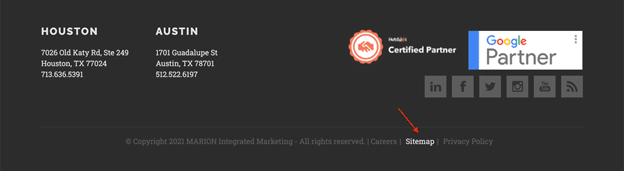
Using the XML sitemap is a simple way to count the number of pages on a website. Plus, the sitemap method is available to anyone! To access a website’s sitemap, scroll to the website footer and follow the link to their XML sitemap.

Footer Example

If you can’t locate a “Sitemap” link on the website, there is another quick solution. View any sitemap in your browser by using either of the following URLs. All you need to do is replace “sitename” with the name of the website!

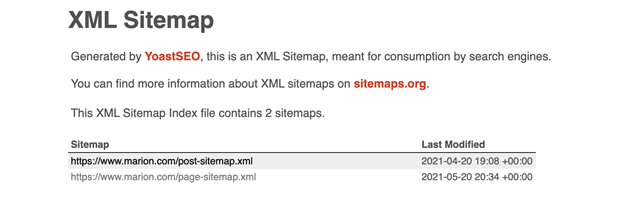
For example, if you wanted to check the number of indexed pages on our website, marion.com, you would search: https://marion.com/sitemap.xml

XML Sitemap

If the website you are checking uses advanced sitemap plugins, such as YoastSEO, the URL count will be automatically shown. Otherwise, you’ll need to count the number of pages manually.

Should every business create an XML sitemap?

Yes, in most cases. Even small businesses benefit from making their content more accessible to search engines. Sitemaps are quick to generate and can be submitted through Google Search Console for free.

2. Site: Operator

For this method, you will need to open a new Google search and copy the following search query, replacing “sitename” with the name of the website you are looking for:

site:sitename.com

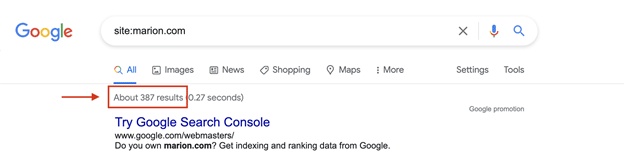
For example, if you were checking our website, marion.com, you would search: site:marion.com.

Google Results

Keep in mind, this number is approximate. Google doesn’t always display the exact count, and the number may fluctuate over time. Still, it’s a quick way to get a rough idea of how many pages a domain has in Google’s index.

3. Google Search Console

For your own website, Google Search Console gives the most reliable picture of indexed pages. To use it, you’ll need to be a verified site owner or have access granted. Once inside, you can open the Index Coverage report (previously called “Index Status”) to see total indexed pages, errors, and exclusions. The Sitemap report also shows how many pages you’ve submitted and how many Google has accepted.

This method is particularly useful for spotting issues. For example, if you’ve submitted 500 pages but only 300 are indexed, it signals that you may need to review your site’s crawlability, content quality, or technical SEO setup.

Why is the page count different between a sitemap and Google Search Console?

Sitemaps show what a site owner submits to Google, while Search Console shows what Google actually indexes. Some pages may be excluded if they’re duplicates, low-quality, or blocked in robots.txt.

Why Your Website Needs an XML Sitemap

XML sitemaps are especially beneficial for large-capacity websites, new websites, and websites that use rich media content. However, almost all websites will benefit from incorporating this feature. Sitemaps allow Google to easily locate web pages and determine when they were last updated.

In addition, website page counters can be used for:

  • Clarifying how many active web pages your site has
  • Seeing all of the pages on your competitor’s domain

This is especially useful for:

  • Large websites with hundreds or thousands of pages
  • New websites with few external links
  • Sites with complex navigation or rich media content

Competitor research is another perk. By reviewing a competitor’s sitemap, you can see the breadth of their published content and how they organize it.

Refresh Your Website with MARION

With these three methods, you now know how to check the number of pages on any site. Most websites make their sitemap easy to find, but even if they don’t, Google’s tools provide alternate routes to the same insight.

MARION is a trusted Texas marketing agency with 40+ years of experience helping businesses grow through website design, digital marketing, and SEO services. We design with both strategy and execution in mind, so your site works hard for your business.

Schedule a free marketing consultation with MARION today and learn how we can help grow your business.

Marketing emails you’ll actually want to read.

Get marketing tips and news sent to 
your inbox.
This field is for validation purposes and should be left unchanged.
Name(Required)

4 Football Marketing Ideas Your Business Can Run With

The passion for football runs deep in Texas. High school, college, or pro…every game draws in thousands of football fans and sports fans, creating a vibrant atmosphere that businesses can tap into. Aligning your marketing campaigns with football season helps you connect with a highly engaged target audience and positions your brand as part of the excitement.

The History of Marketing and Football

Football has long been a cornerstone of sports marketing strategies. Since the early days of televised games, brands have seized the chance to connect with sports teams’ loyal supporters. The Super Bowl, in particular, has become as famous for its commercials as for the game itself. From iconic TV spots to stadium sponsorships and halftime promotions, businesses have used football to increase engagement and reach new audiences.

It’s now 2025, and marketing efforts have expanded. Social media platforms, streaming services, and online communities allow brands to create engaging content and connect with a broader audience before, during, and after live events. From hashtag challenges to real-time fan engagement and limited-time promotion ideas, football offers countless ways to produce quality content that resonates.

Successful Super Bowl Ads

Marketing Campaign Ideas for Football Season

Football season is the perfect time to be fun with your marketing campaigns. The excitement, the camaraderie, and the sheer passion of fans create a unique environment where brands can make a big impact. Here are four creative marketing ideas to help your brand this football season.

1. Fan Loyalty Program

Loyalty programs aren’t new. Brands in nearly every industry use them to keep customers engaged and coming back. The concept is proven: reward repeat interaction, and you build a stronger connection. This football season, you can bring that same winning formula to your business with a Fan Loyalty Program built around the excitement of the game.

Start by giving customers a “fan card” or digital check-in option. Each time they make a purchase during football season (especially on game days) they earn points toward rewards. Those rewards could be:

  • Discounts on future purchases
  • Exclusive branded merchandise (shirts, hats, drinkware, etc.)
  • Early access to new products or services
  • Free add-ons or upgrades with purchases
  • Access to special events you host, such as watch parties or customer appreciation nights
  • Tickets to local football games
  • Gift cards to your store or partner businesses
  • VIP seating or reserved spots at events you sponsor
  • Personalized thank-you packages for top participants
  • Social media shout-outs and features on your website
The more they participate, the more they feel like part of an insider club that’s tied to both your brand and their team spirit.

You can also build momentum by offering double points on rivalry games, surprise giveaways during playoffs, or instant rewards when their team wins. Tie your promotions to the season’s emotional highs, and you’ll keep your audience engaged far beyond the stadium.

Marketing Expert Tip: Track member activity closely and use that data to send personalized offers, like special rewards when their favorite team wins.

2. Local Team Sponsorship

When football season kicks off, your business has a golden opportunity to connect with an energized community…by sponsoring your local team!

A local sponsorship can go so much farther than just logo on a banner. After all, it’s the perfect chance to stand alongside something your audience already supports. It doesn’t matter if it’s high school Friday night lights or a youth league, your presence on the field, in programs, and across team social media keeps your brand in front of fans all season.

Ways to maximize your sponsorship:
  • Host a Game Night Giveaway – Hand out free merch or services to lucky fans in the stands.
  • Feature the Team on Your Social Media – Share game highlights, athlete interviews, and upcoming match schedules.
  • Create Special Game Day Offers – Offer discounts when customers wear team gear to your store.

A local football sponsorship builds community goodwill while driving brand recognition, turning hometown pride into long-term customer loyalty. When the scoreboard lights up, make sure your brand is part of the winning moment!

3. Game Day Recipe Contest

When fans gather for football, the food is almost as important as the score. This season, stand out from the pack by hosting a Game Day Recipe Contest that brings your customers’ creativity to the table and keeps your business in the conversation long after the final whistle.

Invite customers to submit their best tailgate or watch-party recipes. Ask them to share a photo and the story behind their dish. These personal touches create content that’s perfect for your social media marketing, website, and email newsletters…turning your audience into both the creators and the stars of your digital marketing.

Each week, you can highlight standout submissions, encourage fans to vote, and celebrate winners with themed prizes such as team gear, local dining gift cards, or branded cookware. At the end of the season, consider compiling the top entries into a downloadable digital cookbook that features your brand on every page. You can even take it a step further by hosting a live cook-off at a local venue, giving the community a chance to taste and cheer on their favorites.

Marketing Expert Tip: ALWAYS repurpose user-generated recipes and photos throughout the season in your email marketing campaigns and social channels for authentic, ongoing engagement.

4. Tailgate Kit Giveaway

Everyone knows that football season is prime time for tailgating. Your business can tap into that excitement! But how?

A tailgate kit giveaway can include fan favorites like a portable grill, folding chairs, team-themed drinkware, snacks, and a cooler. Add in a branded item or two so your company stays in the spotlight long after kickoff.

How to run your giveaway:
  • Collect Entries In-Store and Online – Give customers a chance to sign up when they visit your location or website.
  • Promote on Social Media – Post photos and videos of the kit to spark interest.
  • Announce the Winner Before a Big Game – Build anticipation by revealing the winner right before a major matchup.
  • Partner with a Local Influencer or Sports Personality – Gain more reach by having them help promote the giveaway.
  • Offer Bonus Entries – Give extra chances to win when customers make a purchase, refer a friend, or share your post.
Bonus:
  • Incorporate a Community Tie-In – Donate a smaller kit to a local charity or youth sports team to add goodwill.

This type of promotion brings energy to your brand, drives foot traffic, and creates shareable moments online.

Marketing Expert Tip: Follow up with all entrants after the contest with a thank-you email blast and a special offer to turn new leads into customers!

Score Big with MARION’s Marketing Expertise

Now is the time to get in the game and make the most of this football season.

At MARION, we create sports marketing strategies that connect with your target audience, increase engagement, and deliver measurable results. From full-service campaigns to focused marketing projects, our Houston marketing agency is ready to help.

Get in touch with our team today!
Marketing emails you’ll actually want to read.

Get marketing tips and news sent to 
your inbox.

This field is for validation purposes and should be left unchanged.
Name(Required)

AI for Small Business: The Smarter Approach to Marketing

AI is no longer a term reserved for big brands with massive budgets. In 2025, small teams can now tap into smart tools that automate tasks, personalize content, and analyze data.

How Small Businesses Are Using AI in Marketing Today

If the idea of using AI sounds intimidating, don’t be discouraged. A lot of business owners feel that way at first, especially when you’ve been doing things the same way for years (if not decades). But once you try it, the benefits become obvious fast. It’s not replacing your team or your entire process. Think of it as taking a some weight off your plate so you can focus on the things that need your attention most.

AI isn’t reserved for big brands anymore.

With the rise of affordable SaaS tools, small businesses now have access to AI-powered platforms once used exclusively by enterprises. If you’re solo running email campaigns, social media, or customer support, there’s likely an AI solution that fits your budget and needs.

Why AI is already part of your marketing (even if you’re not using it yet)

AI already influences how your customers engage with content online. Algorithms decide what shows up in their feeds, which emails land in their inbox, and what ads they see. So, it only makes sense that using AI will give your business a better chance of getting noticed in that crowded space!

How AI Helps Small Businesses Do More with Less

We’re a small business too, and we use AI every day. It helps us handle the repetitive stuff (like scheduling posts or pulling data) so our team can spend more time thinking, writing, and building campaigns. It’s not replacing anyone on our team, just making their work a little faster and a lot easier.

Find the right people faster.

AI can analyze customer behavior and segment audiences automatically. That means you can deliver the right message to the right person at the right time without spending hours poring over spreadsheets.

Skip the blank page.

AI writing tools generate blog outlines, social media posts, and email subject lines in seconds. You still need to guide the message, but these tools help you move faster and skip the blank page struggle.

Make smarter calls with data.

AI tools can forecast which leads are likely to convert. They can spot when customers might leave and show what content earns clicks. Your team still interprets the results and makes the final call, but AI gives you a clearer view to work from.

Let chatbots handle the FAQs.

Today’s chatbots go far beyond canned responses. They can answer common questions, schedule meetings, and guide users through your sales funnel. But they don’t replace the human touch – your team can step in for more nuanced conversations and relationship-building.

Cut the busywork.

From scheduling social posts to managing email drips, AI frees up your team to focus on strategy and creativity rather than busywork.

Learn how to use ChatGPT to generate leads.

ai for small business marketing

AI Marketing Tools for Small Business

You don’t need a complex tech stack to get started. Many tools are built for everyday business owners and marketers. Here are a few categories worth knowing:

AI Tools for Email Marketing

AI email marketing tools for small businesses include send-time optimization, subject line suggestions, and automated audience segmentation.

  • Mailchimp
  • Constant Contact
  • ActiveCampaign

Social Media Assistants

These platforms help you write, schedule, and recycle posts. Some can even turn blog content into social media-ready copy.

  • Buffer
  • Lately

SEO Tools That Use AI

These SEO tools offer keyword suggestions, compare your content with competitors, and provide writing guidance based on search trends.

  • SurferSEO
  • Ahrefs
  • Semrush

AI in CRM Platforms

CRM tools with AI features can generate leads for your small business, track user behavior, and suggest outreach actions to keep your pipeline moving.

  • HubSpot
  • Zoho

Sample Timeline: How to Start Using AI in Your Small Business Marketing

You don’t have to overhaul everything at once. Here’s a simple month-by-month rollout to help you start small and build momentum:

TimeframeActionFocus
Week 1Identify a marketing task to automateStart with something repetitive, like social media marketing or email scheduling.
Week 2-3Choose and test one AI toolTry out a platform of your choosing (see above examples). See how it fits with your current setup.
Week 4Train your team on how to use the toolKeep it simple; watch tutorials, test with a small audience, and ask questions.
Month 2Use AI consistently for one taskMake it part of your workflow and monitor results.
Month 3Add a second AI-powered toolChoose based on the next biggest time-saver like chatbots or keyword research.
Month 4+Review performance and adjustKeep what’s working, tweak what’s not, and expand when you’re ready!

This kind of step-by-step approach keeps things manageable. It gives your team time to adjust and get comfortable with the new tools before adding more.

Common Misconceptions About AI for Small Business

AI tools are more accessible than many business owners realize. But old ideas can still hold people back. Let’s clear a few of those up.

“It’s too expensive”

Many AI tools are subscription-based and priced for smaller teams. You can start small with a single platform (like AI-driven email or social scheduling) before expanding into other tools.

“It’s too complicated to use”

Modern tools are built with non-technical users in mind. Many have simple dashboards, built-in tutorials, and customer support teams to help you get started quickly. If you can manage email or spreadsheets, you can handle most AI-powered platforms without a steep learning curve!

“AI will replace human marketers”

AI helps automate and speed up parts of your workflow. But strategy, brand voice, and creative decision-making still rely on human input. AI assists, you stay in control.

Get Help Applying AI to Your Marketing

If you’re ready to use AI to attract better leads and run smarter campaigns, MARION can help.

We’ve provided outsourced marketing to Texas-based businesses for over 40 years. Our team knows how to blend practical marketing strategy with today’s smart tools (without making things complicated).

Schedule a free consultation to see how AI can fit into your marketing. We’ll help you focus on what works so you can grow your business with confidence!

Marketing emails you’ll actually want to read.

Get marketing tips and news sent to 
your inbox.

This field is for validation purposes and should be left unchanged.
Name(Required)

What You’ll Learn from a Social Media Audit (+ Free Checklist)

Most businesses are active on social media. But ask yourself this: do you really know what’s working? Are your posts bringing in the right people?

A social media audit can help answer these questions for you. It gives you a clear view of your current performance, identify what needs fixing, and shows you what’s already doing well.

What is a Social Media Audit?

A social media audit is a detailed review of your business’s social profiles and performance. It answers questions like:

  • Where are you posting?
  • Who’s engaging?
  • What kind of content gets results?
  • Are you using your time and budget in the right places?

Contrary to popular belief, it’s more than counting likes or followers. A good audit connects your social efforts to business goals, like lead generation or brand awareness.

At MARION, we recommend doing a quick audit once a quarter, and a deeper review before launching new campaigns or changing your content strategy.

What You’ll Learn from a Social Media Audit

A social audit can tell you a lot more than you think. Here are some of the big takeaways:

Which Platforms Are Worth Your Time

Not every social platform delivers the same value. You might be putting effort into Instagram, but all your leads are coming from LinkedIn. Or you may find that X (Twitter) gets plenty of impressions but zero clicks. An audit helps you zero in on where your time and content are actually paying off.

What Content Performs Best (and Worst)

Not all posts are created equal. An audit helps you pinpoint which content types (videos, graphics, links, or simple text) resonate most with your audience. You’ll also see what’s underperforming, so you can stop wasting time on formats that fall flat.

Example: A local contractor may find that project before-and-after images outperform every other post type. That’s a sign to post more of them!

Who’s Engaging with Your Brand

Knowing your audience is key. With the right audit tools, you’ll uncover valuable insights about who’s liking, sharing, and commenting on your posts (their age, location, interests, and more). This lets you tailor content more effectively.

Where Your Followers Are Coming From

When someone clicks through to your site from a social post, that’s momentum you want to understand and build on. Are they coming from boosted posts, organic shares, or maybe even your profile links?

With this data in hand, you can pinpoint what’s creating action and what’s not. If your Facebook content is generating strong referral traffic while Instagram barely registers, it’s worth adjusting your content plan or ad budget accordingly.

If Your Branding Is Consistent Across Channels

Scroll through your social accounts and check:

  • Profile photos and banners: Are they updated and aligned?
  • Bios: Do they match your tone, services, and message?
  • Post visuals: Are your fonts, colors, and styles consistent?

Tip: Your audit should include a branding snapshot for each platform. Uniformity builds trust, even across different audiences.

What Your Competitors Are Doing Better (or Worse)

Reviewing a few of your competitors’ profiles offers useful perspective. You might notice they post more often, but get less engagement. Or maybe they’ve nailed a tone of voice that gets conversations started. Seeing what others do helps you spot gaps or opportunities in your own strategy.

Common Issues a Social Media Audit Can Find

You might be surprised what pops up during a social media marketing audit. Here are some common problems:

  • Inactive or duplicate profiles
  • Off-brand visuals or outdated bios
  • Slow or inconsistent response times to comments and messages
  • Too much promotional content, not enough value or engagement
  • Missing contact info, broken links, or incomplete profiles

These issues are easy to miss day-to-day but can drag down your performance long-term.

Social Media Audit

Get the Free Social Media Audit Checklist

Not sure where to start with your social media marketing audit? Use this quick checklist, it’s a simple way to get clarity before making major changes to your social strategy.

  1. Review each profile photo, banner, and bio to make sure everything is current and on-brand
  2. Check that contact info and website links are accurate and working
  3. Look at the last 3 months of engagement: which platforms are performing best?
  4. Identify which types of posts get the most likes, comments, and shares
  5. Make sure you’re not only posting promotional content (add tips, updates, or behind-the-scenes moments)
  6. Check that you’re using hashtags effectively to expand reach
  7. Review your audience demographics: who’s actually engaging?
  8. Check your branding across platforms: same tone, visuals, and messaging?
  9. Take a peek at 2-3 competitors: what are they doing that you could learn from?
  10. Choose one or two things to fix or improve this month – and repeat the audit quarterly!

This checklist gives you a fast, surface-level view of how your social media is doing. But there’s a lot more that goes into a thorough audit, including reviewing historical trends, analyzing paid performance, identifying content gaps, assessing follower quality, and measuring how your efforts stack up against industry benchmarks.

Want a deeper look at your strategy and how to make it work harder for your business? MARION’s digital marketing agency experts can do a full audit for you, pinpoint what’s working, and help you build a plan that gets results.

Need Help with Your Social Media Marketing?

If you’re frustrated with slow growth or not seeing the results you hoped for, maybe it’s time for a social media audit! MARION works with businesses across Texas to build smart, effective social media strategies.

Our social media marketing specialists will help you:

  • Identify the right channels for your audience
  • Create high-performing content
  • Improve reach and engagement
  • Track results

So, if you’re ready for more direction in your social media management, you’re in the right place!

Contact us today to get started

Marketing emails you’ll actually want to read.

Get marketing tips and news sent to 
your inbox.

This field is for validation purposes and should be left unchanged.
Name(Required)

Beat the Heat: Creative Summer Marketing Ideas for Your Business

When the temperature rises, most people slow down…but your marketing doesn’t have to. Summer offers the chance to stand out while others are on autopilot. If your B2B business depends on staying visible and generating steady leads, this is the time to keep your audience engaged.

Here are 8 summer-friendly tactics to keep your brand active and top-of-mind.

1. Host a Summer Giveaway

It might sound obvious, but branded giveaways still work. Not the “stress ball in a dusty drawer” kind…give them something they’ll use when it’s 103 outside. Think insulated tumblers, cooling towels, portable fans. I once saw a contractor hand out branded can koozies at a local festival — simple, cheap, and everyone kept them. Genius.

Keep it simple: announce the giveaway, ask for an email or a follow, maybe a share to enter. Don’t overcomplicate it. People love low-effort wins, especially when it’s hot and their brain’s running on half speed.

One study even reported that 83% of consumers like receiving promotional products with an advertising message.

2. Create Content That Matches the Season (And the Mood)

Nobody’s in the mood to read a white paper right now. You know it. I know it. So don’t fight it. Instead, make your content quick, useful, and maybe even a little fun.

What are your customers dealing with during this stretch of the year?

Examples:

  • A construction company might publish a blog on “Keeping Cool on the Job: Essential Tips for Summer Construction Work.”
  • A tech company could create a video series on “Optimizing Your Home Office for Summer Productivity,” showcasing ways to stay comfortable and efficient while working from home during the heat.
  • A healthcare provider might share an infographic on “Hydration Hacks: Staying Healthy in the Summer Heat,” offering tips on staying hydrated and the benefits of their hydration products or services.

And don’t be afraid to share a little personality. You’re not writing a textbook here…you’re trying to connect. A little levity goes a long way this time of year.

Creative Summer Marketing tips

3. Summer-Themed Promotions

You don’t need a full-blown campaign to offer a good summer deal. Toss out something limited-time, give it a fun name like “Too Hot to Think Promo” or “Summer Slowdown Special,” and send it to your list with a quick note.

Something like: “We know things feel slow right now. Here’s something to make your life a little easier.”

It doesn’t need to be clever or complicated. In fact, the more human it sounds, the better it performs. Summer is all about energy conservation, for your customers too. Make sure to promote these deals through email and social media marketing.

4. Outdoor Events and Sponsorships

Summer is the season for outdoor events. Consider sponsoring local events like festivals, fairs, or sports games. Not only does this increase brand visibility, but it also shows your support for the local community. Set up a booth or tent with branded giveaways and information about your business.

As a matter of fact, 9 out of 10 marketers agree that experiential marketing boosts compelling engagement.

5. Share a Bit of the Human Side

People like doing business with companies that feel… well, like people. One of the easiest ways to make that happen? Show off your team’s summer vibe.

Post some behind-the-scenes shots. Team BBQs, vacation snapshots, bad sunburn stories (ok, maybe not the last one). Or have your employees share their favorite summer snack or weekend activity.

It takes 10 minutes, and suddenly your business feels less like a logo and more like a group of real folks your audience can relate to.

Examples:

  • Share a series of social media posts featuring your team’s vacation snapshots and stories. This humanizes your brand and gives your followers a glimpse into the lives of the people behind the business.
  • Encourage your customers to share their vacation photos with your products and feature these images in your email newsletters or on your website. Offer a small incentive, like a discount on their next purchase, for participating.
Summer Marketing

6. Ask Your Customers to Share

Here’s the thing: user-generated content performs better than most brand posts. And summer gives you the perfect excuse to ask for it.

Run a social media campaign and start a hashtag (keep it short). Ask customers to post pics using your product or service in their summer routine. Give them a reason to join in — small discount, feature on your feed, bragging rights.

Once you get a few entries, repost them. People love seeing their content shared, and it gives your feed more depth than stock images or “corporate updates.”

7. Give Your Emails a Seasonal Refresh

A quick update to your email visuals and subject lines can make a difference. Highlight limited-time offers, useful tips, or seasonal use cases. Add a fun summer recipe or quick poll for interaction.

Emails that feel timely are more likely to be opened and shared.

Examples:

  • An office supply company could do a newsletter featuring “Top 10 Office Gadgets to Keep You Cool This Summer.”
  • A software development company might create an email marketing campaign titled “Stay Productive in the Heat” with tips on using their tools to maintain efficiency during the summer months.
  • A commercial cleaning service could offer “Summer Cleaning Specials” through their email campaigns, emphasizing how a clean, cool workspace can enhance productivity.
  • A food supplier could send out a summer-themed recipe newsletter showcasing “Cool and Refreshing Office Snacks” that use their products.

8. Refresh Your Visuals

You don’t need a full redesign. Just update your homepage banners, rotate in some warm-weather photos, and change your social profile headers.

It shows people your business is active and paying attention. It’s a small detail, but it adds up — especially when everyone else looks frozen in time.

Even swapping in an image of someone holding a cold drink or working outdoors can make your brand feel more relevant. It’s an easy win.

Don’t Let the Texas Heat Slow Your Business Down

Everyone’s tired, inboxes are lighter, and meetings start getting pushed to “after Labor Day.” That’s your chance. When your competitors go quiet, your voice carries further.

If you’re short on time or ideas, our outsourced marketing agency has your back. At MARION, we work with businesses across Texas to keep their marketing active — even during the dog days of summer. Let us help you beat the heat with our digital marketing services in Austin and Houston, Texas.

Need help with your campaigns, content, or getting something out the door before the heat hits triple digits again? Let’s talk.

Marketing emails you’ll actually want to read.

Get marketing tips and news sent to 
your inbox.

This field is for validation purposes and should be left unchanged.
Name(Required)

How to Conduct B2B Keyword Research Like a Pro

Keyword research is the foundation of a strong SEO strategy. If you’re looking to increase your website’s visibility and attract the right audience, mastering B2B keyword research is a must. Here’s how to do it effectively.

Understand Your Audience

The first step in keyword research is understanding your audience. Who are they? What are their interests, needs, and pain points? Create detailed buyer personas to get a clear picture of your target market. This will help you identify the search terms they’re likely to use.

Brainstorm Seed Keywords

Start by brainstorming a list of seed keywords. These are the basic terms related to your business or industry. For example, if you run a pest control company, your seed keywords might include “termites,” “spiders,” “pest infestation,” and “extermination.” Think broadly at this stage and write down anything that comes to mind.

Use Keyword Research Tools

Once you have your seed keywords, it’s time to expand your list using keyword research tools. Here are some favorites:

  • Ahrefs: Offers extensive data on keyword difficulty, search volume, and competitive analysis.
  • SEMrush: Great for identifying related keywords and analyzing competitor strategies.
  • Ubersuggest: A user-friendly tool that provides keyword suggestions, search volume, and more.

Consider Local SEO Factors

If your business serves a specific geographic area, focus on location-based keywords. Include city or neighborhood names in your research to target local searches effectively. For example, “pest control Houston” or “Austin termite inspection.” Using tools like Google’s Keyword Planner can help you identify local search trends.

Analyze Search Volume and Competition

When evaluating potential keywords, look at two main factors: search volume and competition. Search volume indicates how often a keyword is searched for, while competition shows how difficult it will be to rank for that keyword.

Choosing the right keywords means balancing search volume and competition:

  • High search volume – More traffic potential but often highly competitive.
  • Low competition – Easier to rank for, but might have lower traffic.

Aim for a balance. High search volume is great, but if the competition is too fierce, you might struggle to rank. Conversely, low-competition keywords might have less traffic, but they’re easier to dominate.

Long-Tail vs Short-Tail Keywords

Look for Long-Tail Keywords

Long-tail keywords are longer, more specific phrases that often have lower search volumes but higher conversion rates. For example, instead of “pest control,” a long-tail keyword might be “commercial pest control houston.” These keywords are less competitive and can help you attract highly targeted traffic.

Learn more about long-tail vs. short-tail keywords.

Check Out the Competition

Take a peek at what your competitors are doing. Tools like Ahrefs and SEMrush allow you to analyze the keywords your competitors are ranking for. This can give you insights into their strategy and help you identify gaps in your own.

Match Keywords to User Intent

User intent is a major factor in B2B keyword research. Are people searching for information, looking to make a purchase, or seeking a service? Align your keywords with their intent:

  • Transactional intent: “Best pest control service near me”
  • Informational intent: “How to get rid of ants naturally”

Create a Keyword Plan

Once you have a list of potential keywords, organize them into a plan. Group similar keywords together and map them to specific pages on your website. This will help you create targeted content that aligns with your audience’s search queries.

Monitor and Adjust

Keyword research isn’t a one-and-done task. Regularly monitor your rankings and adjust your digital content strategy as needed. Use analytics tools to track which keywords are driving traffic and conversions. Be ready to tweak your approach based on what’s working and what’s not.

The bottom line is that doing B2B keyword research like a pro takes time and practice — but the results are well worth it.

Get Started with MARION

Looking to boost your SEO rankings? Or do you need year-round marketing support? Either way, MARION can help you identify the most effective keywords to target your ideal audience. Our Houston SEO company will get you started on the path to online success.

Reach out today to learn more about our B2B keyword research services and other marketing packages.

Marketing emails you’ll actually want to read.

Get marketing tips and news sent to 
your inbox.

This field is for validation purposes and should be left unchanged.
Name(Required)