Category: Marketing Campaigns

How to Budget for Facebook Ads That Work

Facebook is the most popular social media platform in the world, with over 2.7 billion active users every day. When done the right way, advertising your local business on Facebook can quickly grow your audience and increase revenue.

In this article, we’ll teach you how Facebook ads work and how to run a successful campaign on a small business budget.

How Much Do Facebook Ads Cost?

Many small business owners struggle with figuring out how much to spend on Facebook ads, but in reality, these ads can cost as little as one dollar per day.

One of the most convenient parts about using Facebook ads is that you can choose how much you want to spend. Facebook will then take that amount and work to get you the best results possible. You can invest as little as $5 a week or as much as $50,000.

The good part about this approach to advertising using social media is that the time and knowledge barriers to entry are very low. You don’t have to be an expert in Facebook advertising to begin. The bad part is that you have little context about how your ad money is being spent. It’s kind of like a used car salesperson asking you how much money you have to your name after you ask them how much a particular car costs.

Your Facebook minimum campaign budget will depend on a variety of factors we’ll discuss below.

Minimum Budget for Facebook Ads

If you have a small- to mid-sized business or are new to Facebook ads, give yourself a budget of around $1.00-$3.50/day for your first few campaigns. Starting off with a low daily budget will allow you to see which ads are most effective, and you can later adjust your budget if needed.

When it comes to small businesses, organic social media posts reach only about 6% of their followers. It would be more beneficial to post occasionally with a small paid budget and ensure your content is reaching potential customers in addition to current followers.

How to Calculate the Best Facebook Ad Budget for a Small Business

how much to spend on Facebook ads

Before isolating your Facebook Ad budget, ask yourself – how much should a business spend on marketing?

Typically, businesses should allocate 5-12% of their revenue for their marketing budget. New companies that want to grow aggressively should spend closer to 12%, while companies that want to maintain their growth might spend only 5%.

Whatever your overall marketing budget, you may want to allocate around 17% to run a successful social media marketing campaign.

How to Run Affordable Facebook Advertising

Many small business owners struggle with advertising because they don’t know how to budget for Facebook ads. According to a new survey, 62% of small businesses feel like their paid Facebook Ads are failing.

how Facebook ads work

Small businesses often experience challenges such as low marketing allowance and even budget cuts. However, just because your business’ marketing budget has been cut doesn’t mean you have to stop advertising.

If you target the right audience with the right content and invest wisely, you should achieve a positive return on investment.

1. Establish Your Facebook Ads Budget

The first step to advertising on Facebook is establishing your budget. There are two types of budgets on Facebook:

  • Daily Budget – This is the average amount you want to spend on an ad each day. For example, if you set your daily budget to $10 over the course of four days, you will be charged up to $40 total.
  • Total Budget – This is the maximum amount you want to spend on an ad until it stops running. For example, if you set your total budget to $20, you’ll be charged no more than $20.

To preserve your budget, we recommend using the Lifetime Budget feature on your ads. This tool allows you to set a specific dollar amount you want to spend over the lifetime of an ad.

To determine the best budget for Facebook ads, you will need to consider a few factors, including your revenue, how aggressive you want to grow, and how much time you can commit to advertising. All of these should be taken into consideration when planning your Facebook ads budget.

Distribute Budget Across Different Ad Types

how much is it to run Facebook ads

It’s important to distribute your Facebook ad spend across different types of Facebook ads. Here are the three main types of Facebook ads you should be using:

  1. Offer Promotion – 60% of your Facebook advertising budget should focus on directly promoting your product or service. You need content-focused ads to get clicks and generate leads.
  2. Audience Building – 20% of your budget should focus on engagement, education, and audience building. This will help you establish an audience that you can continually target over time.
  3. Retargeting – 20% of your Facebook ad spending should be used for retargeting ads. When a potential customer visits your website, tracking cookies will follow them across the internet so that they will continually see your ad on other websites. Facebook is great for retargeting so it’s important to allocate a chunk of your budget for this method.

By splitting your ad budget across these three ad types, you will ultimately get the biggest bang for your buck.

digital marketing packages and pricing

2. Determine the Right Audience

Billions of people use Facebook every day, and your target customers are among them. Narrowing down your audience will help to reach the right buyers and grow your business.

If your audience is too wide, your ads won’t convert and you’ll just be wasting money. Determine who your ideal audience is by paying attention to your current customers’ unique behaviors and interests.

Once you figure out who your potential customers are, you can work on creating content that will resonate specifically with them. Knowing your customers and followers also allows you to create more personalized ad content. Studies show that 71% of consumers prefer personalized ads.

3. Create Effective Ads

When you know who you are trying to reach it’s much easier to create effective ads. Tailoring your content to your target customers’ interests will help you make the most of your small business budget.

The types of ads you run should reflect your business goals. Here are some common goals for small business owners:

  • Generate business leads and attract new customers
  • Build brand awareness
  • Increase new customer calls
  • Improve customer retention
  • Increase website traffic

4. Boost Engaging Posts

One of the cheapest ways to advertise on Facebook is by boosting posts. The boost feature allows you to widen the audience of a post exponentially, targeting relevant users. This tool is great for small businesses because it’s affordable and effective.
Facebook advertising budget for small business

Boosting engaging posts will increase your brand’s visibility and can even help combat algorithm changes. The amount you spend on boosting will be determined by the number of posts you want to boost, the posts’ performance and duration.

However, it’s important to pay attention to which posts you’re boosting. Paying to boost random posts just because it’s quick and easy isn’t the best strategy. Take the time to analyze your content and predict how it will be perceived by a new audience.

5. Identify Effective Ads & Focus on What Works

Once you’ve run a few campaigns, take some time to evaluate and determine which ads and boosted posts achieved the best results. Knowing which ads received the highest engagement will help you decide where to put your future efforts when it comes to creating content. You may even decide to increase your marketing budget.

MARION Can Help Make the Most of Your Small Business Budget

Just because your marketing budget is small doesn’t mean your results have to be. With the right marketing plan, Facebook ads can help you reach new customers and grow your audience while keeping costs low.

MARION is a full-service marketing agency in Texas that has been helping small businesses advertise big since 1981. Our social media marketing strategists in Houston, Austin, and DFW are experienced in working with small- to mid-market marketing budgets.

Marketing emails you’ll actually want to read.

Get marketing tips and news sent to 
your inbox.

This field is for validation purposes and should be left unchanged.
Name(Required)

How Much Should I Spend on Marketing? – Creating a Marketing Budget

Not having the appropriate marketing budget can do significant damage to your company’s potential. Like Henry Ford said, “The man who stops advertising to save money, is like the man who stops a clock to save time.” Cutting back your marketing and advertising costs is not the path to a prosperous business.

But how much do companies spend on marketing in your industry? Having an accurate estimate of what the average marketing budget can be important to know for several reasons.

Jump to Our Marketing Budget Calculator

Knowing your numbers matter whether you’re trying to structure your marketing plan, justifying a round of new funding, or approaching your boss about a marketing budget increase for the next fiscal year.

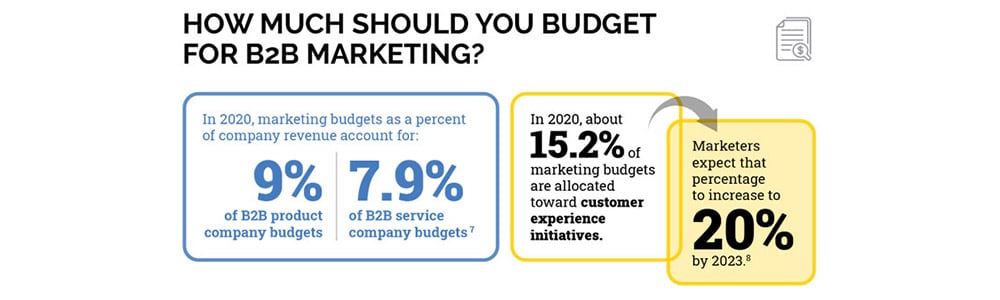
What Percentage of Revenue Should Be Spent on Marketing?

For years, the average marketing budget for small businesses was a recommended 7-8% of revenue, per the SBA. This marketing budget percentage supposedly held true if your revenues were under $5 million and your margins were between 10% and 12% of sales.

As a small business owner, including a marketing budget in your marketing plan is a necessary step toward raising funds for growth. However, there are several business factors that will affect this figure like your marketing goals, your industry, and whether you serve businesses or consumers.

However, since this figure was released, large strides have been made in the world of digital media and smartphones. Not to mention, a global pandemic rocked the world and has already changed what we know about face to face marketing initiatives and daily commutes.

The next sections show the average marketing budget breakdown for B2B vs. B2C companies, 13 different industry segments, and how these percentages will be affected by COVID-19.

B2B vs. B2C

Your average marketing budget will depend largely on whether your business serves businesses or consumers, and whether you offer mainly product or services.

B2B marketing budget breakdown

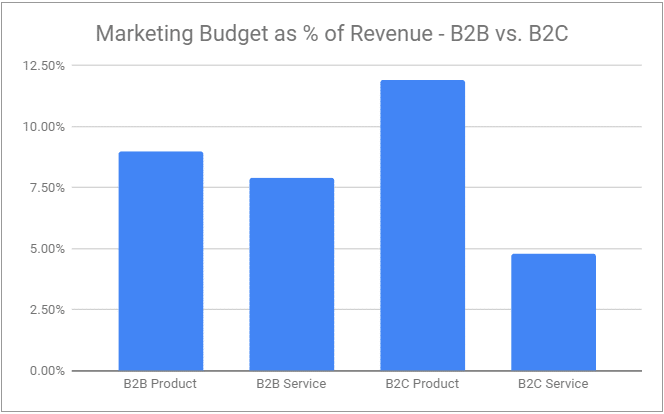
The following table and chart represent the average marketing budget for B2B companies and B2C companies segmented by product and service offerings.

Market Segment% of Revenue
B2B Product9.00%
B2B Service7.90%
B2C Product11.90%
B2C Service4.80%
how much does marketing cost - B2B vs. B2C

Average Marketing Budget by Industry

B2B marketing budget vs. B2C marketing budget comparisons only go so far when industry variation is added to the mix.

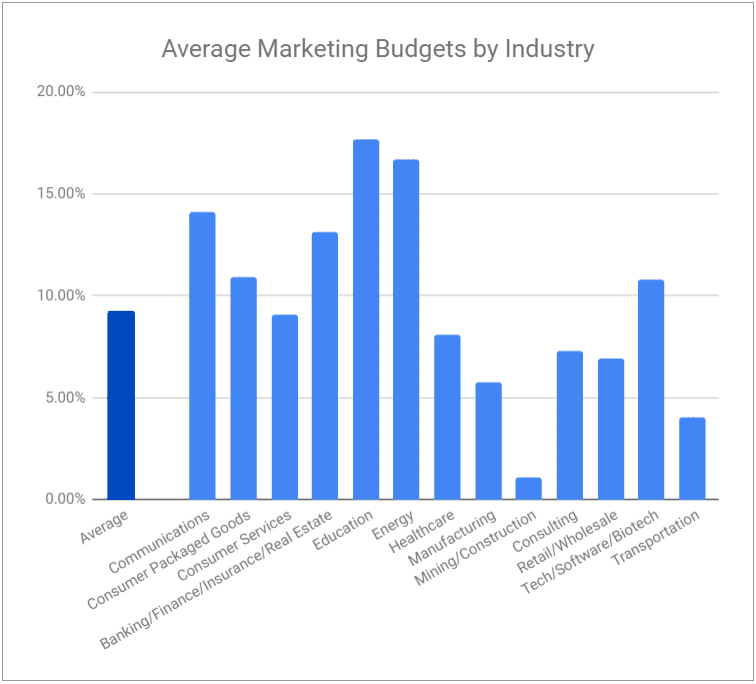
Case in point, the Manufacturing industry reports marketing budgets as 5.74% of revenue while Banking and Finance reports an average of 13.14% of revenue. With such a wide gap, it’s clear you must take a more granular look at the playing field before making an informed estimate about your own projected marketing expenses.

It’s important to recognize that about 79% these marketing budget percentages include the cost of marketing employees. For companies that use outsourced marketing services, their income statement doesn’t include a payroll expense that can be allocated to marketing workers.

The following data on the marketing budget as a percentage of revenue by industry was pulled and aggregated from an August 2019 and February 2020 report by CMO Survey.

Industry Segment% of Revenue
Communications14.09% 
Consumer Packaged Goods10.92% 
Consumer Services9.09% 
Banking/Finance/Insurance/Real Estate13.14% 
Education17.67% 
Energy16.70% 
Healthcare8.12% 
Manufacturing5.74% 
Mining/Construction1.10% 
Consulting7.28% 
Retail/Wholesale6.93% 
Tech/Software/Biotech10.78% 
Transportation4.02% 
Average9.25% 
marketing budget as percentage of revenue by industry

Marketing Budget Calculator

Your estimated annual revenue:

Choose industry segment:

Estimated Marketing Budget:

$0.00

Effect of COVID-19 on Marketing Budgets

So, how much should you spend on marketing your business… during or after a global pandemic? The above marketing budget figures by industry may have held true for the past several years, but are they representative of the world today?

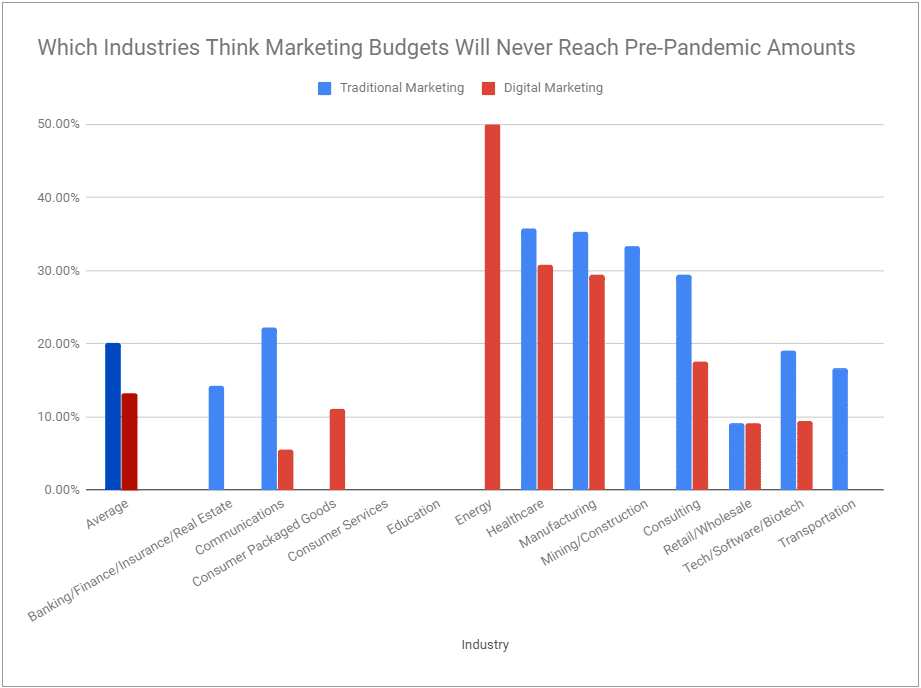
A June 2020 survey by CMO survey asked, “When will budgets return to pre-pandemic levels?” The following chart represents how many marketing leaders from each industry answered “Never” regarding traditional and digital marketing budget rebounds.

marketing budgets by industry - COVID-19 effects

Average Marketing Budget Allocation by Channel

By now, you should have a better answer to the question, “How much should a small business budget for marketing?” However, this doesn’t tell you which marketing strategies you should be executing with your newly established budget.

Benchmark Allocation

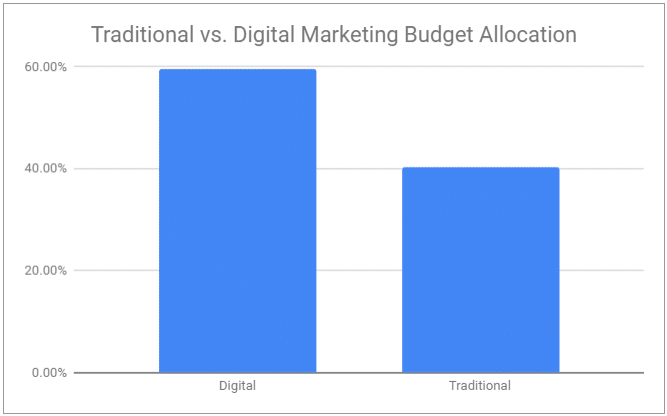
It pays to know (literally) where the rest of the U.S. invests their marketing dollars. Research from eMarketer paints us a picture of a projected 2020 marketing budget breakdown in the U.S.

ChannelAllocation (%)
Digital 59.60%
Traditional 40.40%
 TV26.40%
 Print4.90%
 Radio5.50%
 Out-of-home3.20%
 Directories0.40%

If you’ve been trying to answer the question, “How much should I pay for digital marketing vs. traditional marketing?” These numbers give you a better indication.

how much does marketing cost for a small business - traditional vs. digital

Keep in mind, there are huge national brands that can skew this data. Because of the expense of traditional TV advertising, it can appear disproportionately large. As a provider of both digital and traditional marketing in Texas, we get a large volume of requests for Austin and Houston print design.

It’s also important to recognize that many traditional channels have been migrating to digital. For example, the radio figures above don’t include digital radio and music streaming services which have become massively popular over the past several years.

For many businesses that have historically used traditional marketing, making the move over to a more digital approach doesn’t have to be painful. Our team has experience with B2B web design like industrial or manufacturing web design, that can help improve your digital presence. When you combine a polished site with digital marketing for manufacturers, like SEO for manufacturers or social media for manufacturers, your bottom line is sure to see growth.

Highest ROI Channels

There are several effective marketing channels you could include in your strategy, but we recommend scheduling a free consultation with our team to determine which channels are best for your business.

how much should I spend on marketing - B2B

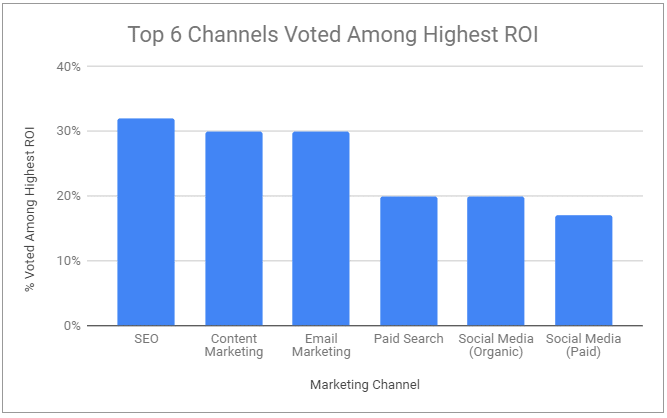
The following chart shows which channels were voted among the highest ROI at the companies of over 600 businesses. This data from a Smart Insights gives us a clear idea of the channels which may have the best return for your budget.

Marketing Channel% Voted Among Highest ROI
SEO32%
Content Marketing30%
Email Marketing30%
Paid Search20%
Social Media (Organic)20%
Social Media (Paid)17%
how much do companies spend on advertising

As a full-service, integrated marketing agency in Texas, MARION offers all of the above to help your marketing succeed across all relevant channels.

Sample Marketing Budget

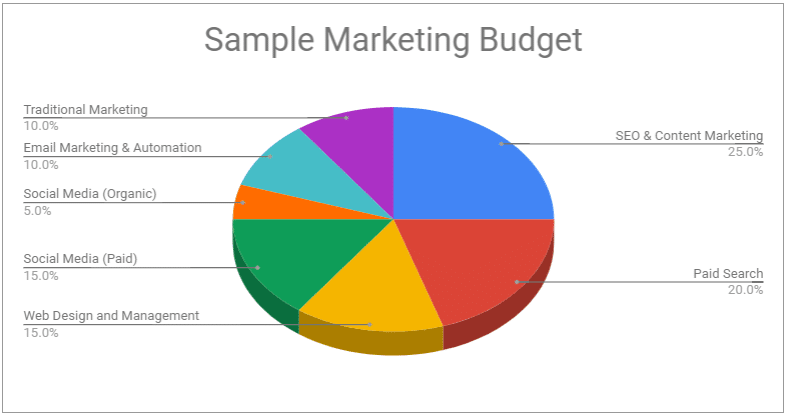
Trying to set and optimize a corporate marketing budget can be difficult. We’ve included a sample marketing budget breakdown in the pie chart below as a possible example.

sample marketing budget for small business

Use a tech company with annual revenues of $5 million as an example. If the average marketing and advertising budget in the tech industry is 10.78% of revenue, then the total marketing budget would be $539,000.

The breakdown for our tech company would be as follows.

Industry:   Tech

Annual Revenue:   $5,000,000

Marketing Budget:   $539,000

example marketing budget for B2B companies

Contact MARION for Expert Help with Marketing Your Business

MARION has been helping Texas businesses for nearly 40 years. We have the people and processes in place to serve your business needs for nearly any channel across most industries. Our competencies include SEO, web design, content marketing, email marketing and automation, PPC, social media marketing, trade show display design, and print and collateral design.

Contact a member of our team today for a free consultation, and we’ll implement a growth plan together.

Marketing emails you’ll actually want to read.

Get marketing tips and news sent to 
your inbox.
This field is for validation purposes and should be left unchanged.
Name(Required)

How to Increase Facebook Followers for Business Pages

In the first quarter of 2020, Facebook reported over 1.73 billion daily active users. Whether you’re employing B2C or B2B marketing strategies, Facebook can be an effective way to connect with your customers and target new audiences. Not having a Facebook Page for this community could cost you potential sales and clients.

In this blog post, we’ll discuss a few examples of how to grow followers on your Facebook Business Page.

Purpose of a Facebook Business Page

Having a Facebook Page creates a space for you to communicate with current and future customers. You can use it to post information about your business and highlight sales, events, products, and much more.

As you increase the amount of Facebook followers, your business’s exposure will grow and reach a massive number of engaged users. We’ll share some tricks of the trade we’ve picked up after years of providing Austin and Houston social media marketing services.

Where to See Facebook Business Page Likes and Followers

You can view your Facebook Business Page’s likes and followers under the “About” section. Wondering what the difference between “liking” and “following” a Page is? When you like a Page, you will start following updates from that page by default.

You also have the option to unfollow it so the content the Page posts won’t show up on your newsfeed. This way, you can show support for a Page without having it clutter your timeline. Following a page means you would like content to show up on your newsfeed.

how to increase Facebook followers for business

How to Get Followers on Your Facebook Business Page

There are several different methods you can try to boost the amount of Facebook followers on your page. Some approaches might work better depending on what type of business you have, but here are some tried-and-true strategies that will work for all types of Pages!

  1. Fill Out Your Profile
  2. Display Social Buttons
  3. Be Engaging and Responsive
  4. Run Ads
  5. Establish Posting Schedule

1. Fill Your Page Out Thoughtfully

People come to your Page searching for more information, so include all the details they could possibly need. This includes up-to-date links, photos, and contact information. For an extra competitive edge, include descriptive and on-brand company biographies and stories.

Your Facebook Page’s content should still feel familiar to your loyal customers. This way, they’ll be inclined to use your Page as a tool to keep updated on your business. Your followers might not be checking your website every day, but they’re most likely scrolling through Facebook multiple times a day.

2. Display Social Buttons

An easy way to advertise your company’s Facebook page and increase your followers is to display easy buttons on your website, other social profiles, and emails. Putting social buttons on your website and cross-promoting across different platforms also has an added benefit of “training” search engines into recognizing and associating your official Page with your business.

Along those same lines, if you’re familiar with Organization Schema Markup, you can use the sameAs property to tell search engines with social media profiles are tied to your business. In this way, search engines can understand which social profiles you maintain and how much of an authority you are across the web.

Contact MARION today if you’d prefer that a trustworthy SEO agency handle the technical details of optimizing your digital presence.

3. Be Engaging and Responsive

When a follower comments on a post or leaves a review, a great way to get more followers on your Facebook Business Page is to reply as soon as possible. A responsive Page provides a valuable way for customers to communicate with you so they’re more likely to interact with your Page. When you provide value and build relationships with your customers, your follower count will grow.

4. Run Facebook Ads

Having a Facebook Business Page makes it easy to run ads so you can boost your Page’s posts and reach more users that don’t follow you. You can even use their ad platform to target specific audiences and demographics, so you can tailor your search for more Facebook followers.

Advertising through social media requires a bit of investment, it is still relatively cheap and simple. This is possibly the most effective way to increase Facebook followers for your Business Page.

5. Create a Posting Schedule

how to get more followers on a Facebook business page

Posting quality content consistently on your Page is a requirement for a successful social media presence. Posting too infrequently is detrimental because your business will be easily forgotten or dismissed. However, this doesn’t mean you should post several times at 11 PM when you remember– you don’t want to spam or annoy your followers.

The best solution is to schedule your posts ahead of time, so they regularly go out at optimal intervals and times. There may be an ideal time for your customers to view your posts based on your industry.

For example, a non-profit might perform better posting on weekdays during work hours, while a retail company might perform better posting on afternoons on the weekend.

Do some research and determine what makes the most sense for your business and watch your follower count rise! Once you have a winning strategy in place, scale it out by creating a content marketing calendar for social media.

MARION Provides B2C and B2B Social Media Marketing Services

If you need guidance on how to increase Facebook followers for business or are too busy with other tasks to manage your social presence, MARION Integrated Marketing has the tools and expertise to help you reach your goals. Our social media team works closely with you to determine the best strategies for your business.

Contact us to schedule a free consultation today and learn more about our social media marketing in Austin, Houston, and DFW!

Marketing emails you’ll actually want to read.

Get marketing tips and news sent to 
your inbox.
This field is for validation purposes and should be left unchanged.
Name(Required)


How to Build a Digital Content Strategy That Dominates Your Industry

Now more than ever, the success of your business depends on your ability to reach potential customers through digital platforms. The Coronavirus pandemic showed the world that traditional, face-to-face marketing is not always possible. Meanwhile, creating an effective web presence for your business practically allows you to generate new business around the clock.

But, in a world where all businesses understand the importance of being found online, how do you transcend the noise? Building a well-researched content strategy for the web is your ticket to a sustainable competitive advantage in your market.

What Is Content Strategy?

Content strategy is the planning and management of all media assets, both traditional and digital, that your company owns. Content strategy is essentially the roadmap that your content marketing campaigns follow to drive results. A sound content strategy is the difference between a marketing department that is treated as a cost center vs. a profit center.

Is a Digital Content Marketing Strategy the Same?

A digital content strategy is part of your content strategy that plans and manages your digital media assets. Content planning in digital marketing has become markedly different from traditional content planning and strategy. Many times, traditional and digital content strategies are trusted to separate sub-units of a marketing department because of the required skill sets.

digital content strategy plan

Some of the main marketing activities of a digital-first content strategy include:

  • Web Design and User Experience (UX) Design
  • Search Engine Optimization (SEO)
  • Pay-per-Click (PPC)
  • Social Media Marketing (SMM)
  • Video Marketing

Why Is a Content Strategy Important?

Content marketing without a content strategy would look like a young child’s soccer game. The game has clearly defined rules and strategies for success, but the players are mostly unaware of them and exert themselves all the same. Your content strategy converts your marketing exertion (employee time, marketing budget, supporting software and marketing tools) into revenue from customer conversions.

Digital Transformation for Marketing

After serving East Texas customers for nearly 40 years, it was easy to identify which businesses were early adopters, majority, or laggards when it comes to building an online content strategy. Some businesses were active participants in trade shows and placing bids on public jobs but didn’t even have a website. Today, having a website and profiles set up on common social media platforms is expected for nearly all brands.

For help with the digital transformation of your marketing, speak with MARION about how our digital marketing agency can help!

Digital Content Types

Digital content isn’t strictly limited to the pages on your website. While many forms of online media are hosted on your site, others can be found across the web on third-party platforms. Some of the more common types of digital marketing content are listed below.

  • Web pages
  • Blog posts
  • Social media posts
  • Case studies
  • Infographics
  • Ebooks and whitepapers
  • Emails
  • Display ads
  • Videos
  • Podcasts

How to Create a Digital Content Strategy

Learning how to make a content strategy for your digital assets can be easy when you follow the right framework. In the sections below, we cover how you can build a digital content guide in five broad steps.

  1. Establish Goals
  2. Audit Existing Content
  3. Conduct Content Strategy Research
  4. Create Digital Content
  5. Publish and Promote

1. Establish Your Goals

Your marketing goals and objectives will frame your entire approach to building a content strategy. The following examples will illustrate very different business needs that will help create an appropriate digital marketing content plan.

content planning in digital marketing - goals

A B2C company that sells packaged food products to grocery retailers may be interested in developing a robust online presence, but it doesn’t need to generate sales with its internet content. They know they can stick to top-of-funnel educational content to build awareness with their target audience and demonstrate expertise to their potential distributors.

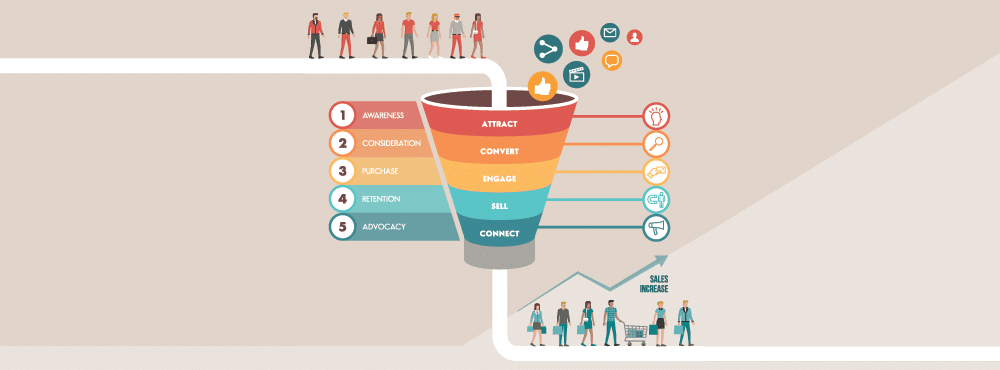
A B2B company that sells high-ticket industrial equipment can generate some sales through its existing network, but they count on their digital content to generate most of its leads. When digital marketing for manufacturers needs to generate business leads, a more inclusive digital content strategy is required. Top-of-funnel, middle-of-funnel, and bottom-of-funnel digital content must be included in a content strategy map that can meet customers at the awareness, consideration, and decision-making stages of their buying process.

When lead generation is the main concern of your digital content strategy, SEO will be a recurring theme that needs to be covered in your planning process. MARION can help deliver effective content marketing services and SEO services to breathe life into your strategy.

Another key part of your goal setting involves who you want to reach with your digital media. Creating buyer personas is a great way to paint a picture of your ideal customer so that you can shape your content to appeal to that persona. We cover the creation of buyer personas in our guide about marketing strategies to improve sales.

2. Audit Your Existing Content

After you’ve established your digital marketing goals, visit your existing base of digital media to see what can be used or reused to meet those goals.

For companies that have been entrenched in a purely traditional marketing approach, you may be able to transpose sell sheets into middle-of-funnel or bottom-of-funnel content assets.

For companies that have been engaging in business blogging without any underlying strategy, you may have plenty of insightful blog articles on your website that just need edited and updated to suit your goals.

digital marketing content plan

Whatever your situation, take inventory of your existing media and, at a minimum, label which stage of the customer journey (awareness, consideration, decision) it pertains to the most. You can also document whether it has a relevant call to action. For instance, if you turn a sell sheet into a web page about your products, you need to have clickable phone numbers or an online form embedded on your page.

3. Do Content Strategy Research

If you’re developing a content strategy that aims to generate customer conversions, your content strategy plan will involve a lot of SEO considerations. One of the best approaches for turning your website and digital marketing properties into an SEO powerhouse is to build the largest, most authoritative base of relevant content in your market.

The best tool to do this with is SEMrush. This video by the SEMrush team walks you through a method for identifying and building a digital-first content strategy that can help you outperform your competitors.

4. Create Your Digital Content

You can create your digital marketing content plan now that you know what topics you need to cover and which technical items you need to include in your digital content.

For blog posts and web pages, use the keyword research that you gathered using SEMrush to create a framework for your page or article. This framework should identify which subtopics you need to include (based on your research of top-performing competitors) and which keywords need to be used within the article.

online content strategy - research

For video content, feel free to use the same topic and keyword research while creating your script. If you’re using YouTube to host your video online, but sure to optimize the tagging section with relevant keywords and include your closed captioning. By seamlessly integrating relevant keywords from the start of your video creation process, you’re setting your production up for success. However, creating a quality video with real insights is a dimension that you’ll have to cover on your own.

IMPORTANT NOTE: Creating digital content that is technically optimized is a qualifying dimension in today’s competitive environment. For your content strategy research to pay off, the insights in your digital content need to be high-quality, and your writing or speaking needs to be engaging and professional.

5. Publish and Promote

Your digital content marketing strategy means nothing if it’s not being found by your target audience. Where are you planning to distribute your new digital content assets?

digital content strategy map for publishing

If you’ve properly optimized your content for search engines, your plan may not be distribution-heavy. Ideally, your new content will rank for relevant keywords and attract your target audience on its own. However, there are ways to supplement that traffic and improve your odds of being found.

For example, your social media posts don’t have to be stand-alone pieces of content. You can create a social media content calendar that systematically shares links to your new website content. You can send regular email updates to your list of subscribers that include references to your videos. You can run paid search ads to your newly minted case studies or whitepapers. You can learn how to advertise on social media so that your new digital content reaches a wider audience than you ever thought possible.

Keep in mind that your digital marketing content plan should include suggested distribution channels even before your content is created. By combining these forethoughts with your customer persona information, you can craft content that truly speaks to your potential customers.

MARION Can Help You Create a Winning Digital Content Strategy

When you’re in need of Houston or Austin web design, content marketing, SEO, social media marketing, or even just general marketing strategy, MARION can help. We have in-house experts that know how to drive results for both B2C and B2B clients in Texas.

Contact us today to schedule a free consultation and discover how we can turn your current marketing assets into a revenue-generating machine!

Marketing emails you’ll actually want to read.

Get marketing tips and news sent to 
your inbox.
This field is for validation purposes and should be left unchanged.
Name(Required)

Social Media Tips for Small Businesses During COVID-19

The Do’s and Don’ts to Follow

As COVID-19 continues to spread, the world today looks a lot different than it did just a few weeks ago. As we all learn to adjust to our new normal, businesses must shift their marketing efforts to reflect the changing environment around them.

Social Media During the Coronavirus Pandemic

Whether your company is or is not open for business, there are adjustments you should make to your social strategy to adapt your brand’s messaging to appropriately match today’s climate.

Let’s explore what your business should and should not be doing on social media during COVID-19.

DON’T

social media during COVID-19

Don’t ignore what’s happening

Everyone has been affected by the coronavirus pandemic in some way. Don’t let your brand appear naive and out of touch to what is happening. If your brand voice is more light and fun, continue toning it down for the time being to reflect the tone of the world and your audience during these difficult times.

You must find the right balance — stay true to who your brand is, while respecting the state we are all in.

Don’t make light of it

Don’t post memes or jokes that make light of the coronavirus or the preventive measures that are being implemented. When drafting posts, remember that your followers or their loved ones may have been affected by the Coronavirus. With that sentiment, make sure your posts would not be viewed as offensive or insensitive.

Also, avoid all political discussions or sharing info that could make you seem biased in any way.

Don’t share false information

Unless your business is in the healthcare industry, do not share updates regarding the status of the coronavirus pandemic. Just because there is a pandemic doesn’t mean you should start sharing health information — leave that job to the experts and trusted news sources.

Any information you choose to share about the coronavirus should be related to your industry, useful to your audience, and come from a credible source.

If, for example, you are a restaurant, it would be appropriate for you to share an article from a highly credible source about how to safely get takeout during the coronavirus. It would not be appropriate for you to make a post about a new drug combination that could treat coronavirus.

Don’t exploit the situation

Now is a time to show empathy and compassion — not to be pushy or salesy in your social media marketing during the Coronavirus pandemic. If you have promotions you need to push on social, do so with caution.

Keep your copy in line with what is happening in the world today. As you write and review your posts, do so with an overly-sensitive eye, always thinking of how you can be helpful, not exploit the situation.  

DO

social media marketing during Coronavirus

Do continue to stay active

Even if your business is not able to remain open or is operating lightly right now, do your best to communicate with your followers frequently. Staying in front of your customers will keep you top of mind when you’re open for business again.

A great way to do this is to provide tips to your customers, tease future promotions, and tote gift cards. For example, my local hair salon, which is closed right now, has launched a campaign called “show us your root.” Every person who posts a picture of their grow out roots with the hashtag #showusyourroots will receive $20 off their next hair appointment.

My mom, who is a fitness instructor, has been posting workout tips and videos for at-home Pilates stretches. And my favorite local boutique is posting about free online shipping and gift card promos. Genius!

Do consider posting about your COVID-19 plan (especially if your business is B2C)

If your business has any direct contact with other human beings, put out a post addressing how your business operations are changing due to coronavirus. Outline your plan for keeping people safe, how you are following CDC guidelines, and what your customers should expect to see differently when they interact with your business.

Make your customers feel safe shopping with you and show that you are taking care of your employees. At its core, your COVID-19 marketing strategy should include updates to your brand’s user experience.

Do Review scheduled posts regularly

If you preschedule your social media posts, review them often during the pandemic prior to posting to make sure they are still relevant. If you’re in need of professional help, contact our Houston social media marketing agency.

It seems like things are changing day by day and minute by minute during COVID-19, so make sure you continue to keep your posts in line with these frequent changes.

Keep your info updated

If your business hours or service operations have changed, make sure to update that on your social profiles and Google my business, as well as creating a social post about it.

Let MARION Help Guide Your Marketing Strategy During This Crisis

We are living in unprecedented times, and it’s only natural to feel confused or uncertain about what steps your business should be taking. Our team is here to help answer your questions and provide top-quality marketing services. We can help guide your Houston, DFW, or Austin social media marketing efforts.

For additional resources and advice on how to appropriately market your business during this time, visit our COVID-19 resource page.

Marketing emails you’ll actually want to read.

Get marketing tips and news sent to 
your inbox.
This field is for validation purposes and should be left unchanged.
Name(Required)


Content Marketing During COVID-19 – The Right Way

You’ve probably received tens, if not hundreds, of marketing messages from businesses regarding the COVID-19 outbreak and accompanying economic crisis. The Coronavirus situation has escalated rapidly, and content marketing during the COVID-19 pandemic can easily hurt your brand despite your best intentions.

So, how often does your business need to communicate about the pandemic? What brand messaging has proven helpful? Is now the time to be opportunistic? We cover these important questions below.

First, Some Coronavirus Terminology

COVID-19 (which stands for Coronavirus Disease 19), is a respiratory disease caused by a novel (new) virus called “severe acute respiratory syndrome coronavirus 2 (SARS-CoV-2),” according to the WHO. The important distinction here is that the disease caused by the virus is COVID-19, while the virus itself is called SARS-CoV-2, a member of the Coronavirus family.

We’ve seen several misuses of the terminology. Maintain the professionalism of your brand by knowing and using the right terms in your messaging.

The Coronavirus Marketing Adoption Curve

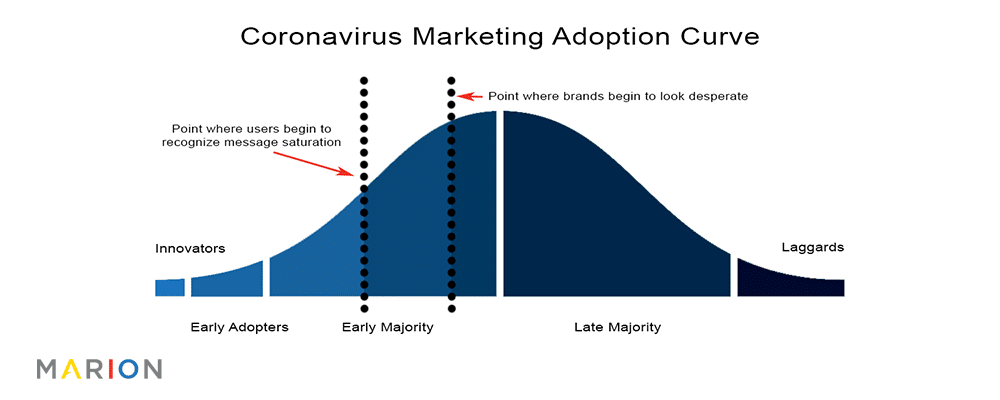
There is quite literally a COVID-19 Marketing Adoption Curve that is a variation of the Product Adoption Curve.

Coronavirus marketing adoption curve

Each message cycles through the innovators (brands that have developed and executed the concept), the early adopters, the early majority, the late majority, then the laggards.

You’ve seen this in action throughout March 2020. Some waves of popular messages include:

  • “We’re Here to Help”
  • “Our Hours of Operation Have Changed”
  • “We’re Offering [Insert Special Offer Here] to Help”
  • “Contactless Pickup Available”
  • “[Insert Company Here] Executive Is Foregoing Salary”
  • “Millennials Are too Old for Spring Break, It’s Gen Z You Want”
  • “How to Avoid Boredom at Home”

Because of the rate at which these messages are adopted by brands, their COVID-19 Marketing Adoption Curve has a very short lifecycle. On our graph above, the two vertical dotted lines indicate:

  1. Where users recognize that they’re receiving a lot of similar messages
  2. Where the message starts to look insincere and can hurt brands that are still sending it

If trendjacking is your brand’s response to the Coronavirus marketing climate, then you’re probably not seeing trending messages until they’ve already reached the early majority stage. This means you could have as little as hours left to tailor the message to your audience before they’re desensitized to the concept.

What does this mean for you? Your company’s COVID-19 content marketing strategy needs to set some guidelines.

Dos and Don’ts of Coronavirus Content Marketing

Communication between your business and its customers is important, but there is a not-so-delicate balance between what you should and shouldn’t convey. Your entire digital marketing strategy during COVID-19 will need to evolve, but we’re talking specifically about your messaging right now.

We’ll start with Coronavirus content marketing practices that you should avoid (while doing our best not to throw anyone under the bus).

Don’t

Don’t engage in the following COVID-19 marketing practices:

  • Send tone-deaf promotional emails that neglect the fear this pandemic is causing
  • Use COVID-19 puns in promotional emails – “Is There a Bright Side to Coronavirus?” email subject line from a solar products company
  • Try to drive foot-traffic to a local business
  • Run exploitative promotions
  • Send messages to your customers about your regular cleaning practices and that sick employees and customers should stay home – this should be business as usual
  • Use the fear of disease spread as a value-added sales benefit – like pushing “touchless” household products
  • Communicate empty “Virtue Signaling” – like a mortgage company sending an email to say “Your health and safety is our priority”
  • Blatantly communicate your desperation or self-interest

Do

Make sure you consider the following practices while marketing during the COVID-19 crisis:

  • Let customers know if your operations have changed, and an estimate of how likely these changes are to remain intact
  • Send out updates as often as needed to adjust customer expectations of your business like
    • We’re back in stock
    • Now offering takeout and delivery
  • Pause automated campaigns or messages
  • Focus on marketing efforts that you can control like SEO and other owned media channels
  • Address frequently asked questions from your customer base that are directly related to your products/services
  • Show empathy in all communications

4 Examples of COVID-19 Content Marketing

We found some examples of good and bad corporate email marketing examples from the latter half of March. Many of these directly correlated with a “Do” or “Don’t” from the sections above.

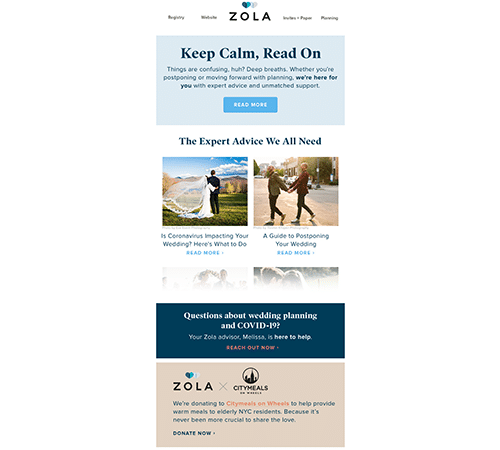
1. Address Relevant FAQs Like ZOLA

Zola is a wedding registry and website company that makes it easy for soon-to-be-married couples to organize their pre-marriage events. At a time when the CDC is recommending that mass gatherings be postponed or canceled, many engaged couples have questions about their special day.

ZOLA faces these questions head-on by providing several educational resources and a line to an event advisor that can help adjust wedding plans. Their message is directly relevant to recipients and genuinely helpful to their target audience.

Subject Line: We’ll figure this out

coronavirus content marketing example - ZOLA

Source: Zola

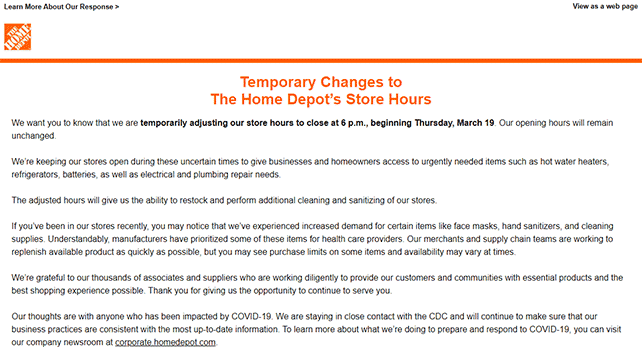
2. Communicate Changes in Store Hours Like Home Depot

Home Depot is a great brand role model to follow during the Coronavirus pandemic. They quickly emailed their customer base about changes in their store hours, as well as temporary shortages in certain products. Their subject line makes the email’s purpose clear and Home Depot kept the email relatively concise.

Subject Line: Temporary Changes to Our Store Hours

examples of COVID-19 content marketing - Home Depot

Source: Home Depot

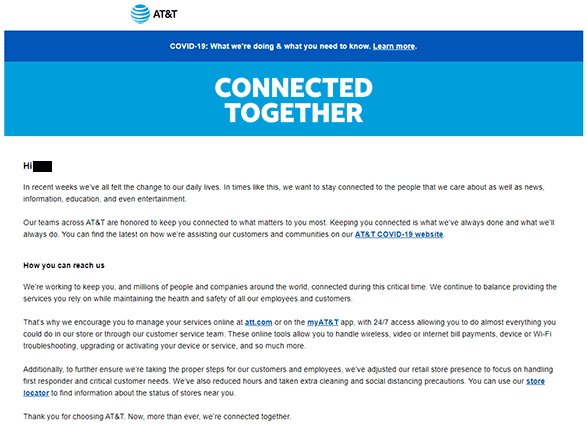
3. Avoid Generic “Business as Usual” Messages

By this point, you’re very familiar with “We’re here for you” emails in your own inbox, and you’ve already developed a blindness to them. Because of the accelerated lifecycle of messages in our Coronavirus Marketing Adoption Curve, any brand still sending this out would be considered a laggard.

For existing customers, this email doesn’t communicate anything new. 24/7 access to your online account, and stores taking “extra cleaning and social distancing measures” are not need-to-know information.

Subject Line: [Your Name], AT&T is here for you.

COVID-19 content marketing example - AT&T

Source: AT&T

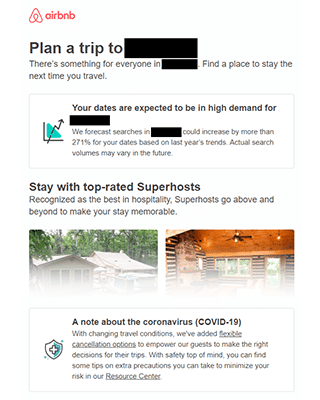
4. Pause Automated Messages

The email below is an example of an automated message that should have been paused. Airbnb has an automated forecasting tool that would normally be helpful to customers, but in this case, it could be harmful to their brand.

With federal social distancing guidelines in place through the end of April, there is very little chance that demand will spike in the next few weeks. The catch-all disclaimer that “Actual search volumes may vary in the future,” is not as helpful as eliminating the automated email altogether.

This example makes it clear why your business should take a close look at the automated marketing systems you have in place.

Subject Line: Searches in [Target Location] for [Target Date] are expected to increase

examples of coronavirus content marketing - Airbnb

Source: Airbnb

Want to Discuss the Impacts of COVID-19 on Your Marketing Efforts?

Your business has no doubt been impacted by the Coronavirus pandemic, and it can be difficult to evaluate the right marketing strategy. MARION has set up a Coronavirus marketing hub to help keep you informed.

We’re also extending free 30 minute marketing consultations to Texas-based businesses. Our Houston marketing agency has advanced experience with businesses employing anywhere between 5 and 150 employees.

Contact us today for help developing a marketing strategy for the present, and a strategy for the future economic rebound.

Marketing emails you’ll actually want to read.

Get marketing tips and news sent to 
your inbox.
This field is for validation purposes and should be left unchanged.
Name(Required)


Generate ROI with Content Marketing for Manufacturers [W/ Examples]

Too many B2B marketers aren’t taking advantage of content marketing, which can cost less than other traditional marketing methods and generate more business leads.

According to DemandMetric, content marketing costs over 60% less than traditional marketing and creates three times as many leads. Discover how your industrial company can develop and leverage a content strategy for better ROI.

Why Is Content Marketing Difficult for Industrial Companies?

Content marketing is a marketing methodology that concentrates on providing valuable information to potential customers and a targeted audience. Inbound marketing agencies use content marketing to create solutions, then let the right prospects find those solutions and request to become a paying customer. Instead of pushing your solutions, you’re providing part of them for free and pulling qualified leads to you.

Content marketing strategies for industrial and manufacturing companies differ from an average business. It can be difficult to come up with engaging content due to the niche content and often “dry” subject matter. Your audience will also be much smaller and more knowledgeable.

Why You Need a Content Strategy for Manufacturing Marketing

According to the Content Marketing Institute, only 51% of North American manufacturing marketers (compared to 73% of B2B content marketers) prioritize their audience’s content needs. From a search engine optimization (SEO) standpoint, putting out optimized content can also increase your organic rankings and drive more traffic to your website. Get ahead of the curve in your industry by creating an effective content marketing strategy.

Content marketing is a cost-effective method of reaching consumers. Your target clients are most likely high-level decision-makers that conduct a lot of research before making any final choices. Build trust and create loyalty through content marketing by providing value to your customers. By answering their questions and solving their issues, you are establishing your company as a thought leader and demonstrating that you are a better, more experienced option than competitors.

manufacturing content marketing strategy

Examples of Manufacturing Content Marketing

When it comes to the inbound marketing methodology, there are three main steps in your customers’ journey:

  1. Awareness
  2. Consideration
  3. Decision

During each phase, the customer has different needs and goals to consider as you develop your industrial content marketing.

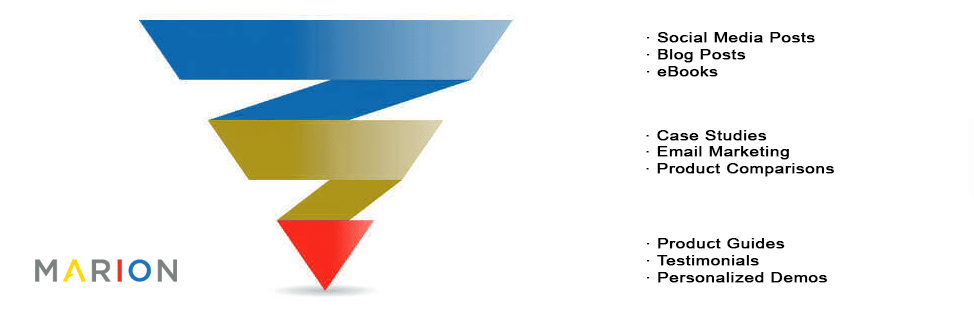
Top of Funnel Examples

content marketing for industrial companies

At the top of the funnel, you are primarily focused on fostering awareness. Your potential client is starting to realize they have a problem and they are looking to find out what it is. Your goal is to educate them and position your offering as (at least part of) the solution.

Blog Posts

Blog posts are a great way to distill complex information into an accessible and approachable format. New visitors will be more likely to engage with your website and start a conversation with new topics and issues for them to consider. Over time, it will also help drive traffic as your industrial or manufacturing SEO improves.

Social Media Posts

Promote your blog posts and other content you create via social media, an inexpensive and effective method for disseminating information and increasing brand visibility. Social media for manufacturers provides opportunities for your audience to discover more information. Your followers are already interested in what you have to say, so you’re always reaching the right audience.

eBooks & Whitepapers

If a topic requires more in-depth treatment, eBooks are a great way to provide value to potential customers. Your B2B customers typically enjoy eBooks because it feels like they are receiving something very useful for free.

Middle of Funnel Examples

content marketing for manufacturing companies

This is the “consideration” stage, where your potential clients are conducting research on who to give their business to. The goal of your manufacturing marketing strategy during this stage is to demonstrate that you are the best fit for their needs.

Case Studies

Case studies are a great way to persuade potential clients that your business is the right choice. Analyze previous success stories so your audience can see how you solved problems for similar customers.

Email Marketing

Email marketing is an inexpensive yet effective method to nurture your leads. With this B2B marketing strategy, you can target different groups by segmenting your email list. Use a drip email marketing campaign to regularly send prospects educational content and develop trust in your brand over time.

Product Comparisons

In the middle of the funnel, buyers know they need a product or service but aren’t sure which one to choose or which features even matter. A buyer’s guide for your solution can help reduce their friction.

Use comparisons of your solutions and your competitors’ offerings to help prospects identify the difference in value. This tool helps highlight your advantages in advance and hopefully moves your would-be customers closer to a purchasing decision.

Bottom of Funnel Examples

industrial content marketing

At the bottom of the funnel, your prospective customers enter the “decision” stage. Your goal is to convert them into a customer by convincing them to choose you over your competitors with all the right targeted content.

Product Guide & Videos

Videos are a great way to showcase your products, services, or testimonials in a visual manner. Some products or services need to be demonstrated, and videos help you answer any remaining questions in a more personal and engaging medium.

Customer Testimonials

Testimonials straight from your previous customers tell your prospective clients that you value customer experience and work to deliver a quality solution. Make it as easy as possible for past customers to share their experience working with you to ensure authenticity.

Personalized Demonstrations

One of the most effective ways to use content marketing to convert your customers is a personalized demo. Create a video that demonstrates exactly how your business can provide the solution to their specific issue. Personalized videos help your lead feel like you are invested in them and are willing to go above and beyond.

Contact MARION for Help with Your Industrial Content Marketing

If your manufacturing company is looking to get started with content marketing, MARION is happy to help! We have decades of experience delivering high-quality manufacturing web design, print design, and marketing campaigns for Texas-based businesses.

Contact our team of experts today and find out how we can help you get started with content marketing for manufacturers.

Marketing emails you’ll actually want to read.

Get marketing tips and news sent to 
your inbox.
This field is for validation purposes and should be left unchanged.
Name(Required)

Social Media for Manufacturers – How to Get B2B Social Media Marketing Results

Social media marketing for B2B may be less straightforward than B2C marketing, but it’s just as important in building your brand and business.

In this blog post, we’ll walk you through which platforms you need to be on as a manufacturer, why it’s an important part of marketing for manufacturing companies, and how to form a manufacturing social media strategy.

Why Social Media for the Manufacturing Industry is Important

Not too long ago, social media didn’t seem like a necessity for B2B companies. However, as the workforce shifts towards a more tech-savvy generation, more and more key decision-makers are going to be looking online for more information before they decide to work with you. This makes social media for manufacturing companies an indispensable channel.

Having a polished social media presence is beneficial for many other reasons. Social media activity can help boost your SEO efforts, generate leads, aid with customer service, and much more.

If your social presence indicates you are a leader in the manufacturing industry and care about communicating with customers, it’s more likely you’ll stand out from your competitors.

Best Social Media Platforms for Manufacturers

Some social media platforms make more sense for manufacturers than others. Your customers will be less inclined to interact on more casual or “trendy” platforms such as Instagram, Pinterest, or Snapchat.

Here are the best manufacturers social media sites to help with your B2B marketing strategies:

LinkedIn manufacturers social media

LinkedIn

LinkedIn is the best B2B social media site to pursue, with over 94% of B2B marketers on the platform. This is a great place for businesses to build thought leadership and develop significant connections.

LinkedIn also has a large number of decision-makers. 45% of LinkedIn members are in upper management. LinkedIn Ads allow for very precise targeting with filters such as job seniority, company size, member age, industry, and much more.

Most users on LinkedIn are on the site to connect with other people in their industry, so that’s already a key step in separating valuable leads from the crowd. LinkedIn also has a Groups feature where you can find, connect, and interact with potential clients in a very targeted pool. Joining a LinkedIn Group is a great platform to showcase content marketing for manufacturing companies, and a fantastic way to drive leads and traffic towards your company.

social media industrial marketing on Facebook

Facebook

Having a page presence on Facebook is still a must. Without a Facebook Page today, your credibility may be questioned. In fact, it could even have a negative impact on local SEO for manufacturing companies.

Many customers will go on your page to contact you through Messenger or public posts and comments. This is a great way to connect with people and direct them to exactly who they need to speak with. These visitors could be looking for quick clarifications and initial questions so it’s important to monitor this channel closely. With over 2.5 billion monthly active users, your social media industrial marketing is bound to reach your target audience through Facebook.

social media marketing for manufacturers on YouTube

YouTube

The possibilities of marketing for your manufacturing company on YouTube are endless. YouTube is a great way to showcase your company and its products to build brand recognition and improve SEO. The video assets you create on YouTube can also be included in your manufacturing website design. While YouTube technically functions as a search engine, many consider it a social media platform because of the engagement it facilitates.

Marketers could upload videos of customer testimonials, product tutorials and demonstrations, service walk-throughs, trade show appearances, and much more. Anything that tells your brand story is worth posting!

Twitter social media marketing for the manufacturing industry

Twitter

Social media marketing for manufacturers doesn’t always prioritize Twitter, but it’s still important to have a company Twitter account. Your role on Twitter should be an educator. Use this channel to share interesting and engaging information.

As a mobile-first platform, many of your clients on-the-go can view your posts easily. If there’s ever a crisis, Twitter is an excellent tool to get any message out quickly and promptly reply to others.

How to Form a Manufacturing Social Media Strategy

The first thing you should do when coming up with a social media strategy for manufacturing is to determine your audience. Which websites are they using the most and which ones are they interacting with you on? If you have no idea, it might be a good idea to investigate what your competitors are doing.

After you decide on which platforms to best reach your potential clients, it’s useful to come up with a content schedule. This way, you can post consistently and build a following that knows they can depend on you.

Make sure you monitor social media regularly so you can quickly respond to customer posts and inquiries. Spread out self-promotion amongst content marketing so long-term followers don’t get fatigued from the same content.

Struggling to Develop a Social Media Strategy? Call MARION Marketing Today!

MARION has years of B2B marketing experience from working closely with industrial manufacturers across Texas. If you need assistance with your social media strategy, our expert team of SEO and social media professionals knows exactly how to craft one customized for your business’s needs.

Contact us today to schedule a free consultation with a member of our marketing agency!

Marketing emails you’ll actually want to read.

Get marketing tips and news sent to 
your inbox.
This field is for validation purposes and should be left unchanged.
Name(Required)


Using Press Releases in Your Marketing Strategy

With all the other brand development strategies available, press releases have fallen to the wayside in recent years. However, a press release can be a very effective tool for marketers. It just takes a little extra work to make it stand out.

In this blog post, we discuss the different reasons to write a press release and how to disseminate one.

What Is a Press Release in Marketing?

A press release in marketing is when a brand releases a summarized announcement of something they are trying to promote. The hope is that news organizations will want to publish a story about it in their publications.

A press release is not a prewritten story to be copy and pasted – journalists decide whether they would like to follow up on the lead and write their own articles or posts. However, press releases can and are often used as quotes or official statements.

do press releases work?

When to Do a Press Release

Utilize press releases when something is newsworthy. This is very important because journalists want to write about things that catch people’s attention and are genuinely worthy of their time.

Journalists and reporters will need to decide if they want to spend their time and effort doing research, getting quotes, and finally actually writing the story. This time investment means that journalists are selective and boring announcements end up being ignored.

What Should Be in a Press Release?

The basics that a press release should include are:

  • the main announcement
  • relevant dates
  • locations
  • contact information

The tone should be professional with correct grammar and no spelling mistakes. This is an official statement from your business and should therefore represent it well. For professional help, contact a Houston internet marketing company like MARION.

How Long Should a Press Release Be?

A press release should be kept short and sweet. Try to keep it all within one page. All you need are a few paragraphs to hook the reporter and give them the most critical information to get them started on their story.

Do Press Releases Work?

These days, the ease of writing and sending out a press release has caused an influx of low quality press releases with little-to-no newsworthiness. Many journalists comb through hundreds of press releases (most are thinly-disguised ads) a day and only get a handful of real leads.

how long should a press release be?

Press releases work when you have something BIG to announce, and only when your company is doing something momentous or consequential. If you’re asking yourself whether it’s newsworthy – it’s probably not. It should be a resounding yes even to an average person with no investment in your operation.

Press releases can be even more effective for internet marketing in Austin or Houston if you tailor it to the publication you’re targeting. What you would send to a large magazine could be different from what you send to a niche blog.

Press Release Marketing Strategy

Consider the following benefits and aspects of writing a press release before adding this to your overall marketing strategy.

Press Release Advantages and Disadvantages

The main advantage of using a press release is the convenience and ease it brings. You can whip it up quickly and send it out to as many journalists as you want. It’s a good way to get the word out when you have something big to announce.

The disadvantage is that most journalists’ inboxes are overflowing with flowery, unimportant press releases which makes it easy for yours to get lost within the crowd. However, when written effectively, a press release can stand out and benefit both you and the journalist.

writing an effective press release

Writing an Effective Press Release

An effective press release grabs attention and tells a story while still conveying its message clearly. It should be designed to save the reporter as much of their time as possible.

Most reporters will open your press release and skim quickly. Include any pertinent background information on products or services that the journalist may have difficulty finding out about on their own. Some writers may drop a story if they cannot find important information easily.

Finally, finish the press release with a boilerplate – a short paragraph summarizing your company that appears at the end of every press release. When written effectively, press releases can be highly beneficial to both B2C and B2B marketing strategies.

How to Write a Press Release for a Product

In addition to the core items above, writing a press release for a product should basically highlight a before and after.

If the product is new for your business, the change is obvious. You need to highlight product benefits and features, how it’s different from similar products on the market, pricing, and a quote from someone at your company who was closely involved with product development.

If the product is a new version of an existing product offering, highlight any new benefits and features, improvements, cost-efficiencies and pricing, and a quote from the development team. If the product is digital, you may want to link to a changelog that reinforces a timeline of the new capabilities.

How to Write a New Hire Press Release

Writing a press release for a new hire is a bit easier. Start with the core press release components, but outline where your new hire fits into the current org chart, how they will add value, and relevant background information that will instill confidence in your customer base.

Most new hire press releases are for high-profile individuals, or highly-specialized individuals who are well-known within their niche. Selling these new employees on your company and its vision should in turn sell your customers on the product/service that you offer.

How to Write a Press Release to Promote Your Business

Factors to consider when writing a press release to promote your business are less defined. As is the common theme throughout this article – your press release needs to add real value to journalists and eventually the community at large.

Show that your business has offered a new free tool, helped the community (by volunteering, a donation, etc.), or has made some sort of interesting technological advancement. The bottom line is, adding value to the world in a big way will turn heads.

Do Press Releases Help SEO?

Writing press releases for SEO used to be a commonplace tactic, but as the quality of press releases fell and the quantity grew, Google started to penalize websites that abused this method.

Nowadays, your press releases should contain no-follow links if you want to avoid being penalized. Many online press release syndication platforms automatically apply the no-follow attribute to all links within press releases anyway.

writing press releases for SEO

Press releases can help indirectly with your SEO if you are writing about interesting developments and actual newsworthy content that will bring people to your website. If you target the right reporters or audience, your press release strategy will help improve your site’s SEO by getting press coverage that develops your brand’s expertise, trustworthiness, and authority.

Where to Send Press Releases for Free

Sending a digital press release is extremely easy with the help of many free websites where you can distribute your press release. Most of these sites offer premium plans with customizable options. Some sites you can use to send press releases for free are:

MARION Can Help Refine Your Marketing Strategy

Writing and sending out press releases can take a lot of time and effort, especially if you’re confused with the process. If you need help on writing a press release to promote your business, let MARION Marketing Agency assist you!

Contact our experienced team today to see which strategy will work best for your business.

Marketing emails you’ll actually want to read.

Get marketing tips and news sent to 
your inbox.
This field is for validation purposes and should be left unchanged.
Name(Required)

15 Low-Cost Marketing Ideas for Small Business Owners

As a small business owner, you may have limited resources when it comes to marketing. Small business marketing is all about getting creative – there are countless things you can do to stretch your dollar, especially with the Internet so readily available.

In this blog post, we’ve compiled our favorite small business promotion ideas for your convenience!

  1. Social Media
  2. Start Blogging
  3. Attend Industry Events
  4. Consider Rebranding
  5. Volunteer
  6. Start Email Marketing
  7. Connect with Reporters
  8. Apply for Awards
  9. Brand Your Vehicle
  10. Customer Referral Programs
  11. Customer Loyalty Programs
  12. Start Podcast
  13. Offer Free Class/Webinar
  14. Build Expertise
  15. Publish Whitepaper

15 Low Cost Marketing Ideas for Small Businesses

Whether you’re in search of B2C or B2B marketing strategies, these fifteen marketing strategy ideas for small business owners are sure to get you started!

Keep in mind that just because one of these strategies works for someone else doesn’t mean it will work for your business. Devise a test campaign with clear marketing goals to see if these techniques can work for your company.

1. Take Advantage of Social Media

One of the best free marketing ideas for small business owners is utilizing social media. Not only is it vital to building on online presence for your business, but the possibilities are endless when it comes to social media platforms. You can host online contests, cross promote your content and videos, respond to customers, reach out to local influencers, and much more.

If you’re looking for creative ways to market your small business, a growing trend is to start a Facebook Group that brings value to others. For example, if you own a bakery, you could start a group called “Houston Bakers” where you can discuss the local industry and help each other troubleshoot common issues. As the leader and moderator of the group, you are establishing yourself as an expert and guide to the rest of the community.

Use our list of recommended free social media tools for small businesses to help you get started.

2. Start A Blog (Helps with SEO, Etc.)

Continuing our list of tips on online marketing ideas for small businesses, starting a blog is one of the most effective and inexpensive options.

Some of the benefits of blogging for marketing include interest generation and improved SEO. By improving your search engine optimization, you can attract more customers to your site and create more opportunities for customer conversions. A blog also brings value by teaching people or informing them of industry concepts, issues, or solutions.

Read our article on search engine optimization outsourcing for more tips on marketing your small business in a cost-efficient way.

3. Attend a Conference or Trade Show (Hand Out Business Cards, Network, Etc.)

marketing for small business owners

It can be difficult to think of low-cost B2B marketing ideas for small businesses – luckily, attending industry events is a goldmine for getting the word out about your company.

Connecting with other businesses in your industry is critical to developing new leads and contacts. You’ll also learn new strategies or attend seminars specially crafted to help you develop your business. Make sure you spend the entire event networking and handing out your business card.

4. Revamp Your Branding

Speaking of business cards, is your business’s branding up-to-date or has it been a while since you refreshed your company’s image? Some places communicate how dated they are with their clunky logos and outmoded color schemes.

One of the most overlooked marketing tips for small businesses is making sure you present the best first impression possible. People have short attention spans and plenty of options – make sure you grab and keep their interest!

Learn more about popular company color schemes that will appeal to your audience. If you’d like professional help, contact our Houston branding agency today!

5. Volunteer or Donate to Boost Your Brand Reputation

marketing strategy ideas for small business

Giving back to your community is an excellent way to create goodwill and boost your brand visibility. When you donate your products or offer your services under your business’s name, people will associate your brand as a helpful and positive presence. People will also see examples of what you offer or try your free samples.

There are several other different ways to market your small business at a charitable event – for example, you could donate a portion of your sales, give your employees a day off to volunteer and represent the company, sponsor an event or team, and much more.

6. Connect with Customers Using Email Marketing (Newsletter, Offers, Etc.)

Contrary to popular opinion, email marketing can be extremely effective. Not only is it an easy, low-cost way to disseminate information to your customers, but it is proven to be an excellent investment – for every $1 you spend on email marketing, you may expect an average return of $38.

An effective email marketing strategy can include monthly newsletters, exciting announcements, push promotional offers, and more!

7. Be Accessible to Reporters

internet marketing for business owners

One of the more unconventional marketing strategy ideas for a small business is to get on local media. Local news reporters are constantly looking for sources to quote – make sure you’re available by signing up for HARO (Help A Reporter Out) for the opportunity to get free press.

If there is a current event in your industry, you could be called in as an expert (giving your business a boost in credibility and visibility). Types of digital marketing campaigns that integrate PR are usually more successful.

8. Submit Your Company for a Business Award

Look at local magazine ratings and reviews or search for business awards in your industry that you can apply to. Magazines will publish information about your business while organizations will often link to your website.

Winning an industry-relevant award is a great way to get your business’s name out and you often get a badge or certificate to display on your website or office. In fact, award acquisition is a popular part of many effective brand development strategies.

9. Brand Your Company Vehicle

If your business utilizes a vehicle, then it’s a no-brainer to outfit the car as a mobile billboard. If a full wrap is too expensive, use magnets and window decals. Wherever you drive, people are exposed to your business’s name and services, creating more opportunities for people to call or search for you.

10. Offer a Customer Referral Program

Word-of-mouth marketing is one of the most powerful tools your small business can take advantage of. 92% of people trust recommendations from friends and family over other forms of marketing campaigns. Ask existing customers to bring in other customers by offering them incentives such as discounts, free products or services, and more.

11. Offer a Customer Loyalty System

Having a rewards program creates more reason for your patrons to return and spend more. Your loyalty system can be as simple as a punch card for a free product or a complex offering of discounts and promotions. You want to create something that keeps your customers coming back.

12. Start an Audio or Video Podcast

successful marketing campaigns for small businesses

A podcast can be a fun way to establish your business as an expert in your industry. These days, all you need is a microphone, possibly a camera, and a laptop to edit and put out your own series.

It seems daunting, but it doesn’t need to be a daily or even weekly product – once a month or once every two months is fine if the quality of the content is gripping! Check out our article for a list of popular Austin and Houston podcasts for business owners.

13. Host a Free Class, Event, or Webinar

Hosting an event is a great way to show off your business’s services and products. People love free events and samples, so take this opportunity to hand out promotional materials and business cards while informing them of upcoming offers.

If hosting a crowd of people is impossible without spending a lot of money, perhaps offering a free webinar to inform the public about an industry process or product would be more effective. There are several tools and platforms available that can help you broadcast online.

14. Establish Yourself as An Industry Expert Online

B2B marketing ideas for small business

This is one of the most inexpensive marketing ideas for small business owners on this list, but it requires a consistent time commitment.

Keep an eye on conversations on websites like Quora or niche websites related to your industry so you can chime in and give answers when called for. Participating in and contributing to forums in a useful way will boost your business’s visibility and perception of helpfulness.

15. Publish a White Paper

Another smart way to advertise your small business and establish expertise is to publish a white paper. You can post it on your website to generate more traffic and make it easily shareable so others can find it and read it. This is another large time commitment, but you can make it easier by repurposing old content you’ve already created such as blog posts or articles.

MARION Can Help with Your Small Business Marketing Needs

If you need more small business advertising ideas, contact our expert team of marketing strategists at MARION today! Our marketing agency has been serving Texas businesses for nearly 40 years. We’d love to help you come up with more cheap advertising ideas for your small business.

Marketing emails you’ll actually want to read.

Get marketing tips and news sent to 
your inbox.
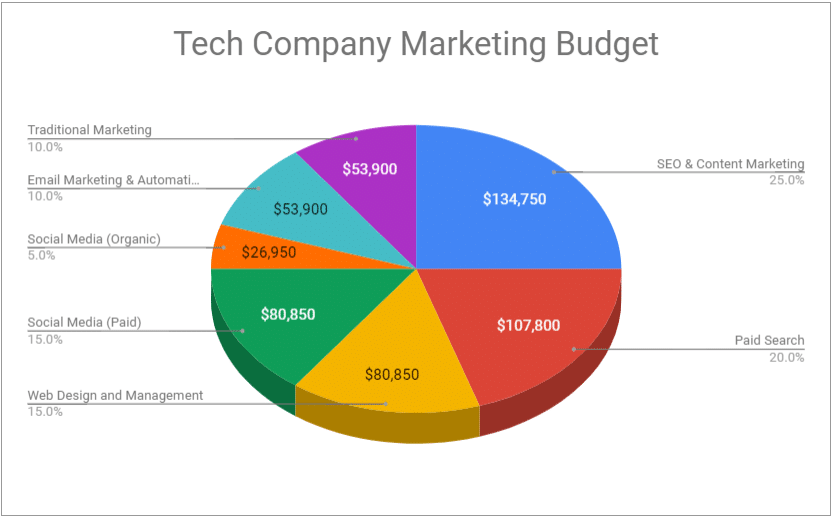
This field is for validation purposes and should be left unchanged.

Name(Required)