Have you ever wondered why, every time you log onto Facebook, you typically see the same people, groups, and company pages showing up repeatedly on your News Feed whereas other people and pages you may be following are never there?
Or maybe you’ve got a business page that has over 10,000 followers, but you’re only getting 1-2 likes or comments on every post you make. As people and businesses continue to enter the world of Facebook, Facebook must decide what content gets that golden spot, which is your News Feed.
To do this, Facebook has an algorithm that it uses to gauge content you are following that will most likely interest you. Although Facebook is a great place to socialize with your friends, at the end of the day, they are still a business. Their business model? Simple! Keep people on Facebook as long as possible. To do so, they have to figure out what content to show that will continuously people interested. So how do they go about doing this? It’s all in the Facebook Algorithm.
Facebook is constantly altering their algorithm. What may be helpful advice on Facebook today, may be completely irrelevant in 6 months. Unfortunately, business pages on Facebook get the short end of the stick when it comes to having their content show up on their followers News Feeds. Why? Because, once again, Facebook is a business at the end of the day, and they want you to spend ad dollars to give you what you want.
In a similar process to how you would optimize your website with SEO to show up higher in Google search results, once you have a better understanding of how the Facebook algorithm works, you’ll be able to get more bang for your buck when it comes to how far your content reaches. Don’t worry; you don’t have to be a coding genius to understand the basics of how it works.
What Does The Facebook Algorithm Take Into Consideration?
No one is a 100% sure how Facebook or Google’s algorithms work. In fact, Lars Backstrom, Engineering Manager for News Feed Ranking at Facebook, estimated that there are as many as 100,000 individual weights which produce what users find in their daily News Feed.
Although it’s impossible to know the secrets to these 100,000 factors, social media marketing companies and top marketing agencies around the world will agree on the following, which can make your content benefit from the Facebook algorithm.
Reactions
Up until 2015, Facebook only had three options for engagements on a post. Like, Comment, or Share. On October 8th, 2015, Facebook released Reactions which added being able to love, laugh, cry, wow, and be angry at posts in addition to just being able to like it.
By offering these emotion-filled reactions, Facebook’s algorithm is gaining insights from users and your audience.
If one of your followers were to click the “love” reaction on one of your post, they have just tweaked their personal Facebook algorithm to show more of your content on their News Feed, without you having to sponsor that piece of content.
The same also works for the “angry” emotion. By giving Facebook the feedback that a certain post is making you angry, the algorithm will know not to show you more of that type of content so that you will ultimately stay on Facebook longer.
So what does mean for your business page? It means that you should optimize your content for getting better reactions out of your audience. Get creative! Think about how you can pull out emotions from your audience to react to your content.
Humor is always a good start but doesn’t always work out if it’s not executed properly. One creative method we used for generating reactions without sponsoring the post, is by using a reactions poll for Beetnik. (Notice how we didn’t include the angry reaction as an option)
Shares
While reactions may play a role in the Facebook Algorithm, shares are golden. When people share content on Facebook, they are essentially telling the algorithm that piece of content is so good they wished they would have posted it themselves.
How will I know that my posts will be engaging enough to gain shares?
In addition to optimizing your content for shares, you can also test content on other social media platforms that have less dependent algorithms such as Twitter and LinkedIn. If you see a decent response on those platforms, you will likely see it on Facebook too.
Videos
Although video content can be a challenge, it is one of the best pieces of content to gain organic impressions on Facebook. Facebook loves video content. Therefore, Facebook Live is ranking much higher in the News Feeds, which is a great way to get your content noticed and interact with your viewers live.
You may have noticed Facebook’s latest feature on your personal timeline known as “Facebook Stories.” Similar to Snapchat, it allows you to post videos which can be viewed for up to 24 hours before disappearing. Although this hasn’t been enabled through Facebook business pages yet, it’s very likely to happen in the near future.
Pro-Tip: Even if you can’t post video content, it’s crucial to always have a link or a photo at the bare minimum.
Boosting Posts
Many people make the mistake of just creating a post and boosting it right off the bat. By boosting posts in this manner, you will be spending more money for a lot less reach. The best practices for boosting a post on Facebook, from the words of Larry Kim, (founder of WordStream) is to “find the unicorn in your content, and boost it!”
What all this unicorn talk means, is posting content to your Facebook organically and then analyzing throughout the week which piece of content you have posted that gained the most traction.
By boosting posts that have already received multiple engagements, you are multiplying the number of impressions the Facebook algorithm will show your content to, even if it’s paid content.
The Take-Away
Organic engagement on Facebook isn’t optimized for business pages. In fact, it’s less than 1%. Now that you have a better understanding of how the algorithm works, you can modify your content and social media marketing strategy to beat these algorithm odds for both your organic and paid reach.
Always keep in mind that all businesses are not one-size-fits-all. What may work for one company, may be completely ineffective for another. It’s always crucial to set up tests to any new strategy that you are implementing for your social media efforts to determine what fits right for your audience.
As a business owner or marketer, you know you must tap a number of resources, implore several strategies, and take advantage of many tools to attract your target audience to your brand and convince them to become customers.
Online marketing became a core consideration in every marketing plan beginning in the mid-2000s and has continued to grow in importance every year. In that time, marketers have learned much about the methodologies used to attract and convert customers successfully.
One tried-and-true methodology that countless small, medium and enterprise businesses have successfully utilized is known as the inbound marketing methodology.
What Is the Inbound Marketing Methodology?
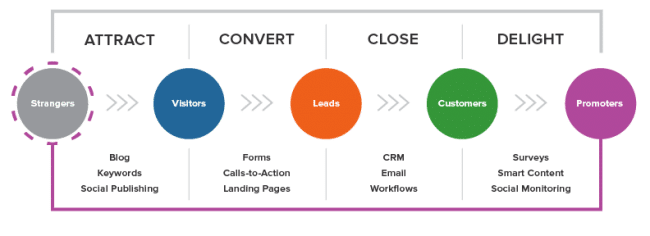
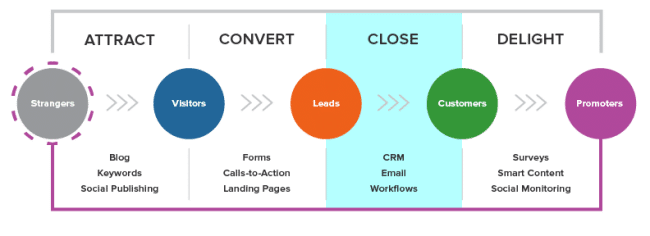
The term “inbound marketing” was coined by HubSpot CEO, Brian Halligan. The inbound marketing methodology refers to the process of bringing customers to you using an attract, convert, close, delight loop instead of pushing your product or services out to them through ads or purchased email lists.
It’s is built on the premise that you create something of value for potential customers, build a relationship with them, and use permission marketing techniques to convert them into paying customers.
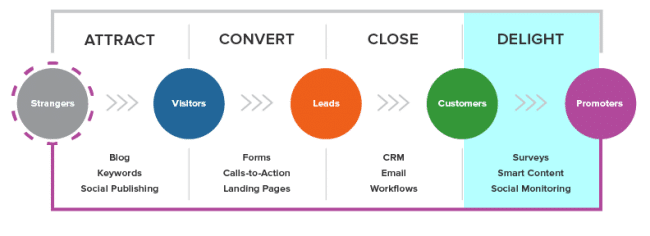
The inbound methodology promotes a 5-stage life cycle in which strangers convert into, not only customers but your brand promoters over time.
What Are the Four Stages of the Inbound Methodology?
There are four levels of strategy in the methodology:
Each stage deals specifically with moving an individual from one lifecycle stage to the next.
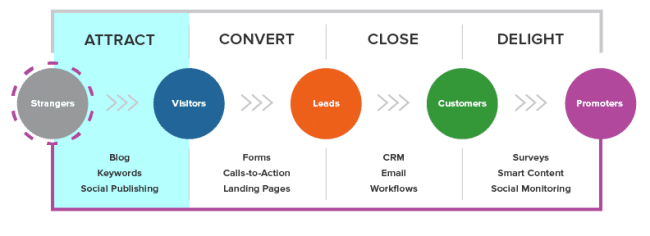
In this post, we are going to address the three core tools used in the all-important “Attract” strategy and how you can implement them to increase the traffic to your website.
The Attract Stage of the Inbound Marketing Methodology
Essentially, the key to attracting visitors to your site is to offer them something of value or to engage with them in a way that encourages them to visit your site, or “attracts” them to your site.
Attracting strangers to your site can be done through a number of means such as blog posts, social media, paid search advertising, and videos. The bottom line is that all content created and designed for inbound marketing should provide value to your target audience.
You can provide value by creating content that serves to answer a customer’s questions, describes the benefits of a product or service, provides helpful instruction, or otherwise engages the customer.
Inbound Marketing with Keyword Targeting
Generating traffic, in and of itself will hold no value for your business. Ideally, you want to attract customers in your target market, those who are most inclined to purchase your products or services.
To attract the right people, you need to identify the keywords and key phrases most likely to be used by your target audience in conjunction with your product or service.
Start by imagining what your target market will be searching for when they seek information about those products or services on a search engine.
Some keywords will be obvious, but the problem is they will be obvious to competitors, who are probably also using them. You need to think of alternatives and other niche keywords that will still be a likely search query and, hopefully, something your competitors haven’t yet thought of.
But even if they have, you can still maintain your edge by using keywords better and smarter, through a variety of inbound marketing techniques.
Keep in mind, your customer may not even know that your product or service exists. Try focusing on identifying common questions that may lead an induvial to the realization that your product or service solves a problem that they have.
If you are struggling with your keyword research, or whether keyword research is even important for your online marketing, have a look at our recent post, Do Keywords Still Matter?
Inbound Marketing with Your Blog
Once you know what keywords might work best, you can develop content that’s informative, interesting and beneficial to the consumer. Start with blog posts, but don’t limit yourself to just a blog. These are some ideas for you to consider when developing inbound marketing content:
Blog posts showcasing new products or describing services
Blog posts discussing industry information or product development
Blog posts answering questions consumers in your target might have
How-to instructional posts
How-to videos, or videos showcasing products in action
Webinars
E-books
Slideshare presentations
Podcasts
Infographics
You can usually easily repurpose one piece of content to encompass many of the above ideas.
Creating the necessary content to attract your visitors effectively is one of the most time consuming and difficult strategies in inbound marketing. If you are struggling to create your content, consider enlisting a professional copywriter or content marketing service.
Inbound Marketing with your Social Media
You may have noticed by now, that it’s called a methodology for a reason. Inbound marketing takes a very methodical approach to converting from strangers into promoters.
We’ve discussed how you should approach establishing targeted keywords and how to create valuable content around those keywords. The next step is to get that content out in front of your target audience.
One of the most effective ways to get your content seen by as many eyes as possible is to promote everything you create across various social media platforms such as Facebook, Twitter, LinkedIn, and Pinterest.
Additionally, your blog should have a subscribe feature, and you should take full advantage of this permission to share as much content with subscribers as possible.
Your Take-Away from the Attract Inbound Methodology Stage
Attracting visitors to your site is the very first, and possibly most important step in converting strangers into your brand promoters, but it’s often easier said than done.
Planning your inbound marketing campaign doesn’t have to be overly difficult, but it isn’t something you can quickly put together either. Executing a truly successful inbound marketing strategy will require you to invest, whether with your time, energy, or capital in your online marketing.
The long game is the best game to play in online marketing, and if you stick with your inbound strategy, you will be glad that you did.
If you don’t have a dedicated marketing and creative team at your disposal, you might consider retaining the services of a professional digital advertising, web design and SEO company to develop a customized campaign that best suits your needs and helps you achieve your marketing goals.
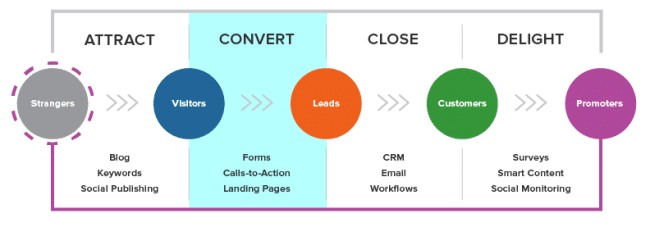
The Convert Stage of the Inbound Marketing Methodology
Developing and running a successful inbound marketing campaign entails much more than attracting visitors to your site – you also need to turn those leads into customers and clients. In other words, “convert” them.
Developing a marketing strategy designed to convert leads, along with having the right content on your site, is key to turning those leads into customers and achieving an optimal ROI.
In the first section in our inbound marketing methodology post, we addressed the three core tools used in the all-important “Attract” strategy of inbound marketing and how you can implement them to increase the traffic to your website.
In this section, we will cover the “Convert” strategy and the most effective ways that you can convert visitors on your website into leads.
Using Persuasive Content to Convert Visitors into Leads
First and foremost, you must present website visitors with quality content that offers visitors the information they seek. Relevant content that not only serves an informational purpose but also explains how visitors might benefit from purchasing your products or utilizing your services piques consumer interest.
It can be hard to find the right balance between educating readers and selling your products in your content marketing strategy, but once you do, you’ll likely find your conversion rate increasing. Always remember to omit meaningless marketing words and focus on the content mantra “clear, not clever.”
Use Calls-To-Action to Trade Value for Info
An important aspect of the inbound marketing methodology is the use of targeted and specific calls-to-action. A call-to-action targets the very moment when many visitors will decide whether to become a lead or not.
Always offer something of value with your calls-to-action. The user needs to feel that they are getting something in return for giving you their coveted contact information. Be specific about it.
While a call-to-action can come in many forms, there are generally four parts to an effective call-to-action.
A visual element – This makes the call-to-action stand apart from other content and draw a user into it.
An initial value proposition, offer, or headline – This makes clear the focus of the call-to-action. For example, “Building a Better ”
An offer description – This elaborates on the initial heading. For example, “Download our four-step process for building brands that ”
An action button/link – This is the actionable item and should reinforce the offer one last time. For example, “Download our free ebook.”
You can see the bottom of this post for an example of one of our calls-to-action working hard to convert visitors into leads.
Send Calls-To-Action to Specific Landing Pages
Once a visitor clicks on a call to action, they should be taken to specially designed landing pages that convert. While it may seem counter-intuitive, these landing pages should contain no top-level navigation menu. All efforts are geared at focusing the visitor on completing your form and becoming a lead.
Your landing pages should contain enough interesting and informative content to peak a consumers’ interest. Using a balance of text, bullets, images, and even videos will serve to increase consumer retention and promote brand awareness.
Alongside the content should be a prominent conversion form. Conversion forms provide visitors with an instructional cue to provide you with contact information, make a purchase, or otherwise convert.
Once an initial conversion has taken place, the pump is primed for further conversions. Don’t be afraid to place another, more in-depth, conversion opportunity directly on the page a visitor hits when they initially convert. These secondary conversion opportunities can often see even higher conversion rates.
Use Optimized Conversion Forms
One of the most important factors in converting your website visitors into leads are your conversion forms.
There are three elements to an effective form:
The form title – This should reinforce the call-to-action that brought the user to the form. For example, “Download your free ”
The form fields – These are the fields, both required and not required, that make up the bulk and complexity of the form
The submit button – The button that completes that conversion process
Don’t make the mistake of thinking that any of these three elements are trivial and ineffectual. The conversion rate for a well-designed form will be drastically better than a form that made without consideration to detail.
First and foremost, make the form title enticing. Except for the contact page on your website, avoid titles like “Send us a message” or “Email [Company Name].” These are not engaging form titles. Instead, opt for action-oriented form titles. If there is not a specific offer use more generic action-oriented titles like “Get started today” or “Schedule your consultation today.”
Form fields should always be equitable to what you are offering and where in the sales cycle the visitor is. For a free give away, like an ebook, don’t ask for the moon, you won’t get the moon, and all you will end up with is a high abandon rate for your landing page.
The rule of thumb with form fields is, ask for the least amount of information that you can to move them into the next stage of the sales process.
Finally, don’t use “submit” for your form’s action button. Be specific. For example, “download our ebook” or even simply “get started.” This small change can have big impacts on your conversion rate.
Your Take-Away from the Convert Inbound Methodology Stage
Converting visitors into leads is not always any easy task. It takes time, patience, and a lot of trial and error to hone in on the factors that will improve your conversion rate.
If you take the time and put in the effort to write informative yet persuasive content, create enticing calls-to-action, and use effective landing pages with optimized conversion forms, you will see your website turn into a lead generation machine.
Many of people that we work with understand that these are areas that they need to focus on, but simply don’t know where or how to begin. If you are unsure where to begin, contact us, and we can work with you to put an effective inbound strategy in place.
The Close Stage of the Inbound Marketing Methodology
Developing and running a successful inbound marketing campaign starts with attracting visitors to your site and converting those visitors into leads, but leads aren’t worth anything if they don’t turn into customers. In other words, you must close the deal.
Closing leads is often overlooked as we plan and evaluate our marketing efforts. We often lay this burden solely on the shoulders of our sales staff, and with good reason, that’s their job. But if you aren’t considering how your marketing efforts can assist your sales staff and increase your close rate, then you are most likely leaving deals on the table.
In the close step of the inbound methodology, we’ll cover how closing deals fits into the inbound marketing methodology and how your marketing can assist your sales staff in turning leads into customers.
Qualify leads better with lead scoring
All leads are not created equal; you and your sales staff are painfully aware of this fact. Your response to all leads should not be equal either.
One of the most important pieces of your marketing plan, whether inbound or outbound, is determining at which point a lead should be handed off from marketing to sales. It may be easier in the early days when leads are scarce, and your sales staff is itching to run down every deal they can. But as your marketing gains traction, prioritizing leads and managing the time of your sales staff will become a greater concern.
Implementing a lead scoring system for qualifying leads is an ideal way to more thoroughly qualify leads and set realistic expectations for both your marketing and sales team.
Just because an individual has filled out a form on your website does not mean that they are ready to become a customer. Especially as you more fully implement an inbound marketing system, individuals should have multiple opportunities to convert on your website, and in many ways.
Determining at which level of engagement they are ready to speak with a member of your sales team and assigning a value to interactions that indicate points along this path is the basis of lead scoring.
Use your content library to nurture leads
If you’re running an inbound marketing strategy correctly, then you are creating a lot of content. Ideally, this content was created specifically with your buyer personas in mind. On top of using this content to attract website visitors to your website initially, it’s time to give it double duty.
Creating nurture campaigns that keep your newly acquired leads engaged with highly relevant content is one of the best ways to build credibility, stay top of mind, and nudge your leads ever closer to becoming your customers.
Nurture campaigns can be designed to more fully qualify leads before your sales team makes contact or as part of your sales process.
Automate emails for better communication
While there is no denying that human to human interaction is extremely important in the sales process, don’t underestimate the advantages that creating automated workflows for your email communications can provide.
Having email workflows allows your sales staff to manage larger funnels by turning over many of the common or necessary communications to an automated system.
Also, creating sales integrated email workflows allows you to have more consistency in the language that you use providing better sales and marketing alignment and ultimately more realistic expectations for incoming customers.
Don’t just close the deal, close the loop
Finally, and possibly most importantly, analyzing and adjusting is a key step in not only closing deals but closing the loop on your marketing effectiveness.
All too often small to mid-sized business owners rely on nothing but their gut instinct in determining which marketing efforts are working and which are falling short. Gut instinct is a powerful tool, and no one is more plugged into what is working and not working that sales staff and business owners, but there are often preconceived notions and beliefs at play that can cloud the true effectiveness of your efforts.
For example, when you close the loop fully, you may find that while social media is generating a larger number of leads, those leads are far less likely to close than the leads generated by your search engine marketing campaigns.
From a gut level you may feel that social media is one of the more effective ways to generate leads for your business because it produces a higher lead quantity. In reality, your search engine marketing is more deserving of future attention and increases in investment.
Getting a truly complete picture of your marketing performance is one of the most powerful and growth-focused investments that you can make in your business.
Your Take-Away from the Close Stage of the Inbound Methodology
The inbound marketing methodology places emphasis on the marketing components of converting leads into customers for a good reason. Too often small to mid-sized businesses hand leads off from marketing to sales only to see the chain of data and alignment broken.
The same online marketing tools that you use to generate traffic and convert those visitors into leads can and should be integrated into your sales process. If you are successful in this endeavor, you will close more deals, increase your revenue, and grow your business.
The Delight Stage of the Inbound Marketing Methodology
We’ve made it! We’ve reached the fourth and final section of our journey through inbound marketing methodology. Since we started, we’ve looked at how to attract your target audience to your brand, how to convert those leads into customers and clients, and how to close the deal, turning those leads into paying customers.
In our final stage of the Inbound Marketing Methodology guide, we’re going to explore ways to “Delight” your new customers and the most effective strategies for turning them into lifelong fans.
Continue to Engage Your Newly Converted Sales
Just because you’ve closed the deal and converted a lead into a customer doesn’t mean you should forget about them and move on to the next hot prospect. Quite the contrary: this is merely the start of a new chapter.
Use Surveys to Obtain Customer Feedback
The best way to find out exactly what your customers want is to simply ask them. Surveys and feedback solicited via tools such as Poll Daddy or Survey Monkey are great ways of finding out what your customers actually think of your product or service.
Before creating a survey, think about your goals. For example, if you’re looking for feedback on your products or service, a customer satisfaction survey may work best for you. Along with the typical, “Are you happy with ‘X’,” type questions, try to include questions that solicit more feedback. Some examples include:
How helpful do you find our website?
What subjects would you like to see covered in our newsletter/blog?
What products/services would you like to see added to our current offerings?
The market research survey is useful if you’re planning to launch a new product or service. Some questions to include are:
What do you like most about our new product/service?
What do you like least about our new product/service?
How would you improve our new product/service?
Feedback from a market research survey may even help you discover new keywords for your marketing strategy. Say, for example, that a large number of respondents report that they would appreciate a training class to go along with your new software offering. If you choose to offer this service based on the feedback, you should also incorporate “software training” into your list of keywords to focus on.
Incorporate Smart Calls-to-Action
We discussed calls-to-action (CTAs) in the ‘Convert’ installment of this series, using them to convert new website visitors into leads. Here, we’re not using just calls-to-action but ‘smart’ calls-to-action.
So what is the difference between a ‘standard’ call-to-action and a ‘smart’ call-to-action? The standard discussed previously simply encourages visitors to click it. Everyone sees the same CTA and gets the same result. A smart CTA, however, takes things a step further. Each customer sees a different CTA based on buyer persona or lifecycle stage. This level of customization allows you to deliver both relevant and effective CTAS timed to help potential customers with their challenges at the point when they are ready to buy.
Utilize Smart Text
Smart text is another way to customize your website messaging to tailor the experience to each user group. This helps provide your existing customers with engaging content personalized to match their specific interests and needs. If, for example, a visitor to your site is a potential buyer, they will be shown content designed to entice them into making an initial purchase.
Alternately, if they are an established customer, they will see different content focused on upgrades, or ongoing support. You can target your content based on anything that you already know about your leads. As you learn more about them and your buying personas become more detailed, the possibilities get even smarter.
Harness the Power of Social Monitoring
Social monitoring should be a regular part of your engagement strategy throughout the buyer’s journey. Social monitoring helps you keep track of the social conversations that are relevant to your business. It also enables you to reach out to your customers with relevant content.
Your social monitoring strategy should go beyond just posting great content. You also need to observe and analyze your efforts. For example, pay attention to which posts are engaging your customers. Look over the posts that received lots of comments and shares. Pay equal attention to the posts that no one seemed to notice. What do they have in common? Do the posts with the most interaction answer frequently asked questions, or include a free offer? Careful analysis will help you determine what type of content to offer your customers in the future.
Another question to ask is “which channels are driving the most traffic?” Although it’s true that a balanced social media strategy integrates multiple platforms, most businesses don’t have time to post to every social media channel available. If you learn that 90% of your traffic is coming from LinkedIn, it will be well worth your time to dedicate more energy to that channel and less to the others. If you’re watching people share your Instagram posts on a regular basis but they don’t turn into conversions, you may want to consider letting go of that channel in order to focus your efforts elsewhere.
Above all, make sure to check your analytics on a weekly basis. By checking your analytics regularly, you can get a better understanding of what your customers want, how to reach them more effectively, and how to make the most of your social media accounts.
Your Take-Away from the Inbound Marketing Methodology
The inbound marketing methodology covers every step traveled on the road from stranger to established customer. It empowers businesses to attract visitors, convert leads, close customers, and keep them delighted and engaged with your business. However, mastering the art of inbound marketing takes a lot of work.
If you are unsure where to begin, contact MARION marketing today and we can guide you through the process necessary to implement an effective inbound strategy for your business.
Marketing, for many, is the major driving force behind the growth of their small business. And it takes a special set of skills to execute a successful small business marketing strategy.
Marketing is a constantly changing landscape of technologies, trends, and ideas. Marketers need to be able to read and respond to market and consumer changes, take strategic action, and ensure they can steer their campaigns through the uncertainty.
Let’s take a look at some of the common traits you’ll find in effective marketers across the small business sector, and how you can cultivate these traits within yourself.
1. They Plan … Constantly
Re-posting trending memes and repackaging marketing buzzwords on the fly can work for a while, but when it comes to a long-term strategy, planning is at the top of every effective marketer’s agenda. In fact, they never stop planning the next campaign, scheduling social media posts or split-testing Facebook ads.
Every effective marketer has a solid marketing strategy. And every solid marketing strategy requires a detailed plan of action. The plan you put together will help guide your efforts in the right direction, keep you focused on your goals, and create small milestones along the way to achieving your higher-level objectives.
Planning also helps to instill trust between you and clients, upper management, or yourself in the case of business owner marketers.
2. They Stay Informed and Engaged
Great marketers have a knack of knowing what makes people tick, what will make them take notice and the how to make them fall in love with a product or service. Great marketers are also often early adopters of new technologies and marketing approaches.
If you want to get the most bang for your marketing buck, you need to understand where the trends are coming from, and where they are going. You don’t want to end up as the last person still paying for ads on MySpace.
Don’t be afraid to try something new, but approach new channels with caution and never blindly jump in. Before you experiment with a new marketing channel, consider the first trait we discussed, and plan. How does this channel fit into your marketing plan and overall strategy?
The best way to approach a new marketing channel that you are considering is by first establishing what your goal for that channel is. If you are going to experiment with a new email marketing platform, what is your goal? Is the goal to increase your brand awareness, conveying a specific marketing message, or to drive traffic to your website?
Once you’ve established your goal, decide how you will track it. Try and avoid tracking it in terms of direct revenue that it creates. Attributing direct revenue is rarely possible, especially with new technologies, and inevitably leads to frustration and confusion. Instead, base your tracking on your goals. If your goal is driving traffic to your website, your metric could be in the rate at which your emails generate clicks to your website, for example. Of course, you’ll need to trust the results that you get.
3. They Trust Data Over Feelings
Trusting feelings and gut instinct are important skills to have, especially for entrepreneurs, but when it comes to marketing, data holds a more complete picture and offers a clearer window into key marketing insights. Because of this, most successful marketers rely on analytics and marketing effectiveness metrics to drive their efforts.
All too often business owners and marketers rely on the “I’ll know if it’s working” approach. For some marketing techniques, this can be true. If you send out an invite to a seminar and no one shows up, it didn’t work.
Other marketing channels are much more complex and require time as well as an understanding of the goal before gains are seen or understood.
For example, if you decide to run ads on a new social platform, don’t decide to turn them off two weeks later because foot traffic hasn’t increased to your store. Instead, understand that this marketing approach usually aims at increasing the number of people who recognize your brand. Your metric could be how many times the ad was seen, or by how many people. So focus on that data to determine the successfulness of the campaign. If you need increased foot traffic, this is probably not the right marketing approach to achieve your goals.
By paying attention to marketing data, you get an unbiased view into what is working and what is not working. Data of particular interest should include ad impressions, how marketing efforts affect conversion rate, multi-channel funnel reports, and reports that show the source of website traffic.
4. They Question the Status Quo
In marketing, there is no reason to follow the herd, and in many ways, it makes sense to challenge the status quo. By breaking the mold and using unique or experimental strategies, marketers will often find a winning solution. From telling a better story to changing the game completely, anything goes in marketing. You just have to be brave enough to take a chance.
Take Apple for example. At the dawn of the computer age, they used the same basic technology to make computers that performed in very similar ways as the computers built be companies like IBM. Their genius came in the simple, yet ingenious, idea to marketing their computers to consumers instead of businesses. Within a few short years, everyone, including IBM, was marketing the “home computer.”
Make it a habit of taking a step back and looking at what the market is doing. Is there a way to differentiate your business or your client’s business from the crowd? You might be surprised at what you find. One key differentiator can make all the difference.
5. They Are Always Learning
Marketers need to keep up to date and ahead of the curve to stay successful in such a volatile industry. For many marketing professionals, this means a regular ritual of trawling new blogs, investing in training or simply keeping up with trending hashtags on Twitter.
More importantly, however, for anyone involved in marketing anything, this should mean watching the data and adjusting. Learn from your mistakes and get better. No marketing strategy is perfect from day one. Only by constantly making small adjustments and being open to what is working and what is not working will you be able to execute on any marketing strategy successfully.
Constant learning is important, but so is being adaptive to change. In a world where a Google algorithm update can change everything you thought you knew, it pays to be flexible.
Final Thoughts
It goes without saying that marketing is a critical business component that shows no signs of ever becoming redundant. In fact, marketing is, in its own right, a thriving industry.
To be successful, and to get the best results for yourself, your clients, or bosses, you need to cultivate a core set of skills and values. Above all, always be ready to, as they say in the Marine Corps, improvise, adapt, and overcome.
Sometimes in the realm of online marketing, we can get a little caught up in our own vernacular. In a world where acronyms abound, a person who doesn’t spend all their time working with PPC, SEO, or SMM may latch on to something like content marketing services as an online marketing strategy that sounds more palatable. Before you decide to jump into content marketing with both feet, you need to ask, do you really understand what content marketing is? What if we told you that PPC, SEO, and SMM could all play important roles in your content marketing strategy?
Don’t worry; while content marketing isn’t as simple as it may sound; it doesn’t require a Ph.D. to understand. We’ll walk you through what it is, why it’s important, and send you on your way with a few tips to help you get started.
There are a number of ways to market your business online, and some will work better for your business than others. Content marketing, if done correctly can be an effective strategy for establishing an online presence. Once you see how content marketing works, you’ll want to take advantage of its benefits.
What is Content Marketing?
Content marketing is a form of B2B brand building that involves the development and sharing of quality media and published content in order to attract, engage and retain customers. It can help raise awareness for companies (particularly B2B companies), and differentiate them from competitors by making them the go-to authority for technical help and industry information.
In the Search Engine Optimization (SEO) world where content is king, content marketing is the gold standard of SEO practices. Google’s latest algorithm updates have made it clear that producing and publishing audience-focused, relevant content is one of the most important factors in ranking highly in search engine results, and updating content frequently is a guaranteed way to get search engines to crawl your site for new data frequently. Additionally, customers are making it increasingly clear that they want more information to help them make important buying decisions, and less information focused on marketing and sales.
Interested in content marketing services? Contact MARION today to get a quote and discuss a unique strategy for your business.
Benefits of Content Marketing
Higher rankings on search engine results pages (SERPS)
Increasing
Number of keywords for which a site ranks
Number of first-time visitors to the website
Total page views
Lowered bounce rates
Improved social metrics
Video views
RSS feed subscribers
Number of likes, +1s, upvotes, etc.
Number of followers
Increasing RSS subscriber growth
Increased conversion rate as measured by leads or sales
In many cases, achieving a higher SERP (another great acronym!) position will contribute to higher amounts of traffic and conversions. SERP positions depend on several factors, but inbound links continue to play a significant role in Google’s algorithm. If Google sees that a lot of other websites are linking to your content, then the search engine assumes that you have reliable information to offer other readers.
Creating content that other sites link to or content that gets shared on social media can do wonders for your search engine optimization.
Content marketing is also a great way of improving your company’s brand recognition. Traditionally, advertisers believe that it takes about seven interactions before a potential customer recognizes a company’s brand. You can arrange interactions through social media posts, pay-per-click (PPC) advertising and a few other tools. When it comes to educating potential customers about your company’s services and products, though, you need informational content that’s fun to read.
While promoting your brand with content marketing, you can also establish yourself as an authority in your industry. When you give your readers in-depth how-to articles, instructional videos, product comparisons and trend forecasts, you show them that your business has an insider’s perspective on the services that they need. Standard advertising alone can’t do that very well.
How to Use Content Marketing Effectively
A lot of companies that try to use content marketing fail because they don’t know how to create effective content strategies. Building a good strategy does require some trial and error, but you can follow some basic rules to help your content do its job well.
Create great content. This may seem obvious, but most content marketing strategies that fail, do so at this crucial step in the process. You should expend 75% of your effort on crafting valuable content and 25% on distributing it.
Use social media to spread your content (SMM – Social Media Marketing). Social media platforms like Facebook and Twitter have become indispensable tools for content marketers. As companies like Facebook adjust their algorithms to make sure users receive high-quality content instead of “fake news,” you can look forward to well-written articles to get even more attention through social media marketing in the near future.
Make search engine optimization (SEO) work for you. Today’s search engine algorithms don’t reward you for keyword stuffing. Using some SEO tricks, however, can help your content reach higher SERP positions. Always write a meta description that’s between 135 and 160 characters; give each page a unique title that includes keywords; and create a sitemap that helps search engines locate your content. A small effort can go a long way when it comes to SEO.
Pay for people to find your content (PPC – Pay Per Click). Sure, it’d be great if all you had to do was post great content and people would find it. Unfortunately, the Field of Dreams approach (“if you build it, they will come”) isn’t a reliable approach, at least not at first. With SEO in mind, and enough effort and time, you should be able to generate traffic by creating content. In the meantime, PPC is an excellent way to pay to distribute your content to people who are searching for it.
Measure the effectiveness of your content. Google Analytics is the most effective free tool for measuring the effectiveness of content. Look for the statistics labeled as “organic traffic” to determine how well your content performs. Knowing what pieces of content do well will make it easier for you to choose topics that interest your readers.
You don’t have to abandon other marketing and advertising strategies to use content marketing. In fact, content marketing often works well in coordination with your existing SEO, PPC, and SMM strategies as well as email marketing services. Before you embark on a new campaign, talk to an expert who can help you develop a strategy that will work for you.
The Content Marketing Process
Audience Analysis
Before implementing a content marketing strategy, we do a thorough analysis of your company’s target audience. Who are they? What kind of content is most relevant to them? What are they hoping to gain from the content? Where do they look for content? Which social media sites are they on?
On-Page Implementation
The foundation of a B2B content marketing strategy is a blog. A blog integrated into your website will allow you to engage your audience, and will ultimately lead to more traffic, increased brand exposure, and higher search engine rankings.
MARION’s in-house team of expert web designers and developers can transition your company’s website to responsive design, allowing your clients to access your content regardless of the device they’re using. We can then create and integrate a unique blog into your website.
Once the blog has been added, our team of experienced content developers and SEO strategists can create one-of-a-kind, audience-focused and relevant content designed to draw in and educate your customers.
Off-Page Implementation
Social media is at the core of any good content marketing strategy. Social networking sites like Facebook, LinkedIn, Twitter, and Instagram allow you to reach new audiences who are poised to engage.
MARION has an experienced team of internet marketing and social media specialists who will help amplify your content and build your brand. Once your content has been published to your blog, we increase your exposure by promoting this content on social media sites that are relevant to your audience, and through RSS feeds. Additionally, we will integrate social media profile and share buttons on your blog to encourage social sharing.
Why MARION for Content Marketing?
MARION Integrated Marketing is a full-service advertising agency, graphic design, and marketing firm. Our in-house team of experienced content writers and website developers work with you to produce and promote various types of content, including blogs, videos, white papers, e-books, infographics, case studies, how-to guides, Q&A articles, photos, and more. We accomplish this through a detailed content marketing strategy, which includes:
Developing and integrating a blog into your website
How One Modern Agency Stacks Up Against Mad Men’s Sterling Cooper of the 1960s.
As Mad Men prepares to enter the second half of its final season, Houston–based advertising agency Design At Work is also anticipating a monumental milestone in its own history — the celebration of its 25th anniversary. While times and advances in technology have certainly driven marked changes in the advertising industry, a comparison of Mad Men’s Sterling Cooper and real–life agency Design At Work reveals that many aspects — the creative process, client relations and even the character traits of a successful executive — have remained constant through the decades.
The Process: Man vs. Machine.
According to John Lowery, founder and CEO of Design At Work, the AMC series provides an accurate depiction of the advertising process and how ads used to be created. Drawing the artwork, stripping, bleeds, color separation, all of the design aspects of creating an ad that are now done using computers used to be done by hand.
While computers have made the design process far less labor intensive, what hasn’t changed is the thought process behind each ad development. “I believe that the creative is a derivative not the driving force, and you end up with better creative by starting with the needs of the client in mind,” Lowery explained. “Our designers still start with a concept and an idea first.” Meaning, just like in the 1960’s, people are still the mechanism responsible for advertisements that truly speak to customers, not the almighty computer.
The Clients: Corporations vs. Small– to Mid–Size Businesses.
In its most simple form, the advertising industry is about two things: winning clients and keeping clients. As both Don Draper and Roger Sterling state in the first season, “The day you sign a client is the day you start losing one (him).” And though Sterling Cooper may go after big corporations while Design At Work targets small– to mid–size businesses, these two firms are one–in–the–same when it comes to satisfying clients’ needs and keeping business in the door.
“This is the same scenario all agencies encounter today,” Lowery said. “I truly believe we can help anyone sell anything, but we also have to build relationships and constantly reaffirm our value in the minds of the clients.”
The Staff: Gender vs. Talent.
The role of women in the work place in the 1960s is an undercurrent that runs through the entire Mad Men series. Peggy’s constant struggle to be seen and treated as an equal among her male copywriting counterparts and Joan’s objectification illustrate the idea that men ran the advertising world in that era.
Flash–forward to 2015 when only 8 of the 32 employees at Design At Work are men. Once a male–dominated company like the rest, it’s arguable that current executive vice president of Design At Work, Tricia Park, was the catalyst for this shift. In 1997, she started as a part time administrator and quickly rose to the top to become Lowery’s right–hand woman.
“We’ve always interviewed objectively, but in many cases the women put more heart into their work. They are more detail–oriented and more nurturing with clients. For the majority of the roles in our company, the female candidates continue to be a better fit.” Lowery said.
The Boss: Don Draper vs. John Lowery. Don and John — even the coincidental rhyming of names hints at the profound similarities between these two advertising executives. Neither Draper nor Lowery came from affluent beginnings, suggesting the career success of each is the product of the unrelenting drive, determination and hard work that characterize both men.
Like Draper, Lowery’s life has been marked by an endless pursuit of more and better. At eight years old, Lowery’s grandfather introduced him to the field of advertising; at 23, he started Design At Work and served as its sole employee. As the business approaches its 25th year, Design At Work has more than 30 employees and is expanding its space to accommodate even more growth. “My goal is to be known as the best advertising agency and the best employer,” Lowery said.
His similarities to Draper, however, stop there. Whereas Draper is aggressive, brooding and unsympathetic, Lowery is hungry and ambitious, yet compassionate and understanding. And while his strive for growth and perfection never wanes, he is also able to find satisfaction in all he has achieved thus far. Something that cannot be said for his silver screen counterpart.
ABOUT DESIGN AT WORK.
Design At Work (DAW) is a full–service advertising and public relations firm that helps small to midsize companies market their products or services through integrated campaigns including advertising, public relations, collateral materials, logo identity, graphic design and website development.