Category: Marketing Campaigns

How to Expand Brand Awareness with LinkedIn Networking

Founded in 2002, LinkedIn stands as one of the world’s most-preferred social networks for many years, but even with a current user base of over 900 million, there exists a vast difference between the platform and others, such as Instagram and TikTok.

Most of its users are professionals looking to network with others, which makes LinkedIn a game-changer for those working to build a brand. Statistically speaking, over 90 percent of B2B marketers use LinkedIn to market their content, and nearly the same amount of people use it to generate quality leads for their business.

Read on to learn how to grow your network on LinkedIn and leverage the platform to engage with your audience and increase brand awareness.

What Is LinkedIn Networking and How Can It Help Your Brand?

LinkedIn is unlike any other social media network in that it is geared toward professionals. The platform’s stated mission is to connect said individuals on a global scale to effectively increase productivity and success.

With that mission in mind, LinkedIn networking is what it sounds like — that is, using the platform to gain professional connections in your niche or industry. Like offline networking, you will usually connect with people on LinkedIn over mutual interests and by sharing knowledge and ideas with those who might benefit.

Networking on LinkedIn can help your brand in the following ways:

  • Casting brands in a professional light, thus further legitimizing your business
  • Enabling connections with qualified leads with interest in your niche
  • Increasing your reach by exposing your brand to millions of potential clients
  • Allowing you to position yourself as an expert in your sector

LinkedIn is a land of opportunity, so brands and creative marketing teams must leverage it well.

How to Use LinkedIn to Make Professional Connections and Grow Your Network

Making connections on LinkedIn is all about learning how to engage with other professionals. If you want to grow your network, the following section will show you how to create a viable strategy beyond simply completing your profile.
social media monitoring guide

7 LinkedIn Networking Strategies for Building Your Brand

Learning how to network on LinkedIn doesn’t have to be complex or daunting. Here are just a few of the most common ways that your brand can make its presence known on the site:

1. Give Your Audience Valuable Content

Quality content allows you to appeal to potential customers by letting them identify you as the go-to expert in your niche. You’ll draw them in by consistently meeting their needs and motivating them to seek additional content.

2. Boost Employee Engagement

Your employees are already invested in the success of your business, so supplying greater visibility to posts by having your employees share them simultaneously will help alert common networks about trending topics and bring more attention to your corporate identity.

3. Use LinkedIn Groups to Build Relationships

Professional networking is all about creating mutually beneficial relationships, so when you join groups, you must do more than just read others’ posts. Ensure you comment and contribute to the discussion at hand, as helping others helps you gain more exposure.

4. Keep Up with Latest Industry News

Understanding what’s going on in your industry is critical. Not only will you be able to leverage new trends as they emerge, but you’ll have tons of ideas and helpful content to share with others.

5. Expand Your Professional Contacts

LinkedIn works best when you are constantly making connections. Since your posts are never distributed to 100 percent of your network, you need at least 1,000 connections to truly raise your brand awareness.

6. Run LinkedIn Ad Campaigns

Paid advertising is only as limited as your budget, and LinkedIn ad campaigns allow you to target a specific demographic and have tighter control of your brand’s narrative.

7. Publish a LinkedIn Article

Publishing LinkedIn articles gives you a chance to showcase your expertise and value to potential clients, who, in turn, will see your business as the go-to brand in your niche.

linkedin networking on phone

Networking Tips and Best Practices for LinkedIn Professionals

Some important LinkedIn networking tips and best practices to follow are as follows:

  • Optimize your profile to better showcase your brand and offers so people can see the benefit of connecting with you
  • Engage with people who comment on your posts or articles
  • Capture attention with rich, media-driven video posts
  • Emphasize quality over quantity by personalizing each connection
  • Continue to engage with contacts after the initial contact
  • Share other people’s posts and content to get noticed and build connections
  • Inject a bit of your personality into every post or connection

If you follow these tips and maintain a professional tone, LinkedIn users will likely enjoy engaging with you and want to learn about your brand. Check out our social media management guide for more helpful tips.

Develop Your Social Media Marketing Strategy with MARION

LinkedIn marketing can be a tricky process because it walks a fine line between the personal and professional realms, but given that many of your prospects are on social media, you need to be there too, ready to capture their attention with effective business tactics.

With MARION’s social media marketing services, you can leverage performance-driven marketing strategies to increase brand awareness and achieve your business goals.

Contact MARION to get started today.

Marketing emails you’ll actually want to read.

Get marketing tips and news sent to 
your inbox.

This field is for validation purposes and should be left unchanged.
Name(Required)

Understanding Marketing Goals and Objectives + Examples

When it comes to marketing, goals and objectives are terms that are often used interchangeably. However, understanding the difference between these two is essential for setting up effective marketing strategies and achieving success in any business endeavor.

In a nutshell, goals tell you where you’re going instead of how you’ll get there, and objectives are specific and measurable milestones that must be achieved to reach a goal.

What Are Marketing Goals?

A marketing goal is a broad aim toward which your efforts are directed. Marketing goals don’t have to be specific. Because of their open-ended nature, setting only marketing goals is not ideal for achieving something in your business.

To gain a better understanding, let’s look at a few examples of marketing goals:

  • I want more customers to visit my website.
  • I want to rank on page one of Google.
  • I want a massive social media following.

While these goals tell us what we want to accomplish, they don’t tell us how to get it. Despite this, knowing how to set marketing goals is important because they lay the foundation for your marketing endeavors.

What Are Marketing Objectives?

Where marketing goals are broad statements, marketing objectives are measurable and specific. The best way to describe an objective is with SMART acronym:

SMART acronym marketing goals

An objective is created when you meet the requirements of the SMART acronym. To get a better idea, let’s look at a few examples of marketing objectives:

  • We need to create 50 customers from 5,000 leads within the next six months from our marketing efforts to reach our revenue goals of $200,000.
  • We want to achieve the number one rank for “Big Screen TV” because it drives an estimated 1,000 visitors to our website monthly.
  • We want to grow our Instagram account by 50,000 followers in the next five months to coincide with our new product launch.

Objectives are the stepping stones to reaching your marketing goals. They lay out the specific steps needed so you can take action. Learn how to set marketing objectives.

Understanding Marketing Goals vs. Objectives

A marketing goal is a broad target that you hope to achieve. A marketing objective is an actionable short-term step that you execute. You must design and implement several objectives to achieve your overarching marketing goal.

how to set marketing goals

How to Set Marketing Goals

Before creating your objectives, you need to set your marketing goals. Let’s look at the process of creating goals for your organization so that you can lay the groundwork for your future marketing campaigns.

1. Review Your Mission Statement with Your Team

Do you know your mission statement? Your mission statement defines why you’re in business in the first place, and it should drive your entire marketing strategy. So, as you define your marketing goals, ask yourself whether it helps you to fulfill your mission statement.

2. Set Your Marketing Targets

Ask yourself this one question — “What does my business hope to accomplish?” Essentially, this is the ultimate goal your marketing team strives to accomplish by the end of an upcoming period.

If you’re setting a short-term goal, you might consider the next quarter. A mid-range goal might account for the next year, and a stretch goal might be set for five years from now.

3. Develop a Marketing Strategy

The next step is to set up a marketing strategy. The strategy you put in place should help you achieve your goals. Let’s look at marketing strategy components you could implement to meet your marketing goals and objectives:

  • Generate leads by creating a blog that delivers helpful content.
  • Create social media pages to promote your blog.
  • Use paid advertising to reach out to new customers.
  • Implement a long-term SEO strategy to rank well in Google to drive organic traffic.

From this point, you can go into more detail on how you plan to implement each step.

4. Tie in Your Marketing Objectives

We’ve already discussed the differences between marketing goals and objectives. Now you must tie the two together through the strategy. For example, let’s say your marketing goal is to increase your conversion rates by 50% in 12 months.

One corresponding piece of your marketing strategy is implementing an SEO strategy that helps you rank well in Google and generate organic traffic. A marketing objective you can implement to support your strategy and reach your goal would be to optimize your nine main organic landing pages for specific keywords so that they make it into the top five spots on Google.

Perhaps you want to deliver on this objective by optimizing three pages per month over the first quarter to reach your 12-month goal in time. Remember, where goals are broad, objectives are specific.

5. Measure the Results

The last step is one of the most important. You need to figure out how you intend to measure your results, so your marketing department can present progress reports and learn from the data.

You must also establish how often you intend to receive these reports (weekly, monthly, quarterly). Once you’ve figured out your timetable, you must determine the specific KPIs (key performance indicators) you intend to track.

You may be tempted to track every marketing KPI you can, but try to sort out the metrics most relevant to your business. Once you’ve identified what those are, you’ll be much more focused as you move forward tracking your results.

what are some marketing goals and objectives?

How To Set Marketing Objectives

Once you’ve set up your marketing goals, you’ll have to set up marketing objectives (as mentioned in Step 3 above) to help you accomplish those goals.

1. Learn How Much Revenue You Need from Your Marketing Campaigns

Let’s say your business generated $5,000,000 in sales last year. Next year you set marketing campaign goals to scale up your sales by 50%. Your marketing objectives must be structured to generate $7,500,000 ($5,000,000 x 1.5) in sales over the next 12 months.

2. Identify How Many Sales You Need to Reach Your Revenue Goals

To make this determination, divide your revenue targets by the value of your average sale. Therefore, if you need to generate $7,500,000 and your average sale is $100,000, you will need to close 75 customers over the next year.

3.  Identify How Much Traffic You Need to Achieve Your Goals

To reverse engineer your traffic numbers, you need to determine your traffic-to-lead conversion rate and lead-to-customer conversion rate based on historical data.

Let’s say that data from the previous three years shows that your average traffic-to-lead conversion rate is about 0.5%, and your average lead-to-customer conversion rate is 5%. This means you’ll need 1,500 leads to reach 75 customers and 300,000 visitors to reach 1,500 leads.

At the end of the day, you need to drive approximately 300,000 visitors to your site over the next year if you hope to reach 75 customers.

There are several important assumptions you make while using the above data. Two of which:

  1. You plan to generate traffic in the same manner that you have during the past three years (from which you’ve calculated your averages).
  2. Your pricing and promotions are still set up so that your average sales will be consistent with the previous year’s.

4. Set Up Benchmarks

Keep in mind that the process of setting up marketing goals is not quick. It takes time to build momentum. That’s why you should set up quarterly benchmarks to track your progress. As you build momentum, set your benchmarks higher and higher for each quarter.

Therefore, the second quarter should be set higher than the first, the third should be higher than the second, and the fourth should be the highest of them all. For example, if you intend to drive 70,000 visitors to your website during the first quarter, you should drive 72,500 in the second, 77,500 in the third, and 80,000 in the last.

how do marketers use data to identify goals?

Implementing Marketing Goals vs. Objectives for Your Business

As you set up your marketing goals and your marketing objectives, you’ll find there’s always room for improvement. Your marketing strategy won’t be perfect the first time, but that’s why you track metrics so you can improve as you go along. As you move forward, you’ll identify the strengths and weaknesses of your marketing strategy, and you can make adjustments until you achieve your overarching goal.

Exceed Your Marketing Goals and Objectives with MARION

If you need help achieving your marketing goals and objectives, we can help you. MARION is a full-service marketing agency that offers internet marketing servicesgraphic design firm services, and traditional marketing services.

Looking to take your marketing efforts to the next level? Contact our team today.

Marketing emails you’ll actually want to read.

Get marketing tips and news sent to 
your inbox.

This field is for validation purposes and should be left unchanged.
Name(Required)

How to Create a Content Calendar + Free Template for Blogs & Social Media

In the words of billionaire tech mogul Bill Gates, “Content is king.” On the internet, knowing you need to produce content to build your brand is one thing, but finding and implementing a successful content strategy takes deliberate effort. A content planning calendar (also known as an editorial calendar) will streamline your marketing and allow you to think strategically about your goals.

What is a Content Calendar?

At its core, a content calendar is a schedule that details what, where, and when you plan to create and post your online content. While you may have a specific branding or revenue goal, your content calendar provides a detailed roadmap for moving from intention to action and achieving your objective.

Types of Content Calendars

An editorial calendar includes three pieces of information: the content you will publish, where you will publish it, and how you will promote it. To that end, there are three types of tools commonly used to create a content calendar:

  • Spreadsheets: Applications like Google Sheets and Excel make it easy to customize templates with your own categories.
  • Project-Management Tools: These allow your team to collaborate and keep track of assignments and deadlines.
  • Calendar Apps: Provide a simple way to schedule content creation and marketing.

No matter the type of calendar you choose, you must ensure that it’s easy to use and interpret for you and your team.

Blog Content Calendar Example

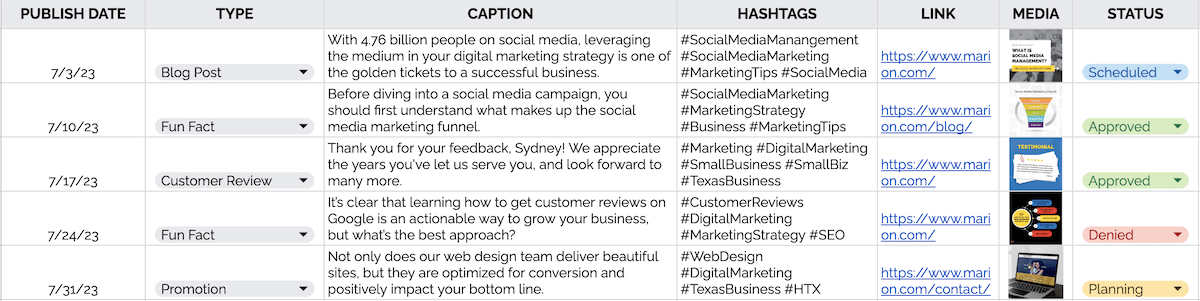
A blog content calendar helps to plan and track the publishing of articles, press releases, and blog posts. A calendar helps ensure all posts are published on time, with relevant topics that will engage readers. Below is an example of a blog post content calendar layout.

blog content calendar example

Social Media Content Calendar Example

A content calendar is an important tool for developing successful social media campaigns. It helps to organize and plan content on various social media platforms, ensuring that your posts are seen by the right people at the right time. Below is an example of a social media content calendar layout.

social media content calendar example

MARION is a full-service marketing agency that offers content marketing in Houston and Austin, Texas. Reach out now to get started!

Who Uses Content Calendars?

Some of the largest journalistic empires in the world make use of editorial calendars to schedule their content creation. However, a content calendar isn’t just for large news corporations. Everyday bloggers, podcasters, YouTubers, and social media managers use them too. In fact, anyone who publishes content regularly can (and should) use a content calendar.

How to Create a Content Calendar

Creating a blog or social media content calendar doesn’t have to be difficult, but you must do some strategic thinking beforehand to develop a solution that works well for you and your team and helps you achieve your ultimate goal.

Establish Your Content Marketing Goals

Before creating a content calendar, you need to understand why you’re creating content in the first place. Determining whether you want to get more traffic, raise your conversion rates, or establish yourself as an authority in your field will give you insight into the type of content you should create and where and how often you should publish.

Build Your Template

A practical editorial schedule starts with a content marketing calendar template that mirrors your team’s content creation workflow. Get started with these four basic steps:

Create a Timeline

Each piece of content should have a set deadline for its publication. How long each content creation step takes will be based entirely on that deadline.

Publishing Frequency

Nail down just how often you will publish your content. Your team should be clear on your content production frequency goals to stay on top of their responsibilities.

Determine Content Types

Your content creation strategy should align with your marketing goals and objectives. For example, you won’t create weekly blog posts if you’re working on building a social media presence. Ensure your editorial calendar includes the content types you want to publish.

Assign Owners

Make sure your team knows who does what. Retaining that knowledge will help streamline your workflow and avoid wasted time and effort due to redundancies.

Tips for Creating Your First Content Calendar

creating content calendar

Creating your first blog content calendar is a daunting task, but there are a few actionable steps you can take to simplify the process for yourself and your team:

  • Ask Questions: Knowing the type of content you create, how often you publish it, and how many people will use your calendar will help you choose the right tool
  • Make it Fit: Create a useful content calendar by listing the steps in your workflow and building them into your spreadsheet or project management application
  • Just Get Started: Start by using a simple content calendar template and refine your process as you go along

Whether you use a simple spreadsheet or a more robust project management application, use what you have and what you’ve learned so far to begin your journey toward more strategic marketing.

Download Your Free Content Calendar Template

If you’re new to creating content calendars, you may be overwhelmed with information and left wondering where to start. Fortunately, our free content calendar template makes getting and staying on track with your content goals easy. Download your Google Docs template today to start building and executing your marketing strategy on your own or with your team.

Download Your Content Calendar Template Here >

Get More Help from the Content Marketing Specialists at MARION

Creating a blog post content calendar is a great place to start working toward expanding your reach, but your marketing efforts shouldn’t end there. Solidifying your brand with a well-designed logo and website and marketing your offers through search engine optimization, paid ads, and a social media presence are all vital pieces of the content marketing puzzle.

Fortunately, our digital marketing experts at MARION have extensive experience providing client-focused integrated marketing services to businesses of all types.

Contact our team today to learn how we can help you build and grow a lasting brand.

Marketing emails you’ll actually want to read.

Get marketing tips and news sent to 
your inbox.

This field is for validation purposes and should be left unchanged.
Name(Required)

Does Direct Mail Advertising Work?

Here’s How to Take Advantage of this Surprisingly Effective Marketing Tactic.

It’s a question our Houston marketing team gets all the time — does direct mail advertising still work in today’s digital world? As with most things, it depends. Direct mail advertising can be an incredibly effective way to reach new clients and grow your business, as long as it’s thoughtfully executed according to best practices.

In fact, a study by the Association of National Advertisers (ANA) found that letter-sized envelope campaigns generated 112% ROI — which is even more striking when compared with the success of other channels1.


Advertising response rates by channel.
In a 2022 report by the ANA, letter-sized direct-mail campaigns significantly outperformed other marketing channels.

The persuasive power of direct mail advertising derives partly from the ease with which we consume it. One study found that consumers expend 21% less cognitive effort on processing pieces of direct mail than they do on digital marketing materials2. Another study used eye-movement tracking and biometrics, such as heart rate and respiration, to compare attention and emotional engagement with direct mail and digital media. Engagement time and recall were significantly higher for direct mail materials3.

Is Direct Mail Marketing Right for Your Business?

Before you dive stamp-first into direct mail marketing, it’s important to consider your target audience and goals.

Let’s start with the first variable: your audience. Are families with children your company’s bread and butter, or do you cater more to retiree crowds? Are there specific cities or neighborhoods you’d like to home in on? A basic understanding of your target demographics will help you determine if direct mail is likely to yield sufficient returns.

Millennials, for example, are more likely than both Gen X and Baby Boomers to use marketing mail as a prompt to go online and make purchases. They also regularly purchase items marketing to them through direct mail4.


Direct mail advertising engagement by generation.
In its 2021 study, USPS uncovered a surprising trend: across every category, millennials were more likely to respond positively to direct mail advertising campaigns.

Now let’s consider your goals. Are you looking to increase awareness of your business, tout a seasonal sale, or simply get people in the door? Direct mail advertising can help you accomplish all of the above. As with any marketing tactic, understanding your objectives will help you to craft an effective message and make smart design decisions.

If you’re looking to encourage millennial consumers to visit your e-commerce site, for example, you might create a QR code to include in the mailer that makes the transition from print to web more seamless. If you want to entice retirees to visit your restaurant, you could incorporate a perforated coupon and a copy of your menu. Once you know where you want to go, you can determine how best to get there.

How to Create an Effective Direct Mail Advertising Campaign.

To maximize your investment in direct mail, it’s important to follow a few basic principles.

Prioritize Brevity and Clarity.

Excess text and small print are a surefire way to sabotage your direct mail advertising campaign. On any given day, consumers spend roughly 30 minutes reading and sorting through their mail5. While this affords a longer consideration window than most digital campaigns, you still have a limited amount of time to capture their attention. Communicating your message clearly and concisely will give you the best chance of cutting through the postal noise.

Keep Your Design Simple and On-Brand.

The best direct mailer designs are clean, easy to read, and consistent with the rest of a company’s brand. Simple, bold fonts and sufficient white space make your materials easier for readers to consume. Just as importantly, on-brand visuals allow you to make the most of the opportunity to build brand awareness while ensuring a similar aesthetic experience across channels.

Incentivize Your Target Audience.

Even the best-looking mailer will soon find its way to the waste basket if the recipient doesn’t perceive it as valuable. To keep your advertisement in their hands and homes longer, find an incentive that speaks to your audience and highlight it visually. Special discounts, for example, are a good option for retailers and restaurants, while free consultations may work for professional service providers and medical practices. You could even include a special gift with the mailer itself, such as a bookmark or branded coffee table book. Unsolicited gifts will serve as a reminder of your brand’s value when consumers come across them in the future.

Embrace the Omnichannel Approach.

To take your campaign to the next level, try coordinating direct mail with other channels. You can create a unique URL, for example, to track recipients who visited your website after reading your mailer. Once you’ve collected their information, you could retarget those prospects with a marketing email or digital display ad and, of course, save their information for use in your next direct mail campaign. There are myriad ways to amplify the effectiveness of direct mail marketing through an integrated, omnichannel approach.

Want to learn more about the surprising efficacy of direct mail marketing? Reach out! We’re ready to help your business reach its goals.


Sources:

  1. 2022 Response Rate Report, Association of National Advertisers
  2. A Bias for Action, Canada Post
  3. Enhancing the Value of the Mail: The Human Response, USPS
  4. Mail & E-Commerce Through the Ages, USPS
  5. 47 Direct Mail Statistics Marketers Should Know in 2023, Postalytics

Growing Your Corporate Identity with Integrated Marketing

Corporate brand identity is a key factor in the success of any business. A well-developed corporate identity can help differentiate your business from competitors, create trust and loyalty among customers, and increase brand recognition.

What Is Corporate Identity?

At the root of your corporate identity is your logo, your symbol to the world of what your company stands for. When your customers see your branding, they are reminded of all their experiences with your company; what they have seen, read, heard, and felt about your company.

It is critical, then, that your brand elements reflect the nature and spirit of your company in a positive way from the moment your logo leaves the drawing board and enters the marketplace. As your brand grows, your logo reflects your identity.

Corporate Identity vs. Brand Identity

Corporate identity and brand identity are two terms that are often used interchangeably but have distinct meanings.

  • Corporate identity is the way a company presents itself to the outside world. It includes things like logos, color schemes, fonts, and more.
  • Brand identity is how a company wants to be perceived by its customers. It consists of elements such as mission statements, taglines, core values, and other aspects that help differentiate it from its competitors.

Both corporate identity and brand identity are important for any business to succeed in the long run. They help create a unique image for the company in the minds of consumers and also ensure that all communication with customers is consistent across all channels.

building corporate image and identity

How Do I Improve My Corporate Identity?

While building corporate identity in a healthy way, always include your logo and the other aspects of your organization’s design – colors, tagline, graphical elements – in all your communications and in all media. Your marketing communications messages and value proposition must be consistent in all media. These consistent visual and verbal representations of your company in print collateral, on the Internet, video, and multimedia will nourish your brand and nurture your corporate identity.

Marketing Plan

Following marketing research, the experts at MARION can help you determine your customers’ needs and, with an integrated marketing campaign, attract and retain more and more satisfied customers to grow your business.

Website Design

Your website reflects your corporate brand identity online. Persuasive content, graphics, and navigation all work in harmony to make your site a standout success. Don’t hold back while investing in your corporate custom website design in Houston because it’s often your brand’s first chance to position itself in a potential customer’s mind.

Search Engine Optimization (SEO)

Search engine optimization gets your site ranking highly on search engines and your corporate identity found on the web. Spending time and even money on SEO services is a way to make sure that your brand is showcased to the most relevant audience when they need your expertise the most.

Digital Marketing

Internet marketing boosts your web presence. Spread your brand across search engines, raise your brand visibility, and increase traffic to your site through online website marketing and a sound digital strategy.

Brand Building

MARION offers services in support of your brand management practices and developing a strong brand-building methodology. We can teach and guide or provide turnkey brand-building services depending on your unique needs and business goals.

Discover MARION's style guide template we've built that gets us the best results for our clients. Download Now!

Logo Design

Logo design is at the root of building your corporate identity, image, and brand. Your customers associate the qualities of your company with your logo. Investing in Houston logo design services can amplify your brand in a highly positive way.

Video Production

Enhance your brand, record events, facilitate training, instruct for safety, and promote your products and services with corporate video productions.

3D Animation

3D animations add dimension and life to your corporate identity. A great tool to impress your customers by creating animated images of a proposed reality.

Printed Brochures

Your corporate capabilities brochure expresses your corporate brand identity in print. Improve your brand development strategy with great graphics and persuasive, to-the-point text within your company brochure or catalog design.

3D Graphic Design

3D graphic designs and illustrations add dimension to your corporate identity. A great tool to impress your customers by creating images of a proposed reality.

Public Relations

Media relations, community relations, public affairs, crisis communications, issue management, and public speaking all impact your corporate identity.

Develop Your Corporate Identity with MARION Integrated Marketing

MARION Integrated Marketing provides a comprehensive suite of services to help you develop your corporate brand identity. From logo design to website development, MARION will work with you to create an image that conveys the values and objectives of your company. With our expertise in marketing strategy and creative design, we can help you develop a unique corporate identity that stands out from the crowd!

Contact MARION today to speak with one of our experts about how our marketing agency in Houston can help build your brand and grow your bottom line.

Marketing emails you’ll actually want to read.

Get marketing tips and news sent to 
your inbox.

This field is for validation purposes and should be left unchanged.
Name(Required)

How to Improve Your Brand Storytelling: Lessons from Guinness

A Multi-decade Masterclass in Crafting a Compelling Brand Narrative

Humans are hardwired to make sense of life through story. Stories help us understand ourselves, define our values and make decisions consistent with those convictions. Brand storytelling leverages the power of effective narratives to connect with audiences in an emotional, values-driven way that centers the customer (rather than the brand) at the heart of the story.

Guinness, one of the world’s largest distributors of stout beer, has been giving a masterclass in brand storytelling for decades. In this article, we’ll extrapolate lessons from the example of Guinness — and explain how you can apply them to your business.

What is Brand Storytelling?

Brand storytelling is a highly effective marketing approach that uses narrative techniques to generate awareness and loyalty, thereby engaging prospects and strengthening relationships with existing customers. The goal is to position your product or service within a larger story that audiences find compelling — something they care about and relate to on an emotional level. To do this, you have to understand your audience.

Guinness knows its target audience well: they’re primarily (but not exclusively) young adults who eschew the hard-partying lifestyle in favor of values like character, integrity and confident self-expression. To connect with these customers, Guinness taps into its own rich history.

The story starts with a signature. In 1759, Arthur Guinness signed a 9,000-year lease on a small, disheveled property and began brewing ale in what would grow to be one of the world’s largest international breweries. Though the brand’s marketing has evolved over time, Guinness’ bootstrapped beginnings as a small business founded by an industrious dreamer continue to supply the narrative context for all its campaigns.

The signature of Arthur Guinness, for example, remains a vital part of the brand’s visual identity — along with its iconic harp and type treatment.

Arthur Guinness’s Signature
In a fantastic example of consistent visual storytelling, Guinness features its founder’s signature throughout its marketing content.

Why is Brand Storytelling Important?

Contemporary audiences are inundated with advertising content. Whether you’re reading the news, scrolling through social media, streaming TV shows or just driving to work, chances are someone is trying to sell you something. To stand out from the crowd, you have to tell your story in a way that makes the consumer feel seen, as though they are the main character in a larger narrative that explains something important about who they are as a person.

Let’s take a look at how Guinness makes the consumer the protagonist. In its “Empty Chair” commercial (part of the “Made of More” campaign), we see a bartender set a glass of Guinness on an empty table. Day after day, customers come and go, but no one claims the beer — in fact, the bartender actively dissuades pub-goers from sitting at the table or moving its chairs. At the end, we discover the intended recipient of the pint: a military veteran returning from active duty. A voiceover explains, “The choices we make reveal the true nature of our character.”

In this example, the audience is invited to identify with the bartender — a hard-working woman who honors the sacrifice of military personnel through daily acts of gratitude. Why? Because she’s “made of more,” and so is the target audience. This story is compelling because it’s not trying to sell beer; it’s trying to promote a lifestyle, an ethos, a way of being, and to encourage an association between this lifestyle and the brand itself.

When audiences see themselves in your story, they want to participate in it. In this case, consumers participated to the tune of £3.88 per every £1 spent on the “Made of More” campaign. The brand also saw a decrease in price sensitivity and an increase in awareness1.

The “Mode of More” campaign’s ROI reveals the power of effective brand storytelling.

What are the Elements of a Strong Brand Narrative?

Crafting a cogent and consistent narrative isn’t as difficult as it seems. By following a few basic principles of effective brand storytelling, you can delight audiences and increase your ROI.

Be Real and Relatable. 

Advertising is most powerful when it engages people emotionally. Storytelling invites your customers to connect with your brand on a more personal, human level. It can show them the real people behind the brand, giving them a glimpse behind the curtain to see what makes your business move. This can help build trust and connection. Guinness’ “In Pursuit of More” campaign, for example, takes customers into the original St. James’s Gate Brewery, introducing the people who work behind the scenes to brew their signature Irish stout.  

Cultivate Brand Loyalty. 

Storytelling can help people connect to your brand by reflecting parts of their personality back to them. When a customer identifies with a brand’s message, they are more likely to feel a sense of brand loyalty. For this to work, it’s important to stay true to your brand’s core identity and make sure to tell your story authentically. In addition to integrity and hard work, Guinness’ “Made of More” campaign celebrates the “confidence to carve [your] own path,” which taps into their brand’s history and resonates with customers who seek adventure.   

Guinness ‘Made of More’ Print Advertisement
The “Made of More” campaign appeals to Guinness’ target audience by telling a story of strength, originality and integrity.

Emphasize Your Differences. 

The way you tell your story can help you stand out from your competitors. What’s different about your approach? What expertise do you bring to the table? What obstacles did you overcome on your journey? Tell your customers — in your own voice. Smart storytelling, which can include personal anecdotes, real-world experiences, earnest explanations or an unexpected approach, can help showcase your business’ personality and make your messaging more memorable. In its 1929 advertisements, Guinness distinguished its voice as strong, sturdy and bold with its now-iconic “Guinness is Good for You” and “Guinness for Strength” campaigns. While Guinness isn’t really good for you and it doesn’t make you stronger, the ads have staying power — just like Guinness’ story.

Return on investment for the Guinness Made of More campaign.
In this memorable ad, Guinness showcases its working-class persona.

With a relatable brand story that resonates with your target audience and emphasizes what makes you different, you can strengthen existing relationships and form new partnerships. Ready to captivate customers with authentic storytelling? Let us know. We’re here to help you be bold, go forth and share your story.  


Sources:

  1. ‘Made of More’: Guinness increases global effectiveness, Thinkbox

The Great Debate: In-House vs. Outsourced Marketing

How to Decide Between In-House Marketing, an Agency or a Combination of Both.

When deciding how best to select and organize your marketing team, one consideration tends to trump all: budget. It’s true that the decision to outsource or maintain an internal team can have a huge impact on your overall spend, but there are also other factors to keep in mind when making this important call. Staffing, quality and return on investment (ROI) can all be affected by your decision.

In this article, we’ll look at the pros and cons associated with in-house and outsourced marketing.

What Is Outsourced Marketing?

The term “outsourcing” has become a bit of a boogeyman, conjuring up images of disinterested workers in far-off places. In this case, outsourced marketing refers to the practice of hiring an external agency to plan, execute and manage your marketing and advertising processes. The best agencies learn everything there is to know about your business — including your history, differentiators, customers and goals — then execute campaigns that directly impact your bottom line.

Let’s take a closer look at the pros and cons of outsourced marketing.


The benefits and drawbacks of working with a marketing agency.
When deciding if a marketing agency is the best option for your business, it’s helpful to consider the pros and cons.

The Pros of Outsourced Marketing.

Specialized Expertise.

Marketing agencies offer the benefit of wide-ranging expertise in a range of disciplines — all for a flat project fee or monthly retainer. So rather than hiring individual specialists in content marketing, search engine optimization (SEO), graphic design or web development, for example, your company can benefit from the combined knowledge and creativity of a seasoned team with all the skills you need (and even some you don’t know you need just yet).  

Fresh Perspective.

In addition to diverse talent and technical knowledge, agencies have broad, cross-industry awareness of the ways in which various marketing tactics can be deployed. As such, they can offer an unbiased, fresh perspective on your messaging, market opportunities and goals, helping you to identify innovative strategies an in-house team may not have considered.

Scalability and Flexibility.

With an outsourced team, you can scale your marketing efforts quickly and efficiently. As your business grows or marketing needs change, you can easily adjust the scope of your engagement with the agency by adding or removing services as needed. If, for example, you want to experiment with digital advertising, but don’t have the resources to do so, you can simply enlist the help of your agency. Such flexibility allows you to stay agile and creative for a relatively minimal cost.

The Cons of Outsourced Marketing.

Limited Control.

When partnering with an agency, you run the risk of losing control over creative direction, messaging and strategic decision-making. To prevent this, it’s important to vet an agency before committing to the relationship. You’re looking for a partner who communicates clearly, listens well and genuinely cares about the success of your business. When you trust your agency to prioritize your preferences and goals, you don’t have to worry about losing control.

Potential for Miscommunication.

Since many agencies charge an hourly fee, transparency and effective communication are essential. If an agency misunderstands your priorities, for example, they might devote too many hours to a project of lesser importance, forcing you to choose between postponing the development of something critical or increasing your budget for that month. Again, when you find an agency that listens well, communicates candidly and “gets” you, you can avoid these pitfalls.

What Is In-House Marketing?

Simply put, keeping your marketing in-house means you hire an internal team to handle everything from digital ads to PR. As with outsourced marketing, there are advantages and challenges associated with this approach.


The pros and cons of hiring an in-house marketing team.
Thinking of hiring an in-house marketing team? This list of pros and cons will help you decide if it’s the right option for you.

The Pros of In-House Marketing.

Control and Flexibility.

An internal team gives you complete control over your processes and tactics. This means you can determine your own creative direction, messaging, strategy and internal workflows. Moreover, with an in-house team, it can be easier to quickly pivot when necessary and interact with customers in real-time.

Deep Brand Understanding.

Depending on the team, an internal marketing department may possess a deep and thorough understanding of your company’s brand, enabling them to create campaigns that align with your mission and values. This can result in effective messaging that consistently reinforces your brand identity.

The Cons of In-House Marketing.

Limited Expertise.

While in-house marketing teams may be familiar with the company’s brand, they often lack the expertise and experience necessary to execute complex marketing strategies. This can result in disappointing ROIs and campaigns that fail to reach the intended audience.

High Cost.

The cost of staffing your own team includes more than base pay. It also involves recruitment costs, onboarding and training time, benefits, expensive technology and software subscriptions. Moreover, when employees leave, your investment in their development leaves with them.

Lack of Objectivity.

Sometimes, being “too close” to the company’s culture and goals can backfire, resulting in campaigns that are too inwardly focused, don’t meet the needs of the target audience or don’t effectively differentiate the business from its competitors. An external agency, on the other hand, has the benefit of distance and perspective, which can contribute to the creation of more effective campaigns.

The Best of Both Worlds: Combining an In-House Team with an External Agency.

In some cases, a combination of both in-house and outsourced can be the best option. Many small-to-mid-size businesses choose to hire an in-house marketing manager, for example, to handle day-to-day communications with the agency while executing a portion of marketing tasks on their own. This approach can help busy executives delegate the management of smaller projects and streamline communication between the company and its agency. The key is to know your organization’s strengths and outsource the projects for which you lack sufficient resources.

Interested in partnering with an agency that understands your values, preferences and goals? Reach out. We’d love to help you take your business to the next level.

Creating a Social Media Marketing Funnel that Converts

Within the past decade, social media has become the go-to place for people to socialize, find local entertainment, and discover new products to buy. Consider that the average user now spends nearly two and a half hours on various social media sites every day, and a lot of that time is spent shopping.

As social media has grown, so has social shopping. This means that businesses in every niche and of every size must now use social media to target an audience, drive interest in products and services, and convert them into customers.

While countless creative marketing strategies can help optimize your web presence, the social media marketing funnel should be at the top of your list.

This strategy is the one that can take your customer from the beginning of their social media journey to the end, with the goal of converting them into repeat customers and becoming advocates of your brand.

What Is a Social Media Marketing Funnel and Why Is It Important?

Before diving into a detailed social media funnel strategy, you should first understand what makes up the social media funnel.

What Is a Social Media Marketing Funnel?

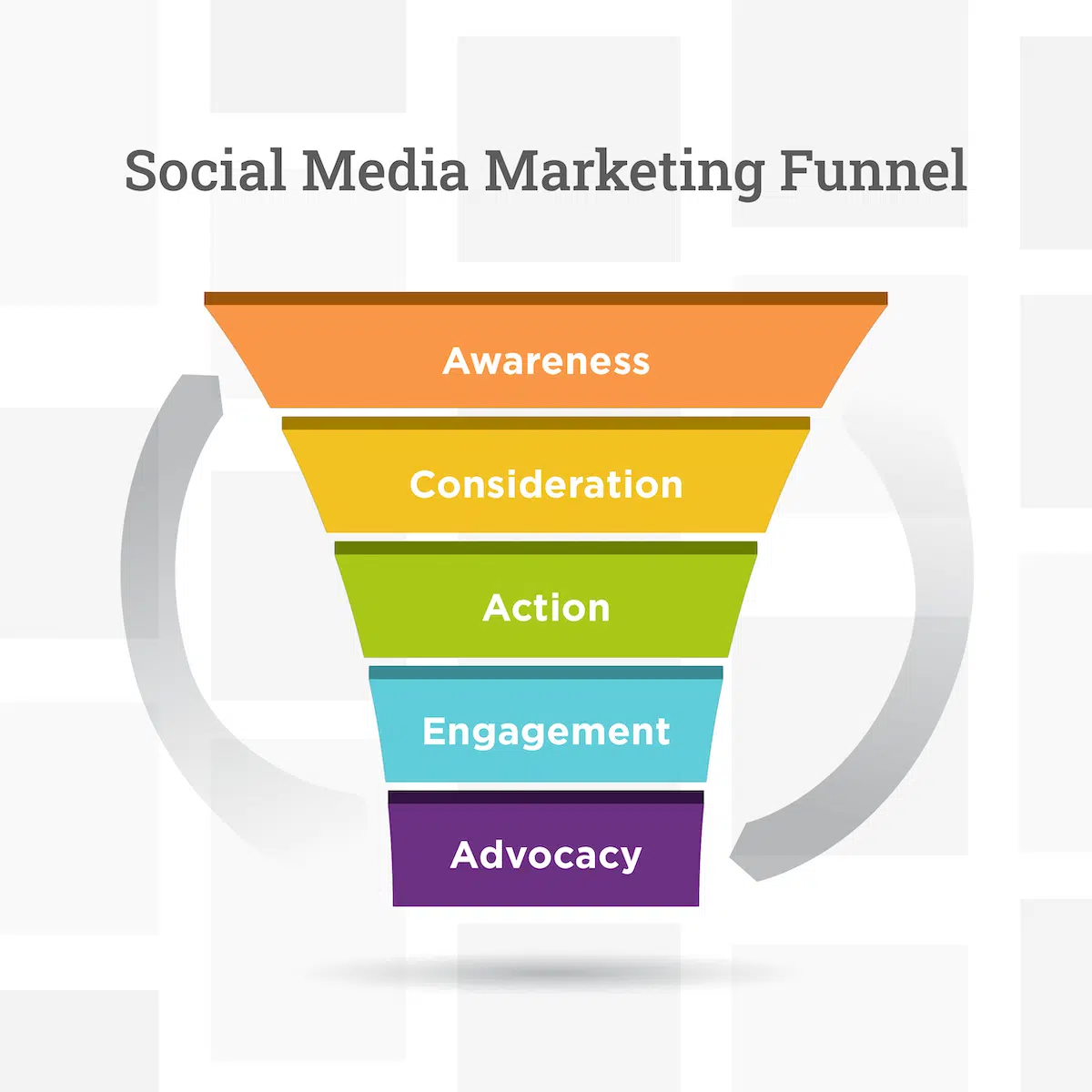
A social media funnel is a specific path your followers travel from the time they discover your brand on a social media platform to the time that they ultimately become fans and/or customers.

There are five stages in the social funnel system:

  1. Awareness
  2. Consideration
  3. Action
  4. Engagement
  5. Advocacy

Creating content that targets each stage is vital, as this is how you gain customer conversions and build brand loyalty.

How Is a Social Media Marketing Funnel Important in a Business’ Social Media Presence?

Social media can be a powerful tool for reaching your target audience, building brand awareness, and driving paid conversions. But if your social media strategy mostly consists of posting random content without a defined strategy, you won’t get the results you’re looking for.

That’s why the social media marketing funnel is key. In fact, a social media sales funnel is perhaps the single most important part of optimizing the social media presence of your business.

By using this digital content strategy, you’ll be able to tailor your content to meet the exact current needs of your audience while drastically increasing the likelihood of conversions. Not only does this create revenue and increase your ROI, but it also helps you build lasting relationships with your online customers.

What Are the 5 Stages of the Social Media Funnel?

Now that you understand why creating your marketing funnel is so important, it’s time to learn the specific stages and what you need to do within them.

Social_Media_Marketing_Funnel

1. Awareness

During this stage, social media users will have the opportunity to learn about your brand, your values, and your products. The awareness stage is when potential buyers evaluate your business to determine whether it aligns with their wants and needs.

This is not the point in the funnel to start pitching your products, however. Start with things that are more simple and offer users plenty of value to ensure that your brand sticks in their minds, and they’ll return later to learn more.

To do this, your content needs to be engaging and eye-catching. Regardless of the specific platform you’re using, begin by creating dazzling visuals. This is important because studies show that over 65% of people are predominantly visual learners.

Remember, visuals need to be more than just images — think photos, carousel posts, GIFs, illustrations, infographics, animations, memes, and videos. According to statistics, social media users will retain 95% of a message watched on video as opposed to only 10% when reading it in text.

2. Consideration

In this stage, leads should see your brand as a good fit for their needs. But it’s important to ensure that your brand stands out from similar businesses so leads remember you.

After reaching the right people in the awareness stage, you can interact with users who are now more likely to purchase from you.

During the consideration stage, users look for specific product information to decide whether your brand is a good fit for them. This stage also includes researching why your product is better than your competition’s.

To begin generating more leads, you want to provide details about what you’re selling. For best results, make it a point to share:

  • Explainer videos
  • Case studies
  • Guides
  • Product reviews
  • Influencer endorsements
  • Testimonials from happy customers

social marketing funnel

3. Action

This is where you want to get your social media audience to take action and become paying customers. When a user reaches this conversion stage, they already have a clear intent to purchase from you. And many will now transition from fans into customers if you direct them correctly.

One of the best social media funnel strategies in the action stage is to optimize each of your profiles with social shopping. By doing this, you make it possible for users to purchase from you without exiting the app.

Turn all your profiles into virtual storefronts, then make it easy for people to purchase your goods within the social media app. Start by:

  • Creating catalogs of your products
  • Including clickable links
  • Adding product stickers
  • Giving your followers exclusive promo codes and discounts

While you may be tempted to skip over the nurturing that needs to be done in the awareness and consideration stages, it will often result in a failure to convert your audience. It’s important to make your audience feel engaged with you before attempting to persuade them to buy.

Avoid jumping to the action stage without first building trust and awareness. Failure to do so will likely cause you to waste valuable time and money.

4. Engagement

The engagement stage is all about building long-term loyalty with customers after they’ve made a purchase from you through your social media sales funnel strategy.

This stage is essential for one simple reason: finding new customers will cost your business five times more than retaining existing ones. Because of this, you should never forget about your existing audience after they’ve made a purchase. Continue to nurture them and provide value in your content to make sure they won’t forget you.

It’s important to understand that your customer’s journey through the sales funnel isn’t linear. When you employ a solid social media funnel strategy, it’s more of a circular journey that they continue to travel with you.

One powerful strategy during the engagement stage is to provide customers with lead magnets. An example of a lead magnet would be offering an informative e-book to your social media customers in return for their email addresses.

5. Advocacy

Once you’ve gained a loyal following, you’ll certainly begin getting repeat buyers. But you should also encourage your customers to share positive recommendations about your brand with their friends, family, and social media followers.

It’s well-known that people trust word-of-mouth recommendations far more than marketing messages. That kind of enthusiasm is exactly what you need to engender during the advocacy stage.

To encourage advocacy, the first thing to do is give your buyers excellent customer service. Always focus on creating a positive experience for your customers that exceeds their expectations.

It’s also smart to incentivize advocacy by offering referral programs to customers who promote your brand to their social media followers.

social media funnel

Perfecting Your Social Funnel System

To increase brand awareness, drive engagement, and turn interested consumers into repeat customers, it’s critically important that you focus on each of the five steps of the social media funnel.

For best results, invest in each step equally rather than putting most of your time, effort, and money into only one or two areas. For example, you wouldn’t want to apply all your resources to the action stage. Your audience is smart enough to know when you’re trying to sell them something rather than offering a solution to their problem.

If your time and resources are limited, start at the beginning of the funnel and invest there to optimize your customers’ entire social media journey.

Start Building Innovative Social Media Campaigns with MARION Today!

So, you’re interested in building innovative and successful social media campaigns for your business — but where do you start?

MARION is a digital marketing agency that offers social media marketing in Houston and Austin, Texas. From creating compelling visuals to writing captivating copy, our experts can help you build campaigns that will engage your followers and grow your business.

Contact MARION today to schedule a free consultation!

Marketing emails you’ll actually want to read.

Get marketing tips and news sent to 
your inbox.

This field is for validation purposes and should be left unchanged.
Name(Required)

How to Build a Successful Word-of-Mouth Marketing Strategy

As a business owner, you know how critical it is to have an effective marketing strategy. Marketing can make or break your organization. It can soar your company to faster growth than your competitors and help you stand out in your industry.

While some businesses turn to digital and traditional marketing to reach new customers, another strategy is often more lucrative: Word-of-mouth marketing can drive your organization to new heights, usually with less expense than other advertising strategies.

What Is Word-of-Mouth Marketing?

Word-of-mouth (WOM) marketing relies on your customer base telling others about their fantastic experiences with your business. Rather than relying on your marketing team to create advertisements about your company’s products or services, you’ll ask your customers to spread the word to their families, friends, and the public.

Some ways to boost WOM marketing efforts include asking for customer testimonials or creating referral programs.

Why Should Marketers Care About Digital Word-of-Mouth?

The benefits of word-of-mouth advertising are clear. Digital word-of-mouth marketing statistics show that 92% of consumers believe brand recommendations when they come from a friend. Similarly, people are four times more likely to purchase a product someone they know endorses.

Distrust among consumers when it comes to company brand advertising is widespread. In fact, 75% of consumers don’t trust a company’s advertisements. They’d rather perform their own research, which often includes checking an organization’s reviews, before buying a product.

word of mouth wom marketing

Word-of-Mouth Marketing Strategies

You have several options when searching for a word-of-mouth strategy that will work for your organization. For example, you can encourage online word-of-mouth marketing through user-generated content or influencer marketing, or directly ask customers to share their opinions of your company.

Take a look at some easy-to-implement marketing WOM strategies.

User-Generated Content

User-generated content occurs when a customer posts about your company on a social media platform. For example, they might rave about the customer service at your restaurant or talk about how your product solved a specific problem they had.

You can grow your web presence and encourage user-generated content by rewarding customers who post positive content about your brand or surprising them with a grateful response from your company’s social media account.

Influencer Marketing

Influencer marketing typically requires a company to form a partnership with a social media influencer whose audience mirrors the demographics and behavior of the organization’s customers.

Usually, the company will pay the influencer to produce an ad or video proclaiming the benefits of an organization’s merchandise. The goal is to generate brand awareness and increase sales among the influencer’s followers.

Referral Programs

Referral programs rank highly among examples of successful word-of-mouth marketing campaigns. A referral program rewards an existing customer with a special bonus when they successfully recommend a friend to sign up for a company’s services or buy a specific product.

Social Media Monitoring

Social media monitoring involves surveying social media platforms for mention of your organization. You can take advantage of social listening tools, which provide real-time data about posts mentioning your company on social media platforms, review sites, or blogs.

Every time your company receives a mention, you can reply to the poster’s comments with your own creative response.

Customer Testimonials

Customer testimonials are reviews of clients’ experiences with your brand, products, or services. You can ask your clients to leave testimonials on your website or popular review platforms like Google and Yelp. Highlight positive reviews on your website and other channels to encourage potential clients to take the next step with your company.

Examples of Successful Word-of-Mouth Marketing Campaigns

Word-of-mouth marketing is a powerful tool to spread the word about your products and services and build trust with your audience. Below, we will look at some examples of successful word-of-mouth marketing campaigns to inspire your own campaign.

Spotify Wrapped

Every year, #SpotifyWrapped trends on social media with massive engagement. Hundreds of millions of users across various platforms share their Wrapped data with friends and followers. This is viral marketing at its finest.

spotify wrapped marketing

Spotify Wrapped 2022

Mint Mobile Refer A Friend

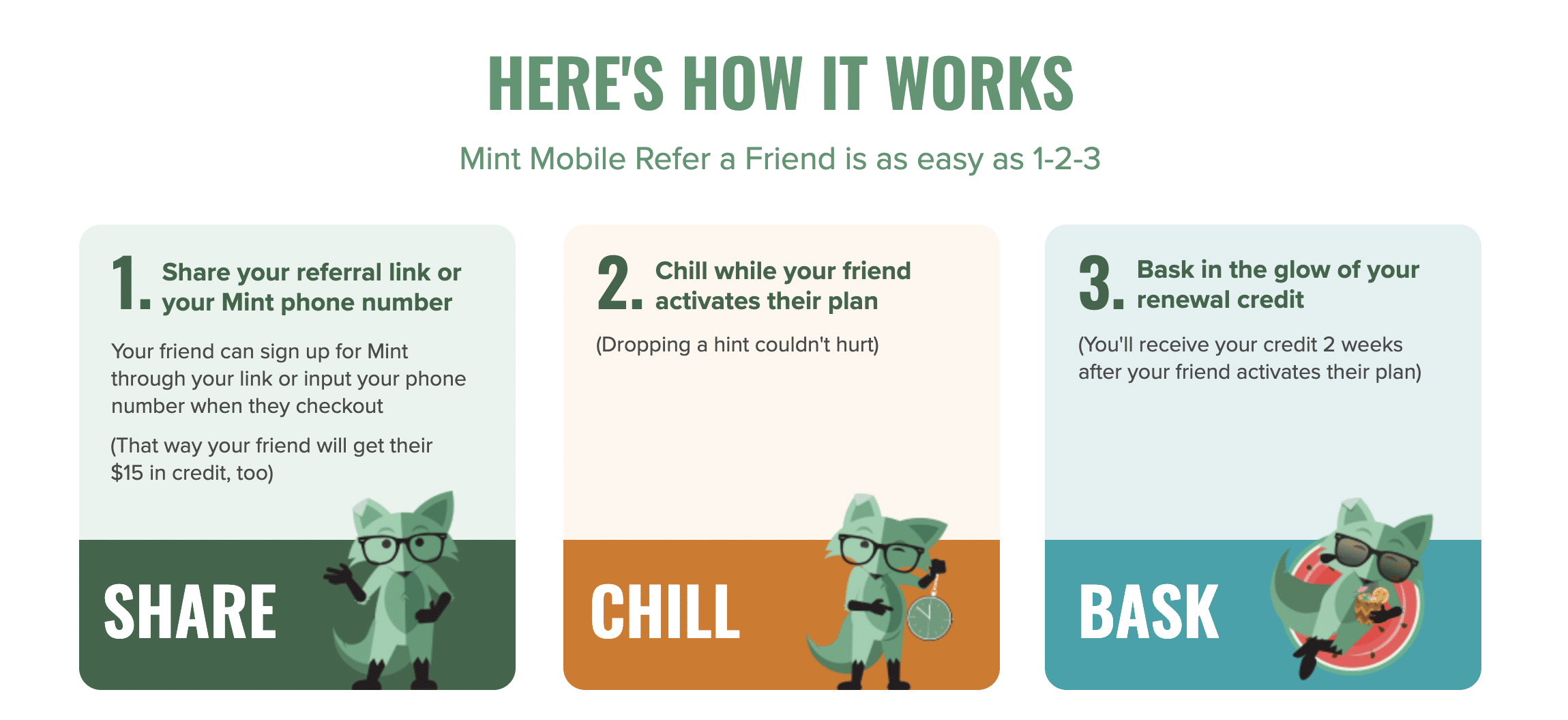
Mint Mobile uses referral programs to broaden its customer base. When a customer’s friend signs up for a phone plan with Mint, it rewards the current customer with credits they can use toward free cell phone service.

mint mobile referral marketing

Mint Mobile Refer A Friend

Canva’s 15 Billionth Design Challenge

Canva invited users to be a part of history in this successful word-of-mouth marketing campaign in 2023. The 15th Billion Designs Challenge encouraged users to participate in the online Canva community by sharing their design entries on social media with #15BillionDesigns.

canva word of mouth marketing

Canva 15 Billion Designs

Marketing Strategies to Complement Your Word-of-Mouth Campaign

Here are a few of the highest ROI marketing channels you can use to supplement your WOM advertising strategies.

  • Buzz Marketing: Bombard online channels with news about your company; the excess information creates word-of-mouth advertising for your brand.
  • Viral Marketing: Create a unique piece of content to spread quickly around the internet and generate free advertising for your business.
  • Social Media Marketing: Post advertisements on social media platforms to reach your target audience and generate brand awareness.
  • Blog Marketing: Develop written content designed to attract interest from consumers; you can post blogs on your website or publish articles on other sites closely followed by your target audience.

These additional strategies can generate word-of-mouth promotion, allowing you to build awareness and generate excitement among your audience.

Build a Business Worth Talking About with MARION

Now that you know how to increase word-of-mouth referrals through practical strategies, consider taking your marketing to the next level with MARION. MARION is a customer-centric digital marketing agency that will develop a holistic advertising program to uncover your brand’s potential. Connect with our team to learn more.

Contact us today for a free marketing consultation.

Marketing emails you’ll actually want to read.

Get marketing tips and news sent to 
your inbox.

This field is for validation purposes and should be left unchanged.
Name(Required)

Creative Marketing: What It Is and Why You Should Pursue It

Simply put, the purpose of marketing is to create awareness of a product, service, or event. Creative marketing is one of the most interesting and desirable aspects of marketing, as it can be used to convey a message through creativity. It brings customers to the company’s product and helps them keep their attention. It’s a proven way to boost conversion rates!

What is Creative Marketing?

Creative marketing is not just about coming up with catchy slogans or designing an attractive logo for a company. Instead, it involves using tools such as music, sound effects, symbols, and images to make consumers interested in buying a product.

Why Creative Marketing Matters Today

Creative advertising is an essential part of the modern marketing industry. It’s more than just an additional ingredient—it’s at the core of everything businesses do today. Creative marketing is crucial to the success of any company because it’s all about changing perceptions and connecting with potential customers on a new level.

Creativity has always been considered an essential resource in marketing, but it has taken on greater significance in recent years. With the rise of social media, consumers are bombarded with messages about products and services every day. To stand out, marketers must be innovative and creative in their marketing campaigns to gain attention and interest from potential buyers.

Check out these creative, successful social media campaigns.

creative marketing plan

The Challenge of Creativity in Marketing

Creativity is the cornerstone of marketing. It is one of the most critical aspects of an organization’s marketing efforts. A creative mind is what separates a good marketer from a great marketer. In addition, a creative mind can help build up ideas that are not only effective but also refreshing. 

As the digital environment continues to change, marketers are faced with increasing challenges regarding creativity. Marketing in an online environment is much different than traditional marketing, which poses some unique obstacles for marketers looking to be creative in their work.

The emergence of AI writers has made marketers’ jobs more streamlined and efficient as they can focus on what they are best at — creativity and emotions — rather than wasting time on technical skill sets and research.

How to Foster Creativity in Your Marketing Efforts

Did you know that 75% of individuals believe they are not living up to their creative potential? Becoming more creative can be challenging, as developing your artistic skills takes time and effort. It won’t happen overnight! However, the following tips will help you tap into your right brain and increase your creativity in marketing:

  • Brainstorming: Brainstorming is a great way to develop new ideas for your product. You can do it alone or in a group, but ensure all participants are active and engaged.
  • Ask yourself: When was the last time you went out of your comfort zone? Trying new things will give you fresh ideas and perspectives that you never imagined before.
  • Bring the team together: Put together a creative task force of people with different backgrounds and skill sets. They will be able to provide different views and experiences that can be used for breakthrough marketing ideas.
creative marketer

What Creative Marketers Do Differently Than Traditional Marketers

Creative marketing is about individual creativity and the uniqueness of your product. Creative marketers rely on their wits, intuition, and skills to get where others can’t.

Traditional marketing is about tactics, techniques, and best practices. Traditional marketers use strategic methods to get your attention in crowded markets, but these techniques aren’t as effective as they once were. To truly get in front of people these days, you need to be creative.

Elevate Your Brand with a Creative Marketing Agency

To recap, creative marketing is a type of marketing that focuses on creativity and emotions. It is an effective tool used by businesses to generate new ideas and fresh perspectives while still engaging with customers. Creative marketing will never replace traditional forms of marketing. However, it can complement them in a way that brings out the best in both.

Simply ‘being creative’ isn’t always as easy as it sounds. Luckily, our digital marketing agency is here to help! The team at MARION has been serving Texas businesses for over 40 years. We’ve taken a creative approach to developing custom marketing plans for various industries. Check out MARION’s design portfolio to see what our creative designers can do.

Contact us today to learn how we can help your business grow by incorporating a creative strategy into your marketing project.

Marketing emails you’ll actually want to read.

Get marketing tips and news sent to 
your inbox.

This field is for validation purposes and should be left unchanged.
Name(Required)