Category: Lead Generation

GEO vs. SEO: What’s the Difference and Why It Matters

Generative Engine Optimization (GEO) is an extension of the same principles, adjusted for AI-generated results like those from Google SGE, ChatGPT, and Gemini. If your content is clear, useful, and built on real expertise, you’re already in a strong position.

What is SEO?

Search Engine Optimization (SEO) is the long-standing practice of optimizing web content so it ranks higher in search engine results. Traditional SEO includes:

  • Keyword research and placement
  • Meta tags and descriptions
  • Link building
  • Technical structure (speed, mobile experience, crawlability)
  • Content relevance and authority

These elements help search engines interpret your content and determine how it compares to competing pages.

What is GEO?

Generative engines like ChatGPT, Gemini, and Perplexity often pull their answers directly from top-ranking web pages in traditional search engine results. That means what works for SEO often works for GEO, because these AI tools rely on the same source material to inform their responses.

Generative Engine Optimization (GEO) focuses on preparing your content for AI-generated answers, not just traditional search rankings. This includes platforms like Google’s Search Generative Experience (SGE) and other web-integrated AI tools.

GEO builds on familiar SEO fundamentals. It’s more of a shift in how content is interpreted and delivered through AI-driven experiences than a reinvention of the strategy. In fact, many GEO tactics build on familiar SEO fundamentals:

  • Structuring content clearly so AI can process it
  • Answering specific, intent-driven queries (often in FAQ format)
  • Showing authority and experience
  • Using visuals, lists, and formatting that’s easy to parse

Learn more: What is Generative SEO?

Key Differences: SEO vs. GEO

SEOGEO
Ranks content for search listingsOptimizes content for AI summaries
Relies on keyword volume & backlinksRelies more on content clarity & structure
Focuses on SERPs (search engine results pages)Focuses on zero-click, AI-generated answers
Easier to measure with tools like AhrefsHarder to track and measure right now

Where SEO and GEO Overlap

Most SEO practices still apply to GEO. GEO reframes the goal: instead of ranking on a page of links, your content might be quoted or summarized directly by an AI. The foundational strategy remains very similar. about how your content is picked up and presented in modern search.

Shared tactics:

  • Use of headings and subheadings
  • Skimmable formatting
  • Writing that addresses real user intent
  • Building trust through experience and clarity

How Search Queries Play Out in SEO vs. GEO

Let’s look at two example queries and how traditional SEO and GEO approaches differ in how they address them.

Example 1: “How much does a roof replacement cost in Austin?”

  • SEO Approach: A traditional SEO page might include a blog post titled “Roof Replacement Costs in Austin” that uses keywords like “roofing prices Austin” and includes a pricing chart buried mid-page. This helps it rank for that phrase in the SERPs.
  • GEO Approach: To increase the chances of appearing in an AI-generated answer, the same page might start with a clear, direct answer to the question in the first paragraph, followed by a bulleted breakdown of factors that affect cost, and an FAQ section. AI systems are more likely to lift content that’s structured this way.

Example 2: “What is the best CNC material for aerospace parts?”

  • SEO Approach: A manufacturer might write a detailed blog post with the keyword “CNC materials for aerospace” and include explanations throughout the article. It may rank well with good backlinks and keyword usage.
  • GEO Approach: For generative engines, the content would benefit from a short introductory paragraph directly answering the question, followed by scannable subheadings comparing materials (like aluminum vs. titanium), and clear definitions. This format helps AI models quote or summarize it quickly.

These examples show how GEO favors clarity and structure, but still builds on SEO fundamentals. By anticipating the format and behavior of AI-driven tools, you can make your content more adaptable across both search environments.

Grow your business with digital marketing - CTA banner

What You Should Focus on Now

  • Write for people first: Google’s guidance still favors helpful content. Don’t create content solely for bots.
  • Add FAQs and question-based sections: These make your content more likely to appear in AI-generated responses.
  • Keep your content current: AI systems often look for timely, relevant sources.
  • Watch out for “AI-optimized” shortcuts: GEO is still new, and many tools or services make claims without real data behind them.

When comparing GEO vs. SEO for lead generation, the difference isn’t about choosing one or the other. It’s about knowing how they connect!

Ready to Align Your Strategy with SEO and GEO?

GEO builds on SEO, not replaces it. In the GEO vs. SEO conversation, it’s more accurate to think of GEO as a natural progression. As tools like ChatGPT, Gemini, and Google’s SGE change how people interact with search, it’s smart to create content that fits both traditional engines and AI platforms.

If you’re ready to adjust your digital content strategy for the future of search, MARION marketing agency can help you create content that performs in both spaces.

Let’s talk.

Marketing emails you’ll actually want to read.

Get marketing tips and news sent to 
your inbox.

This field is for validation purposes and should be left unchanged.
Name(Required)

How Superman Marketing Balances Mass Appeal with Fan Centricity

In a marketing universe crowded with reboots, remakes, and relaunches, DC’s 2025 Superman: Legacy campaign has pulled off something rare: it speaks to everyone without watering down its message. The movie hits theaters on July 11, and analysts already expect it could cross the $1 billion mark globally thanks to a creative marketing effort that blends global visibility with sharp cultural relevance.

New Superman Movie Marketing Campaign – The Highlights

The Superman: Legacy campaign deployed an inventive set of tactics aimed at high public visibility while keeping core fans engaged. Some of the standout elements included:

  • Iconic Visuals: The Superman “S” shield beamed across landmark buildings, with a towering statue perched on London’s Shard.
  • Brand Tie-Ins: Collaborations with Samsung, Krispy Kreme, and Progressive extended the reach into consumer moments from tech to treats.
  • Localized Engagement: Jersey drops with EC Bahia and city activations like Daily Planet pop-ups created a personal touch in physical spaces.
  • Fan-Centric Content: Posters featuring lesser-known characters and director interactions gave longtime fans more than surface glitz.
  • Multichannel Content Drops: With trailer launches and exclusive content for CinemaCon attendees, the campaign was tailored for every format.
  • Early Access & Screenings: Prime members and IMAX audiences got advance looks, fueling buzz and urgency.
New Superman Movie Marketing Campaign

Image source: Krispy Kreme

Why This Campaign Works

With the campaign groundwork laid out, it’s time to look closer at how these efforts played out across audience segments, creative formats, and messaging choices. Here’s what made the Superman rollout moreso strategic than promotional.

1. Two Audiences, Two Sets of Expectations

To pull this off, the integrated marketing campaign had to speak fluently to two very different audiences. Superman’s marketing had to cater to:

  • Casual fans: Families, general moviegoers, and anyone who’s seen a superhero movie.
  • Hardcore fans: Comic readers, lore-keepers, and long-time DC loyalists.

This same tension exists in many markets. Some want big-picture inspiration; others want detailed, in-the-weeds substance.

Marketing Takeaway: Segment your messaging. Don’t talk to your entire audience the same way. Build a digital content strategy that answers surface-level curiosity and deep technical needs. As someone who’s led campaigns across both niche verticals and mass-market brands, I can tell you this is where most marketers miss…assuming one message can do everything.

2. Broad (Yet Unmissable) Campaigns for Mass Appeal

Superman’s visual branding has been showing up everywhere:

  • The iconic “S” shield was projected onto landmark buildings around the world.
  • A 300-meter statue of Superman was installed atop London’s Shard skyscraper, drawing international headlines.
  • The campaign featured strategic brand collaborations with Samsung, Krispy Kreme, and Progressive that brought Superman into everyday moments and consumer touchpoints.

Each activation reinforced an emotionally uplifting tone: strength, hope, and optimism. No need for origin-story fatigue, this was clean, confident storytelling for anyone with eyes.

Marketing Takeaway: You don’t have to be dull to be professional. Use visually arresting creative across channels where your audience lives, such as industry news outlets, LinkedIn, targeted display. Brand recall starts with visibility and resonance.

3. Hardcore Fans Got Their Moment

This campaign wasn’t only designed for the mainstream. It carved out moments specifically for the superfans, like character posters featuring Mr. Terrific and Hawkgirl, comic-accurate costume design, and behind-the-scenes drops from director James Gunn. These touches spoke directly to people who pay attention to every frame and share every theory.

Marketing Takeaway: Your most engaged prospects need more than surface-level content marketing. Publish long-form whitepapers, host AMA-style webinars, or build product deep-dives for them. Let your technical audience nerd out.

4. Customized Content for Every Channel

Superman’s campaign appeared across platforms that spoke to different types of viewers. With everything from short-form YouTube teasers to long-form interviews and event exclusives, every piece of content had a place. Even retail tie-ins were localized to fit their markets. The marketing team didn’t blast one message across every channel. Rather, they matched the format and tone to the space (and the people in it).

Marketing Takeaway: Different stakeholders need different content. Align your distribution to match their expectations. Use targeted landing pages, role-specific case studies, and flexible content workflows that reflect real buying journeys.

5. Participation Was Part of the Strategy

This wasn’t a celebration of Superman. It was built to celebrate the people who care about him. From limited-edition jerseys to pop-up newspaper stands and fan-first screenings, the audience became part of the rollout experience.

Marketing Takeaway: Turn customers into advocates. Let your buyers wear your brand through spotlight case studies, co-hosted events, or community-driven content. People are more likely to share what they feel a part of.

Your brand doesn’t need to be the star. Your customer does. Make your messaging focus on what they gain, what they overcome, and how they move forward.

build a better brand CTA banner

Echoes of Barbie: Warner Bros. Applies a Proven Formula

Warner Bros. has put into motion a marketing strategy for Superman: Legacy that strongly resembles its groundbreaking approach with the Barbie movie. From colorful cross-brand partnerships to global stunts and a press tour that puts the cast front and center, the blueprint is unmistakably familiar.

Just like Barbie, the Superman campaign has leaned into cultural moments. Themed pop-ups, character-driven content drops, and visually striking out-of-home elements mirror the techniques that made Barbie a marketing phenomenon. It’s a reminder that storytelling doesn’t start on release day. It begins the moment a campaign hits the streets.

Want a breakdown of how Barbie’s campaign changed the game? Read MARION’s full blog on Barbie movie marketing here.

Work with MARION to Build Your Marketing Strategy

Strong campaigns don’t ride the middle. They use layered strategies that:

  • Draw attention with emotionally relevant creative.
  • Support deeper consideration with detail-rich content.
  • Build loyalty by making people feel like part of something real.

Are you lacking strategic messaging and content creation in your digital campaigns? MARION marketing agency has worked with clients across industries to build campaigns that don’t blend in…and we’re ready to do the same for you! Ready to start your next digital marketing campaign?

Let’s talk about your marketing goals.

Marketing emails you’ll actually want to read.

Get marketing tips and news sent to 
your inbox.

This field is for validation purposes and should be left unchanged.
Name(Required)

Generative AI & GEO Explained: What it Means for Your SEO Rankings

Have you noticed a drop in your website’s traffic and search rankings? You’re not the only one. Many businesses are experiencing a decline in organic search results. It’s no surprise that one of the biggest reasons is how AI (and a growing focus on Generative Engine Optimization aka GEO) is changing the way search engines like Google work.

The AI Shift: Why Search Engines Are Changing

Search engines are no longer just looking for keywords on a page. Instead, AI helps them understand the intent behind a search and provides the best possible answer…sometimes without the user even needing to click on a website.

  • AI-Generated Summaries: Google now generates its own AI summaries at the top of search pages, pulling from different websites. A study found that when AI summaries appear, organic clicks can drop by over 70%.
  • Zero-Click Searches: About 60% of Google searches now end without a user clicking on a website, as answers are provided directly in search results.
  • Voice and Chatbot Search: 1 in 3 consumers use voice search now, further reducing traditional clicks to websites.

These changes are giving rise to a new SEO approach often called Generative Engine Optimization (GEO), which prioritizes content that AI can easily interpret and serve to users directly in results.

What is Generative Engine Optimization (GEO)?

GEO is the emerging approach to optimizing content for AI-powered search experiences, like Google’s Search Generative Experience (SGE). At a glance, it may sound like a new frontier, but in practice, many GEO tactics echo long-standing SEO principles.

  • The basics still matter: Content quality, expertise, and clear structure (headings, short paragraphs, supporting visuals) are all critical in helping AI understand and rank your pages.
  • FAQs are gaining importance: With AI often serving users Q&A-style answers, including question-based sections in your content increases visibility.
  • Reviews may play a bigger role: Customer reviews (especially through Google) can add trust signals and help content surface in AI summaries.

The challenge is that unfortunately GEO is hard to measure right now (but hopefully not for long). Traditional SEO tools like Ahrefs or SurferSEO aren’t built to track how AI-generated results impact your site. New tools like HubSpot’s AI Search Grader are emerging, but their accuracy and benchmarks are still evolving.

For now, be cautious with services hyping “AI-optimized” content. With no standard tools or clear benchmarks yet, many are simply rebranding existing SEO tactics without proven results.

Why Your Website’s Traffic is Dropping

Google’s AI-driven updates make it harder for businesses to attract clicks. Search results increasingly highlight Google’s own tools (like Maps, Shopping, and YouTube) while competition for organic rankings grows.

  • Google Favors Its Own Platforms: Organic results are pushed lower down the page in favor of Google-owned content.
  • More Competition: More businesses are fighting for a shrinking pool of organic clicks.
  • SEO Standards Are Changing: Keyword-heavy pages don’t rank as well as content that is trustworthy, in-depth, and user-focused. (this isn’t a new concept)
  • Technical SEO Matters More: Slow load times, poor mobile experience, and confusing navigation negatively impact rankings.
geo chatgpt new search

How to Adapt Your SEO and GEO Strategy

To stay competitive, focus on creating high-quality, helpful content that truly benefits your audience. Articles should quickly answer common questions and demonstrate real expertise. According to Google, content that is well-structured, fact-based, and easy to read is more likely to be featured in AI-generated results.

1. Improve Your Content Strategy

High-quality content has always mattered, but with AI-driven search, it’s now essential. Google prioritizes content that delivers real value rather than just targeting keywords. Simply posting frequently isn’t enough. Your content must be insightful, useful, and well-structured to rank well.

Write content that answers user questions clearly and provides unique value. Instead of surface-level topics, focus on expert insights and detailed explanations that showcase your authority. (and can’t possibly be answered in just an AI summary)

Structuring your content with clear headings and summaries makes it easier for search engines and AI tools to recognize its relevance. This type of structured, high-value content is also more likely to be recognized by AI-driven search engines and surfaced through GEO mechanisms like Google’s Search Generative Experience.

2. Target the Right Keywords

Choosing the right keywords is no longer about stuffing your website with popular search terms. AI-powered search engines prioritize relevance and intent over keyword repetition. To improve rankings, focus on three main types of keywords:

  • Long-Tail Keywords: These are longer, more specific phrases that reflect exactly what a user is searching for. Instead of targeting “manufacturing solutions,” aim for “best manufacturing solutions for small automotive companies.” Long-tail keywords account for 70% of all web searches and usually have less competition.
  • Question-Based Keywords: Many searches are now phrased as questions, especially with voice search. Instead of just “metal fabrication techniques,” optimize for “What are the best metal fabrication techniques for aerospace parts?” Creating FAQ sections and answering specific questions within your content increases the chances of appearing in featured snippets and AI search results.
  • Commercial and Transactional Keywords: These are used when someone is ready to make a decision. Instead of just “custom furniture,” optimize for “best custom furniture design company in Houston” or “hire a custom furniture manufacturer for hotels.” These keywords tend to attract users who are more likely to convert into customers.

3. Strengthen Technical SEO

A well-designed website isn’t enough; search engines also evaluate the technical foundation. Slow load times, poor mobile optimization, and broken links can hurt rankings, no matter how good the content is. Staying on top of your technical SEO ensures that search engines can properly crawl, understand, and rank your website, making it easier for users to find your content.

  • Site Speed & Mobile Experience: Slow load times and poor mobile usability reduce rankings.
  • Structured Data Markup: Helps search engines understand and highlight your content.
  • Navigation & Fixes: Broken links and poor site structure harm user experience and rankings.

4. Build Brand Authority

Focus on quality over quantity when link building. A handful of strong, relevant links from reputable industry sources will do far more for your website’s credibility than dozens of low-quality links.

Google now prioritizes natural, authoritative backlinks, so investing in building real relationships, guest posting on respected sites, and getting organic mentions in trusted publications will help strengthen your online presence and rankings. A few strong links from reputable industry websites are far more valuable than dozens of low-quality links.

The Future of SEO in an AI-Driven World

If your rankings are slipping, don’t panic. This shift is happening across all industries and many of us are being affected. Just know that SEO is not going away anytime soon, but it is definitely changing and will never be the same. The good news is that businesses that focus on creating valuable content, strengthening their brand, and keeping up with technical best practices will continue to thrive.

Partner with MARION for Smarter SEO

Need help navigating SEO in the AI era? Contact MARION today to develop a strategy that keeps your business visible and competitive in terms of SEO, GEO, AI, and everything in between!

Marketing emails you’ll actually want to read.

Get marketing tips and news sent to 
your inbox.

This field is for validation purposes and should be left unchanged.
Name(Required)

The role of marketing in business growth

Why midsize companies need more than great products and services.

You’ve built a solid foundation — a product or service customers love, a team that delivers and a growing base of loyal clientele. But at some point, most midsize companies run into the same question: how do we grow from here?

For many, the answer is marketing. Not just a new logo or a few posts on social media. We’re talking about strategic, consistent, insight-driven marketing that positions your brand for long-term growth. And when done well — particularly with the help of an agency that brings specialized expertise — marketing doesn’t just make your company look good. It drives real, measurable results.

Here, we explore the key role marketing plays in business growth.

How marketing impacts growth.

Marketing is often seen as the cherry on top — something that’s nice to have once the “real work” is done. But the reality is this that marketing is an essential part of the real work. It’s what builds brand recognition, drives qualified leads, supports sales and creates the kind of loyalty that keeps customers coming back.

Here’s how marketing contributes to growth on multiple levels.

Brand awareness.

You can’t grow if no one knows you exist. Strategic marketing ensures your company gets in front of the right people — not just more people. Whether it’s through search engine optimization, targeted digital ads or smart media placements, marketing helps you attract attention and stay top of mind.

For example, when a Houston-based grocery chain asked us to create an integrated branding campaign to attract customers and drive growth, we didn’t just splatter the airwaves indiscriminately. We leveraged print and digital advertising, radio ads, direct and email marketing, social media and public relations support based on a strategic understanding of their audience’s behaviors, needs and preferences. In doing so, we helped this brand capture customers’ attention and expand their footprint.

Lead generation.

Marketing bridges the gap between interest and action. By creating content that speaks to your audience’s pain points and values, you can build trust and encourage engagement — turning prospects into leads and leads into customers.

Digital channels are a key part of any content marketing strategy. Filling your website with useful, keyword-rich information that serves your audience while making it easier for them to find you is immensely valuable — as are outbound strategies such as social media and email marketing.

At the same time, the traditional print route can be hugely impactful, particularly as brands continue to compete for audiences’ attention in an overcrowded digital space. Direct mail campaigns and even sales collateral such as brochures can be used to reinforce your brand and connect with audiences.

Sales enablement.

Oh, and did we mention that all the content your marketing team is generating can be used to empower your sales team? Every pitch deck, flyer, brochure, whitepaper, blog article and social media post gives them an opportunity to share something valuable with clients. Whether it’s a sales-focused piece that makes your offerings more digestible, informational content about your industry or a fun piece of swag, marketing arms your sales team with the tools they need to close deals faster.

Customer loyalty.

Growth isn’t just about acquisition. It’s also about retention. Thoughtful, ongoing marketing — such as email campaigns, social content and customer success stories — helps to deepen your relationship with existing customers, thereby encouraging repeat business and referrals.


Why midsize companies benefit from agency support.

Midsize companies often find themselves in a unique position: large enough to need a strong marketing team, but not quite large enough to justify building an internal department filled with specialists.

That’s where agency partnerships can be transformative.

Access to specialized skills.

From branding and content marketing to digital ads, search engine optimization and web development, a full-service agency brings together professionals who live and breathe their craft. That means your campaigns benefit from a depth of knowledge that would be hard (and expensive) to hire in-house.

Strategic insight.

An experienced agency doesn’t just take orders — it helps you think bigger. With broad, cross-industry perspective, a good agency can spot opportunities, identify blind spots and recommend new ways to stand out in your space.

Consistency and cohesion.

One of the biggest barriers to growth is inconsistent messaging. Agencies help unify your brand voice across all platforms — from your website and print materials to your email newsletters and social ads — so your story lands clearly and consistently.

Tangible results.

A full-service agency doesn’t just make things look good. It aligns every creative initiative with your business goals. That means developing marketing strategies that not only increase web traffic or generate buzz — but also deliver qualified leads, higher conversion rates and long-term ROI.

The soft and hard returns of strategic marketing.

Not all marketing success shows up in a spreadsheet. While metrics like leads, sales and conversion rates are important, so are soft returns, such as stronger market positioning and a more consistent and defined brand identity. With the right marketing partner, you can advance all these objectives.

So whether you’re trying to hit revenue goals, break into a new market or just bring more focus to your existing efforts, investing in a strategic marketing plan — implemented by an expert agency — could be the best growth decision you make.

Ready to grow?

At Design At Work, we’ve helped midsize companies clarify their brand, connect with the right audience and grow with purpose. Contact us to discuss how we can do the same for you.

AI for Small Business: The Smarter Approach to Marketing

AI is no longer a term reserved for big brands with massive budgets. In 2025, small teams can now tap into smart tools that automate tasks, personalize content, and analyze data.

How Small Businesses Are Using AI in Marketing Today

If the idea of using AI sounds intimidating, don’t be discouraged. A lot of business owners feel that way at first, especially when you’ve been doing things the same way for years (if not decades). But once you try it, the benefits become obvious fast. It’s not replacing your team or your entire process. Think of it as taking a some weight off your plate so you can focus on the things that need your attention most.

AI isn’t reserved for big brands anymore.

With the rise of affordable SaaS tools, small businesses now have access to AI-powered platforms once used exclusively by enterprises. If you’re solo running email campaigns, social media, or customer support, there’s likely an AI solution that fits your budget and needs.

Why AI is already part of your marketing (even if you’re not using it yet)

AI already influences how your customers engage with content online. Algorithms decide what shows up in their feeds, which emails land in their inbox, and what ads they see. So, it only makes sense that using AI will give your business a better chance of getting noticed in that crowded space!

How AI Helps Small Businesses Do More with Less

We’re a small business too, and we use AI every day. It helps us handle the repetitive stuff (like scheduling posts or pulling data) so our team can spend more time thinking, writing, and building campaigns. It’s not replacing anyone on our team, just making their work a little faster and a lot easier.

Find the right people faster.

AI can analyze customer behavior and segment audiences automatically. That means you can deliver the right message to the right person at the right time without spending hours poring over spreadsheets.

Skip the blank page.

AI writing tools generate blog outlines, social media posts, and email subject lines in seconds. You still need to guide the message, but these tools help you move faster and skip the blank page struggle.

Make smarter calls with data.

AI tools can forecast which leads are likely to convert. They can spot when customers might leave and show what content earns clicks. Your team still interprets the results and makes the final call, but AI gives you a clearer view to work from.

Let chatbots handle the FAQs.

Today’s chatbots go far beyond canned responses. They can answer common questions, schedule meetings, and guide users through your sales funnel. But they don’t replace the human touch – your team can step in for more nuanced conversations and relationship-building.

Cut the busywork.

From scheduling social posts to managing email drips, AI frees up your team to focus on strategy and creativity rather than busywork.

Learn how to use ChatGPT to generate leads.

ai for small business marketing

AI Marketing Tools for Small Business

You don’t need a complex tech stack to get started. Many tools are built for everyday business owners and marketers. Here are a few categories worth knowing:

AI Tools for Email Marketing

AI email marketing tools for small businesses include send-time optimization, subject line suggestions, and automated audience segmentation.

  • Mailchimp
  • Constant Contact
  • ActiveCampaign

Social Media Assistants

These platforms help you write, schedule, and recycle posts. Some can even turn blog content into social media-ready copy.

  • Buffer
  • Lately

SEO Tools That Use AI

These SEO tools offer keyword suggestions, compare your content with competitors, and provide writing guidance based on search trends.

  • SurferSEO
  • Ahrefs
  • Semrush

AI in CRM Platforms

CRM tools with AI features can generate leads for your small business, track user behavior, and suggest outreach actions to keep your pipeline moving.

  • HubSpot
  • Zoho

Sample Timeline: How to Start Using AI in Your Small Business Marketing

You don’t have to overhaul everything at once. Here’s a simple month-by-month rollout to help you start small and build momentum:

TimeframeActionFocus
Week 1Identify a marketing task to automateStart with something repetitive, like social media marketing or email scheduling.
Week 2-3Choose and test one AI toolTry out a platform of your choosing (see above examples). See how it fits with your current setup.
Week 4Train your team on how to use the toolKeep it simple; watch tutorials, test with a small audience, and ask questions.
Month 2Use AI consistently for one taskMake it part of your workflow and monitor results.
Month 3Add a second AI-powered toolChoose based on the next biggest time-saver like chatbots or keyword research.
Month 4+Review performance and adjustKeep what’s working, tweak what’s not, and expand when you’re ready!

This kind of step-by-step approach keeps things manageable. It gives your team time to adjust and get comfortable with the new tools before adding more.

Common Misconceptions About AI for Small Business

AI tools are more accessible than many business owners realize. But old ideas can still hold people back. Let’s clear a few of those up.

“It’s too expensive”

Many AI tools are subscription-based and priced for smaller teams. You can start small with a single platform (like AI-driven email or social scheduling) before expanding into other tools.

“It’s too complicated to use”

Modern tools are built with non-technical users in mind. Many have simple dashboards, built-in tutorials, and customer support teams to help you get started quickly. If you can manage email or spreadsheets, you can handle most AI-powered platforms without a steep learning curve!

“AI will replace human marketers”

AI helps automate and speed up parts of your workflow. But strategy, brand voice, and creative decision-making still rely on human input. AI assists, you stay in control.

Get Help Applying AI to Your Marketing

If you’re ready to use AI to attract better leads and run smarter campaigns, MARION can help.

We’ve provided outsourced marketing to Texas-based businesses for over 40 years. Our team knows how to blend practical marketing strategy with today’s smart tools (without making things complicated).

Schedule a free consultation to see how AI can fit into your marketing. We’ll help you focus on what works so you can grow your business with confidence!

Marketing emails you’ll actually want to read.

Get marketing tips and news sent to 
your inbox.

This field is for validation purposes and should be left unchanged.
Name(Required)

What You’ll Learn from a Social Media Audit (+ Free Checklist)

Most businesses are active on social media. But ask yourself this: do you really know what’s working? Are your posts bringing in the right people?

A social media audit can help answer these questions for you. It gives you a clear view of your current performance, identify what needs fixing, and shows you what’s already doing well.

What is a Social Media Audit?

A social media audit is a detailed review of your business’s social profiles and performance. It answers questions like:

  • Where are you posting?
  • Who’s engaging?
  • What kind of content gets results?
  • Are you using your time and budget in the right places?

Contrary to popular belief, it’s more than counting likes or followers. A good audit connects your social efforts to business goals, like lead generation or brand awareness.

At MARION, we recommend doing a quick audit once a quarter, and a deeper review before launching new campaigns or changing your content strategy.

What You’ll Learn from a Social Media Audit

A social audit can tell you a lot more than you think. Here are some of the big takeaways:

Which Platforms Are Worth Your Time

Not every social platform delivers the same value. You might be putting effort into Instagram, but all your leads are coming from LinkedIn. Or you may find that X (Twitter) gets plenty of impressions but zero clicks. An audit helps you zero in on where your time and content are actually paying off.

What Content Performs Best (and Worst)

Not all posts are created equal. An audit helps you pinpoint which content types (videos, graphics, links, or simple text) resonate most with your audience. You’ll also see what’s underperforming, so you can stop wasting time on formats that fall flat.

Example: A local contractor may find that project before-and-after images outperform every other post type. That’s a sign to post more of them!

Who’s Engaging with Your Brand

Knowing your audience is key. With the right audit tools, you’ll uncover valuable insights about who’s liking, sharing, and commenting on your posts (their age, location, interests, and more). This lets you tailor content more effectively.

Where Your Followers Are Coming From

When someone clicks through to your site from a social post, that’s momentum you want to understand and build on. Are they coming from boosted posts, organic shares, or maybe even your profile links?

With this data in hand, you can pinpoint what’s creating action and what’s not. If your Facebook content is generating strong referral traffic while Instagram barely registers, it’s worth adjusting your content plan or ad budget accordingly.

If Your Branding Is Consistent Across Channels

Scroll through your social accounts and check:

  • Profile photos and banners: Are they updated and aligned?
  • Bios: Do they match your tone, services, and message?
  • Post visuals: Are your fonts, colors, and styles consistent?

Tip: Your audit should include a branding snapshot for each platform. Uniformity builds trust, even across different audiences.

What Your Competitors Are Doing Better (or Worse)

Reviewing a few of your competitors’ profiles offers useful perspective. You might notice they post more often, but get less engagement. Or maybe they’ve nailed a tone of voice that gets conversations started. Seeing what others do helps you spot gaps or opportunities in your own strategy.

Common Issues a Social Media Audit Can Find

You might be surprised what pops up during a social media marketing audit. Here are some common problems:

  • Inactive or duplicate profiles
  • Off-brand visuals or outdated bios
  • Slow or inconsistent response times to comments and messages
  • Too much promotional content, not enough value or engagement
  • Missing contact info, broken links, or incomplete profiles

These issues are easy to miss day-to-day but can drag down your performance long-term.

Social Media Audit

Get the Free Social Media Audit Checklist

Not sure where to start with your social media marketing audit? Use this quick checklist, it’s a simple way to get clarity before making major changes to your social strategy.

  1. Review each profile photo, banner, and bio to make sure everything is current and on-brand
  2. Check that contact info and website links are accurate and working
  3. Look at the last 3 months of engagement: which platforms are performing best?
  4. Identify which types of posts get the most likes, comments, and shares
  5. Make sure you’re not only posting promotional content (add tips, updates, or behind-the-scenes moments)
  6. Check that you’re using hashtags effectively to expand reach
  7. Review your audience demographics: who’s actually engaging?
  8. Check your branding across platforms: same tone, visuals, and messaging?
  9. Take a peek at 2-3 competitors: what are they doing that you could learn from?
  10. Choose one or two things to fix or improve this month – and repeat the audit quarterly!

This checklist gives you a fast, surface-level view of how your social media is doing. But there’s a lot more that goes into a thorough audit, including reviewing historical trends, analyzing paid performance, identifying content gaps, assessing follower quality, and measuring how your efforts stack up against industry benchmarks.

Want a deeper look at your strategy and how to make it work harder for your business? MARION’s digital marketing agency experts can do a full audit for you, pinpoint what’s working, and help you build a plan that gets results.

Need Help with Your Social Media Marketing?

If you’re frustrated with slow growth or not seeing the results you hoped for, maybe it’s time for a social media audit! MARION works with businesses across Texas to build smart, effective social media strategies.

Our social media marketing specialists will help you:

  • Identify the right channels for your audience
  • Create high-performing content
  • Improve reach and engagement
  • Track results

So, if you’re ready for more direction in your social media management, you’re in the right place!

Contact us today to get started

Marketing emails you’ll actually want to read.

Get marketing tips and news sent to 
your inbox.

This field is for validation purposes and should be left unchanged.
Name(Required)

How to Build a Better Email Marketing Customer Journey

When the temperature rises and inboxes get flooded, most emails go unread. Not because people don’t check their emails, but because what lands in their inbox doesn’t match where they are in their decision-making process.

That’s why you need a well-built email marketing customer journey.

So don’t just write more emails, write better ones…emails that land at the right time, say the right thing, and make people feel like your business gets what they need.

What is the Email Marketing Customer Journey?

The email marketing customer journey is the path your leads and customers take, from first touch to long-term loyalty, all through email communication. Think of it as a chain of conversations, each one with a purpose, each one building trust.

It’s not a funnel. It’s not a drip campaign you set and forget. It’s a sequence of relevant touchpoints that respond to behavior and guide the reader without feeling like a sales pitch.

Step 1: Break the Journey into Stages

Mapping your email marketing customer journey starts with understanding where your audience is mentally and emotionally. These are the five core stages to build around:

1. Awareness

This is the introduction. They don’t know who you are or what you offer.

Email Example:

  • “Top 5 Costly Mistakes in [Industry] and How to Avoid Them”
  • “2025 Trends You Shouldn’t Miss in [Sector]”

2. Consideration

They’re weighing options and comparing solutions. They might be reading case studies or asking around.

Email Example:

  • “How [Client Name] Cut Downtime by 38% in 3 Months”
  • “Webinar Invite: Choosing the Right [Service/Product] Partner”

3. Purchase

This is your chance to help them take action. They’re nearly ready to buy.

Email Example:

  • “Limited-Time Offer: Get Started with No Setup Fee”

4. Onboarding

The deal’s closed but the journey’s not done. Now’s your chance to make a strong first impression.

Email Example:

  • “Welcome to [Your Company Name] – Here’s What to Expect”

5. Repeat & Referral

You’ve earned their trust. Now make it easy for them to return (or refer others).

Email Example:

  • “Here’s What’s New Since You Last Checked In”
  • “Know Someone Who Needs [What You Do]? Share and Save.”
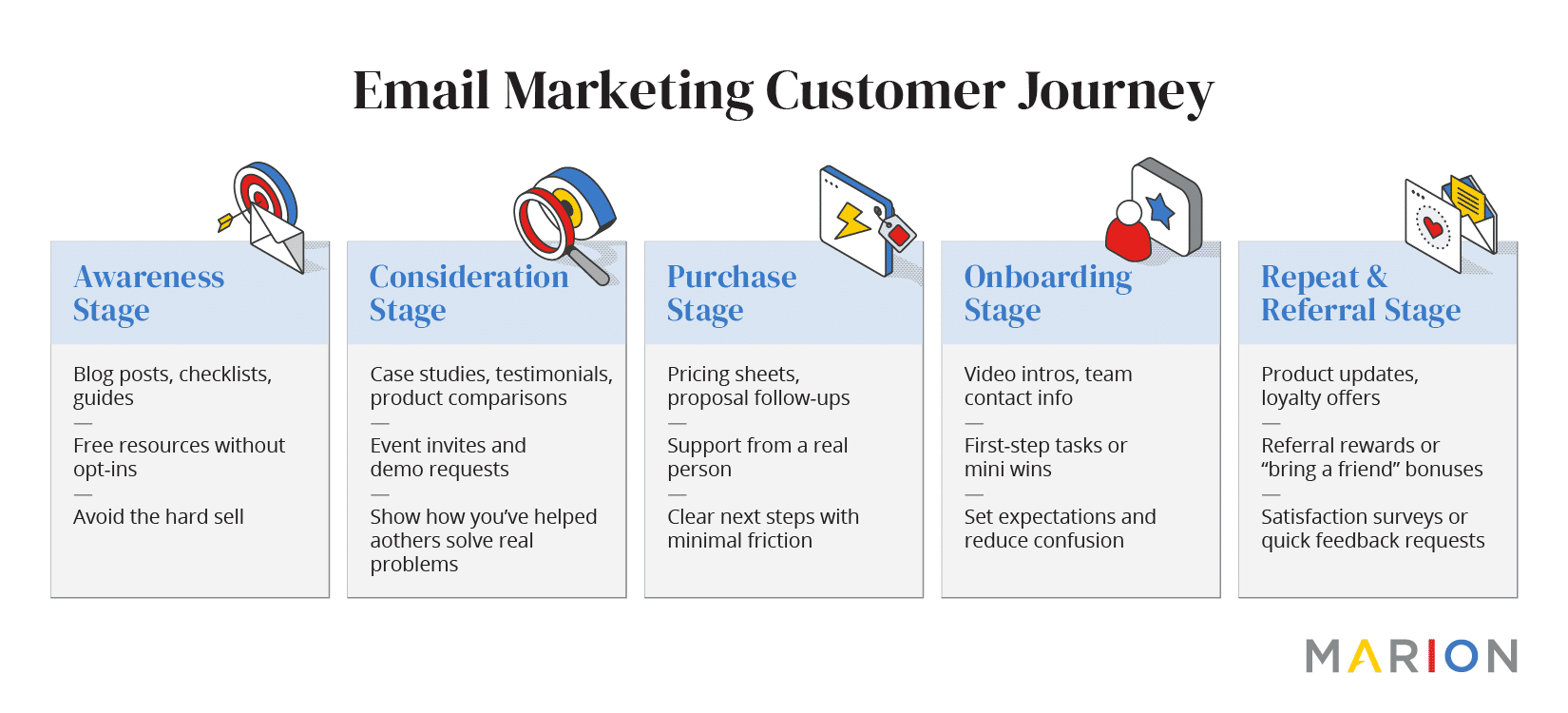
Email Marketing Customer Journey

Step 2: Match Your Content to the Stage

Each stage of the email marketing customer journey deserves its own message, tone, and content. A strong lead magnet (something like a checklist, industry guide, or free resource) can set the right tone from day one.

Here’s how to align what you send with what your audience actually wants to see:

Awareness Stage

  • Blog posts, checklists, guides
  • Free resources without opt-ins
  • Avoid the hard sell

Consideration Stage

  • Case studies, testimonials, product comparisons
  • Event invites and demo requests
  • Show how you’ve helped others solve real problems

Purchase Stage

  • Pricing sheets, proposal follow-ups
  • Support from a real person
  • Clear next steps with minimal friction

Onboarding Stage

  • Video intros, team contact info
  • First-step tasks or mini wins
  • Set expectations and reduce confusion

Repeat & Referral Stage

  • Product updates, loyalty offers
  • Referral rewards or “bring a friend” bonuses
  • Satisfaction surveys or quick feedback requests

Expert Tip: Don’t write for your product. Write for the questions people are asking in their head at that moment.

Need help creating lead magnets, ebooks, or case studies that attract qualified leads? MARION offers content marketing services tailored to each stage of your customer journey.

Step 3: Use Behavior to Trigger the Right Messages

Send emails based on what your audience is actually doing (not what you assume they’re ready for).

Set Triggers Like:

  • Signing up for a newsletter
  • Viewing a pricing page
  • Downloading a guide
  • Attending a webinar

For example, if someone clicks a link to view your pricing but doesn’t reach out, send a follow-up: “Still have questions about pricing? Here’s a breakdown + who to contact.”

Timing Matters

Send too many emails too fast and you’ll lose trust. Wait too long and the opportunity passes.

Space your messages based on behavior and urgency, not a pre-set calendar.

Pro Tip: Automate workflows but keep the tone personal. Use names, ask questions, and make replies feel welcome.

Step 4: Measure and Adjust Often

Track the usual metrics (opens, clicks, unsubscribes) but don’t stop there.

What Really Matters:

  • How many people reply
  • How many convert to calls, demos, or purchases
  • How many move from one stage to the next

Test subject lines. Watch where people drop off. Cut the dead weight and double down on what works.

Fun fact: Personalized email messages improve click-through rates by 14% and conversions by 10%.

Common Gaps (and How to Fix Them)

Most companies miss the mark in a few areas. Here’s where things fall apart (and how to fix them):

1. No Welcome Series

That first impression sets the tone. A welcome email should:

  • Confirm what they signed up for
  • Deliver immediate value
  • Introduce your brand tone and personality

2. No Follow-Up After Quotes or Proposals

If they asked for pricing and you don’t follow up, that’s a missed chance. Send a brief message that adds clarity, not pressure.

3. No Re-Engagement for Cold Leads

Someone goes quiet after a few emails? Send a soft check-in like:

  • “Still exploring options? Here’s something you might find helpful.”

4. No Post-Sale Touchpoints

The sale is only the middle. A simple follow-up to ask how things are going or to share what’s next can lead to longer relationships and referrals.

Fixing the above gaps often starts with better strategy. MARION provides email marketing audits and campaign planning for businesses ready to tighten up their follow-through.

Ready to Build a Smarter Email Marketing Customer Journey?

Most email marketing falls short because it’s out of sync with what people actually need. Timing, tone, and clarity matter more than volume.

At MARION, we help businesses plan and execute email strategies that do more than hit inboxes. We create email marketing customer journeys that match how your audience thinks and moves…from first contact to loyal customer. Our marketing agency team can work with you to map out the exact touchpoints your leads need, create content that feels personal, and set up the automation that keeps it all running without feeling robotic.

If it feels like a chore to write, it’s probably a chore to read…we help you avoid that.

Let’s talk about what your next step should look like!

Marketing emails you’ll actually want to read.

Get marketing tips and news sent to 
your inbox.

This field is for validation purposes and should be left unchanged.
Name(Required)

Beat the Heat: Creative Summer Marketing Ideas for Your Business

When the temperature rises, most people slow down…but your marketing doesn’t have to. Summer offers the chance to stand out while others are on autopilot. If your B2B business depends on staying visible and generating steady leads, this is the time to keep your audience engaged.

Here are 8 summer-friendly tactics to keep your brand active and top-of-mind.

1. Host a Summer Giveaway

It might sound obvious, but branded giveaways still work. Not the “stress ball in a dusty drawer” kind…give them something they’ll use when it’s 103 outside. Think insulated tumblers, cooling towels, portable fans. I once saw a contractor hand out branded can koozies at a local festival — simple, cheap, and everyone kept them. Genius.

Keep it simple: announce the giveaway, ask for an email or a follow, maybe a share to enter. Don’t overcomplicate it. People love low-effort wins, especially when it’s hot and their brain’s running on half speed.

One study even reported that 83% of consumers like receiving promotional products with an advertising message.

2. Create Content That Matches the Season (And the Mood)

Nobody’s in the mood to read a white paper right now. You know it. I know it. So don’t fight it. Instead, make your content quick, useful, and maybe even a little fun.

What are your customers dealing with during this stretch of the year?

Examples:

  • A construction company might publish a blog on “Keeping Cool on the Job: Essential Tips for Summer Construction Work.”
  • A tech company could create a video series on “Optimizing Your Home Office for Summer Productivity,” showcasing ways to stay comfortable and efficient while working from home during the heat.
  • A healthcare provider might share an infographic on “Hydration Hacks: Staying Healthy in the Summer Heat,” offering tips on staying hydrated and the benefits of their hydration products or services.

And don’t be afraid to share a little personality. You’re not writing a textbook here…you’re trying to connect. A little levity goes a long way this time of year.

Creative Summer Marketing tips

3. Summer-Themed Promotions

You don’t need a full-blown campaign to offer a good summer deal. Toss out something limited-time, give it a fun name like “Too Hot to Think Promo” or “Summer Slowdown Special,” and send it to your list with a quick note.

Something like: “We know things feel slow right now. Here’s something to make your life a little easier.”

It doesn’t need to be clever or complicated. In fact, the more human it sounds, the better it performs. Summer is all about energy conservation, for your customers too. Make sure to promote these deals through email and social media marketing.

4. Outdoor Events and Sponsorships

Summer is the season for outdoor events. Consider sponsoring local events like festivals, fairs, or sports games. Not only does this increase brand visibility, but it also shows your support for the local community. Set up a booth or tent with branded giveaways and information about your business.

As a matter of fact, 9 out of 10 marketers agree that experiential marketing boosts compelling engagement.

5. Share a Bit of the Human Side

People like doing business with companies that feel… well, like people. One of the easiest ways to make that happen? Show off your team’s summer vibe.

Post some behind-the-scenes shots. Team BBQs, vacation snapshots, bad sunburn stories (ok, maybe not the last one). Or have your employees share their favorite summer snack or weekend activity.

It takes 10 minutes, and suddenly your business feels less like a logo and more like a group of real folks your audience can relate to.

Examples:

  • Share a series of social media posts featuring your team’s vacation snapshots and stories. This humanizes your brand and gives your followers a glimpse into the lives of the people behind the business.
  • Encourage your customers to share their vacation photos with your products and feature these images in your email newsletters or on your website. Offer a small incentive, like a discount on their next purchase, for participating.
Summer Marketing

6. Ask Your Customers to Share

Here’s the thing: user-generated content performs better than most brand posts. And summer gives you the perfect excuse to ask for it.

Run a social media campaign and start a hashtag (keep it short). Ask customers to post pics using your product or service in their summer routine. Give them a reason to join in — small discount, feature on your feed, bragging rights.

Once you get a few entries, repost them. People love seeing their content shared, and it gives your feed more depth than stock images or “corporate updates.”

7. Give Your Emails a Seasonal Refresh

A quick update to your email visuals and subject lines can make a difference. Highlight limited-time offers, useful tips, or seasonal use cases. Add a fun summer recipe or quick poll for interaction.

Emails that feel timely are more likely to be opened and shared.

Examples:

  • An office supply company could do a newsletter featuring “Top 10 Office Gadgets to Keep You Cool This Summer.”
  • A software development company might create an email marketing campaign titled “Stay Productive in the Heat” with tips on using their tools to maintain efficiency during the summer months.
  • A commercial cleaning service could offer “Summer Cleaning Specials” through their email campaigns, emphasizing how a clean, cool workspace can enhance productivity.
  • A food supplier could send out a summer-themed recipe newsletter showcasing “Cool and Refreshing Office Snacks” that use their products.

8. Refresh Your Visuals

You don’t need a full redesign. Just update your homepage banners, rotate in some warm-weather photos, and change your social profile headers.

It shows people your business is active and paying attention. It’s a small detail, but it adds up — especially when everyone else looks frozen in time.

Even swapping in an image of someone holding a cold drink or working outdoors can make your brand feel more relevant. It’s an easy win.

Don’t Let the Texas Heat Slow Your Business Down

Everyone’s tired, inboxes are lighter, and meetings start getting pushed to “after Labor Day.” That’s your chance. When your competitors go quiet, your voice carries further.

If you’re short on time or ideas, our outsourced marketing agency has your back. At MARION, we work with businesses across Texas to keep their marketing active — even during the dog days of summer. Let us help you beat the heat with our digital marketing services in Austin and Houston, Texas.

Need help with your campaigns, content, or getting something out the door before the heat hits triple digits again? Let’s talk.

Marketing emails you’ll actually want to read.

Get marketing tips and news sent to 
your inbox.

This field is for validation purposes and should be left unchanged.
Name(Required)

HVAC Marketing Strategies That Actually Drive Leads (and Revenue)

Today’s HVAC market is packed with competition and rising customer expectations. The middle of summer or the dead of winter are peak seasons when potential customers are searching online for fast, reliable HVAC help. The challenge? Making sure your company is the one they call.

If your HVAC business relies on word of mouth alone, you’re leaving money on the table. It takes a modern, localized, and measurable strategy to bring in steady leads all year long.

The HVAC Buyer Has Changed

Homeowners and property managers no longer flip through the Yellow Pages when their HVAC systems break down – they head straight to Google. Search behavior has shifted dramatically, and with that comes a more informed, more impatient customer.

Today’s HVAC buyer:

  • Searches online during high-stress moments. If it’s 100 degrees and the AC goes out, they want fast help and immediate availability.
  • Relies heavily on reviews. A five-star rating and recent customer feedback often outweigh years of experience if your web presence is weak.
  • Is mobile-first. Most searches happen from phones. If your site isn’t responsive and your phone number isn’t clickable, you’re losing leads.
  • Trusts appearance. A professionally branded website with licensing information and technician photos makes a big difference in credibility.

To stay competitive, HVAC companies need to meet buyers where they are: on mobile search, with trustworthy information, and a reason to act now.

Digital Marketing Tactics That Deliver for HVAC Businesses

If your goal is to drive more high-quality leads and fill your calendar with booked jobs, these proven digital strategies should be at the core of your HVAC marketing plan.

1. Local SEO

In competitive metro areas like Dallas and Houston, showing up in the top 3 Google results can dramatically impact your call volume. We’ve helped HVAC businesses in big cities climb into the Map Pack by optimizing their local listings and encouraging consistent review generation.

Google’s “Map Pack” dominates local HVAC searches, and getting into that 3-pack can make or break your lead flow. To do that:

  • Optimize your Google Business Profile with accurate info, service categories, photos, and service descriptions.
  • Build local citations on directories like Yelp, Angi, and BBB with consistent NAP info.
  • Generate and respond to Google reviews to boost visibility and build trust at a glance.
  • Create location-based service pages that target searchers in each city or neighborhood you serve.

2. Paid Search (Google Ads)

Some HVAC services are too urgent to wait for SEO. Paid ads help you show up immediately for searches like “AC repair near me”, “Emergency furnace repair 24/7”, or “HVAC replacement financing Houston”.

With a well-built campaign, you can:

  • Control spend based on seasonality
  • Use call-only ads for faster conversions
  • Run retargeting ads to bring back visitors who didn’t convert the first time

3. Website Optimization

Across Texas – from San Antonio to Dallas – we see too many HVAC websites that look outdated or take too long to load on mobile. These missed opportunities can mean thousands in lost revenue during peak seasons. A fast, modern site builds instant trust and keeps customers from clicking over to your competitors.

Once people land on your site, every second counts. A clear and easy-to-navigate experience can be the difference between a booked job and a bounce. Think of your website as your 24/7 salesperson; it should answer key questions, build trust, and make it easy to take action! Once people click through, your website needs to close the deal.

  • Make sure it’s mobile-friendly and loads in under 3 seconds
  • Use CTAs like “Book Now” or “Call for a Free Estimate” in prominent positions
  • Display trust-building elements: reviews, guarantees, technician credentials, financing options
  • Add real photography to avoid the generic feel of stock images

4. Email & Text Automation

Stay connected with your customers and increase repeat business:

  • Automate thank-you emails with review links after completed jobs
  • Schedule annual maintenance reminders for AC tune-ups and furnace checks
  • Promote seasonal offers via SMS for timely promotions

Traditional Marketing Still Has a Role (If Done Right)

Digital-first doesn’t mean digital-only. A smart mix of offline marketing still works – especially for HVAC businesses that rely on neighborhood visibility.

  • Place yard signs after every successful install or repair job. Explore our signage design services here.
  • Use branded vehicle wraps with a bold phone number and service promise.
  • Distribute door hangers with limited-time discounts before peak seasons.
  • Sponsor local school events or sports teams to build goodwill and name recognition.

When paired with digital tracking (like using unique phone numbers), even traditional marketing can drive measurable ROI.

Tracking ROI in HVAC Marketing

You wouldn’t run an HVAC business without measuring system performance. Your digital marketing should follow the same standard.

Start by tracking:

  • Leads by source. Know which ones come from Google Ads, organic search, or door hangers.
  • Call tracking. Assign unique numbers to each marketing channel to tie phone calls to revenue.
  • Form submissions. Use a CRM to capture lead details and monitor close rates.
  • Cost per lead (CPL) and customer lifetime value (CLTV). These metrics show what’s working and where you can improve.

At MARION, we set up HVAC campaigns to be fully measurable from day one because the only marketing that matters is the kind that drives real, trackable revenue.

Get a Smarter HVAC Marketing Strategy with MARION

Consistent visibility, trust, and local lead generation are what drive growth in the HVAC space. You don’t need a bigger budget. You need a smarter strategy.

Our home services marketing agency helps HVAC companies grow through:

  • Local SEO and Google Business Profile optimization
  • Conversion-focused web design
  • ROI-driven Google Ads management
  • Review generation and reputation management
  • Email and automation campaigns that keep your brand top-of-mind

Let’s make this your busiest year yet.

Contact MARION today to schedule your free HVAC marketing consultation and start generating more calls, more estimates, and more booked jobs.

Marketing emails you’ll actually want to read.

Get marketing tips and news sent to 
your inbox.
This field is for validation purposes and should be left unchanged.
Name(Required)

When is the right time to hire a marketing agency?

When it comes to marketing partnerships, Timing is everything.

Knowing when to hire a marketing agency can be tricky. Outsourcing your marketing efforts could be a game changer, but it’s not always the right move at the right time. If you’re trying to grow, rebrand or take your company to the next level, partnering with the right agency can help you do so more effectively. But if your business is struggling in other areas or you’re facing an existential crisis, jumping into a marketing investment might not be the best course of action.

Let’s take a look at when you should (and shouldn’t) bring in a marketing agency.

When you shouldn’t hire a marketing agency.

1. Your business is struggling.

If your company is facing a crisis, such as serious financial or operational challenges, now is not the time to invest in a marketing agency. Marketing can’t save a business that’s already in survival mode. If your business is on the verge of closing its doors, it’s better to focus on fixing internal problems first, such as improving your product, cutting costs or streamlining operations. Marketing can be an important part of recovery — but only once the business has a solid foundation and a clear direction.

2. You’re not ready to commit to long-term initiatives.

Marketing isn’t a one-time fix. It’s a long-term effort that requires planning, testing and consistency over time. If you’re just looking for a quick boost in sales, a marketing agency might not be the right answer. Marketing agencies typically work with clients on ongoing initiatives that require time and attention. A quick-fix mentality often leads to disappointment and wasted resources.

3. You don’t have a defined company DNA or clear goals.

A marketing agency can help refine and promote your branding — but if your company’s identity isn’t fully developed, or if you don’t know what you stand for, it’s hard to expect an agency to work their magic. Before outsourcing, make sure you have a clearly defined DNA (or sense of company identity) and concrete goals in place. If you’re still figuring out who you are as a business, it may be worth taking the time to work on your identity before seeking professional help with branding.


When you should hire a marketing agency.

1. You’re ready to rebrand or relaunch.

Rebranding can be one of the most transformative and rewarding steps for a business, but it’s also a big job. If your company has changed — whether that’s through leadership, product offerings or a shift in market positioning — now might be the right time to consider working with an agency. A rebrand is the perfect opportunity to refine your messaging, update your branding and develop a fresh marketing approach that better aligns with your current business goals.

Hiring a marketing agency for this process ensures you have a team of experts guiding the transformation, providing everything from market research to brand design and execution. Plus, agencies can help ensure the rebrand resonates with your target audience.

2. You’ve hit a growth plateau.

If your company is stuck in a rut, hiring a marketing agency can give you the fresh perspective and strategic direction you need to supercharge growth. Agencies, like Design At Work, have experience working with businesses at various stages of growth, so they can help you pinpoint opportunities to strengthen existing relationships and reach new customers through various marketing and advertising channels. They can also help you evaluate the strength of your current messaging and visual branding, as it’s possible outdated materials may be hindering your company’s continued growth.

3. You need specialized expertise.

Marketing covers a lot of ground — everything from search engine optimization and content creation to paid ads, social media and email campaigns. If your team lacks expertise in any of these areas, it’s time to consider hiring an agency. Even if you have an in-house team, they may not have the bandwidth or specific skillset to take your marketing efforts to the next level.

Outsourcing some or all of these tasks gives you access to a whole team of specialized professionals who can handle the complexities of branding and marketing, allowing you to focus on other aspects of your business.

4. Your team is overwhelmed.

As a growing business, your internal marketing or sales team may not have the time or resources to keep up with everything on their plate. If your team is stretched thin — whether due to rapid expansion or just the daily grind of basic marketing efforts — hiring an agency can help lighten the load.

Agencies are great at providing support during high-demand periods, like big product launches or seasonal promotions. They can help manage your content calendar, design recurring content and ensure your marketing stays consistent, while your internal team focuses on other pieces of the marketing puzzle.

The decision to hire a marketing agency should come after careful consideration of your company’s needs and objectives. While marketing can certainly help fuel growth and brand recognition, it’s not a magic solution to internal problems or business struggles.

If you’re looking to enhance your brand, accelerate growth or leverage specialized expertise, working with a marketing agency can help you achieve your goals more effectively. But if your business is facing deeper challenges, it might be worth addressing those first before diving into a new partnership.

Need guidance on whether it’s time for your business to outsource some or all of its marketing? Contact us!