Category: Branding Design

Buc-ee’s Billboards & the Art of Roadside Marketing

In a world where ads change faster than you can say “billboard,” Buc-ee’s has it all figured out. They’ve made billboards not just a pit stop for information but a part of the adventure. And honestly, who wouldn’t want to pull over for a beaver promising the best restrooms and snacks in the Lone Star State? It’s a billboard game-changer, Texas-style.

Buc-ee’s Billboard Marketing Strategy

Buc-ee’s billboards are not just ads; they’re landmarks. Whether you’re cruising down the highway at 80 mph or stuck in traffic, you can’t help but notice the promise of clean restrooms and colossal snacks just a few exits away. And the beaver mascot? Iconic. Buc-ee is the road trip companion you never knew you needed!

Size Matters

You can’t miss them, and you definitely can’t forget them. What makes them effective? Well, first off, they’re massive. You know how they say everything’s bigger in Texas? Well, Buc-ee’s creative marketing team took that seriously, especially when it comes to billboards.

The billboards are often oversized, featuring Buc-ee himself – the beaver mascot – along with bold and playful messaging. These billboards serve as miniature invitations to experience the larger-than-life world of Buc-ee’s.

Fun Messaging

Buc-ee’s is known for its creative and attention-grabbing billboard marketing campaigns. Here are some examples that have garnered attention in the past:

  • YOU HAD ME AT HODWY
  • IT’S A TEXAS THANG
  • THE BEAVER MADE ME DO IT
  • IT’S ALL ABOUT THE BRISKET, BABY
  • RISK IT FOR THE BRISKET
  • RESTROOM HALL OF FAME

Strategic Placements

Strategically located along major highways and interstates, Buc-ee’s billboards capture the attention of road-trippers and commuters alike. The placement is not just about visibility. It’s about ensuring that potential customers are enticed at precisely the right moment – when they’re making decisions about where to stop for gas, snacks, and a break.

Consistent Branding

Buc-ee’s billboards aren’t just ads; they’re a continuation of the brand’s personality. But what’s fascinating is that they somehow manage to look the same year after year, and it works.

The beaver mascot is a constant presence, and the billboards echo the same friendly, humorous, and welcoming vibe that customers experience inside the stores. This consistency builds a strong corporate identity and creates a connection with the audience.

Urgency and Enticement

Buc-ee’s billboards often feature limited-time promotions and exclusive offerings. This creates a sense of urgency and entices passersby to make an impromptu stop at the nearest Buc-ee’s. Whether it’s a special deal on snacks or a reminder of the next clean restroom oasis, the billboards play on the immediate needs and desires of travelers.

Community Engagement

Some Buc-ee’s billboards go beyond advertising the store; they engage with the local community. Announcements of store openings, community events, or even playful messages related to local happenings contribute to Buc-ee’s image as a friendly neighbor, despite its massive size.


View this post on Instagram


A post shared by Buc-ee’s (@bucees)

What Can We Learn from Buc-ee’s Billboards?

As businesses explore ways to stand out, there’s much to glean from Buc-ee’s successful and playful approach to traditional marketing. By focusing on clean design, clever messaging, and strategic placements, the gas station has taught us that effective marketing is about making a lasting impression. Buc-ee’s turned the mundane billboard concept into a dynamic tool for engaging with their audience.

The strategic use of size, placement, branding, urgency, and community engagement has transformed these roadside advertisements into an integral part of the Buc-ee’s experience. As travelers hit the road, they can’t help but be drawn into the world of Buc-ee’s, one billboard at a time.

Stand Out with MARION Marketing Services in Texas

Ready to take your marketing to the next level? Look no further! MARION offers outsourced marketing services right here in Texas. Whether you’re aiming for viral billboards or want to elevate your overall brand presence, our team has the creativity and expertise to make it happen.

Contact us today to explore how MARION can transform your marketing game.

Marketing emails you’ll actually want to read.

Get marketing tips and news sent to 
your inbox.

This field is for validation purposes and should be left unchanged.
Name(Required)

Analyzing the Success Story of Taylor Swift’s Eras Tour Marketing

Taylor Swift, the queen of reinvention, has once again left the world in awe with her groundbreaking Eras Tour. As she gracefully transitions from one era to another, Swift’s ability to captivate audiences through her music and storytelling is undeniable.

However, behind this seamless transformation lies a team of marketers that has propelled her tour to unprecedented heights. In this blog, the experts at MARION take a closer look at the strategic marketing behind Taylor Swift’s Eras Tour, uncovering the secrets that have kept fans engaged and mesmerized throughout each chapter of her illustrious career.

Dissecting the Eras Tour

Taylor Swift’s Eras Tour is a revolutionary concert experience that showcases the artist’s artistic evolution and growth throughout her career. Unlike traditional tours, each segment of the tour represents a distinct era of her music, with unique themes, set designs, and visual elements to reflect the essence of that era.

The Eras Tour takes fans on a nostalgic journey through Taylor’s musical transformation — from her country roots to pop superstardom. It is not just a concert but an immersive experience that immerses the audience in the world of each era, connecting them emotionally to the songs and stories behind them. Swift’s Eras Tour has set a new standard for live performances, demonstrating her team’s marketing genius and ability to continuously captivate her loyal fan base.

Taylor Swift’s Genius Marketing Team

Taylor Swift’s Eras Tour has taken the music industry by storm, captivating fans and garnering immense success. The seamless integration of creative marketing strategies has played a pivotal role in its triumph. From innovative branding to interactive experiences, Swift’s team has elevated her tours to more than just concerts — but unforgettable cultural events.

1. Building Anticipation and Hype

Like the Barbie movie marketing, Taylor Swift’s team crafted a masterful pre-tour promotional campaign, generating excitement and anticipation among her loyal fan base. Through social media teases, cryptic clues, and interactive fan experiences, Swift created a sense of mystery and intrigue around her tour, setting the stage for an unforgettable experience.

2. Personalized Fan Engagement

One of the standout aspects of the Eras Tour marketing was Taylor Swift’s commitment to connecting with her fans on a personal level. She organized exclusive pre-show events and surprise meet-and-greets and hosted online contests, allowing fans to feel a sense of ownership and inclusion in the tour’s success. This personalized approach fostered a devoted community and generated unparalleled enthusiasm.

taylor swift fans eras tour

3. Captivating Visuals and Stage Production

Taylor Swift’s Eras Tour was a visual feast for the audience. From elaborate stage designs to stunning visual effects, every aspect was meticulously curated to create an immersive experience. The marketing efforts focused on highlighting these visual elements through behind-the-scenes content, live performance snippets, and professional photography, attracting both longtime fans and curious newcomers.

4. Leveraging Social Media and Digital Platforms

Swift’s team understood the power of social media and the importance of a strong online presence. By leveraging platforms like Instagram, TikTok, Twitter, and YouTube, she engaged with fans directly, shared exclusive content, and provided regular updates about the tour. This not only fueled the excitement but also enabled fans to become enthusiastic brand ambassadors, spreading the word across their networks.

5. Data-Driven Decision Making

Behind the scenes, Taylor Swift’s team undoubtedly leveraged data analytics to drive their marketing decisions. By understanding fan demographics, preferences, and market trends, they were able to tailor their strategies to specific target audiences. This data-driven approach ensured that resources were allocated effectively, maximizing the impact of the marketing efforts.

Taylor’s Eras of Strategic Marketing Campaigns

To expand her reach and tap into new markets, Taylor Swift embarked on strategic partnerships and collaborations throughout her career. She garnered additional marketing support and cross-promotion opportunities by teaming up with brands.

By aligning her image with the right partners, Swift reached new audiences and further solidified her standing as a global star!

What Can Brands Learn from Taylor Swift’s Marketing Success?

In conclusion, the marketing success of Taylor Swift’s Eras Tour can be attributed to a combination of factors. Building anticipation, personalized fan engagement, captivating visuals, strategic partnerships, leveraging digital platforms, and informed decision-making have all played a crucial role.

By analyzing and dissecting these strategies, marketers can gain valuable insights to apply to their own campaigns, and fans can gain a deeper appreciation for the incredible marketing journey that contributed to the unforgettable Eras Tour.

Dive Deeper into The World of Marketing with MARION

From digital marketing to branding, content creation, and beyond, our seasoned team of professionals is here to guide you through the ever-changing landscape of modern marketing. Let MARION be your trusted partner in navigating the intricacies of marketing, unlocking endless possibilities for your brand’s growth and success.

Contact our team today and visit our blog to discover innovative techniques, actionable insights, and success stories that have propelled businesses to new heights!

Marketing emails you’ll actually want to read.

Get marketing tips and news sent to 
your inbox.

This field is for validation purposes and should be left unchanged.
Name(Required)

How to Design a Winning Trade Show Booth

Follow These Tips to Wow Prospective Customers at Your Next Trade Show.

Picture this: You’re standing in the middle of a crowded trade show booth. Your signage and lighting positively sparkle as prospective customers eagerly engage with your interactive product displays. You’re fielding questions left and right, seamlessly gathering attendee data and swapping business cards like a networking ninja.

Sounds great, right? With clear objectives, thoughtful planning and savvy design, you can make this dream a reality. Here we’ll outline the fundamentals of effective trade show booth design, from setting achievable goals to crafting a compelling message for your target audience.

How to Plan Your Trade Show Booth.

Before you decide the “how” of your booth, it’s important to understand the “why.” Are you looking to generate leads among a well-known target audience? Or are you seeking to build brand awareness within a new market vertical? The following questions can help you determine your goals for the event.


Trade Show Attendee Statistics
These statistics about attendees suggest the impact a strong trade show presence can have.

Who is your target audience?

As with any marketing initiative, it’s important to define your audience. Will you be targeting prospective customers, industry peers or potential investors? Understanding your audience will help you refine your messaging and visual approach.

Who is your competition?

Information about your competitors’ previous approaches to trade shows can help you differentiate your booth and set achievable goals. What were their goals and objectives? What kind of messaging and visuals did they use? What do you like about their approach and, more importantly, how can you differentiate your own booth to ensure it stands out?

How will your booth align with your overall marketing strategy?

It’s important to set goals that support your business’ overall marketing strategy. Is your company focused on boosting awareness, generating leads or promoting a new product or service? Considering how the trade show fits into your overall marketing strategy can help you refine your objectives for the event.

What are your goals for the trade show?

Once you’ve identified your target audience, studied the competition and reviewed your company’s overall marketing strategy, it’s time to determine specific, measurable goals for your trade show booth. For example, you might want to gather contact information for a certain number of quality leads, or close a certain number of sales. However you define success, make sure your objectives are SMART: specific, measurable, achievable, relevant and time-bound.

How to Design a Trade Show Booth That Stands Out.

Once you’ve defined your goals, you’re ready to make decisions about the look, feel and functionality of your booth. The following best practices will help you to create an on-brand experience that attracts your target audience and keeps them engaged.


Trade Show Booth Mockup
This mockup of a trade show booth demonstrates the importance of on-brand design elements that encourage interaction.

Stay True to Your Brand.

While your objectives may be unique to the trade show in question, your messaging and visuals should align with your branding guidelines. Make sure every aspect of the experience, from physical signage to virtual data-gathering interfaces, reinforces your brand identity while delivering a message that feels specific and relevant to the event at hand.

Keep the content simple.

A tradeshow booth is more often than not meant to be a backdrop for what’s happening inside your booth. With this in mind, it’s important to keep content minimal, embracing large catchy headlines and keeping your company’s logo is front and center. Highlighting a few key points or differentiators is also good if you want to give booth visitors a quick snapshot of what you offer. More than likely, chairs, tables and people will be standing in front of your booth graphics, so small wording or small details will get lost or not seen.

Highlight Key Visual Elements.

As with content, you’ll want to select images carefully and use them smartly. Make sure you’re drawing attention to the specific products and services that reiterate what your company offers. Strategically placed lighting or illumination can further help to guide visitors’ eyes, while also adding to the “vibe” of your booth. When selecting lighting, consider how you want guests to feel – relaxed, energized, solemn, powerful? Once you know how you want booth visitors to feel, you can select visuals and design a lighting scheme that achieves the effect.

Embrace the Power of Play.

It’s not enough to drive traffic to your booth. To achieve measurable results, you have to delight, engage and inspire attendees to take action, whether that means providing their email addresses or making a purchase. Interactive activities, such as live product demonstrations, touch screen displays, games and trivia, photo booths and even virtual reality simulators encourage guests to linger and explore — giving you the opportunity to make one-on-one connections.

Don’t Sleep on the Swag.

Who doesn’t love a free tote bag, t-shirt or travel mug? Treating your attendees to useful, high-quality branded items is well worth the investment. They not only drive traffic to your booth, but also increase the likelihood that visitors will remember your company fondly. Whatever you choose, make sure the items clearly reflect your brand and connect to your product or service. If you’re a fuel carrier with a fleet of delivery trucks, for example, you might offer branded keychains that remind prospects of your professional team of truck drivers.


Designing a trade show booth can be overwhelming, but by keeping these best practices in mind, you’ll be well on your way to a successful event. Better yet — let Design At Work do the heavy lifting! We can help you plan, design and execute a booth that attracts visitors and generates leads. Let’s talk about your next trade show.


Sources:

  1. 150+ Trade Show Stats That Reveal All, Trade Show Labs

Brand Positioning 101: How to Create an Effective Positioning Strategy

The most successful brands are, above all else, known for something. They have a unique value proposition that customers easily understand, thus differentiating them from their competitors. Identifying what makes your company’s products or services one-of-a-kind can go a long way to developing a solid following. Known as brand positioning, that sort of identification plays a critical role in any viable marketing strategy.

What Is Brand Positioning in Marketing?

Before discussing how to develop a proper brand positioning strategy, the base-level question — What is positioning in marketing? — must be answered.

At its core, brand positioning identifies the traits that a company’s products or services unique within its particular market sector. It can also refer to specific qualities that a single company possesses: Walmart, for instance, is known for being an inexpensive retailer that attracts cost-conscious consumers looking for affordable groceries, clothing, and home goods, whereas Apple is known for producing high-value electronics with clean and sleek designs.

Types of Positioning Strategies

Multiple types of positioning strategies may suit your business, though a few of the most common include customer service, convenience, price, quality, and differentiation. You’ll want to carefully examine your company and what it has to offer to determine the positioning strategy that best suits your organization.

Developing a Successful Positioning Strategy

Determining and forming a suitable market positioning strategy for your organization is a relatively easy process, so long as you follow the series of steps below:

Step 1: Conducting Market Research to Identify Target Audience and Competitors

You’ll want to start the process by thoroughly evaluating all aspects of your target audience, including their demographics, buying behaviors, geography, and income. Knowing your buyers can help you better understand their needs and why they continue to choose your company.

Your buyer analysis should unveil some characteristics that will make it easier to determine what your brand positioning strategy should be. For instance, if you’re targeting wealthier individuals in their 40s, you might position your products as high-quality and equally classy.

You’ll also want to examine your competitor’s positioning. Check out their website and social media accounts to understand the strategies they’re using and how you might be able to improve upon them.

Brand Positioning target audience

Step 2: Defining Your Unique Selling Proposition and Value Proposition

Once you specify your brand positioning, you can develop its unique selling proposition (USP) and value proposition. You’ll want to communicate these two throughout all of your external messaging to ensure that potential buyers clearly understand what you have to offer.

Competitor analysis can also help you define your USP. Through your evaluation, you should pick up on certain trends. For instance, you might see that your competitors don’t offer free trials for their services or that their pricing is much more expensive than yours. Ensure you communicate the strengths you provide over your competitors in your value proposition.

Step 3: Crafting Your Brand Story and Messaging to Connect with Your Target Audience

Your next step is to develop your brand’s story and messaging. Your brand’s story will clearly explain what you have to offer to your buyers and why your company is the right choice for them. You can showcase your story through text, but a simple video that’s visible on your website alongside pages that fully describe your company can help fully convey your message.

Once you decide on your approach to messaging, it is critical to maintain it whenever you communicate with your customers.

Step 4: Choosing the Right Communication Channels to Reach Your Target Audience

You can use multiple communication channels to connect with your audience, but you don’t need to be everywhere at once. Instead, concentrate on where your buyers are most likely to congregate.

For a B2B organization, for example, developing a social media presence on LinkedIn and through industry conferences can help you reach your target audience. Meanwhile, an e-commerce company seeking to attract younger buyers might find TikTok and Instagram better alternatives.

Step 5: Creating Consistency Across All Touchpoints to Build a Strong Brand Image

Once you establish your messaging and positioning, you’ll need to maintain consistency to strengthen your brand image, or else your buyers will lose sight of your value proposition.

As such, if you position your brand as high-quality, you must stick with that positioning throughout all your communications and advertising. If you suddenly decide to change your positioning and focus on a low price point, it could damage your company’s reputation and ultimately confuse your buyers.

Stand Out in a Competitive Business Landscape with MARION Marketing Services

In the early days of your business, figuring out the correct positioning for your company’s products and services can be challenging. You’re new to the market and want to grow your revenue fast, so you might ignore brand positioning in favor of generating quick sales, but that’s a mistake, to put it bluntly.

You’ll want to establish a USP and value proposition early on to guarantee you can create consistent messaging that resonates with your target buyers and grows your company’s following.

MARION can help you build the right market positioning strategy for your organization — reach out to us today to get started!

Marketing emails you’ll actually want to read.

Get marketing tips and news sent to 
your inbox.

This field is for validation purposes and should be left unchanged.
Name(Required)

We’re All Living in Barbie’s World (of Marketing Genius)

The new Barbie movie marketing has dazzled both young hearts and nostalgic souls, proving that online success can be as magical as the world of Barbie herself. Join us as we unpack the creative marketing strategies that captured the attention of millions worldwide.

Deconstructing the Barbie Movie’s Marketing Success

Lights, camera, marketing! With a projected $115+ million box office opening, the new Barbie movie serves as a testament to the power of effective marketing strategies in driving the success of a brand — but how did they do it?

NYX x Barbie

Building on Brand Legacy

For decades, the Barbie brand has been an iconic symbol of fashion and imagination. Leveraging this strong brand legacy, the Barbie movie has successfully capitalized on people’s emotional connection with the brand. By bringing the beloved doll to life on the big screen, the film has managed to tap into the nostalgia and affinity that consumers have for Barbie, thereby creating a strong foundation for their marketing success.

OPI x Barbie

OPI x Barbie

Targeted Marketing Campaigns

Understanding their target audience has been crucial to the Barbie movie’s marketing success. In the past, the franchise consistently tailored its marketing campaigns to resonate with young girls and their parents. But now, through a mix of digital and traditional marketing channels, paid ads, social media campaigns, and influencer partnerships, the movie has effectively rebranded and expanded its audience.

Tapping into Nostalgia

Marketers took a delightful trip down memory lane by collaborating with brands that resonated with the Barbie-loving generation of the past. Limited-edition merchandise, Barbie-themed cafes, and throwback-inspired events created a nostalgic buzz that warmed the hearts of those who grew up with this timeless doll.

Swoon x Barbie

Swoon x Barbie

Social Media Takeover

Barbie took the internet by storm, with her own social media accounts buzzing with exciting updates, behind-the-scenes peeks, and heartwarming messages of empowerment. The social media takeover was a whirlwind of inspiration and joy!

  • Teasers: From the very beginning, marketers knew that tapping into Barbie’s iconic fashion prowess was a must. Teasers featuring stunning outfits and jaw-dropping accessories started popping up on social media, leaving fans eagerly awaiting the movie’s release. Talk about a successful word-of-mouth marketing strategy!
  • AR Filters: Who wouldn’t want to try on Barbie’s fabulous wardrobe? Snapchat and Instagram Augmented Reality (AR) filters made this possible, allowing fans to virtually try on Barbie’s iconic outfits and accessories right from their phones. Barbie magic — now accessible at your fingertips!
  • Viral Challenges: What better way to engage audiences than with fun and creative viral challenges? For example, #BarbieNails and #Barbiecore are gaining traction on social media, inviting fans to share their Barbie-inspired content.
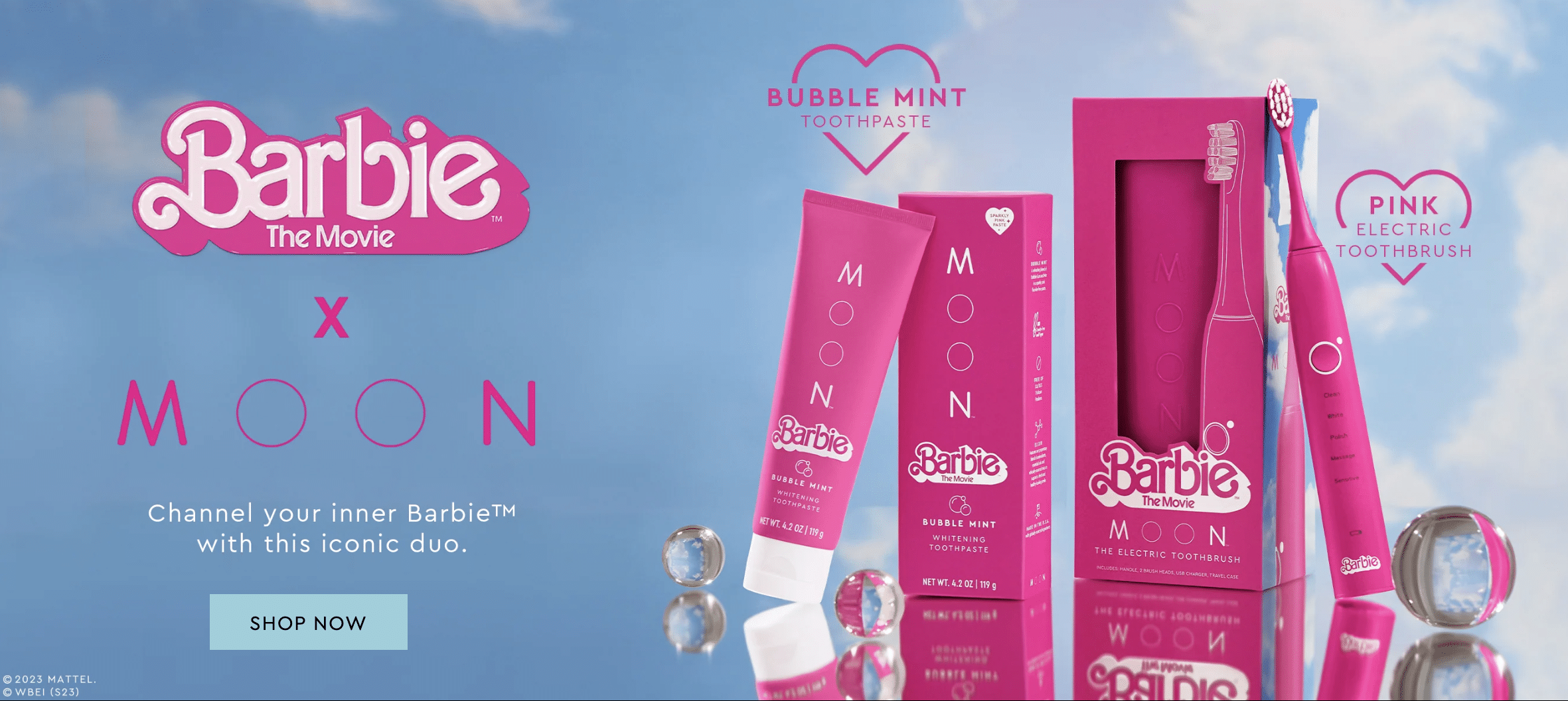
barbie x moon

Moon Oral Beaty x Barbie

Strategic Partnerships

One of the key elements behind the Barbie movie marketing is the strategic partnerships they have formed. Collaborating with renowned production studios, such as Mattel Creations and Universal Pictures, has not only helped ensure high-quality production but also provided access to wider distribution networks. Additionally, partnering with influential celebrities and artists for appearances and soundtracks has further enhanced the movie’s appeal and reach.

pinkberry barbie

Pinkberry x Barbie

A Star-Studded Premiere

Marketers pulled out all the stops for the Barbie movie premiere in Los Angeles, turning it into a star-studded extravaganza. Celebrities, fashion influencers, and even a surprise Barbie runway show took center stage, ensuring that this movie’s launch was as glamorous as the doll herself.

The Barbie marketing magic didn’t stop at the premiere. Themed events sprouted up worldwide, from Barbie fashion shows to Barbie-inspired art installations, celebrating the iconic doll (and helping marketing efforts).

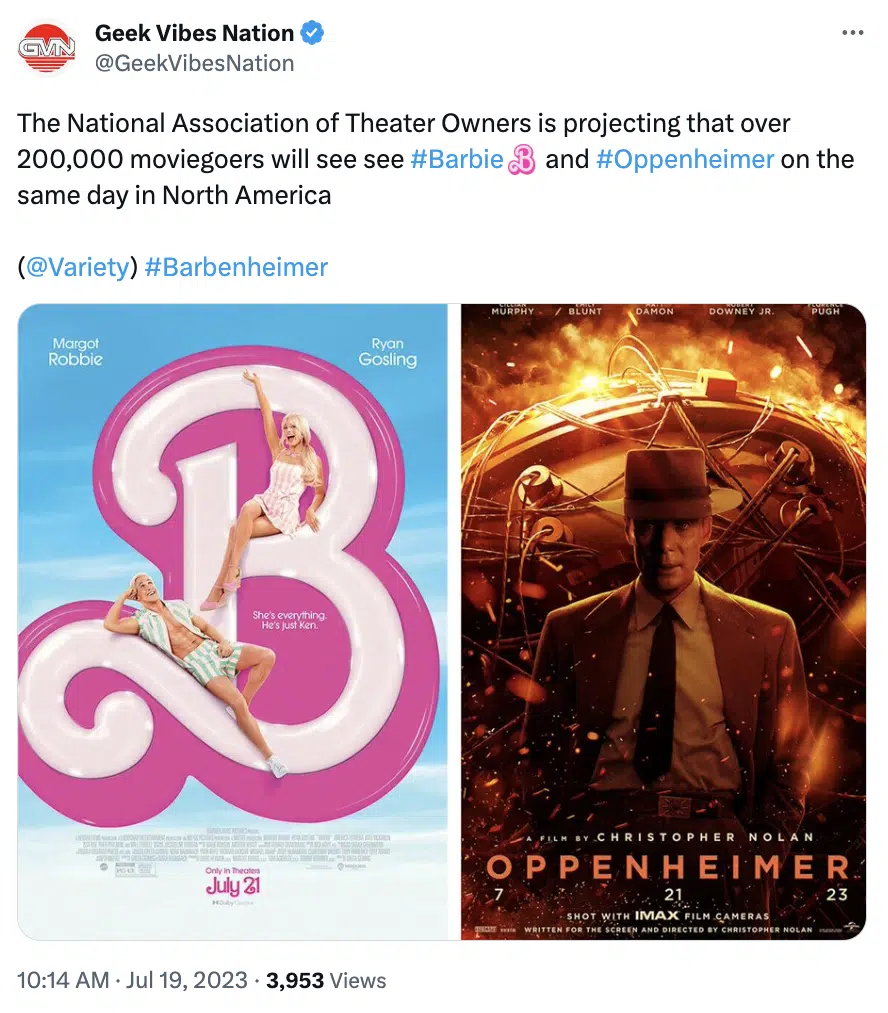
Barbenheimer Marketing: Barbie vs. Oppenheimer Approaches

In contrast to Barbie’s maximalist approach to marketing, Oppenheimer’s marketing strategy was far more low-key. Oppenheimer first sparked interest online with a live countdown announcement launching the official trailer. Longer trailers eventually followed, in addition to social media interactions by the film’s cast members.

barbenheimer tweet

Twitter

In the realm of marketing, the Barbie movie is proving to be more than just a blockbuster film — it’s a celebration of dreams, fashion, and nostalgia. Through clever strategies that embraced social media challenges, brand partnerships, and creative teasers, marketers breathed life into the timeless doll and showcased her inspirational journey on the big screen. Here’s to the enduring magic of Barbie and the marketers who made this enchanting movie a marketing sensation!

Create A Campaign Worth Talking About with MARION

In the quest for extraordinary marketing campaigns that leave a lasting impact, look no further than MARION. Our team of creative masterminds is dedicated to helping you create a campaign worth talking about. From concept to execution, we combine innovative strategies, captivating visuals, and compelling storytelling to ensure your brand’s message resonates with your target audience. Let’s create a marketing campaign that sets the world abuzz!

Contact MARION today for a free marketing consultation.

Marketing emails you’ll actually want to read.

Get marketing tips and news sent to 
your inbox.

This field is for validation purposes and should be left unchanged.
Name(Required)

How to Expand Brand Awareness with LinkedIn Networking

Founded in 2002, LinkedIn stands as one of the world’s most-preferred social networks for many years, but even with a current user base of over 900 million, there exists a vast difference between the platform and others, such as Instagram and TikTok.

Most of its users are professionals looking to network with others, which makes LinkedIn a game-changer for those working to build a brand. Statistically speaking, over 90 percent of B2B marketers use LinkedIn to market their content, and nearly the same amount of people use it to generate quality leads for their business.

Read on to learn how to grow your network on LinkedIn and leverage the platform to engage with your audience and increase brand awareness.

What Is LinkedIn Networking and How Can It Help Your Brand?

LinkedIn is unlike any other social media network in that it is geared toward professionals. The platform’s stated mission is to connect said individuals on a global scale to effectively increase productivity and success.

With that mission in mind, LinkedIn networking is what it sounds like — that is, using the platform to gain professional connections in your niche or industry. Like offline networking, you will usually connect with people on LinkedIn over mutual interests and by sharing knowledge and ideas with those who might benefit.

Networking on LinkedIn can help your brand in the following ways:

  • Casting brands in a professional light, thus further legitimizing your business
  • Enabling connections with qualified leads with interest in your niche
  • Increasing your reach by exposing your brand to millions of potential clients
  • Allowing you to position yourself as an expert in your sector

LinkedIn is a land of opportunity, so brands and creative marketing teams must leverage it well.

How to Use LinkedIn to Make Professional Connections and Grow Your Network

Making connections on LinkedIn is all about learning how to engage with other professionals. If you want to grow your network, the following section will show you how to create a viable strategy beyond simply completing your profile.

social media monitoring guide

7 LinkedIn Networking Strategies for Building Your Brand

Learning how to network on LinkedIn doesn’t have to be complex or daunting. Here are just a few of the most common ways that your brand can make its presence known on the site:

1. Give Your Audience Valuable Content

Quality content allows you to appeal to potential customers by letting them identify you as the go-to expert in your niche. You’ll draw them in by consistently meeting their needs and motivating them to seek additional content.

2. Boost Employee Engagement

Your employees are already invested in the success of your business, so supplying greater visibility to posts by having your employees share them simultaneously will help alert common networks about trending topics and bring more attention to your corporate identity.

3. Use LinkedIn Groups to Build Relationships

Professional networking is all about creating mutually beneficial relationships, so when you join groups, you must do more than just read others’ posts. Ensure you comment and contribute to the discussion at hand, as helping others helps you gain more exposure.

4. Keep Up with Latest Industry News

Understanding what’s going on in your industry is critical. Not only will you be able to leverage new trends as they emerge, but you’ll have tons of ideas and helpful content to share with others.

5. Expand Your Professional Contacts

LinkedIn works best when you are constantly making connections. Since your posts are never distributed to 100 percent of your network, you need at least 1,000 connections to truly raise your brand awareness.

6. Run LinkedIn Ad Campaigns

Paid advertising is only as limited as your budget, and LinkedIn ad campaigns allow you to target a specific demographic and have tighter control of your brand’s narrative.

7. Publish a LinkedIn Article

Publishing LinkedIn articles gives you a chance to showcase your expertise and value to potential clients, who, in turn, will see your business as the go-to brand in your niche.

linkedin networking on phone

Networking Tips and Best Practices for LinkedIn Professionals

Some important LinkedIn networking tips and best practices to follow are as follows:

  • Optimize your profile to better showcase your brand and offers so people can see the benefit of connecting with you
  • Engage with people who comment on your posts or articles
  • Capture attention with rich, media-driven video posts
  • Emphasize quality over quantity by personalizing each connection
  • Continue to engage with contacts after the initial contact
  • Share other people’s posts and content to get noticed and build connections
  • Inject a bit of your personality into every post or connection

If you follow these tips and maintain a professional tone, LinkedIn users will likely enjoy engaging with you and want to learn about your brand. Check out our social media management guide for more helpful tips.

Develop Your Social Media Marketing Strategy with MARION

LinkedIn marketing can be a tricky process because it walks a fine line between the personal and professional realms, but given that many of your prospects are on social media, you need to be there too, ready to capture their attention with effective business tactics.

With MARION’s social media marketing services, you can leverage performance-driven marketing strategies to increase brand awareness and achieve your business goals.

Contact MARION to get started today.

Marketing emails you’ll actually want to read.

Get marketing tips and news sent to 
your inbox.

This field is for validation purposes and should be left unchanged.
Name(Required)

How to Create a Content Calendar + Free Template for Blogs & Social Media

In the words of billionaire tech mogul Bill Gates, “Content is king.” On the internet, knowing you need to produce content to build your brand is one thing, but finding and implementing a successful content strategy takes deliberate effort. A content planning calendar (also known as an editorial calendar) will streamline your marketing and allow you to think strategically about your goals.

What is a Content Calendar?

At its core, a content calendar is a schedule that details what, where, and when you plan to create and post your online content. While you may have a specific branding or revenue goal, your content calendar provides a detailed roadmap for moving from intention to action and achieving your objective.

Types of Content Calendars

An editorial calendar includes three pieces of information: the content you will publish, where you will publish it, and how you will promote it. To that end, there are three types of tools commonly used to create a content calendar:

  • Spreadsheets: Applications like Google Sheets and Excel make it easy to customize templates with your own categories.
  • Project-Management Tools: These allow your team to collaborate and keep track of assignments and deadlines.
  • Calendar Apps: Provide a simple way to schedule content creation and marketing.

No matter the type of calendar you choose, you must ensure that it’s easy to use and interpret for you and your team.

Blog Content Calendar Example

A blog content calendar helps to plan and track the publishing of articles, press releases, and blog posts. A calendar helps ensure all posts are published on time, with relevant topics that will engage readers. Below is an example of a blog post content calendar layout.

blog content calendar example

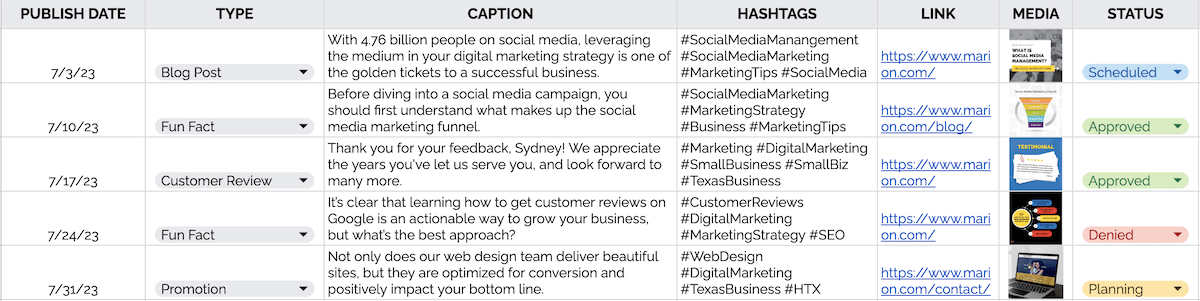
Social Media Content Calendar Example

A content calendar is an important tool for developing successful social media campaigns. It helps to organize and plan content on various social media platforms, ensuring that your posts are seen by the right people at the right time. Below is an example of a social media content calendar layout.

social media content calendar example

MARION is a full-service marketing agency that offers content marketing in Houston and Austin, Texas. Reach out now to get started!

Who Uses Content Calendars?

Some of the largest journalistic empires in the world make use of editorial calendars to schedule their content creation. However, a content calendar isn’t just for large news corporations. Everyday bloggers, podcasters, YouTubers, and social media managers use them too. In fact, anyone who publishes content regularly can (and should) use a content calendar.

How to Create a Content Calendar

Creating a blog or social media content calendar doesn’t have to be difficult, but you must do some strategic thinking beforehand to develop a solution that works well for you and your team and helps you achieve your ultimate goal.

Establish Your Content Marketing Goals

Before creating a content calendar, you need to understand why you’re creating content in the first place. Determining whether you want to get more traffic, raise your conversion rates, or establish yourself as an authority in your field will give you insight into the type of content you should create and where and how often you should publish.

Build Your Template

A practical editorial schedule starts with a content marketing calendar template that mirrors your team’s content creation workflow. Get started with these four basic steps:

Create a Timeline

Each piece of content should have a set deadline for its publication. How long each content creation step takes will be based entirely on that deadline.

Publishing Frequency

Nail down just how often you will publish your content. Your team should be clear on your content production frequency goals to stay on top of their responsibilities.

Determine Content Types

Your content creation strategy should align with your marketing goals and objectives. For example, you won’t create weekly blog posts if you’re working on building a social media presence. Ensure your editorial calendar includes the content types you want to publish.

Assign Owners

Make sure your team knows who does what. Retaining that knowledge will help streamline your workflow and avoid wasted time and effort due to redundancies.

Tips for Creating Your First Content Calendar

creating content calendar

Creating your first blog content calendar is a daunting task, but there are a few actionable steps you can take to simplify the process for yourself and your team:

  • Ask Questions: Knowing the type of content you create, how often you publish it, and how many people will use your calendar will help you choose the right tool
  • Make it Fit: Create a useful content calendar by listing the steps in your workflow and building them into your spreadsheet or project management application
  • Just Get Started: Start by using a simple content calendar template and refine your process as you go along

Whether you use a simple spreadsheet or a more robust project management application, use what you have and what you’ve learned so far to begin your journey toward more strategic marketing.

Download Your Free Content Calendar Template

If you’re new to creating content calendars, you may be overwhelmed with information and left wondering where to start. Fortunately, our free content calendar template makes getting and staying on track with your content goals easy. Download your Google Docs template today to start building and executing your marketing strategy on your own or with your team.

Download Your Content Calendar Template Here >

Get More Help from the Content Marketing Specialists at MARION

Creating a blog post content calendar is a great place to start working toward expanding your reach, but your marketing efforts shouldn’t end there. Solidifying your brand with a well-designed logo and website and marketing your offers through search engine optimization, paid ads, and a social media presence are all vital pieces of the content marketing puzzle.

Fortunately, our digital marketing experts at MARION have extensive experience providing client-focused integrated marketing services to businesses of all types.

Contact our team today to learn how we can help you build and grow a lasting brand.

Marketing emails you’ll actually want to read.

Get marketing tips and news sent to 
your inbox.

This field is for validation purposes and should be left unchanged.
Name(Required)

The Great Debate: In-House vs. Outsourced Marketing

How to Decide Between In-House Marketing, an Agency or a Combination of Both.

When deciding how best to select and organize your marketing team, one consideration tends to trump all: budget. It’s true that the decision to outsource or maintain an internal team can have a huge impact on your overall spend, but there are also other factors to keep in mind when making this important call. Staffing, quality and return on investment (ROI) can all be affected by your decision.

In this article, we’ll look at the pros and cons associated with in-house and outsourced marketing.

What Is Outsourced Marketing?

The term “outsourcing” has become a bit of a boogeyman, conjuring up images of disinterested workers in far-off places. In this case, outsourced marketing refers to the practice of hiring an external agency to plan, execute and manage your marketing and advertising processes. The best agencies learn everything there is to know about your business — including your history, differentiators, customers and goals — then execute campaigns that directly impact your bottom line.

Let’s take a closer look at the pros and cons of outsourced marketing.


The benefits and drawbacks of working with a marketing agency.
When deciding if a marketing agency is the best option for your business, it’s helpful to consider the pros and cons.

The Pros of Outsourced Marketing.

Specialized Expertise.

Marketing agencies offer the benefit of wide-ranging expertise in a range of disciplines — all for a flat project fee or monthly retainer. So rather than hiring individual specialists in content marketing, search engine optimization (SEO), graphic design or web development, for example, your company can benefit from the combined knowledge and creativity of a seasoned team with all the skills you need (and even some you don’t know you need just yet).  

Fresh Perspective.

In addition to diverse talent and technical knowledge, agencies have broad, cross-industry awareness of the ways in which various marketing tactics can be deployed. As such, they can offer an unbiased, fresh perspective on your messaging, market opportunities and goals, helping you to identify innovative strategies an in-house team may not have considered.

Scalability and Flexibility.

With an outsourced team, you can scale your marketing efforts quickly and efficiently. As your business grows or marketing needs change, you can easily adjust the scope of your engagement with the agency by adding or removing services as needed. If, for example, you want to experiment with digital advertising, but don’t have the resources to do so, you can simply enlist the help of your agency. Such flexibility allows you to stay agile and creative for a relatively minimal cost.

The Cons of Outsourced Marketing.

Limited Control.

When partnering with an agency, you run the risk of losing control over creative direction, messaging and strategic decision-making. To prevent this, it’s important to vet an agency before committing to the relationship. You’re looking for a partner who communicates clearly, listens well and genuinely cares about the success of your business. When you trust your agency to prioritize your preferences and goals, you don’t have to worry about losing control.

Potential for Miscommunication.

Since many agencies charge an hourly fee, transparency and effective communication are essential. If an agency misunderstands your priorities, for example, they might devote too many hours to a project of lesser importance, forcing you to choose between postponing the development of something critical or increasing your budget for that month. Again, when you find an agency that listens well, communicates candidly and “gets” you, you can avoid these pitfalls.

What Is In-House Marketing?

Simply put, keeping your marketing in-house means you hire an internal team to handle everything from digital ads to PR. As with outsourced marketing, there are advantages and challenges associated with this approach.


The pros and cons of hiring an in-house marketing team.
Thinking of hiring an in-house marketing team? This list of pros and cons will help you decide if it’s the right option for you.

The Pros of In-House Marketing.

Control and Flexibility.

An internal team gives you complete control over your processes and tactics. This means you can determine your own creative direction, messaging, strategy and internal workflows. Moreover, with an in-house team, it can be easier to quickly pivot when necessary and interact with customers in real-time.

Deep Brand Understanding.

Depending on the team, an internal marketing department may possess a deep and thorough understanding of your company’s brand, enabling them to create campaigns that align with your mission and values. This can result in effective messaging that consistently reinforces your brand identity.

The Cons of In-House Marketing.

Limited Expertise.

While in-house marketing teams may be familiar with the company’s brand, they often lack the expertise and experience necessary to execute complex marketing strategies. This can result in disappointing ROIs and campaigns that fail to reach the intended audience.

High Cost.

The cost of staffing your own team includes more than base pay. It also involves recruitment costs, onboarding and training time, benefits, expensive technology and software subscriptions. Moreover, when employees leave, your investment in their development leaves with them.

Lack of Objectivity.

Sometimes, being “too close” to the company’s culture and goals can backfire, resulting in campaigns that are too inwardly focused, don’t meet the needs of the target audience or don’t effectively differentiate the business from its competitors. An external agency, on the other hand, has the benefit of distance and perspective, which can contribute to the creation of more effective campaigns.

The Best of Both Worlds: Combining an In-House Team with an External Agency.

In some cases, a combination of both in-house and outsourced can be the best option. Many small-to-mid-size businesses choose to hire an in-house marketing manager, for example, to handle day-to-day communications with the agency while executing a portion of marketing tasks on their own. This approach can help busy executives delegate the management of smaller projects and streamline communication between the company and its agency. The key is to know your organization’s strengths and outsource the projects for which you lack sufficient resources.

Interested in partnering with an agency that understands your values, preferences and goals? Reach out. We’d love to help you take your business to the next level.

10 Common Mistakes to Avoid When Rebranding Your Business

Whether you’re interested in expanding your brand into the international sphere or revamping your image to stay in step with the times, rebranding your business can provide many benefits. From broadening your reach to remaining relevant to increasing your revenue — all are possible if you commit to a sound rebranding strategy.

And yet, as ethical as your motivation to rebrand might be (and as clear as your vision may seem), you could make some easy mistakes if you’re unaware of the most common errors.

Top 10 Rebranding Mistakes That Hurt Your Business

From Uber creating a logo deemed unidentifiable to Weight Watchers changing a name that resonated with consumers since the brand’s inception, there are several ways that your rebranding efforts may backfire. Therefore, it’s important that you note these prevalent rebranding mistakes so that you can dodge them.

Not Doing Your Research

Solid market research is crucial to a successful rebranding campaign. That is, you must have a solid grasp of what your audience values in a brand — research reveals that 82% of consumers want a brand’s principles to reflect their own.

A handful of the most prized values a brand can demonstrate include:

  • Sustainability
  • Authenticity
  • Consistency

Depending on your niche, market research may entail a combination of qualitative analyses (examining your competition and consumers) and quantitative research, which will urge you to dig deeper to explore audience segmentation and brand positioning.

Not Using a Brand Style Guide

Authority, credibility, and trust are built through consistency through every touchpoint of the consumer’s journey. This includes everything from the color scheme on your social media to the voice you use in your posts.

To this end, a brand style guide is imperative. It functions as a rule book that establishes how your brand is presented, ensuring that every facet of your organization (including everything from your logo to how your phones are answered) represents your brand’s vision, personality, and mission.

Lack of Cross-Channel Consistency

Imagine a prospective customer discovering your brand on TikTok (thanks to your bright, riveting content) but finding your email blasts are totally out of character with the personality represented on the social media app.

You must foster a bond with your consumers to boost conversions. Statistics back this: 67% of customers will continue doing business with a brand only if they trust it. This means you need to prioritize consistency across all of your channels, such as:

  • Advertisements
  • Email
  • Social media
  • Direct mail

This reinforces the necessity of refining your corporate identity (based on market research) before you start rebranding your business.

Copying a Competitor

Imitation may be one of the greatest forms of flattery, but mimicking your competition can work against you. It may:

  • Fail to differentiate you as a unique entity — and consumers may choose to go with a well-known brand they trust rather than a newcomer
  • Decimate profit margins because you’ll be forced to keep your prices in line with your competition, even if you’re delivering a superior product or service
  • Result in humiliating online attacks from your competitors and consumers, which could harm your reputation

Your competition should inspire you to do better, but there’s a huge difference between finding inspiration from another and mimicking their style and actions.

Rebranding Only Your Logo

Rebranding only your logo is the equivalent of installing a new door on your house and calling it a home renovation. However, rebranding your business is far more profound. It’s an enterprise that should result in a fresh, improved makeover that covers the entirety of the experience you’ll provide your consumers.

Also, if your logo has proven to work and is a large part of your identity, enhance it instead of reinventing it. Just look at Gap and Tropicana for one of the biggest rebranding mistakes you could make: Changing your image so completely that you become unrecognizable to consumers.

rebranding mistakes examples (1000 × 350 px)

Changing the Name Unnecessarily

Unnecessarily changing your name is much like rebranding a logo that already works. It will almost surely cause whiplash in your audience.

Not Communicating Your Rebrand/No Rollout Strategy

Remember the importance of consistency? This applies to how you manage your makeover. “Surprising” your consumers with a rejuvenated brand identity — even if it’s better — will only cause frustration, confusion, and, quite possibly, the loss of their loyalty.

Playing It Safe

It’s safe to say you’re committed to rebranding your business to attract new customers. But a rebrand that fails to take risks (which in itself may capture attention) risks falling into the noise of the 31.7 million small businesses currently operating in the U.S. today.

Rushing the Process

Your consumers can feel the effects of a hasty rebranding effort. Therefore, rebranding should be conducted thoroughly and meticulously from start to finish and beyond. Further, changing too rapidly may prompt a negative reaction from your consumers.

Failing to Understand Why You’re Rebranding

Establishing your reasons for rebranding must be front and center before you start the process. A new brand philosophy, for example, must guide every single decision you make. If you’re rebranding your business because of a new location, this should heavily influence your rebranding strategy.

Rebranding vs. Refresh: Which Is Right for You?

If you want to enrich or modernize your brand, you might not need a complete overhaul. In fact, this may counter your marketing goals and result in a loss of revenue. Ask yourself:

  • Does my present situation justify a rebrand?
  • Do I just want to be perceived as more relevant and contemporary, and attract new consumers?

If you fall into the latter camp, a rebrand may be a waste of your time and resources, and you may be better off simply revitalizing your image and investing in content marketing.

Avoid Rebranding Mistakes with MARION

You may have the best intentions with renovating your brand, but it’s too easy to take a wrong turn and inadvertently create a rebranding disaster.

MARION ensures that you accomplish the opposite. We concentrate on three primary marketing practices — traditional marketing, digital marketing, and brand and design — to help clients like you surpass their potential.

Explore our services today to make your rebrand or refresh an absolute success.

Marketing emails you’ll actually want to read.

Get marketing tips and news sent to 
your inbox.

This field is for validation purposes and should be left unchanged.
Name(Required)

Creative Marketing: What It Is and Why You Should Pursue It

Simply put, the purpose of marketing is to create awareness of a product, service, or event. Creative marketing is one of the most interesting and desirable aspects of marketing, as it can be used to convey a message through creativity. It brings customers to the company’s product and helps them keep their attention. It’s a proven way to boost conversion rates!

What is Creative Marketing?

Creative marketing is not just about coming up with catchy slogans or designing an attractive logo for a company. Instead, it involves using tools such as music, sound effects, symbols, and images to make consumers interested in buying a product.

Why Creative Marketing Matters Today

Creative advertising is an essential part of the modern marketing industry. It’s more than just an additional ingredient—it’s at the core of everything businesses do today. Creative marketing is crucial to the success of any company because it’s all about changing perceptions and connecting with potential customers on a new level.

Creativity has always been considered an essential resource in marketing, but it has taken on greater significance in recent years. With the rise of social media, consumers are bombarded with messages about products and services every day. To stand out, marketers must be innovative and creative in their marketing campaigns to gain attention and interest from potential buyers.

Check out these creative, successful social media campaigns.

creative marketing plan

The Challenge of Creativity in Marketing

Creativity is the cornerstone of marketing. It is one of the most critical aspects of an organization’s marketing efforts. A creative mind is what separates a good marketer from a great marketer. In addition, a creative mind can help build up ideas that are not only effective but also refreshing. 

As the digital environment continues to change, marketers are faced with increasing challenges regarding creativity. Marketing in an online environment is much different than traditional marketing, which poses some unique obstacles for marketers looking to be creative in their work.

The emergence of AI writers has made marketers’ jobs more streamlined and efficient as they can focus on what they are best at — creativity and emotions — rather than wasting time on technical skill sets and research.

How to Foster Creativity in Your Marketing Efforts

Did you know that 75% of individuals believe they are not living up to their creative potential? Becoming more creative can be challenging, as developing your artistic skills takes time and effort. It won’t happen overnight! However, the following tips will help you tap into your right brain and increase your creativity in marketing:

  • Brainstorming: Brainstorming is a great way to develop new ideas for your product. You can do it alone or in a group, but ensure all participants are active and engaged.
  • Ask yourself: When was the last time you went out of your comfort zone? Trying new things will give you fresh ideas and perspectives that you never imagined before.
  • Bring the team together: Put together a creative task force of people with different backgrounds and skill sets. They will be able to provide different views and experiences that can be used for breakthrough marketing ideas.
creative marketer

What Creative Marketers Do Differently Than Traditional Marketers

Creative marketing is about individual creativity and the uniqueness of your product. Creative marketers rely on their wits, intuition, and skills to get where others can’t.

Traditional marketing is about tactics, techniques, and best practices. Traditional marketers use strategic methods to get your attention in crowded markets, but these techniques aren’t as effective as they once were. To truly get in front of people these days, you need to be creative.

Elevate Your Brand with a Creative Marketing Agency

To recap, creative marketing is a type of marketing that focuses on creativity and emotions. It is an effective tool used by businesses to generate new ideas and fresh perspectives while still engaging with customers. Creative marketing will never replace traditional forms of marketing. However, it can complement them in a way that brings out the best in both.

Simply ‘being creative’ isn’t always as easy as it sounds. Luckily, our digital marketing agency is here to help! The team at MARION has been serving Texas businesses for over 40 years. We’ve taken a creative approach to developing custom marketing plans for various industries. Check out MARION’s design portfolio to see what our creative designers can do.

Contact us today to learn how we can help your business grow by incorporating a creative strategy into your marketing project.

Marketing emails you’ll actually want to read.

Get marketing tips and news sent to 
your inbox.

This field is for validation purposes and should be left unchanged.
Name(Required)