Category: Brand Development

How to Improve Your Brand Storytelling: Lessons from Guinness

A Multi-decade Masterclass in Crafting a Compelling Brand Narrative

Humans are hardwired to make sense of life through story. Stories help us understand ourselves, define our values and make decisions consistent with those convictions. Brand storytelling leverages the power of effective narratives to connect with audiences in an emotional, values-driven way that centers the customer (rather than the brand) at the heart of the story.

Guinness, one of the world’s largest distributors of stout beer, has been giving a masterclass in brand storytelling for decades. In this article, we’ll extrapolate lessons from the example of Guinness — and explain how you can apply them to your business.

What is Brand Storytelling?

Brand storytelling is a highly effective marketing approach that uses narrative techniques to generate awareness and loyalty, thereby engaging prospects and strengthening relationships with existing customers. The goal is to position your product or service within a larger story that audiences find compelling — something they care about and relate to on an emotional level. To do this, you have to understand your audience.

Guinness knows its target audience well: they’re primarily (but not exclusively) young adults who eschew the hard-partying lifestyle in favor of values like character, integrity and confident self-expression. To connect with these customers, Guinness taps into its own rich history.

The story starts with a signature. In 1759, Arthur Guinness signed a 9,000-year lease on a small, disheveled property and began brewing ale in what would grow to be one of the world’s largest international breweries. Though the brand’s marketing has evolved over time, Guinness’ bootstrapped beginnings as a small business founded by an industrious dreamer continue to supply the narrative context for all its campaigns.

The signature of Arthur Guinness, for example, remains a vital part of the brand’s visual identity — along with its iconic harp and type treatment.

Arthur Guinness’s Signature
In a fantastic example of consistent visual storytelling, Guinness features its founder’s signature throughout its marketing content.

Why is Brand Storytelling Important?

Contemporary audiences are inundated with advertising content. Whether you’re reading the news, scrolling through social media, streaming TV shows or just driving to work, chances are someone is trying to sell you something. To stand out from the crowd, you have to tell your story in a way that makes the consumer feel seen, as though they are the main character in a larger narrative that explains something important about who they are as a person.

Let’s take a look at how Guinness makes the consumer the protagonist. In its “Empty Chair” commercial (part of the “Made of More” campaign), we see a bartender set a glass of Guinness on an empty table. Day after day, customers come and go, but no one claims the beer — in fact, the bartender actively dissuades pub-goers from sitting at the table or moving its chairs. At the end, we discover the intended recipient of the pint: a military veteran returning from active duty. A voiceover explains, “The choices we make reveal the true nature of our character.”

In this example, the audience is invited to identify with the bartender — a hard-working woman who honors the sacrifice of military personnel through daily acts of gratitude. Why? Because she’s “made of more,” and so is the target audience. This story is compelling because it’s not trying to sell beer; it’s trying to promote a lifestyle, an ethos, a way of being, and to encourage an association between this lifestyle and the brand itself.

When audiences see themselves in your story, they want to participate in it. In this case, consumers participated to the tune of £3.88 per every £1 spent on the “Made of More” campaign. The brand also saw a decrease in price sensitivity and an increase in awareness1.

The “Mode of More” campaign’s ROI reveals the power of effective brand storytelling.

What are the Elements of a Strong Brand Narrative?

Crafting a cogent and consistent narrative isn’t as difficult as it seems. By following a few basic principles of effective brand storytelling, you can delight audiences and increase your ROI.

Be Real and Relatable. 

Advertising is most powerful when it engages people emotionally. Storytelling invites your customers to connect with your brand on a more personal, human level. It can show them the real people behind the brand, giving them a glimpse behind the curtain to see what makes your business move. This can help build trust and connection. Guinness’ “In Pursuit of More” campaign, for example, takes customers into the original St. James’s Gate Brewery, introducing the people who work behind the scenes to brew their signature Irish stout.  

Cultivate Brand Loyalty. 

Storytelling can help people connect to your brand by reflecting parts of their personality back to them. When a customer identifies with a brand’s message, they are more likely to feel a sense of brand loyalty. For this to work, it’s important to stay true to your brand’s core identity and make sure to tell your story authentically. In addition to integrity and hard work, Guinness’ “Made of More” campaign celebrates the “confidence to carve [your] own path,” which taps into their brand’s history and resonates with customers who seek adventure.   

Guinness ‘Made of More’ Print Advertisement
The “Made of More” campaign appeals to Guinness’ target audience by telling a story of strength, originality and integrity.

Emphasize Your Differences. 

The way you tell your story can help you stand out from your competitors. What’s different about your approach? What expertise do you bring to the table? What obstacles did you overcome on your journey? Tell your customers — in your own voice. Smart storytelling, which can include personal anecdotes, real-world experiences, earnest explanations or an unexpected approach, can help showcase your business’ personality and make your messaging more memorable. In its 1929 advertisements, Guinness distinguished its voice as strong, sturdy and bold with its now-iconic “Guinness is Good for You” and “Guinness for Strength” campaigns. While Guinness isn’t really good for you and it doesn’t make you stronger, the ads have staying power — just like Guinness’ story.

Return on investment for the Guinness Made of More campaign.
In this memorable ad, Guinness showcases its working-class persona.

With a relatable brand story that resonates with your target audience and emphasizes what makes you different, you can strengthen existing relationships and form new partnerships. Ready to captivate customers with authentic storytelling? Let us know. We’re here to help you be bold, go forth and share your story.  


Sources:

  1. ‘Made of More’: Guinness increases global effectiveness, Thinkbox

10 Common Mistakes to Avoid When Rebranding Your Business

Whether you’re interested in expanding your brand into the international sphere or revamping your image to stay in step with the times, rebranding your business can provide many benefits. From broadening your reach to remaining relevant to increasing your revenue — all are possible if you commit to a sound rebranding strategy.

And yet, as ethical as your motivation to rebrand might be (and as clear as your vision may seem), you could make some easy mistakes if you’re unaware of the most common errors.

Top 10 Rebranding Mistakes That Hurt Your Business

From Uber creating a logo deemed unidentifiable to Weight Watchers changing a name that resonated with consumers since the brand’s inception, there are several ways that your rebranding efforts may backfire. Therefore, it’s important that you note these prevalent rebranding mistakes so that you can dodge them.

Not Doing Your Research

Solid market research is crucial to a successful rebranding campaign. That is, you must have a solid grasp of what your audience values in a brand — research reveals that 82% of consumers want a brand’s principles to reflect their own.

A handful of the most prized values a brand can demonstrate include:

  • Sustainability
  • Authenticity
  • Consistency

Depending on your niche, market research may entail a combination of qualitative analyses (examining your competition and consumers) and quantitative research, which will urge you to dig deeper to explore audience segmentation and brand positioning.

Not Using a Brand Style Guide

Authority, credibility, and trust are built through consistency through every touchpoint of the consumer’s journey. This includes everything from the color scheme on your social media to the voice you use in your posts.

To this end, a brand style guide is imperative. It functions as a rule book that establishes how your brand is presented, ensuring that every facet of your organization (including everything from your logo to how your phones are answered) represents your brand’s vision, personality, and mission.
Lack of Cross-Channel Consistency

Imagine a prospective customer discovering your brand on TikTok (thanks to your bright, riveting content) but finding your email blasts are totally out of character with the personality represented on the social media app.

You must foster a bond with your consumers to boost conversions. Statistics back this: 67% of customers will continue doing business with a brand only if they trust it. This means you need to prioritize consistency across all of your channels, such as:

  • Advertisements
  • Email
  • Social media
  • Direct mail

This reinforces the necessity of refining your corporate identity (based on market research) before you start rebranding your business.

Copying a Competitor

Imitation may be one of the greatest forms of flattery, but mimicking your competition can work against you. It may:

  • Fail to differentiate you as a unique entity — and consumers may choose to go with a well-known brand they trust rather than a newcomer
  • Decimate profit margins because you’ll be forced to keep your prices in line with your competition, even if you’re delivering a superior product or service
  • Result in humiliating online attacks from your competitors and consumers, which could harm your reputation

Your competition should inspire you to do better, but there’s a huge difference between finding inspiration from another and mimicking their style and actions.

Rebranding Only Your Logo

Rebranding only your logo is the equivalent of installing a new door on your house and calling it a home renovation. However, rebranding your business is far more profound. It’s an enterprise that should result in a fresh, improved makeover that covers the entirety of the experience you’ll provide your consumers.

Also, if your logo has proven to work and is a large part of your identity, enhance it instead of reinventing it. Just look at Gap and Tropicana for one of the biggest rebranding mistakes you could make: Changing your image so completely that you become unrecognizable to consumers.
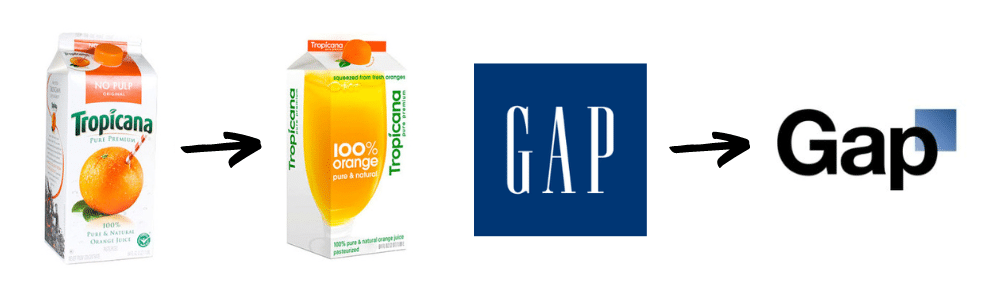
rebranding mistakes examples (1000 × 350 px)

Changing the Name Unnecessarily

Unnecessarily changing your name is much like rebranding a logo that already works. It will almost surely cause whiplash in your audience.

Not Communicating Your Rebrand/No Rollout Strategy

Remember the importance of consistency? This applies to how you manage your makeover. “Surprising” your consumers with a rejuvenated brand identity — even if it’s better — will only cause frustration, confusion, and, quite possibly, the loss of their loyalty.

Playing It Safe

It’s safe to say you’re committed to rebranding your business to attract new customers. But a rebrand that fails to take risks (which in itself may capture attention) risks falling into the noise of the 31.7 million small businesses currently operating in the U.S. today.

Rushing the Process

Your consumers can feel the effects of a hasty rebranding effort. Therefore, rebranding should be conducted thoroughly and meticulously from start to finish and beyond. Further, changing too rapidly may prompt a negative reaction from your consumers.

Failing to Understand Why You’re Rebranding

Establishing your reasons for rebranding must be front and center before you start the process. A new brand philosophy, for example, must guide every single decision you make. If you’re rebranding your business because of a new location, this should heavily influence your rebranding strategy.

Rebranding vs. Refresh: Which Is Right for You?

If you want to enrich or modernize your brand, you might not need a complete overhaul. In fact, this may counter your marketing goals and result in a loss of revenue. Ask yourself:

  • Does my present situation justify a rebrand?
  • Do I just want to be perceived as more relevant and contemporary, and attract new consumers?

If you fall into the latter camp, a rebrand may be a waste of your time and resources, and you may be better off simply revitalizing your image and investing in content marketing.

Avoid Rebranding Mistakes with MARION

You may have the best intentions with renovating your brand, but it’s too easy to take a wrong turn and inadvertently create a rebranding disaster.

MARION ensures that you accomplish the opposite. We concentrate on three primary marketing practices — traditional marketing, digital marketing, and brand and design — to help clients like you surpass their potential.

Explore our services today to make your rebrand or refresh an absolute success.

Marketing emails you’ll actually want to read.

Get marketing tips and news sent to 
your inbox.

This field is for validation purposes and should be left unchanged.
Name(Required)

Creative Marketing: What It Is and Why You Should Pursue It

Simply put, the purpose of marketing is to create awareness of a product, service, or event. Creative marketing is one of the most interesting and desirable aspects of marketing, as it can be used to convey a message through creativity. It brings customers to the company’s product and helps them keep their attention. It’s a proven way to boost conversion rates!

What is Creative Marketing?

Creative marketing is not just about coming up with catchy slogans or designing an attractive logo for a company. Instead, it involves using tools such as music, sound effects, symbols, and images to make consumers interested in buying a product.

Why Creative Marketing Matters Today

Creative advertising is an essential part of the modern marketing industry. It’s more than just an additional ingredient—it’s at the core of everything businesses do today. Creative marketing is crucial to the success of any company because it’s all about changing perceptions and connecting with potential customers on a new level.

Creativity has always been considered an essential resource in marketing, but it has taken on greater significance in recent years. With the rise of social media, consumers are bombarded with messages about products and services every day. To stand out, marketers must be innovative and creative in their marketing campaigns to gain attention and interest from potential buyers.

Check out these creative, successful social media campaigns.

creative marketing plan

The Challenge of Creativity in Marketing

Creativity is the cornerstone of marketing. It is one of the most critical aspects of an organization’s marketing efforts. A creative mind is what separates a good marketer from a great marketer. In addition, a creative mind can help build up ideas that are not only effective but also refreshing. 

As the digital environment continues to change, marketers are faced with increasing challenges regarding creativity. Marketing in an online environment is much different than traditional marketing, which poses some unique obstacles for marketers looking to be creative in their work.

The emergence of AI writers has made marketers’ jobs more streamlined and efficient as they can focus on what they are best at — creativity and emotions — rather than wasting time on technical skill sets and research.

How to Foster Creativity in Your Marketing Efforts

Did you know that 75% of individuals believe they are not living up to their creative potential? Becoming more creative can be challenging, as developing your artistic skills takes time and effort. It won’t happen overnight! However, the following tips will help you tap into your right brain and increase your creativity in marketing:

  • Brainstorming: Brainstorming is a great way to develop new ideas for your product. You can do it alone or in a group, but ensure all participants are active and engaged.
  • Ask yourself: When was the last time you went out of your comfort zone? Trying new things will give you fresh ideas and perspectives that you never imagined before.
  • Bring the team together: Put together a creative task force of people with different backgrounds and skill sets. They will be able to provide different views and experiences that can be used for breakthrough marketing ideas.
creative marketer

What Creative Marketers Do Differently Than Traditional Marketers

Creative marketing is about individual creativity and the uniqueness of your product. Creative marketers rely on their wits, intuition, and skills to get where others can’t.

Traditional marketing is about tactics, techniques, and best practices. Traditional marketers use strategic methods to get your attention in crowded markets, but these techniques aren’t as effective as they once were. To truly get in front of people these days, you need to be creative.

Elevate Your Brand with a Creative Marketing Agency

To recap, creative marketing is a type of marketing that focuses on creativity and emotions. It is an effective tool used by businesses to generate new ideas and fresh perspectives while still engaging with customers. Creative marketing will never replace traditional forms of marketing. However, it can complement them in a way that brings out the best in both.

Simply ‘being creative’ isn’t always as easy as it sounds. Luckily, our digital marketing agency is here to help! The team at MARION has been serving Texas businesses for over 40 years. We’ve taken a creative approach to developing custom marketing plans for various industries. Check out MARION’s design portfolio to see what our creative designers can do.

Contact us today to learn how we can help your business grow by incorporating a creative strategy into your marketing project.

Marketing emails you’ll actually want to read.

Get marketing tips and news sent to 
your inbox.

This field is for validation purposes and should be left unchanged.
Name(Required)

How the Best Taglines Make a Splash

You’ve heard it from us before, but we’re here to say it again. Every business needs a brand. And, in addition to the visual identity — we’re talking logos, color palettes, typography and textures — a tagline is an essential element of your business’ brand. It works in tandem with your visual identity and your stylistic voice to set the…

Keep Your Brand Top of Mind with Email Marketing

Today, our lives are more tethered to the digital realm than ever before — thank you, smart phones, Zoom meetings, cryptocurrency and the Metaverse. So, it’s probably no surprise that digital tools play an important role in your business’ marketing strategy. Email marketing is just one such tool that’s invaluable to have in your toolkit.

Combining speed and flexibility with a relatively small price tag, email marketing offers businesses of all sizes and in all industries the chance to get valuable facetime with customers. At the same time, it strengthens brand awareness with each eblast. If you ask us, that sounds like a win-win. Of course, there are a few pitfalls to avoid to keep you from being relegated to the dreaded “spam” folder. That’s why we’re here to walk you through a few ways to make the most of your email marketing journey.

Less is More.

While it might be tempting to send out back-to-back eblasts to your entire email list — we’re going to stop you right there before you hit “send.” Think about all the unread emails piling up in your inbox from retailers, community organizations, apps and social media platforms. Even if you’ve opted into the list, having your inbox flooded with messages can be annoying at best. Instead, think about frequency strategically. Set a cadence that keeps your brand on your audience’s radar without overwhelming them. This might take the form of a monthly newsletter, quarterly recap or seasonal sale. 

Get Personal.

With nearly 60% of email marketers citing personalization as one of the best ways to increase engagement, it makes sense that we’re seeing a trend toward personalized messages. If you’re asking customers to share personal information with you, it’s a great way to show them that you’re listening. Segment your list according to their personal details — for example, by industry or title — and create targeted content for each segment. Celebrate birthdays with a quick note or special discount, call people by their first names in the body or subject line and craft customer journeys that are relevant to where they are in the sales process.

Highlight Your Brand.

When it comes to building brand awareness, consistency is key. For example, Forbes reported that brand consistency across platforms could boost revenue by up to 23%. A big part of this is pretty simple: As people become more familiar with your brand elements — colors, logo, tagline and even stylistic voice — it’s easier for them to remember it in the future. Email marketing offers a great way to reinforce those elements. Each piece of email marketing should align with your overall brand messaging, helping build recognition and encourage connection.

Be Real.

Brand loyalty is driven by emotional connection. Showcasing the people, processes, traditions or values instilled in your company can help tell your story in a way that resonates with your audience. This may take the form of team spotlights, Q&As, community initiatives or time lapse videos of a special project. While this may look different, depending on your industry and business model, all companies have a story to tell. Email marketing offers an avenue for sharing a behind-the-scenes look at the things that bring your business together.

Don’t Wait, Authenticate.

Don’t let all that hard work end up in the junk folder, never to see the light of day. Before you send your very first campaign, you’ll want to make sure you authenticate your domain. Without getting too into the technical weeds, email authentication essentially acts as a “digital signature” to show that your emails are legit. This helps with deliverability, making sure you’re reaching the inboxes of most, if not all, of the recipients on your list.

These steps can help you get started developing a strategic plan — but this is still just the tip of the iceberg. Email marketing is multifaceted and offers numerous options for engaging with customers, showcasing your brand and building awareness. If you want to learn more about how these tips — and more — can help you grow your business, let us know. Our team is here to help.

Tips for Getting Started with Marketing Services in Houston

Marketing services in Houston are a great way to get your brand out there. These services can help you multiply your reach and generate more revenue for your business.

How? There are a number of ways that Houston marketing services can help you with your business, from SEO to social media marketing. There is no one-size-fits-all solution, so it is important that you meet with a company and have a conversation about what makes the most sense for you and your business.

There are many benefits to getting marketing services in Houston from an experienced company, but the best is the expertise that professional marketers have in their field. They know what works best for different industries, so they will be able to offer advice on how to get started correctly and maximize ROI (return on investment).

4 Simple Steps To Get Your Company’s Marketing Services Business Going

It is not enough to just think about marketing. There are some key steps that you need to take before you start marketing your business.

Below are four simple steps that will help you get your company’s marketing services business going.


  1. Commit To Investing In It: Despite what some might say, marketing is not a luxury for businesses with deep pockets. It is a necessity for all businesses who want to succeed and grow their revenue.


  2. Create A Marketing Strategy: You will need a solid, documented strategy for how you plan to market your company’s products and services going forward. This should include the tactics you plan on using as well as an estimate of the resources it will take to implement those tactics on an ongoing basis over the next 12 months.


  3. Partner with Experts: Whether you hire in-house or outsource, you have to rely on experts in today’s digital world to see success with marketing.


  4. Start With Your Website: This is your digital storefront. If you’re overwhelmed and not sure where to start, begin with optimizing your website.


Internet Marketing Services Secrets That Will Help Your Brand

Brands need to have a clear strategy for their marketing activities and this section will give you the most successful internet marketing tactics that work best for brands.

The first thing to do is create a brand image for your company with a strong message and personality. Every company needs to have a clear strategy from the beginning, so they can establish their identity on the Internet. The next step is to create quality content that is engaging and shareable in order to get more followers on social networks. You should also establish partnerships with other companies in order to increase exposure for your brand outside of the internet world. The rest? Well, they’re secret for a reason. 

How To Partner with the Right Marketing Agency in Houston

The idea of partnering with an agency is that they will take care of all the hard work and focus on your marketing needs. Actually, it’s just the opposite. The best agencies and partners understand that you’re not in this alone and they’re there to help you succeed. So don’t just blindly find a marketing agency and partner with them without knowing what they can do for you.

If you want to work with the right Houston marketing agency, then you need to know what types of services they provide so you can determine if they are the best fit. To review MARION’s marketing services, click here.

Marketing emails you’ll actually want to read.

Get marketing tips and news sent to 
your inbox.

This field is for validation purposes and should be left unchanged.
Name(Required)

Why Outsourcing Is A Cost-Effective Way of Marketing Your Business

Outsourcing your marketing tasks can be a cost-effective way to market your business.

Outsourcing has the potential to save you time, money, and resources when it comes to marketing. Oftentimes you will need outside help when it comes to marketing your business, but sometimes the best thing for you is if you outsource part of your marketing process.

This article will explore some of the most important benefits that come with outsourcing your marketing tasks.

Why You Need to Outsource Your Marketing Tasks

In today’s market, companies have to be on their toes from the moment they start operations. They have to be competitive and innovative in order to stay afloat. In previous times, marketing was confined to a company’s four walls. Today, marketing has become a top concern for business owners who want their brands to reach a wider audience and achieve greater success.

The best way for a company to grow is by outsourcing some or all of its marketing tasks – starting with tasks that can be outsourced – such as data analysis, social media management, content management, and virtual assistant services.

3 Best Ways to Outsource Your Marketing Tasks for Less Time & Money

Marketing is a time-consuming and expensive endeavor for most small business owners. You can outsource the marketing tasks to other specialists, but you need to know how to go about it.

Here are three ways you can outsource your marketing tasks and save time and money in the process:

1. Hire a Marketing Agency: You can hire a full-service marketing agency that specializes in services such as content writing, SEO optimization, etc. They would take care of all your marketing needs at a fixed monthly cost which is much lower than hiring an employee for each task or paying hourly rates for freelancers.

2. Hire Freelancers: The other way to outsource your marketing tasks is by hiring freelancers who specialize in specific areas of work.

3. Do a Hybrid Approach: This might be the best option, as you can enjoy the benefits of both freelancers and a marketing agency.

Why Outsourcing Your Marketing Work is the Key to a Productive Workflow

Outsourcing marketing work can help you to create a better, more productive workflow.

The conventional way of marketing is no longer as effective as it once was. Technology has changed the world and the way people view things. In the olden days, advertisers only had to make sure that they were reaching their target audience by broadcasting their message through on-air media and print advertisements. Nowadays, it becomes a challenge for marketers to reach out to people who can be interested in their products or services due to the change in communication habits and platform use.

Outsourcing your marketing work can help you with a variety of things: from creating a content calendargenerating more leads, improving customer engagement rates, increasing organic traffic from search engines, managing social media campaigns and so much more!

Other Advantages of Outsourcing Your Marketing Tasks

Marketing outsourcing can provide a unique solution to many of the problems faced by marketing teams, such as time and labor constraints, lack of in-house expertise, and lack of budgets.

As an example, you might outsource your advertising campaigns to an agency that specializes in that area. This ensures that you’re not wasting time with skillsets that you don’t have and instead focusing on what you’re best at – creativity, emotions, and your brand.

To learn more about outsourced marketing servicescontact us today.

Marketing emails you’ll actually want to read.

Get marketing tips and news sent to 
your inbox.
This field is for validation purposes and should be left unchanged.
Name(Required)

Branding vs. Marketing – How Are They Different?

It’s common to hear the terms “branding” and “marketing” thrown around when discussing the best way to grow a successful business. It’s easy to confuse the two, as they are often used as substitutes instead of separate concepts that should each be given careful consideration.

Learn about the differences in branding vs. marketing today to help you understand the unique benefits of each activity, and how to apply those benefits to your organization!

What Is Branding?

Branding is the distillation and communication of a company’s values, core principles, mission, style – basically whatever makes your company, product, or service unique. Your brand is generally communicated through graphics like logos, color schemes, fonts, and writing tone.

According to industry pro, Seth Godin, “A brand is the set of expectations, memories, stories, and relationships that, taken together, account for a consumer’s decision to choose one product or service over another.” Seth goes on to say that your brand only has value if it commands a premium, earns word of mouth, or is picked among a choice of other brands.

The process of developing a brand strategy has fluctuated very little over time. Many of the core components of a brand remain the same as they were 50 years ago, as the essence of a product or company evolves slower than its communication channels.

Common Branding Activities

In the bigger picture of branding and marketing strategy, your branding activities will typically include (but are not limited to):

  • Brand Style Guide Creation
  • Color Scheme Development
  • Establishing a Tone and Voice for Communication
  • Logo Design
  • Mission and Vision Statements
  • Core Values and Principles Development
  • Reputation Management
  • Unique Intangibles of Brand

Branding is rarely done in a vacuum, and the above items will need to be workshopped and refined based on target market research and user testing. Follow our guide on how to choose a branding agency for the best chance at finding a good firm for branding in Houston, Austin, or DFW.

branding and marketing strategy

What Is Marketing?

Marketing is the profitable connection of your product or service with paying customers. Marketing revolved around sales and promotion and cannot be successful unless your business offerings are reaching paying customers.

Depending on what your business provides, you can use either B2C or B2B marketing strategies to push your message out or pull your target customers into an interaction. Your marketing strategies and tactics should evolve as different trends in the time and attention expenditure of your target audience change.

For example, a television advertisement may have been the best way to reach the widest range of potential customers 30 years ago. However, as internet access became more widespread, social media turned into one of the largest marketplaces for customer time and attention.

Typical Marketing Activities

Most marketers will engage with one or several of the following strategies/tactics:

Digital marketing services have grown at an incredible rate in the past 20 years, largely because of the number of potential customers your brand can find on internet properties like publishing outlets, social media platforms, and search engines.

difference between branding and marketing

What Is the Difference Between Branding and Marketing?

Many people use branding and marketing almost interchangeably, but there are clear differences in branding vs. marketing. The following is an oversimplified attempt at explaining the difference between marketing and branding.

Branding is developing what should be communicated, and marketing is the act of communicating it.

Obviously, there is some overlap between marketing and branding. For example, graphic design is used to develop certain tangible elements of a brand like its colors and the feel of its logo. Graphic design is also used to market a brand via infographics, digital and physical collateral like sell sheets and product PDFs, and even within the design of a website.

Reputation management has also become very convoluted as digital marketing systems continue to integrate reputation signals into their platforms. For example, local SEO marketing takes reputation signals like reviews and direct brand searches into account while ranking search results.

The Psychological Difference

Psychologist Michael Levine highlights perhaps the most important difference between a branding and marketing strategy. “It is said that emotions drive 80 percent of the choices Americans make, while practicality and objectivity only represent about 20 percent of decision-making… People purchase or choose what they want, not what they need.”

At the end of the day, your marketing can try to use every statistic and rational angle under the sun to get someone to choose your brand over the next one. However, the way your brand makes a potential customer feel will be the deciding factor eight times out of ten.

In short, a strong brand can transform your product or service from a commodity into a market winner. This is exactly why you must invest plenty of time and energy into developing your brand before you begin marketing.

Brand Manager vs. Marketing Manager

A great technique for differentiating the different in a marketing manager vs. brand manager comes from Steve Johnson, CEO at Under10 Consulting. Steve recommends replacing “manager” with “expert” in both titles.

A marketing manager then becomes a marketing expert – someone who can organize strategies and tactics to communicate a brand and help get the sales process started. Fundamentally, a marketing manager should be able to make this happen for any number of brands, as the skillset is generally transferable (though that’s not always the case).

A brand manager could be thought of as a brand expert – someone who understands the ins and outs of a brand’s identity. It is this person’s job to undergo extensive user testing to determine what brand aspects best resonate with the target customer, and even readjust the brand’s understanding of the target customer if need be. The brand manager is essentially an agent of the brand, ready to evaluate and decide what is best for the brand at any given point.

Brand Marketing vs. Growth Marketing

Because of the tactical nature of marketing today, there is an obsession with growth marketing (AKA “performance marketing”). The beauty of the internet and voice-over IP (VOIP) phone systems is that you can track almost everything about a potential customer’s interaction with your business.

This is great for analytical marketers and provides a somewhat clear path for improvement since their success can be gained and indicated by the relevant stats. However, industry veterans have begun asking if the younger, technically-savvy crowd of performance marketers are actually good at marketing, or just good at the tactics associated with each platform.

You can almost completely ignore a brand identity and still achieve high share counts, high rankings, and high click-through rates that lead to increased sales. However, the short-sighted approach to marketing doesn’t continually invest in a brand that can stand strong when your potential customers make an emotional choice.

Brand marketing is a more holistic approach to branding and marketing. This type of marketing considers the visual and tonal aspects of your brand throughout all platforms and uses those components as an advantage. A strong brand can accelerate social media, SEO, and paid ad results, and brand marketers know it.

MARION Is the Branding and Marketing Company You’ve Been Looking for

MARION has been serving the marketing and branding needs of Texas businesses for nearly 40 years. Our Texas marketing agency has the skill set it takes to develop a powerful brand and successfully bring it to market in a profitable way.

Marketing emails you’ll actually want to read.

Get marketing tips and news sent to 
your inbox.

This field is for validation purposes and should be left unchanged.
Name(Required)

Content Marketing During COVID-19 – The Right Way

You’ve probably received tens, if not hundreds, of marketing messages from businesses regarding the COVID-19 outbreak and accompanying economic crisis. The Coronavirus situation has escalated rapidly, and content marketing during the COVID-19 pandemic can easily hurt your brand despite your best intentions.

So, how often does your business need to communicate about the pandemic? What brand messaging has proven helpful? Is now the time to be opportunistic? We cover these important questions below.

First, Some Coronavirus Terminology

COVID-19 (which stands for Coronavirus Disease 19), is a respiratory disease caused by a novel (new) virus called “severe acute respiratory syndrome coronavirus 2 (SARS-CoV-2),” according to the WHO. The important distinction here is that the disease caused by the virus is COVID-19, while the virus itself is called SARS-CoV-2, a member of the Coronavirus family.

We’ve seen several misuses of the terminology. Maintain the professionalism of your brand by knowing and using the right terms in your messaging.

The Coronavirus Marketing Adoption Curve

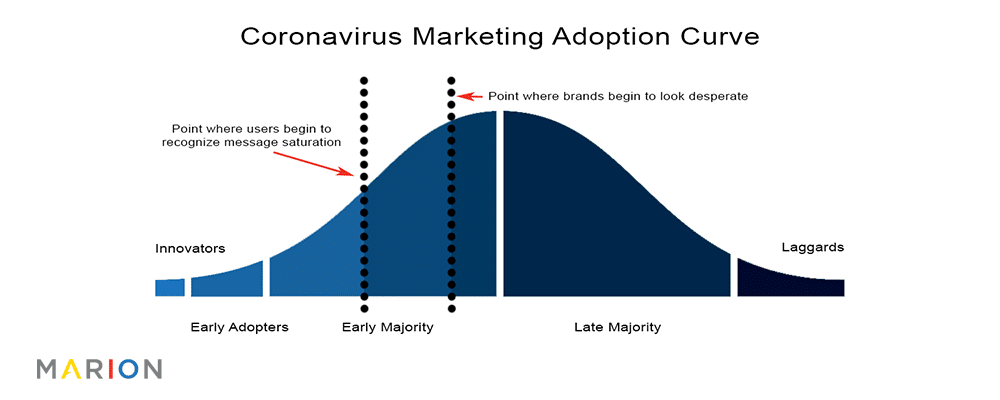
There is quite literally a COVID-19 Marketing Adoption Curve that is a variation of the Product Adoption Curve.

Coronavirus marketing adoption curve

Each message cycles through the innovators (brands that have developed and executed the concept), the early adopters, the early majority, the late majority, then the laggards.

You’ve seen this in action throughout March 2020. Some waves of popular messages include:

  • “We’re Here to Help”
  • “Our Hours of Operation Have Changed”
  • “We’re Offering [Insert Special Offer Here] to Help”
  • “Contactless Pickup Available”
  • “[Insert Company Here] Executive Is Foregoing Salary”
  • “Millennials Are too Old for Spring Break, It’s Gen Z You Want”
  • “How to Avoid Boredom at Home”

Because of the rate at which these messages are adopted by brands, their COVID-19 Marketing Adoption Curve has a very short lifecycle. On our graph above, the two vertical dotted lines indicate:

  1. Where users recognize that they’re receiving a lot of similar messages
  2. Where the message starts to look insincere and can hurt brands that are still sending it

If trendjacking is your brand’s response to the Coronavirus marketing climate, then you’re probably not seeing trending messages until they’ve already reached the early majority stage. This means you could have as little as hours left to tailor the message to your audience before they’re desensitized to the concept.

What does this mean for you? Your company’s COVID-19 content marketing strategy needs to set some guidelines.

Dos and Don’ts of Coronavirus Content Marketing

Communication between your business and its customers is important, but there is a not-so-delicate balance between what you should and shouldn’t convey. Your entire digital marketing strategy during COVID-19 will need to evolve, but we’re talking specifically about your messaging right now.

We’ll start with Coronavirus content marketing practices that you should avoid (while doing our best not to throw anyone under the bus).

Don’t

Don’t engage in the following COVID-19 marketing practices:

  • Send tone-deaf promotional emails that neglect the fear this pandemic is causing
  • Use COVID-19 puns in promotional emails – “Is There a Bright Side to Coronavirus?” email subject line from a solar products company
  • Try to drive foot-traffic to a local business
  • Run exploitative promotions
  • Send messages to your customers about your regular cleaning practices and that sick employees and customers should stay home – this should be business as usual
  • Use the fear of disease spread as a value-added sales benefit – like pushing “touchless” household products
  • Communicate empty “Virtue Signaling” – like a mortgage company sending an email to say “Your health and safety is our priority”
  • Blatantly communicate your desperation or self-interest

Do

Make sure you consider the following practices while marketing during the COVID-19 crisis:

  • Let customers know if your operations have changed, and an estimate of how likely these changes are to remain intact
  • Send out updates as often as needed to adjust customer expectations of your business like
    • We’re back in stock
    • Now offering takeout and delivery
  • Pause automated campaigns or messages
  • Focus on marketing efforts that you can control like SEO and other owned media channels
  • Address frequently asked questions from your customer base that are directly related to your products/services
  • Show empathy in all communications

4 Examples of COVID-19 Content Marketing

We found some examples of good and bad corporate email marketing examples from the latter half of March. Many of these directly correlated with a “Do” or “Don’t” from the sections above.

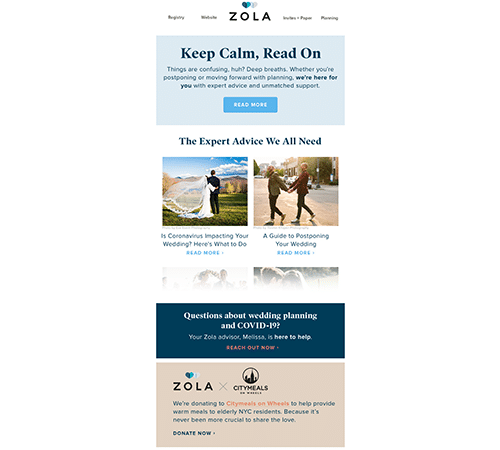
1. Address Relevant FAQs Like ZOLA

Zola is a wedding registry and website company that makes it easy for soon-to-be-married couples to organize their pre-marriage events. At a time when the CDC is recommending that mass gatherings be postponed or canceled, many engaged couples have questions about their special day.

ZOLA faces these questions head-on by providing several educational resources and a line to an event advisor that can help adjust wedding plans. Their message is directly relevant to recipients and genuinely helpful to their target audience.

Subject Line: We’ll figure this out

coronavirus content marketing example - ZOLA

Source: Zola

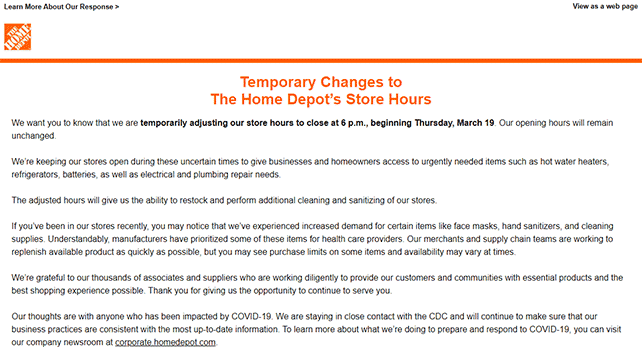
2. Communicate Changes in Store Hours Like Home Depot

Home Depot is a great brand role model to follow during the Coronavirus pandemic. They quickly emailed their customer base about changes in their store hours, as well as temporary shortages in certain products. Their subject line makes the email’s purpose clear and Home Depot kept the email relatively concise.

Subject Line: Temporary Changes to Our Store Hours

examples of COVID-19 content marketing - Home Depot

Source: Home Depot

3. Avoid Generic “Business as Usual” Messages

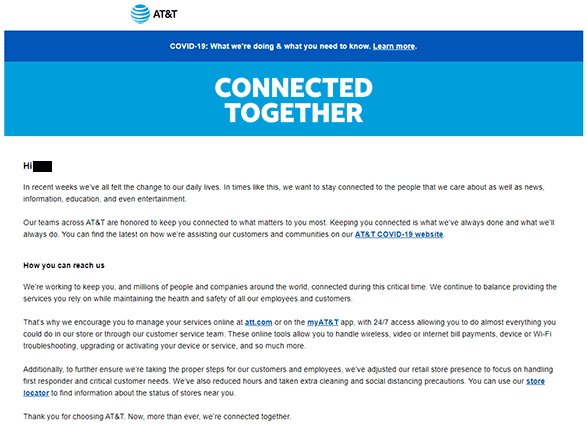
By this point, you’re very familiar with “We’re here for you” emails in your own inbox, and you’ve already developed a blindness to them. Because of the accelerated lifecycle of messages in our Coronavirus Marketing Adoption Curve, any brand still sending this out would be considered a laggard.

For existing customers, this email doesn’t communicate anything new. 24/7 access to your online account, and stores taking “extra cleaning and social distancing measures” are not need-to-know information.

Subject Line: [Your Name], AT&T is here for you.

COVID-19 content marketing example - AT&T

Source: AT&T

4. Pause Automated Messages

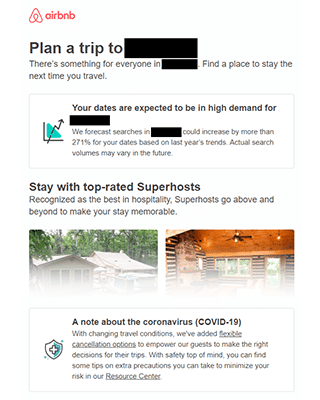
The email below is an example of an automated message that should have been paused. Airbnb has an automated forecasting tool that would normally be helpful to customers, but in this case, it could be harmful to their brand.

With federal social distancing guidelines in place through the end of April, there is very little chance that demand will spike in the next few weeks. The catch-all disclaimer that “Actual search volumes may vary in the future,” is not as helpful as eliminating the automated email altogether.

This example makes it clear why your business should take a close look at the automated marketing systems you have in place.

Subject Line: Searches in [Target Location] for [Target Date] are expected to increase

examples of coronavirus content marketing - Airbnb

Source: Airbnb

Want to Discuss the Impacts of COVID-19 on Your Marketing Efforts?

Your business has no doubt been impacted by the Coronavirus pandemic, and it can be difficult to evaluate the right marketing strategy. MARION has set up a Coronavirus marketing hub to help keep you informed.

We’re also extending free 30 minute marketing consultations to Texas-based businesses. Our Houston marketing agency has advanced experience with businesses employing anywhere between 5 and 150 employees.

Contact us today for help developing a marketing strategy for the present, and a strategy for the future economic rebound.

Marketing emails you’ll actually want to read.

Get marketing tips and news sent to 
your inbox.

This field is for validation purposes and should be left unchanged.
Name(Required)


How to Choose a Branding Agency – 5 Top Questions to Ask Firms

No matter what your business brings to the table, if your brand positioning is weak or non-existent, then you’re just wasting your time. Distinguishing your brand from the competition calls for a level of strategy and finesse that you can only achieve with the right branding firm at your back.

Picking the right branding agency, however, comes with its own set of challenges. With so many options to choose from, you’ll need to ask the right questions to find the right fit.

What Is a Branding Agency?

Branding agencies offer specialized services that help to create, develop, improve, and maintain your brand identity. Agencies will identify your goals and objectives and work to develop an intimate understanding of your business. This information is used to create a plan that strategically positions your business and helps spread brand awareness.

What Does a Branding Agency Do?

In addition to helping a business establish their brand, many agencies also offer advertising services. The primary goal of a branding agency is to help a business identify its “brand message” and communicate that message through various advertising and marketing campaigns.

A great reputation can be hard to build, but the expert team at MARION makes it easy. Give our branding agency in Houston a try today.

How to Choose a Branding Agency

It’s natural to feel overwhelmed when you first begin your search for a branding company. There are literally thousands of agencies to choose from, so it’s essential that you have a method in place to find the best option for your organization.

what does a branding agency do?

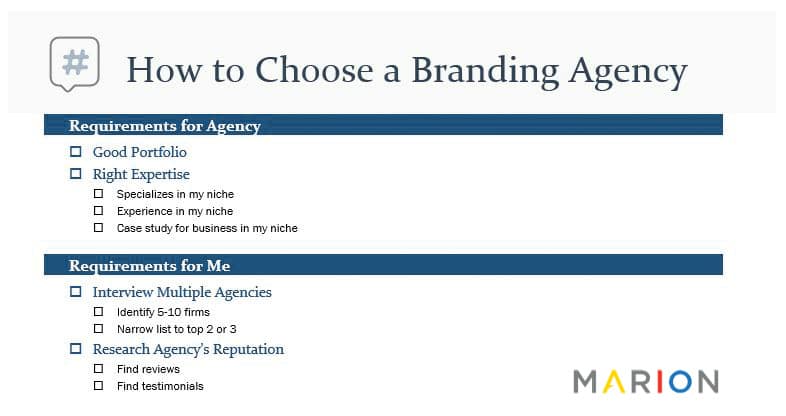
Here are a few quick tips to help you identify a good branding agency:

  • Right expertise – Ensure the branding agency you decide to work with specializes (or has experience) in your niche. This will make it easier for the agency to craft an effective brand development strategy.
  • Good portfolio – What kind of results has the agency achieved for past clients? A good track record means they know what they’re doing.
  • Interview multiple agencies – Don’t just go with the first agency you encounter. Identity at least five to ten firms you feel are a great fit for your business. Then narrow that list down to two or three choices so you can move forward to the interview phase.
  • Research the agency’s industry reputation – Every agency leaves a digital footprint whether they like it or not. One of the easiest ways to identify an agency’s reputation is through testimonials. The experiences of past clients will provide a firsthand account of what an agency can bring to the table for your business.

5 Questions to Ask a Branding Agency

Once you’ve made your final decisions, you’ll still need to find an agency that’s just right for your business. To help you make an informed decision here are five questions to ask the branding agencies you’ve narrowed your list down to.

questions to ask a branding agency

1. What Results Have You Gotten for Past Clients?

A branding firm shouldn’t have to hide their results from you. If you’re going to pay them good money to build and spread your brand message, then you have a right to see what they can deliver for your business.

Whether these results come in the form of portfolios, reports, analytics, or marketing case studies, it’s important you can measurably see how they’ve helped past clients. A consistent track record of satisfied clientele should give you some peace of mind.

Check out MARION’s design portfolio and digital marketing case study for examples.

2. What Kind of ROI Can I Expect?

Before you spend money with an agency, do you know how to set marketing goals? Your return on investment will be determined by the goals and objectives you set for your marketing strategy.

Thus, this question can’t be answered until you have a fully fleshed out plan in place, complete with marketing KPIs and metrics to help you track your progress. Asking about ROI should prompt a conversation about the future of your brand and various creative ways to create brand awareness.

3. Can You Walk Me Through Your Strategic Process?

The earning potential of branding companies is wholly dependent on their level of creativity. What is their creative process? How will this creativity be used to boost your brand? Is there anything unique about the way they perform market research?

what is a branding agency?

A good branding agency will be able to walk you through their strategic process. If what you hear resonates, then that’s a good sign they may be the right firm for you.

Beyond just branding and collateral creation, can you expect enduring results? For example, are your firm’s branding strategies cohesive with B2C or B2B marketing strategies?

4. Can You Execute a Brand Identity Campaign?

If the answer to this question is no, then you’re talking to the wrong agency. You don’t want to work with an agency that simply establishes your brand and lets go of the wheel. You need an agency that can execute a fully fleshed out campaign from A to Z.

You should want a single firm handling all of your branding such as MARION’s Austin branding agency. Having one agency establish your brand and another to execute the strategy will cause delays and possibly lead to less than desirable results.

5. Why Are You Interested in Working with My Brand?

When you ask this question, take note of the language used from each agency. Do they have a firm grasp of your industry? Do they speak industry jargon? Do they truly understand what your brand brings to the table?

If their answer is too generic, you may want to move on to the next agency. This list of questions to ask a branding firm is a good primer to identifying genuine experts based on their language and behavior. Non-verbal communication can say a lot about the fit between you and a branding agency, so engage in person if possible.

Make Sure the Glove Fits

Learning how to choose a branding agency takes time and patience. The time you put into your search will ensure you’re matched with a firm that’s perfect for your organization. Rush the process, and you may end up with a brand that doesn’t quite suit your company.

If you’re on the hunt for an agency that can help you establish and promote your brand, contact MARION today. We offer a range of services including web design, digital marketing, graphic design and much more. Meet with the strategists at our marketing firm to see if our agency is the right fit for your business.

Marketing emails you’ll actually want to read.

Get marketing tips and news sent to 
your inbox.

This field is for validation purposes and should be left unchanged.
Name(Required)