Category: Marketing Campaigns

How to Build a Better Email Marketing Customer Journey

When the temperature rises and inboxes get flooded, most emails go unread. Not because people don’t check their emails, but because what lands in their inbox doesn’t match where they are in their decision-making process.

That’s why you need a well-built email marketing customer journey.

So don’t just write more emails, write better ones…emails that land at the right time, say the right thing, and make people feel like your business gets what they need.

What is the Email Marketing Customer Journey?

The email marketing customer journey is the path your leads and customers take, from first touch to long-term loyalty, all through email communication. Think of it as a chain of conversations, each one with a purpose, each one building trust.

It’s not a funnel. It’s not a drip campaign you set and forget. It’s a sequence of relevant touchpoints that respond to behavior and guide the reader without feeling like a sales pitch.

Step 1: Break the Journey into Stages

Mapping your email marketing customer journey starts with understanding where your audience is mentally and emotionally. These are the five core stages to build around:

1. Awareness

This is the introduction. They don’t know who you are or what you offer.

Email Example:

  • “Top 5 Costly Mistakes in [Industry] and How to Avoid Them”
  • “2025 Trends You Shouldn’t Miss in [Sector]”

2. Consideration

They’re weighing options and comparing solutions. They might be reading case studies or asking around.

Email Example:

  • “How [Client Name] Cut Downtime by 38% in 3 Months”
  • “Webinar Invite: Choosing the Right [Service/Product] Partner”

3. Purchase

This is your chance to help them take action. They’re nearly ready to buy.

Email Example:

  • “Limited-Time Offer: Get Started with No Setup Fee”

4. Onboarding

The deal’s closed but the journey’s not done. Now’s your chance to make a strong first impression.

Email Example:

  • “Welcome to [Your Company Name] – Here’s What to Expect”

5. Repeat & Referral

You’ve earned their trust. Now make it easy for them to return (or refer others).

Email Example:

  • “Here’s What’s New Since You Last Checked In”
  • “Know Someone Who Needs [What You Do]? Share and Save.”
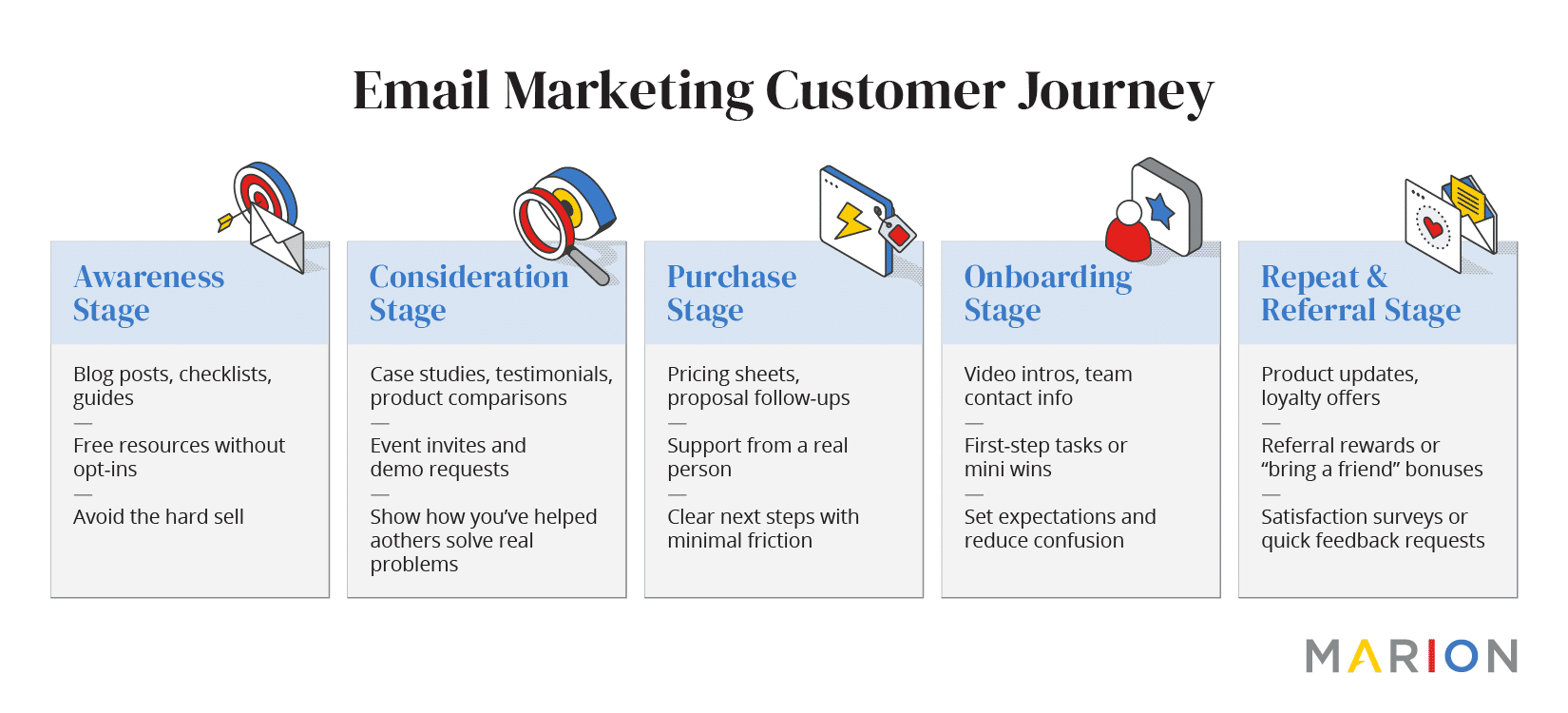
Email Marketing Customer Journey

Step 2: Match Your Content to the Stage

Each stage of the email marketing customer journey deserves its own message, tone, and content. A strong lead magnet (something like a checklist, industry guide, or free resource) can set the right tone from day one.

Here’s how to align what you send with what your audience actually wants to see:

Awareness Stage

  • Blog posts, checklists, guides
  • Free resources without opt-ins
  • Avoid the hard sell

Consideration Stage

  • Case studies, testimonials, product comparisons
  • Event invites and demo requests
  • Show how you’ve helped others solve real problems

Purchase Stage

  • Pricing sheets, proposal follow-ups
  • Support from a real person
  • Clear next steps with minimal friction

Onboarding Stage

  • Video intros, team contact info
  • First-step tasks or mini wins
  • Set expectations and reduce confusion

Repeat & Referral Stage

  • Product updates, loyalty offers
  • Referral rewards or “bring a friend” bonuses
  • Satisfaction surveys or quick feedback requests

Expert Tip: Don’t write for your product. Write for the questions people are asking in their head at that moment.

Need help creating lead magnets, ebooks, or case studies that attract qualified leads? MARION offers content marketing services tailored to each stage of your customer journey.

Step 3: Use Behavior to Trigger the Right Messages

Send emails based on what your audience is actually doing (not what you assume they’re ready for).

Set Triggers Like:

  • Signing up for a newsletter
  • Viewing a pricing page
  • Downloading a guide
  • Attending a webinar

For example, if someone clicks a link to view your pricing but doesn’t reach out, send a follow-up: “Still have questions about pricing? Here’s a breakdown + who to contact.”

Timing Matters

Send too many emails too fast and you’ll lose trust. Wait too long and the opportunity passes.

Space your messages based on behavior and urgency, not a pre-set calendar.

Pro Tip: Automate workflows but keep the tone personal. Use names, ask questions, and make replies feel welcome.

Step 4: Measure and Adjust Often

Track the usual metrics (opens, clicks, unsubscribes) but don’t stop there.

What Really Matters:

  • How many people reply
  • How many convert to calls, demos, or purchases
  • How many move from one stage to the next

Test subject lines. Watch where people drop off. Cut the dead weight and double down on what works.

Fun fact: Personalized email messages improve click-through rates by 14% and conversions by 10%.
Common Gaps (and How to Fix Them)

Most companies miss the mark in a few areas. Here’s where things fall apart (and how to fix them):

1. No Welcome Series

That first impression sets the tone. A welcome email should:

  • Confirm what they signed up for
  • Deliver immediate value
  • Introduce your brand tone and personality

2. No Follow-Up After Quotes or Proposals

If they asked for pricing and you don’t follow up, that’s a missed chance. Send a brief message that adds clarity, not pressure.

3. No Re-Engagement for Cold Leads

Someone goes quiet after a few emails? Send a soft check-in like:

  • “Still exploring options? Here’s something you might find helpful.”

4. No Post-Sale Touchpoints

The sale is only the middle. A simple follow-up to ask how things are going or to share what’s next can lead to longer relationships and referrals.

Fixing the above gaps often starts with better strategy. MARION provides email marketing audits and campaign planning for businesses ready to tighten up their follow-through.

Ready to Build a Smarter Email Marketing Customer Journey?

Most email marketing falls short because it’s out of sync with what people actually need. Timing, tone, and clarity matter more than volume.

At MARION, we help businesses plan and execute email strategies that do more than hit inboxes. We create email marketing customer journeys that match how your audience thinks and moves…from first contact to loyal customer. Our marketing agency team can work with you to map out the exact touchpoints your leads need, create content that feels personal, and set up the automation that keeps it all running without feeling robotic.

If it feels like a chore to write, it’s probably a chore to read…we help you avoid that.

Let’s talk about what your next step should look like!

Marketing emails you’ll actually want to read.

Get marketing tips and news sent to 
your inbox.

This field is for validation purposes and should be left unchanged.
Name(Required)

Beat the Heat: Creative Summer Marketing Ideas for Your Business

When the temperature rises, most people slow down…but your marketing doesn’t have to. Summer offers the chance to stand out while others are on autopilot. If your B2B business depends on staying visible and generating steady leads, this is the time to keep your audience engaged.

Here are 8 summer-friendly tactics to keep your brand active and top-of-mind.

1. Host a Summer Giveaway

It might sound obvious, but branded giveaways still work. Not the “stress ball in a dusty drawer” kind…give them something they’ll use when it’s 103 outside. Think insulated tumblers, cooling towels, portable fans. I once saw a contractor hand out branded can koozies at a local festival — simple, cheap, and everyone kept them. Genius.

Keep it simple: announce the giveaway, ask for an email or a follow, maybe a share to enter. Don’t overcomplicate it. People love low-effort wins, especially when it’s hot and their brain’s running on half speed.

One study even reported that 83% of consumers like receiving promotional products with an advertising message.

2. Create Content That Matches the Season (And the Mood)

Nobody’s in the mood to read a white paper right now. You know it. I know it. So don’t fight it. Instead, make your content quick, useful, and maybe even a little fun.

What are your customers dealing with during this stretch of the year?

Examples:

  • A construction company might publish a blog on “Keeping Cool on the Job: Essential Tips for Summer Construction Work.”
  • A tech company could create a video series on “Optimizing Your Home Office for Summer Productivity,” showcasing ways to stay comfortable and efficient while working from home during the heat.
  • A healthcare provider might share an infographic on “Hydration Hacks: Staying Healthy in the Summer Heat,” offering tips on staying hydrated and the benefits of their hydration products or services.

And don’t be afraid to share a little personality. You’re not writing a textbook here…you’re trying to connect. A little levity goes a long way this time of year.

Creative Summer Marketing tips

3. Summer-Themed Promotions

You don’t need a full-blown campaign to offer a good summer deal. Toss out something limited-time, give it a fun name like “Too Hot to Think Promo” or “Summer Slowdown Special,” and send it to your list with a quick note.

Something like: “We know things feel slow right now. Here’s something to make your life a little easier.”

It doesn’t need to be clever or complicated. In fact, the more human it sounds, the better it performs. Summer is all about energy conservation, for your customers too. Make sure to promote these deals through email and social media marketing.

4. Outdoor Events and Sponsorships

Summer is the season for outdoor events. Consider sponsoring local events like festivals, fairs, or sports games. Not only does this increase brand visibility, but it also shows your support for the local community. Set up a booth or tent with branded giveaways and information about your business.

As a matter of fact, 9 out of 10 marketers agree that experiential marketing boosts compelling engagement.

5. Share a Bit of the Human Side

People like doing business with companies that feel… well, like people. One of the easiest ways to make that happen? Show off your team’s summer vibe.

Post some behind-the-scenes shots. Team BBQs, vacation snapshots, bad sunburn stories (ok, maybe not the last one). Or have your employees share their favorite summer snack or weekend activity.

It takes 10 minutes, and suddenly your business feels less like a logo and more like a group of real folks your audience can relate to.

Examples:

  • Share a series of social media posts featuring your team’s vacation snapshots and stories. This humanizes your brand and gives your followers a glimpse into the lives of the people behind the business.
  • Encourage your customers to share their vacation photos with your products and feature these images in your email newsletters or on your website. Offer a small incentive, like a discount on their next purchase, for participating.
Summer Marketing

6. Ask Your Customers to Share

Here’s the thing: user-generated content performs better than most brand posts. And summer gives you the perfect excuse to ask for it.

Run a social media campaign and start a hashtag (keep it short). Ask customers to post pics using your product or service in their summer routine. Give them a reason to join in — small discount, feature on your feed, bragging rights.

Once you get a few entries, repost them. People love seeing their content shared, and it gives your feed more depth than stock images or “corporate updates.”

7. Give Your Emails a Seasonal Refresh

A quick update to your email visuals and subject lines can make a difference. Highlight limited-time offers, useful tips, or seasonal use cases. Add a fun summer recipe or quick poll for interaction.

Emails that feel timely are more likely to be opened and shared.

Examples:

  • An office supply company could do a newsletter featuring “Top 10 Office Gadgets to Keep You Cool This Summer.”
  • A software development company might create an email marketing campaign titled “Stay Productive in the Heat” with tips on using their tools to maintain efficiency during the summer months.
  • A commercial cleaning service could offer “Summer Cleaning Specials” through their email campaigns, emphasizing how a clean, cool workspace can enhance productivity.
  • A food supplier could send out a summer-themed recipe newsletter showcasing “Cool and Refreshing Office Snacks” that use their products.

8. Refresh Your Visuals

You don’t need a full redesign. Just update your homepage banners, rotate in some warm-weather photos, and change your social profile headers.

It shows people your business is active and paying attention. It’s a small detail, but it adds up — especially when everyone else looks frozen in time.

Even swapping in an image of someone holding a cold drink or working outdoors can make your brand feel more relevant. It’s an easy win.

Don’t Let the Texas Heat Slow Your Business Down

Everyone’s tired, inboxes are lighter, and meetings start getting pushed to “after Labor Day.” That’s your chance. When your competitors go quiet, your voice carries further.

If you’re short on time or ideas, our outsourced marketing agency has your back. At MARION, we work with businesses across Texas to keep their marketing active — even during the dog days of summer. Let us help you beat the heat with our digital marketing services in Austin and Houston, Texas.

Need help with your campaigns, content, or getting something out the door before the heat hits triple digits again? Let’s talk.

Marketing emails you’ll actually want to read.

Get marketing tips and news sent to 
your inbox.

This field is for validation purposes and should be left unchanged.
Name(Required)

The hidden costs of DIY Marketing

Why going it alone might cost your business more than you think.

Small and midsize businesses often juggle tight budgets, making DIY marketing seem like an appealing option to cut costs. On the surface, it feels practical and empowering — after all, you know your business best. But while managing your own marketing might initially save money, the hidden costs can quickly pile up, negatively impacting your overall success.

Before committing to a do-it-yourself approach, consider these sneaky expenses and potential setbacks that might be lurking beneath the surface.

The opportunity cost of your time.

Time is your most valuable asset, and DIY marketing demands a significant investment. Hours spent crafting social posts, editing newsletters or creating sales sheets are hours not spent building relationships, developing new products and strategizing your next big move. Even if you’re outsourcing to freelancers — whether for content, design or website updates — you’re still spending time managing the process, providing direction, organizing assets, and chasing down deliverables.

While handling marketing in-house may feel cost-effective, you’re essentially pulling resources away from your core competencies. Remember, every hour dedicated to marketing tasks means less attention to what you and your team do best — serving your customers and growing your business.


Costly Rookie Mistakes.

Marketing isn’t as simple as it might appear. Missteps, especially in digital marketing, can drain your budget quickly. For instance, improperly set up PPC ads or social media campaigns can burn through your dollars without generating meaningful results. Even worse, these blunders might harm your brand’s reputation or confuse potential customers. The same goes for traditional marketing — think billboards with unclear messaging, tradeshow booths that don’t reflect your brand, or brochures with inconsistent visuals. When your materials don’t align with your brand or speak to your audience, you risk wasting both money and opportunity.

By entrusting your strategy to marketing professionals, you’re investing in expertise. Agencies know the pitfalls of the field and how to avoid them, keeping your budget working harder and smarter.

Inefficient targeting and wasted resources.

Effective marketing isn’t about reaching everyone. It’s about reaching the right people. DIY efforts often lack the strategic precision of professionally managed campaigns, leading to resources spent targeting audiences who are unlikely to convert. Without expert insight into customer behaviors, platforms and messaging, your carefully crafted marketing could simply be shouting into the void.

Professional marketers use data-driven strategies to pinpoint your ideal customers, maximizing every dollar spent and driving more valuable engagement.

Underestimating the value of professionals — and professional tools.

Behind every great marketing campaign is a team of experts who bring more than just creativity. They know how to use the right tools and resources to manage your brand effectively, optimize campaigns and adapt quickly when something isn’t working. It’s not just about having access to advanced platforms; it’s about knowing how to use them strategically. Sure, free online tools exist, but they usually offer limited functionality. Advanced tools that professionals leverage — such as in-depth analytics software, SEO optimization platforms, design software and email marketing systems — often come with a price tag that’s hard to justify when you’re marketing solo. However, without these tools and the expertise to use them well, you’re likely to miss opportunities to optimize performance and drive real ROI.

Inconsistent branding and messaging.

Consistency is key when building brand recognition and trust. DIY marketing often leads to disjointed branding — different voices, varying visuals and uneven quality across channels. This inconsistency confuses your audience and weakens your brand credibility.

By contrast, a professional marketing agency ensures your branding is cohesive and resonates powerfully across every platform. With experienced graphic designers and copywriters on your side, you get visual and verbal alignment that reflects your brand’s personality and values. Uniform messaging builds trust and positions your company as professional, reliable and memorable.

Underutilizing analytics.

One of the biggest mistakes businesses make in DIY marketing is overlooking or misunderstanding analytics. Without clear insights into what’s working (and what’s not), your marketing decisions become guesswork. Proper analytics tracking requires expertise — knowing what metrics to measure, how to interpret them and how to pivot strategically. Professional marketers regularly use analytics to refine their approaches, resulting in more effective spending and stronger outcomes.

Missing out on fresh perspectives.

Marketing thrives on creativity and fresh perspectives. Handling everything internally can result in tunnel vision, where new opportunities or innovative strategies go unnoticed. Professional marketing agencies bring an outsider’s view, backed by experience across diverse industries and campaigns, sparking creativity and innovation that might never arise internally.

The cost of burnout.

Marketing is relentless. DIY marketers frequently juggle numerous responsibilities, which inevitably leads to burnout. When you’re stretched too thin, both the quality and consistency of your marketing suffer — along with your mental and emotional health. Burnout not only impacts marketing effectiveness, but can also negatively affect other aspects of your business operations.

Knowing when it’s time for professional help.

DIY marketing can seem cost-effective in the short term, but it’s crucial to recognize when it might be holding your business back. Professional marketers not only save you from the hidden expenses outlined above, but also position your company for sustained growth.

At Design At Work, we partner with businesses just like yours, delivering strategic expertise and creative solutions that drive real results — without the hidden costs. Ready to reclaim your time, optimize your efforts and fuel your growth? Contact us today and let’s talk about how professional marketing can transform your business.

HVAC Marketing Strategies That Actually Drive Leads (and Revenue)

Today’s HVAC market is packed with competition and rising customer expectations. The middle of summer or the dead of winter are peak seasons when potential customers are searching online for fast, reliable HVAC help. The challenge? Making sure your company is the one they call.

If your HVAC business relies on word of mouth alone, you’re leaving money on the table. It takes a modern, localized, and measurable strategy to bring in steady leads all year long.

The HVAC Buyer Has Changed

Homeowners and property managers no longer flip through the Yellow Pages when their HVAC systems break down – they head straight to Google. Search behavior has shifted dramatically, and with that comes a more informed, more impatient customer.

Today’s HVAC buyer:

  • Searches online during high-stress moments. If it’s 100 degrees and the AC goes out, they want fast help and immediate availability.
  • Relies heavily on reviews. A five-star rating and recent customer feedback often outweigh years of experience if your web presence is weak.
  • Is mobile-first. Most searches happen from phones. If your site isn’t responsive and your phone number isn’t clickable, you’re losing leads.
  • Trusts appearance. A professionally branded website with licensing information and technician photos makes a big difference in credibility.

To stay competitive, HVAC companies need to meet buyers where they are: on mobile search, with trustworthy information, and a reason to act now.

Digital Marketing Tactics That Deliver for HVAC Businesses

If your goal is to drive more high-quality leads and fill your calendar with booked jobs, these proven digital strategies should be at the core of your HVAC marketing plan.

1. Local SEO

In competitive metro areas like Dallas and Houston, showing up in the top 3 Google results can dramatically impact your call volume. We’ve helped HVAC businesses in big cities climb into the Map Pack by optimizing their local listings and encouraging consistent review generation.

Google’s “Map Pack” dominates local HVAC searches, and getting into that 3-pack can make or break your lead flow. To do that:

  • Optimize your Google Business Profile with accurate info, service categories, photos, and service descriptions.
  • Build local citations on directories like Yelp, Angi, and BBB with consistent NAP info.
  • Generate and respond to Google reviews to boost visibility and build trust at a glance.
  • Create location-based service pages that target searchers in each city or neighborhood you serve.

2. Paid Search (Google Ads)

Some HVAC services are too urgent to wait for SEO. Paid ads help you show up immediately for searches like “AC repair near me”, “Emergency furnace repair 24/7”, or “HVAC replacement financing Houston”.

With a well-built campaign, you can:

  • Control spend based on seasonality
  • Use call-only ads for faster conversions
  • Run retargeting ads to bring back visitors who didn’t convert the first time

3. Website Optimization

Across Texas – from San Antonio to Dallas – we see too many HVAC websites that look outdated or take too long to load on mobile. These missed opportunities can mean thousands in lost revenue during peak seasons. A fast, modern site builds instant trust and keeps customers from clicking over to your competitors.

Once people land on your site, every second counts. A clear and easy-to-navigate experience can be the difference between a booked job and a bounce. Think of your website as your 24/7 salesperson; it should answer key questions, build trust, and make it easy to take action! Once people click through, your website needs to close the deal.

  • Make sure it’s mobile-friendly and loads in under 3 seconds
  • Use CTAs like “Book Now” or “Call for a Free Estimate” in prominent positions
  • Display trust-building elements: reviews, guarantees, technician credentials, financing options
  • Add real photography to avoid the generic feel of stock images

4. Email & Text Automation

Stay connected with your customers and increase repeat business:

  • Automate thank-you emails with review links after completed jobs
  • Schedule annual maintenance reminders for AC tune-ups and furnace checks
  • Promote seasonal offers via SMS for timely promotions

Traditional Marketing Still Has a Role (If Done Right)

Digital-first doesn’t mean digital-only. A smart mix of offline marketing still works – especially for HVAC businesses that rely on neighborhood visibility.

  • Place yard signs after every successful install or repair job. Explore our signage design services here.
  • Use branded vehicle wraps with a bold phone number and service promise.
  • Distribute door hangers with limited-time discounts before peak seasons.
  • Sponsor local school events or sports teams to build goodwill and name recognition.

When paired with digital tracking (like using unique phone numbers), even traditional marketing can drive measurable ROI.

Tracking ROI in HVAC Marketing

You wouldn’t run an HVAC business without measuring system performance. Your digital marketing should follow the same standard.

Start by tracking:

  • Leads by source. Know which ones come from Google Ads, organic search, or door hangers.
  • Call tracking. Assign unique numbers to each marketing channel to tie phone calls to revenue.
  • Form submissions. Use a CRM to capture lead details and monitor close rates.
  • Cost per lead (CPL) and customer lifetime value (CLTV). These metrics show what’s working and where you can improve.

At MARION, we set up HVAC campaigns to be fully measurable from day one because the only marketing that matters is the kind that drives real, trackable revenue.

Get a Smarter HVAC Marketing Strategy with MARION

Consistent visibility, trust, and local lead generation are what drive growth in the HVAC space. You don’t need a bigger budget. You need a smarter strategy.

Our home services marketing agency helps HVAC companies grow through:

  • Local SEO and Google Business Profile optimization
  • Conversion-focused web design
  • ROI-driven Google Ads management
  • Review generation and reputation management
  • Email and automation campaigns that keep your brand top-of-mind

Let’s make this your busiest year yet.

Contact MARION today to schedule your free HVAC marketing consultation and start generating more calls, more estimates, and more booked jobs.

Marketing emails you’ll actually want to read.

Get marketing tips and news sent to 
your inbox.

This field is for validation purposes and should be left unchanged.
Name(Required)

When is the right time to hire a marketing agency?

When it comes to marketing partnerships, Timing is everything.

Knowing when to hire a marketing agency can be tricky. Outsourcing your marketing efforts could be a game changer, but it’s not always the right move at the right time. If you’re trying to grow, rebrand or take your company to the next level, partnering with the right agency can help you do so more effectively. But if your business is struggling in other areas or you’re facing an existential crisis, jumping into a marketing investment might not be the best course of action.

Let’s take a look at when you should (and shouldn’t) bring in a marketing agency.

When you shouldn’t hire a marketing agency.

1. Your business is struggling.

If your company is facing a crisis, such as serious financial or operational challenges, now is not the time to invest in a marketing agency. Marketing can’t save a business that’s already in survival mode. If your business is on the verge of closing its doors, it’s better to focus on fixing internal problems first, such as improving your product, cutting costs or streamlining operations. Marketing can be an important part of recovery — but only once the business has a solid foundation and a clear direction.

2. You’re not ready to commit to long-term initiatives.

Marketing isn’t a one-time fix. It’s a long-term effort that requires planning, testing and consistency over time. If you’re just looking for a quick boost in sales, a marketing agency might not be the right answer. Marketing agencies typically work with clients on ongoing initiatives that require time and attention. A quick-fix mentality often leads to disappointment and wasted resources.

3. You don’t have a defined company DNA or clear goals.

A marketing agency can help refine and promote your branding — but if your company’s identity isn’t fully developed, or if you don’t know what you stand for, it’s hard to expect an agency to work their magic. Before outsourcing, make sure you have a clearly defined DNA (or sense of company identity) and concrete goals in place. If you’re still figuring out who you are as a business, it may be worth taking the time to work on your identity before seeking professional help with branding.


When you should hire a marketing agency.

1. You’re ready to rebrand or relaunch.

Rebranding can be one of the most transformative and rewarding steps for a business, but it’s also a big job. If your company has changed — whether that’s through leadership, product offerings or a shift in market positioning — now might be the right time to consider working with an agency. A rebrand is the perfect opportunity to refine your messaging, update your branding and develop a fresh marketing approach that better aligns with your current business goals.

Hiring a marketing agency for this process ensures you have a team of experts guiding the transformation, providing everything from market research to brand design and execution. Plus, agencies can help ensure the rebrand resonates with your target audience.

2. You’ve hit a growth plateau.

If your company is stuck in a rut, hiring a marketing agency can give you the fresh perspective and strategic direction you need to supercharge growth. Agencies, like Design At Work, have experience working with businesses at various stages of growth, so they can help you pinpoint opportunities to strengthen existing relationships and reach new customers through various marketing and advertising channels. They can also help you evaluate the strength of your current messaging and visual branding, as it’s possible outdated materials may be hindering your company’s continued growth.

3. You need specialized expertise.

Marketing covers a lot of ground — everything from search engine optimization and content creation to paid ads, social media and email campaigns. If your team lacks expertise in any of these areas, it’s time to consider hiring an agency. Even if you have an in-house team, they may not have the bandwidth or specific skillset to take your marketing efforts to the next level.

Outsourcing some or all of these tasks gives you access to a whole team of specialized professionals who can handle the complexities of branding and marketing, allowing you to focus on other aspects of your business.

4. Your team is overwhelmed.

As a growing business, your internal marketing or sales team may not have the time or resources to keep up with everything on their plate. If your team is stretched thin — whether due to rapid expansion or just the daily grind of basic marketing efforts — hiring an agency can help lighten the load.

Agencies are great at providing support during high-demand periods, like big product launches or seasonal promotions. They can help manage your content calendar, design recurring content and ensure your marketing stays consistent, while your internal team focuses on other pieces of the marketing puzzle.

The decision to hire a marketing agency should come after careful consideration of your company’s needs and objectives. While marketing can certainly help fuel growth and brand recognition, it’s not a magic solution to internal problems or business struggles.

If you’re looking to enhance your brand, accelerate growth or leverage specialized expertise, working with a marketing agency can help you achieve your goals more effectively. But if your business is facing deeper challenges, it might be worth addressing those first before diving into a new partnership.

Need guidance on whether it’s time for your business to outsource some or all of its marketing? Contact us!

Website Maintenance & Management Guide for Business Success

Imagine walking into a store with flickering lights, broken shelves, and outdated products. You’d probably turn around and leave, right? That’s exactly how visitors feel when they land on a poorly maintained website.

Your website is a 24/7 sales rep, but if it’s slow, outdated, or broken…it’s costing you customers. Let’s fix that.

What We’ll Cover

Website maintenance doesn’t have to be overwhelming. Here’s what you’ll learn in this guide:

  1. Why Website Maintenance Matters
  2. Common Website Issues
  3. Essential Maintenance Tasks
  4. DIY vs. Hiring a Pro
  5. How Often to Update
  6. Best Tools for Website Maintenance
  7. What to Do if Your Website Breaks
  8. Why Outsourcing Website Management is Worth It

Now, let’s dive in.

1. Why Website Maintenance Matters for Your Business

Your website isn’t a “set it and forget it” deal. Regular maintenance is crucial for:

Expert Tip: A fast, secure, and regularly updated website builds trust and boosts conversions.

2. Common Website Issues That Hurt Your Business

Here’s what might be secretly sabotaging your website:

  • Slow Load Times53% of users leave if a page takes more than 3 seconds to load. (you know it’s true)
  • Broken Links & 404 Errors – Frustrate visitors and hurt SEO rankings.
  • Outdated Content – Makes you look inactive or irrelevant.
  • Security Vulnerabilities – Outdated plugins and software make you a hacker’s easy target.
  • Poor Mobile Experience – Most users won’t recommend a business with a poorly designed mobile site. Not to mention, Google prioritizes mobile-friendly sites. Run a mobile usability test on a regular basis.

Fun Fact: Did you know that Amazon once lost an estimated $34 million in a one-hour website outage?

3. Essential Website Maintenance Tasks (Even If You’re Not a Techie)

One of the biggest mistakes business owners make is thinking website maintenance is just about security. It’s also about user experience. A slow or broken site frustrates visitors and makes them leave before converting.

Not a tech wizard? No problem. Here’s a simple checklist:

  • Update software & plugins (monthly)
  • Run security scans (weekly)
  • Fix broken links (quarterly)
  • Test site speed & performance (quarterly)
  • Backup your site (weekly or before updates)
  • Check mobile responsiveness (quarterly)

“Is website maintenance necessary if I’m not making changes to my site?”

Yes! Even if you’re not adding new content, backend updates, security patches, and performance monitoring are still very important.

4. DIY vs. Professional Website Management: What’s Right for You?

DIY Approach: If you have time and a little patience, you can handle basic updates, backups, and monitoring.

Hire a Pro: If you’d rather focus on your business than wrestle with WordPress errors, outsourcing is your best bet.

I’ve seen too many businesses wait until their site is completely broken before reaching out for help. Think of website maintenance like regular check-ups for your car. Waiting until something crashes can cost you far more in lost revenue, security breaches, and frustrated customers. A little prevention goes a long way.

5. How Often Should You Update Your Website?

TaskFrequency
Software & Plugin UpdatesMonthly
Security & Malware ScansWeekly
Content RefreshQuarterly
Full Site BackupWeekly/Before Updates
SEO & Performance AuditQuarterly

Expert Tip: If your website hasn’t been updated in over a year, you’re overdue for a check-up.

need a website designer

6. Top Tools & Services for Website Maintenance

No need to start from scratch! These tools have your back:

The right tools can make website maintenance almost effortless. But tools alone aren’t enough. You need the expertise to interpret the data and take the right actions. Investing in a website management service ensures your site is not just monitored but actively optimized for security, speed, and conversions.

7. What to Do If Your Website Breaks or Gets Hacked

A hacked website is every business owner’s nightmare, but the worst thing you can do is panic. Instead, have a solid backup strategy (and a professional you can call.) MARION web development agency has helped businesses recover their websites in hours, but those without backups? That’s where things get tricky.

First, don’t panic. Follow these steps:

  1. Check for updates – Outdated software is often the culprit.
  2. Restore a backup – Always have a recent version ready.
  3. Scan for malware – Use Sucuri or Wordfence.
  4. Change passwords – Secure your accounts.
  5. Call in a pro – If all else fails, get expert help.

Pro Tip: Regular backups are your best insurance policy. If things go south, you can restore your site in minutes.

8. Hiring a Website Management Service: Why It’s Worth It

You’ve got enough on your plate. Keeping your website secure, updated, and running smoothly shouldn’t be another headache.

At MARION marketing agency, we take care of the heavy lifting so you can focus on growing your business. Our website maintenance services include:

✓ Security monitoring & malware removal

✓ Regular updates & performance optimization

✓ 24/7 uptime monitoring & support

SEO and content updates

Your website is too important to ignore. Let’s make sure it’s working for you, not against you.

Ready for a worry-free website? Contact MARION today for expert website management that keeps your business ahead of the curve.

Marketing emails you’ll actually want to read.

Get marketing tips and news sent to 
your inbox.

This field is for validation purposes and should be left unchanged.
Name(Required)

How Austin Businesses Can Capitalize on SXSW

For local businesses, SXSW brings more than big crowds. It’s a chance to share what makes your brand unique. With thousands of visitors in town, it’s the perfect time to connect with new customers and make a lasting impression. Here’s how you can make the most of it.

What is SXSW?

SXSW, or South by Southwest, is an annual conglomerate of film, interactive media, and music festivals and conferences held in Austin, Texas, during March. It’s renowned for its diverse programming, attracting industry professionals, influencers, and enthusiasts from around the world.

The Marketing Potential at SXSW

In 2023, over 345,000 people attended the SXSW Conference & Festivals and SXSW EDU.

With the right approach, SXSW can serve as a launching pad for your brand to make a lasting impact in the hearts and minds of festival-goers.

It’s a huge marketing opportunity with several advantages:

  • Global Audience – With attendees from various industries and countries, SXSW provides a platform to reach a diverse and influential audience.
  • Innovation Hub – It’s a hotspot for innovation and cutting-edge technology, making it an ideal space to showcase new products, services, and ideas.
  • Networking – The event facilitates networking with industry leaders, potential partners, and customers, fostering valuable connections.
  • Brand Exposure – Participating in SXSW can significantly increase brand visibility through sponsorships, events, and media coverage.
  • Trendsetting – Being associated with SXSW allows brands to align themselves with trends and emerging technologies, positioning them as forward-thinking and relevant.

SXSW Marketing Tips for Local Businesses

SXSW gives Austin businesses a chance to get creative, reach a global crowd, and keep up with industry trends. But how do you make the most of it?

Embrace the Festival Spirit.

During SXSW, Austin businesses embrace the festival spirit by offering special promotions, themed events, and exclusive discounts to attract attendees.

From restaurants and bars to boutiques and art galleries, businesses all over the city decorate their storefronts with SXSW-themed displays and signs to draw in the crowds walking by.

Host Engaging Events and Activations.

Many Austin businesses seize the opportunity to host their own events and activations during SXSW, ranging from live music performances and art exhibits to product launches and networking mixers.

By curating unique experiences that align with the festival’s themes and interests, businesses can attract a diverse audience and generate buzz around their brand.

Collaborate with SXSW Partners and Sponsors.

Partnering with SXSW organizers, sponsors, and fellow businesses allows Austin-based companies to amplify their marketing reach and access exclusive opportunities.

Whether through co-branded promotions, sponsored stages, or collaborative marketing campaigns, partnerships play a big role in maximizing exposure and driving foot traffic.

Work with Local Influencers and Brand Ambassadors.

Teaming up with SXSW organizers, sponsors, and other businesses helps Austin companies expand their reach and tap into exclusive opportunities.

Co-branded promotions, sponsored stages, and joint marketing efforts can bring in more customers and boost online presence.

Provide Authentic Austin Experiences.

One of the many advantages that Austin businesses have during SXSW is their ability to offer authentic, local experiences that resonate with visitors.

Serving up Texas barbecue, hosting live music, or showcasing local artists and artisans…Austin businesses have plenty of ways to stand out and connect with SXSW attendees. Highlighting what makes your brand unique can draw in crowds and create memorable experiences.


View this post on Instagram


A post shared by SXSW (@sxsw)

MARION Marketing Services in Austin, Texas

Ready to elevate your brand’s presence in Austin, Texas? Let MARION’s expert marketing services be your guide to success! Whether you’re looking to dominate the local market during SXSW or year-round marketing support, our team is here to help. Don’t miss out on this opportunity to stand out and thrive in one of the nation’s fastest-growing business hubs!

Reach out today to learn how we can tailor our strategies to your Austin business.

Marketing emails you’ll actually want to read.

Get marketing tips and news sent to 
your inbox.

This field is for validation purposes and should be left unchanged.
Name(Required)

How the Houston Rodeo’s Advertising Ropes in Crowds Year After Year

The heartbeat of Houston reverberates through the dust clouds kicked up at the Houston Livestock Show and Rodeo, an iconic event that consistently ropes in massive crowds year after year. As experienced marketing creatives in Houston, the team at MARION has had the privilege of witnessing firsthand the marketing brilliance behind this annual spectacle.

Houston Livestock Show and Rodeo Success

In 2022, the Houston Rodeo had an incredible year, pulling in a whopping $190 million in revenue. It’s a testament to the event’s popularity and the fantastic experiences it offers to the community.

2023 was another huge hit, bringing together over 2.5 million attendees! The exciting mix of rodeo fun, great entertainment, and community spirit made it a must-attend event for folks in and around Houston.

Marketing the Houston Rodeo

As many of us already know, the Houston Rodeo is a cultural phenomenon, blending traditional rodeo events, world-class entertainment, and a carnival atmosphere. But what keeps this colossal event at the forefront of the city’s consciousness? It’s the rodeo’s unwavering commitment to strategic advertising.

Houston skyline

Multiple Demographic Appeal

The Houston Livestock Show and Rodeo isn’t only about bull riding and country music. It brings together people from all backgrounds. Some come for the action-packed rodeo events. Others love the concerts, carnival rides, or family exhibits. And let’s be honest—the food is a huge draw. No matter what brings people in, the event keeps them coming back. That’s why rodeo advertising works. It reaches a wide audience with different interests.

Scholarships & Grants

The Houston Rodeo’s annual distribution of millions of dollars in scholarships serves as a marketing strategy by not only demonstrating a commitment to community welfare and education but also fostering a positive and loyal relationship with the local population.

This philanthropic effort not only enhances the rodeo’s reputation but also generates positive publicity, attracting sponsors and attendees who appreciate the organization’s dedication to supporting educational opportunities for the community’s youth. When people see an event investing in the future, they support it!

Partnerships & Sponsors

The Houston Rodeo brings in major sponsors like Coca-Cola and Verizon, but local businesses play a huge role too. National brands add credibility and funding, while hometown sponsors make the event personal. When a Houston-based company partners with the rodeo, it deepens its roots in the community. Rodeo advertising creates an opportunity to connect with an audience that’s already engaged.

Diverse Entertainer Lineup

Country, hip-hop, Tejano, pop; the Houston Rodeo lineup has something for everyone. A mix of artists means more ticket sales, media coverage, and social media buzz. Every night draws in a different crowd, keeping energy high throughout the event. For businesses, rodeo advertising taps into that excitement, giving brands exposure to thousands of attendees from all over.

Houston Rodeo

Pre-Rodeo Events

Engaging activities like the Annual Go Texan Parade and Bar-B-Que Contest generate positive word-of-mouth advertising. Attendees share their experiences with friends and family, creating a buzz that extends beyond the event itself, effectively promoting the rodeo.

Additionally, these pre-rodeo events typically attract media coverage, providing the Houston Rodeo with additional exposure. News outlets — both local and potentially national — cover these festivities, further amplifying the rodeo’s reach and generating interest among a broader audience.

Make Houston Work for Your Business with MARION

Houston is full of opportunity. The Houston Rodeo proves how the right marketing can bring people together and build lasting connections. Imagine what a smart strategy could do for your business.

MARION helps businesses connect with the right audience through digital marketing, branding, and strategic partnerships. Local shop or growing company, we create marketing that sticks.

Contact us today to explore how our B2B marketing services can lasso in success for your business!

Marketing emails you’ll actually want to read.

Get marketing tips and news sent to 
your inbox.

This field is for validation purposes and should be left unchanged.
Name(Required)

Marketing Strategies Inspired by Spring Training

As the air warms and the crack of the bat fills stadiums, baseball season isn’t the only thing getting into full swing. Spring Training focuses on preparation, practice, and fine-tuning skills to help players perform their best when the games count. Businesses can take a similar approach to their marketing strategies, using this time to refine their tactics and build a winning game plan.

In this blog, the experts at MARION will show how businesses can take cues from Spring Training to strengthen their marketing approach, focusing on preparation, practice, and continual improvement. With the right strategy, baseball marketing can be as precise and impactful as a perfectly executed double play.

How to Hit Your Marketing Targets with Spring Training Tactics

Spring Training proves that success is built over time. It takes discipline, consistent effort, and a willingness to adjust when necessary. Businesses that apply these same principles to their traditional marketing strategies will be better equipped to stand out in a competitive marketplace. Baseball marketing isn’t just swinging blindly. It’s having a clear plan and executing it with precision.

1. Preparation: Building a Solid Foundation

Spring Training begins long before the first pitch is thrown, with players and coaches meticulously preparing for the season ahead. Similarly, businesses must lay a solid foundation by conducting thorough market research, defining their target audience, and setting clear marketing goals and objectives.

Much like a baseball team prepares for the season ahead, businesses need a solid foundation to support their marketing efforts. A well-researched baseball marketing strategy can help make sure campaigns hold up against changing trends and competitive pressures.

2. Practice: Consistent Repetition Leads to Mastery

At the heart of Spring Training is the concept of practice — repetitive drills and exercises designed to sharpen skills and build muscle memory. Similarly, businesses must dedicate time and resources to consistent practice in their marketing efforts, whether it’s crafting compelling content, refining messaging, or optimizing marketing campaigns.

Marketing efforts should be tested and fine-tuned regularly. It could be adjusting social media ad targeting, refreshing website content, or improving email campaigns. Repetition and consistency help businesses develop marketing strategies that perform when it matters most.

3. Refining Techniques: Embracing Feedback and Adaptation

Spring Training isn’t just putting in the reps. It’s also taking feedback, identifying weaknesses, and making adjustments. A team that doesn’t learn from past mistakes will struggle when the regular season begins. The same holds true for marketing.

Businesses need to monitor campaign performance, track engagement metrics, and listen to customer feedback to identify what’s working and what isn’t. A successful baseball marketing strategy isn’t set in stone. It evolves based on data, industry shifts, and customer behavior. By making small adjustments and embracing flexibility, businesses can fine-tune their digital content strategies for better results.

Spring Training

Play Ball with a Stronger Marketing Strategy

Success in marketing, much like baseball, requires preparation, consistency, and the ability to adjust when necessary. No matter how experienced you are, there’s always room to improve and refine your approach. Take the time to review your strategy, put in the work, and make the necessary tweaks to keep moving forward.

Step Up Your Marketing Game with MARION

Ready to hit a home run with your marketing efforts? Let MARION be your strategic partner in reaching your business goals. From comprehensive market research to targeted advertising campaigns, we have the expertise and resources to help you swing for success.

Send us a message to connect with a specialist and learn more about our outsourced marketing services.

Marketing emails you’ll actually want to read.

Get marketing tips and news sent to 
your inbox.

This field is for validation purposes and should be left unchanged.
Name(Required)

Is Local Lead Generation Worth it for Your Business?

Local lead generation can be a game-changer for businesses looking to attract nearby customers. But is it the right approach for your business? The short answer: most likely, yes.

Let’s break it down and see why local lead generation is a smart investment.

What is Local Lead Generation?

Local lead generation is the process of attracting and converting potential customers in a specific geographic area. This strategy is essential for businesses that rely on foot traffic, local services, or community engagement.

Examples of Businesses that Benefit from Local Lead Generation:

  • Home service providers – Plumbers, electricians, and landscapers
  • Retail stores – Boutiques, furniture shops, and grocery stores
  • Medical professionals – Dentists, chiropractors, and physical therapists
  • Restaurants and cafes – Local eateries looking to bring in more customers
  • Law firms and financial services – Attorneys, CPAs, and insurance agencies

If your company depends on local customers, investing in business lead generation is a no-brainer.

how to advertise small local business - social media

How Does Local Lead Generation Work?

The key to local lead generation is making sure your business gets found by the right people at the right time. Here’s how it works:

1. Optimize for Local SEO

Local SEO helps your business get found when people search for services in your area. Start by claiming and optimizing your Google Business Profile. This is one of the most important steps for showing up in local searches.

Next, make sure your website includes local keywords like “roofing services in Dallas” instead of generic terms. Also, get listed on local directories like Yelp, Angi, and the BBB to improve credibility and visibility.

2. Run Targeted Ads

Paid ads can put your business in front of the right customers fast. Google Ads allows you to target people searching for your services in real time, while Facebook and Instagram ads help you reach potential customers based on their interests and location. If you’re looking for an extra local push, try Nextdoor advertising, which focuses on connecting you with people in your immediate neighborhood.

3. Engage with Your Community

Building a strong local presence isn’t just a marketing strategy. It’s also about real connections. Here are some great ways to get your name out there:

  • Attend local networking events
  • Partner with other local businesses
  • Sponsor community events and sports teams

4. Encourage and Manage Reviews

Customer reviews can make or break your local reputation. The best way to build trust is to ask satisfied customers to leave reviews on Google and Yelp. Most people are happy to do it if you make it easy for them. But reviews aren’t just about word of mouth marketing; how you handle them matters too. Always respond professionally to both positive and negative feedback.

A simple thank-you goes a long way for happy customers, while a thoughtful response to criticism shows potential customers that you care. And make sure you don’t let great reviews go unnoticed; showcase testimonials on your website and social media to build credibility and attract even more business!

Fact: 76% of people who search for a local business on their smartphone visit a business within 24 hours. (Source: Google)

word of mouth wom marketing

Expert Tips for Better Local Lead Generation

No fluff, no gimmicks – just real strategies that help local businesses get found and get customers.

Tip #1: Be Active on Google Business Profile

Make sure your business profile is always up-to-date with accurate information, such as your hours, address, phone number, and services. Regularly updating this information ensures potential customers can easily find and contact you. In addition to keeping the basics updated, take the time to post weekly updates, promotions, or special offers.

This helps your business stay relevant in search results and signals to Google that your profile is active, which can improve your visibility. Engaging with customer reviews and responding promptly also adds credibility and trust to your profile, encouraging more interaction and conversions.

Learn how to get Google reviews for your business.

Tip #2: Use Hyper-Local Keywords

Instead of “best plumber,” try “best plumber in Austin, TX.” It makes a huge difference in rankings.

Tip #3: Test Different Ad Platforms

Google Ads work for immediate results but don’t sleep on Facebook, Instagram, and Nextdoor.

Facebook and Instagram let you target people based on interests, location, and behaviors, while Nextdoor helps you specifically reach people in your local area. Trying out different platforms can help you find where your ads work best and connect with more potential customers.

Tip #4: Build Relationships with Other Local Businesses

Cross-promote each other’s services. A coffee shop and a bakery? Perfect referral partners. This kind of collaboration not only drives more foot traffic but also strengthens relationships with other local business owners.

Tip #5: Track Your Results

Use tools like Google Analytics, Facebook Insights, and call tracking to measure what’s working. Tracking your results helps you see which integrated marketing campaigns or strategies bring in the most leads, so you can invest more in what’s effective.

lead magnet checklist download

Common Questions About Local Lead Generation

Q: How long does it take to see results?

A: SEO and organic efforts can take 3-6 months, while paid ads can generate leads in days.

Q: Do I need a website for local lead generation?

A: Yes. A website builds credibility, improves SEO, and acts as a hub for your marketing efforts.

Q: What’s the best platform for local lead generation?

A: Google Business Profile is essential, but Google Ads, Facebook, and local directories are great too.

The bottom line is: more people than ever are searching online for local businesses. If your company isn’t showing up where customers are looking, you’re losing business to competitors who are actively advertising their small local business.

Final Thoughts: Is Local Lead Generation Worth It?

If you want more local customers, the answer is yes! A well-executed local lead generation strategy puts your business in front of people who are actively searching for your products or services.

Want to get started but not sure how? Contact MARION today for a free consultation!

We offer digital marketing services in Dallas, Houston, and Austin, Texas.

Marketing emails you’ll actually want to read.

Get marketing tips and news sent to 
your inbox.

This field is for validation purposes and should be left unchanged.
Name(Required)