You can’t ignore social media. Eighty one percent of Americans have at least one social media account somewhere, and that percentage is only going to continue to rise. Whether we’re showing off photos on Instagram, promoting blog posts on Facebook or sharing tips on Twitter, having a social media presence can be an important part of marketing success. With that comes knowing how to deal with social media mistakes.
Things happen, even to the biggest brands on the planet. However, your business is not defined by the mistakes you make on social media, but by how you respond to those mistakes. Before we look at some common social media mistakes, we want to remind you of two of the golden rules of social media.
The Golden Rules of Social Media:
Always double-check your work. Even when you’re in a rush, taking a few extra seconds to make sure everything looks perfect on a social media post will save you headaches. You can’t be called out for mistakes you didn’t make.
If you do get called out for something, step away from the computer before responding. The world is full of people who want to revel in your mistakes. Don’t give them the satisfaction of responding when you’re fired up.
Even when keeping rule number one in mind, errors can happen. Here’s how to deal with some of the more common social media mistakes.
Examples of Problems and Solutions for Tricky Social Media Situations.
Problem: You’ve misspelled something in a post.
Solution: If the post doesn’t have an interaction associated with it, quietly delete it then repost it again with the corrected spelling. If people are interacting with your post in spite of the misspelling, keep the post up, but post a corrected version later. If anyone calls you out on the misspelling, thank them politely for catching it before posting an updated version of the post.
Problem: You’ve linked to the wrong media.
Solution: Copy/paste fails are rare, but they’re usually not the end of the world. Delete your post, and make sure to apologize for the error when reposting. This is a great time to show off that social media voice you’ve developed in order to come off as sincere and personable.
Problem: You’ve posted something from your personal account on your business account.
Solution: Again, this is something that can happen to any company, no matter how large. If in the heat of the moment you forget to make sure you’re logged into your personal account, delete the post and make sure to explain the mistake quickly. Be honest, be sincere and apologize if necessary.
Need more help with your social media strategies? Design At Work would love to apply our experience to your business.
We work with many law firms and one of the biggest challenges for any new or established law firm is generating a steady stream of website traffic.
While there are countless ways that you can address this need, it should almost go without saying that focusing on your search engine optimization is time and money well spent.
If you’re wondering how important it is for your website to show up in relevant search results, let’s just look at the facts.
96% of people use a search engine while seeking legal advice.
74% of consumers will visit a law firm website to take action while seeking legal advice.
These consumer statistics from The National Law Review make one thing obvious – your law firm needs to be visible online.
Simply creating a website won’t cut it in today’s digital landscape. With 96% of people using search engines to seek out legal advice, your firm’s task is to cut through the noise and rank highly enough to be found when potential customers raise their hand for legal help.
Focusing on SEO for your law firm websites is your ticket to the top of the search results. Unlike a lot of other posts out there on SEO for law firms, I’m not going to claim that domination of the search results is as simple as following a few steps. After all, you’re an expert in legal matters, not attorney search engine marketing.
Outsourcing SEO for Law Firm Websites
You’re a legal expert, not an SEO expert. When you break it down financially, an hour of time spent doing billable work for a client is more valuable to you than doing an hour of SEO. Fortunately, you don’t have to pick one or the other.
MARION’s SEO for Law Firms
Average User Rating: (5 / 5) Based on 4 reviews
When you use MARION Marketing’s SEO Services, we build your organic website presence, so you can stay client focused. Contact us for more information on how our search engine optimization services can grow your bottom line.
This post will cover techniques for improving where your website is showing up in search engines, but if you’re wondering why your site doesn’t show up in search engines at all, you may want to address some bigger issues before diving into this post.
In this post, we will walk you through the most critical components of your law firm’s SEO marketing, including keyword selection, mobile-friendliness, site structure, technical SEO, local SEO strategies, content creation, and more.
You may decide that there are more profits to be had by using a reputable SEO service than doing it yourself. If so, make sure you know what to look for in a reputable SEO company. We have years of experience working with law firms to grow their digital presence and their bottom line, so reach out to us with any questions that you may have.
Organic Traffic Doesn’t Have to Come from Google
One of the first SEO tips that many lawyers may or may not be aware of is that organic traffic doesn’t have to come from Google.
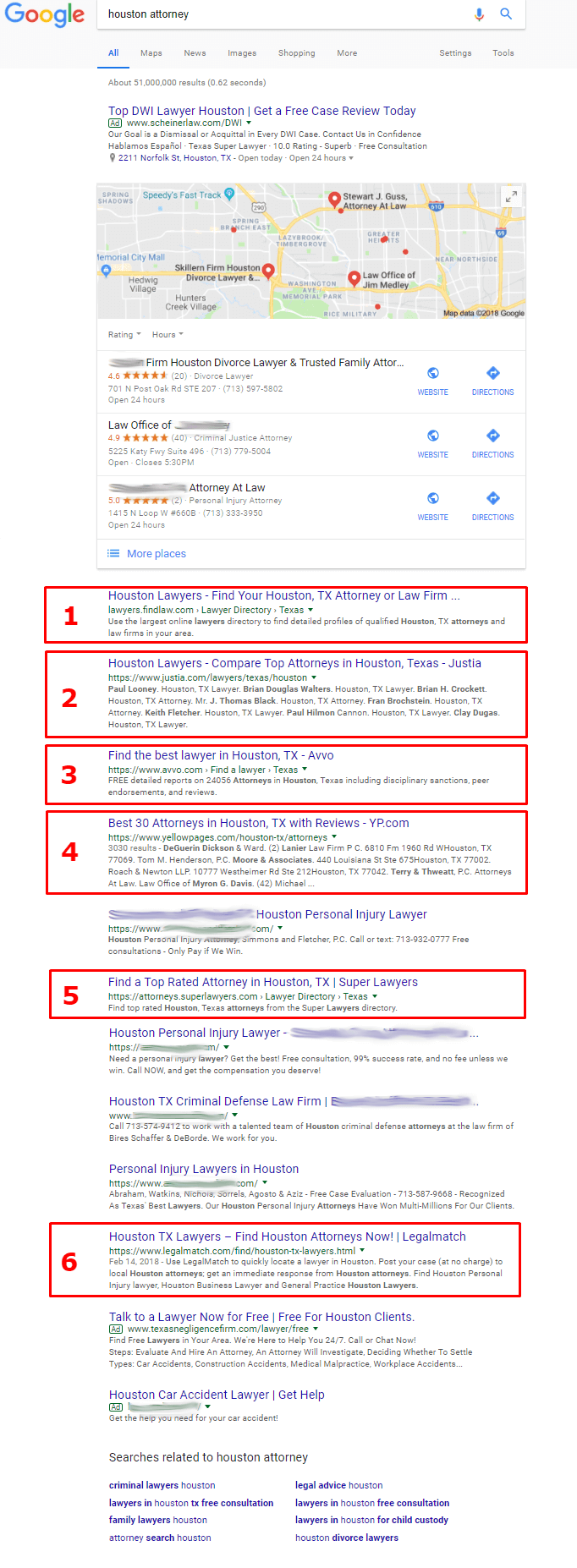
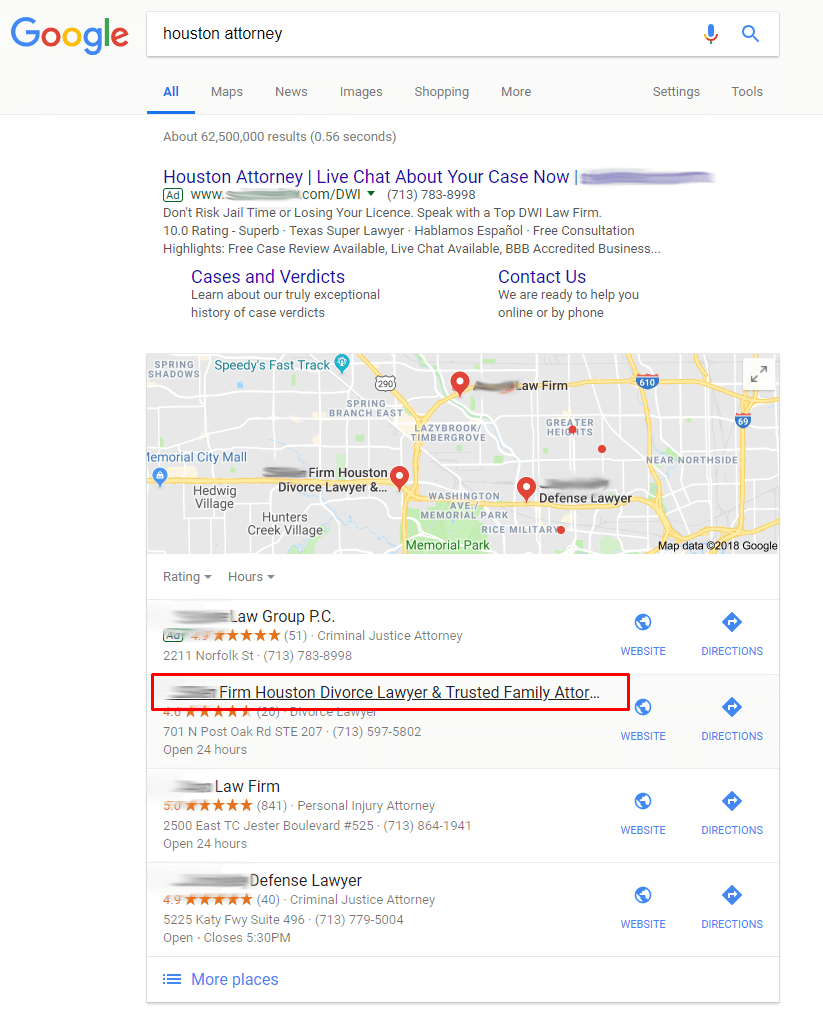
I’ll demonstrate my point with an example. If you own a general practice law firm in Houston, your SEO marketing efforts might focus on ranking for, “Houston lawyer.”
Take a look at the organic search engine results page (SERP) for this keyword. Don’t consider the ads and local results at the top of the page for now, but instead focus on the, “10 blue links.”
As it turns out, six of the ten organic results are listings pages from sites like findlaw.com, justia.com, and avvo.com. Only four of the “10 blue links” are actual law firm websites in the Houston area. The low ratio is because of the sizeable margins on law firm services, and the profitability of selling leads in this industry.
Disadvantages of Purchasing Leads from Listings Sites
For a firm hoping to invest in SEO services, niche business listings sites add an extra layer of competition to the mix.
On top of having to outrank the other lawyers that offer competitive services, you must outrank listings websites that want to outperform you in the organic search arena. Their goal is to collect consistent lead revenues from firms like yours.
The business listings players often have more marketing dollars, and a stronger SEO presence backing them. They use this technique in an attempt to force you to purchase leads on a recurring basis instead of relying on the powerful lead generation tool that you already own – your website.
Advantages of Purchasing Leads from Listings Sites
On the bright side, professional listings websites provide an opportunity to source more business at a fraction of the price that you’d pay to show up in Google searches using Google AdWords.
For example, at the time of writing this article, the suggested AdWords CPC (cost-per-click) bid for the keyword, “Houston attorney,” is $22.05. What this means is that every time someone clicks on your advertisement in Google, you’ll pay an estimated $22.
If you don’t have an optimized ad landing page that converts well, you could quickly blow through thousands of advertising dollars with no new customers to show for it. The value of SEO services could easily outweigh the value of purchase leads in this case.
A site like avvo.com might offer leads at a much lower rate. Additionally, because of the qualifying information on the Avvo website, a purchased lead could end up being higher quality.
Rank for Keywords on All Levels of the Inbound Funnel
One of the main components of your SEO will be identifying keyword groups at each level of the inbound marketing funnel.
I’ve seen it time and time again – law firm websites are composed of a few pages detailing the services they offer, and little else. Unfortunately, that doesn’t demonstrate to users or search engines that you are a subject matter expert.
Keep in mind that your law firm’s search engine optimization plan should be mutually exclusive, and exhaustive.
For example, for a child protective services defense attorney in Fort Worth, Texas, writing three blog posts that focus on keywords related to, “CPS rights in Texas,” would be ill-advised. Your three blog posts would be competing with one another. Instead, create one longer page that is more thorough, and exhausts every relevant angle for the topic at hand.
Good search engine optimization for lawyers starts with creating a plan for identifying keyword groups related to your niche and then developing high-quality content for the top, middle, and bottom of your marketing funnel.
If you’re not familiar with the “marketing funnel” I’m referring to, let me explain.
Top-of-Funnel Content for SEO
Top-of-funnel content is general and mostly information. The goal of top-of-funnel content is rarely to make a direct sale, but rather to provide value for a website visitor so that they come back to your site.
Top-of-funnel content also provides context to search engine algorithms to establish in which areas your firm specializes.
Middle-of-Funnel Content for SEO
Middle-of-funnel content will align with the next step of the buyer’s journey. This content should speak to someone who is probably in the market for services related to the ones that you offer, but still needs more information about the details.
They might be interested in prices, how to shop around for a good or service, and reviews for goods or services that are convenient for their location.
Bottom-of-Funnel Content for SEO
Bottom-of-funnel content is for users who are ready to make a purchase. This content should probably include details about your product or service so that someone on your site knows exactly what they’re about to buy.
Your bottom-of-funnel content will likely take the form of a product or services page that highlights features, pricing, FAQs, and the next steps required for a purchase.
Consider our previous example of the child protective services defense attorney in Fort Worth. You might create a blog post on the topic, “what are my CPS rights in Texas?”
You could include a form on your blog post page that offers a free eBook about “how to select a lawyer.” At the end of the eBook, you could include a call to action that links to a page you created that goes over your experience as a “CPS defense attorney,” and how to contact you.
Mobile-Friendliness
If you were to open your website on a mobile phone right now, would you have a hard time using it?
Out of all global online traffic, mobile online traffic accounted for 52.64% in 2017.
This stat from Statista makes it clear why your website should be mobile-friendly. Your law firm’s search engine optimization is all about supplying when there is demand, or in other words, meeting people where they are. If people are searching from their mobile phones or tablets – meet them there.
This blog post probably isn’t the first time you’ve heard about mobile-friendliness. Even Google says that the majority of your site visitors are probably using a mobile device.
In case you aren’t clear on what mobile-friendliness means, it refers to having a site that fits the user’s screen when they are on mobile devices.
In the past, web developers used to make separate versions of websites that fit certain screen sizes, but that method is outdated. Today, web developers use responsive design to achieve mobile-friendliness.
What Is Responsive Design?
Responsive design is a web design technique that uses one set of HTML (the content and structure of your site), but different CSS (the look and feel of your site) to visually style web pages to fit the device that a visitor is using. Responsive design creates a good user experience for anyone viewing your site, on any device.
Mobile-friendliness and responsive design became very critical to search engine optimization when Google announced that mobile-friendliness would be used as a ranking signal starting in April 2015.
You can use this tool from Google to test the mobile-friendliness of your site.
If you’re finding that your site isn’t mobile-friendly, reach out to us to learn more about our web design service and how we can work to make your site responsive.
Site Structure
As a lawyer, you know that how you say something can be even more important than what you say. The same is true for the SEO efforts of any attorney when it comes to your site structure.
The layout of your pages can tell your users (and search engines) a lot. Your site structure can help make your website more user-friendly and helpful than your competitors’ sites.
A more helpful site aligns with Google’s original mission statement to, “Organize the world’s information and make it universally accessible and useful.”
To explain how important site structure can be, I’ll go over the three scenarios that different sized firms might experience and their corresponding SEO friendly website structures.
One Service – Use an Exact Match Domain
For a law firm that specializes in only one niche, an exact match domain (EMD) will facilitate the best SEO results.
Despite the fact that Google has made several attempts to eliminate the advantages that exact match domains provide, I’ve found that they still tend to rank more easily than a branded domain name.
For example, a lawyer that only focuses the Oil & Gas industry in Houston might opt for the domain name: houstonoilandgaslawfirms.com.
Do your keyword research before choosing an EMD to make sure that your keyword of interest is being searched enough to warrant using it in your domain name.
When search engines and users see your website name, it’s abundantly clear that you are an expert in Houston oil and gas related legal issues. Any sub-pages on your site should be about your actual firm, or about particular components of Houston oil and gas litigation.
Because you only serve one location and offer one service, there is no confusion as to which area of expertise of your law firm. Your home page IS your specialty services page.
For example, your URLs might look something like this:
Your Domain: com/
Services Page URL: com/
Blog Post URL: com/private-equity-best-practices-energy-industry/
Multiple Services – Use a branded domain with sub-services
A firm with several services should use a branded domain, with sub-pages for each specialty you provide.
A branded domain is just the name of the law firm and not a specific keyword. A branded domain will keep your site from becoming inherently associated with one service over another.
Adding sub-pages for each specialty will help keep your related content in silos. For example, when you add blog content (and, yes, your SEO efforts should include business blogging), add it under the corresponding specialty page.
Let’s pretend I own a law firm, and my branded domain is simply tonylawfirm.com. I have two specialties in green energy, and oil and gas.
Your Domain: com/
Services Page URL: com/green-energy-attorney/
Services Page URL: com/oil-gas-attorney/
Blog Post URL: com/green-energy-attorney/renewable-energy-incentives/
Blog Post URL: com/oil-gas-attorney/deepwater-oil-spillage-litigation/
Multiple Location – Use branded domain with sub-locations, then sub-services
For a practice with several locations, either throughout one state or across the country, your site structure should showcase your locations under a branded domain name. The first directory after your domain name should specify each location.
It’s possible that you offer services for several specialties at each location. In that case, your URL structure under each location will look like the layout about one location and multiple services (from the previous section).
Pretend that my law firm has grown, and tonylawfirm.com now has two locations offering oil & gas, and green energy legal services at each location.
Your site structure will have a huge effect on the success of your search engine marketing, so don’t rush through it. Doing it right the first time will make your law firm’s SEO efforts more successful, and make your firm more profitable in the long run.
Technical SEO
Technical SEO refers to the web development-related aspects of SEO. Technical SEO is typically not an area that someone in the legal field excels at or an area in which they should excel.
Mastering the technical side of SEO is often time-consuming, and if done the first time correctly, will only require minimal monthly maintenance.
Because of the time-consuming upfront investment, it makes sense to outsource this matter to a legal SEO expert. That being said, it can be helpful to at least know what you don’t know so that you can effectively shop around for the best SEO for lawyers.
Verify and Submit Sitemap
If you have only 30 seconds to understand what a book is about, I’m betting you’d read the synopsis and then scan through the table of contents.
Search engines also frequently scan the table of contents for your website, called a sitemap, to make sure they know what your site covers.
Instead of crawling through your site page by page to see if there are any additions, search engine bots use the sitemap to account for the layout of your content quickly.
Don’t worry about the details of creating a sitemap – there are a lot of services out there that you can use to create one for free. If your site is built with WordPress, you can use the free version of the Yoast plugin to create and maintain your sitemap automatically.
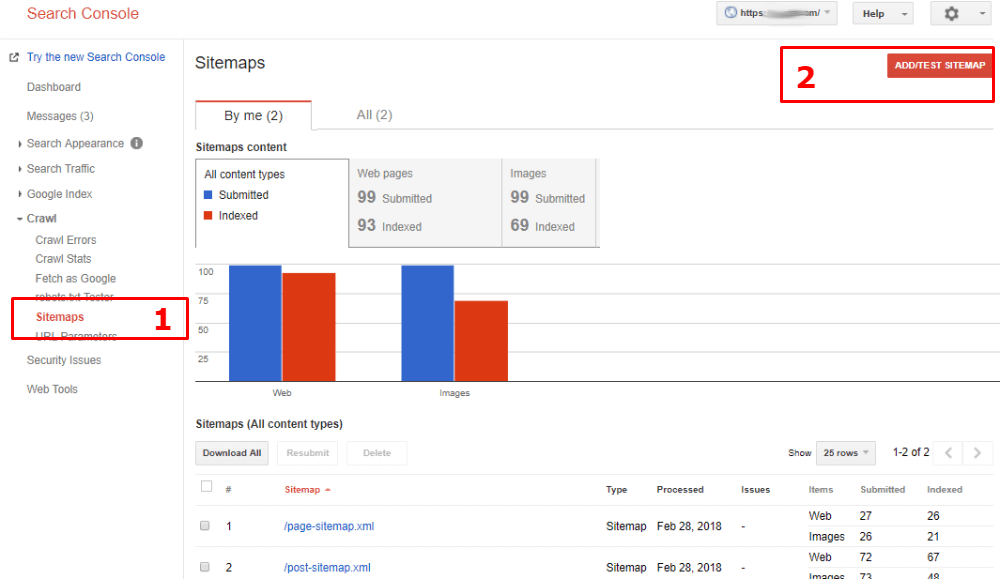
Once you create your sitemap, you’ll want to submit it to Google Search Console and Bing Webmaster Tools. Google Search Console is more important because of Google’s market share, so we’ll quickly go over how to do that.
Go to your Google Search Console, and select the web property for your law firm’s website.
Click “Sitemaps” in the left-hand navigation.
Click “Add/Test Sitemap” in the top right corner.
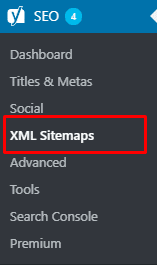
You will then be prompted to enter your sitemap’s URL. If you’re using the Yoast plugin, login to your WordPress account, and select “XML Sitemaps” from the left-hand navigation under Yoast SEO.
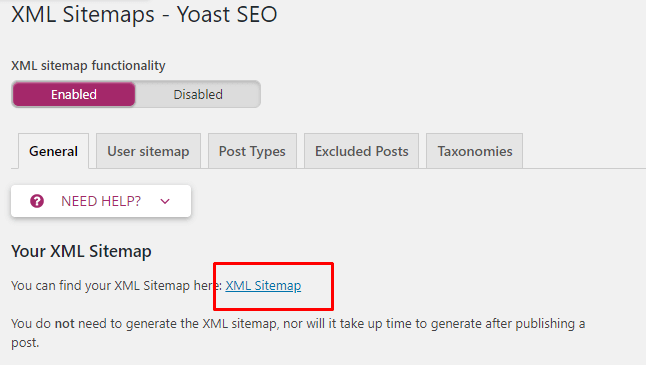
You will land on a page that contains your XML Sitemap link. Copy this link, navigate back to Search Console, paste it into the field asking for your XML sitemap link, and click submit.
Submitting your sitemap to Google is a big step toward improving your law firm SEO.
Verify Robots.txt
Robots.txt is like the security checkpoint at the courthouse. Your robots.txt file contains directions about which internet bots can or cannot access your site.
Using a robots.txt file is a way to prevent malicious or spammy web crawlers from accessing your web pages, although some robots can ignore these instructions and access your site anyway.
To find your file, type in your domain and append /robots.txt to the URL. For example, if my site is https://www.tonylawfirm.com, then my robots.txt would be found at https://www.tonylawfirm.com/robots.txt.
If your site is built with WordPress, your robots directive should at least include the following:
User-agent: *
Disallow: /wp-admin/
Allow: /wp-admin/admin-ajax.php
For more specific instructions about how the code on robots.txt works, check out the MOZ article about managing your robots directive.
Check Site Speed
The speed of your site is important for several reasons.
Your website should be fast enough that it doesn’t create a negative experience for your users.
Your site should be fast enough to ensure that your search engine marketing efforts aren’t penalized.
Your site should not be too taxing for a mobile device on a 3G network to load.
With more and more visitors using mobile devices to conduct Google searches, your site needs to be accessible on mobile phones. Smartphones frequently use lower bandwidth connections than a device connected to WiFi. If the slower connection on 3G networks requires 10 seconds to load one of your pages, your website users will probably just visit a competitor’s site that loads faster.
To test and troubleshoot your page load times, use the Google PageSpeed Insights tool. By entering your site’s URL, you can see which technical aspects of your pages can be improved for faster load speeds and happier visitors.
When visitors are happy, Google is happy, and your firm’s website will not be penalized for page speed issues.
Set Up SSL and HTTPS
Making sure your site is secure can add value for both users and your SEO performance. Having an SSL installed on your site should provide users with a green lock and the word “Secure” (depending on which browser you use) indicating that your site is safe to use.
In addition to creating an aspect of trust for your visitors, if your site has an SSL certificate and uses the HTTPS secure protocol, you can conduct financial transactions (like credit cards or PayPal exchanges) directly on your pages.
In addition to user-friendliness, Google announced in 2014 that the use of HTTPS encryption provides a small ranking boost for your site.
Contact your website hosting provider for more instruction on how to change HTTP to HTTPS encryption and make an immediate improvement to your lawyer SEO performance.
Local SEO
Local search engine optimization for lawyers is all about being found for potential clients in your area.
When it comes to legal services, your law firm’s proximity to customers has a big effect on your bottom line. Search engines understand this facet of doing business and have implemented local SEO measures to reward firms that have a strong, locally-based web presence.
To see an example of local SEO for attorneys in action, consider our “Houston attorney” search query from earlier in this article.
The local map is typically the first thing a search engine user sees when they conduct a local search. For this reason, search engine optimization for lawyers should include a strategy to gain visibility in the local business results, or map pack, for your locality. Here’s how you make it happen.
GMB
Creating or verifying your firm’s Google My Business (GMB) listing is the first step in capturing traffic from your local map pack. You can follow these detailed instructions from Google, but we’ll go over the critical steps here. If you don’t have a GMB listing, your first step will be to visit https://business.google.com/create and create it.
Verify
Unless you’re a new business, there is a chance that your business already has a GMB listing, and you just need to verify it.
You can verify by having a postcard sent to your business’s physical location in the mail. There are even certain periods of time where Google offers an expedited verification process so that businesses can gain control of their listing without sending a postcard.
These special verification periods allow local businesses to adjust holiday hours – making their search data more accurate and helpful for users.
You can’t show up in the local map packs until your business is verified. Make sure to notify whoever internally manages your law firm’s mail that you are expecting a postcard from Google, then finish the verification process as soon as possible.
Optimize
Once your GMB property is verified, you can begin the editing process.
Start by editing your business name, which will appear directly in the map pack, when you’re listed. As you can see from the “Houston attorney” local map pack above, the business name with “Attorney,” in it outranked the listings without that keyword.
Including keywords in your GMB business name will help your local map pack position, but it may also put you at risk if your registered business name or DBA isn’t exactly what you’ve listed.
Competitors could easily report your listing for spamming and cause your GMB ranking to drop. See Google’s business description guidelines for more on the topic of overly spammy law firm listings.
Be sure to enter a business description as part of the optimization of your GMB account. As of March 2018, Google has begun displaying these descriptions in your GMB listing once you click on it from the search results.
The quality and number of reviews that you get for your GMB listing can have a very big impact on your local rankings. Any Austin law firm SEO expert or law firm SEO expert in Houston will tell you that getting recent 5 star reviews can help you nab the top of a local pack in a matter of days.
There are special guidelines on review spam. For instance, paying someone to leave you a positive review is against Google’s guidelines.
Try to generate reviews by asking happy customers to leave a review on your GMB listing. Incentivizing reviews could get you penalized, so offering a quality product or service with consistently great customer support is the best way to influence this SEO factor.
Local SEO Directory Mangement
AVVO, Justia, Lawyers.com, and NOLO are examples of industry-specific legal SEO directories. Earlier in this article, we discussed how you could leverage paid traffic through these directories, but many times a free listing will be helpful too.
Look for locally specific, or niche directory websites that are relevant to your firm.
For instance, a statewide law services listing site can be both helpful for directly driving leads, and beneficial for your search engine marketing.
When adding listings to local directories, make sure you’re using a consistent name, address, and phone number (NAP) for your business. This NAP should also be listed somewhere on your website and marked up with the appropriate schema.
Adding schema markup to your website is a technical SEO task that can be difficult to perform if you don’t have any web development experience.
Social Media
Social media is helpful for just about every aspect of your digital marketing efforts. Even independent of your website, social media platforms can be great for building a highly engaged audience.
However, you don’t own your social media platforms, and they could be taken away at any point due to factors that are out of your control. That’s why you should always try to leverage the SEO-specific benefits that social media channels offer your site.
Most social media sites allow you to enter a website URL in your company’s profile page. Using this option is a great way to connect your social audience to your website once you’ve demonstrated that you are a subject matter expert in your industry.
Like SEO, you want to meet your potential customers where they’re at, and the popularity of social media is undeniable.
In addition to using social channels to drive organic traffic, you can also run social media ads locally. Advertising on social media won’t necessarily help your search engine marketing efforts, but it will help drive relevant traffic to your site at a more predictable rate.
Content Creation
For lawyers who enjoy writing, it’s tempting to turn your website into a collection of professional musings that you’re positive will attract a crowd.
This type of, “If you build it, they will come,” attitude is common, but you won’t find strategic legal SEO service providers taking this approach.
There are plenty of tools that can help you determine what your target audience is searching for online. Once you collect that data, you can systematically address topics with the highest demand that are the most likely to generate leads.
A good starting point for creating web content that will improve your law firm’s search engine optimization is to analyze the websites of your organics competitors.
There is an important distinction between your competitors and your organic competitors. The firm up the road with a 20-year-old, single page website may very well be your competitor, but if they operate mainly off a referral system and highly developed professional network – researching their website won’t get you anywhere.
Conduct a Google search for some of the search terms that you’d like to rank for, then plug the resulting web pages into an online keyword research tool to see what topics their content covers.
Conducting this research will help you identify what your target audience is demanding before you start publishing your expert insights to your website.
Avoid Press releases
If you must publish a press release by paying an online PR company to syndicate your self-made news, you’re probably wasting your money.
Do-it-yourself online press releases haven’t had an impact on search engine optimization for lawyers in quite a few years. Further, self-produced online press releases are very rarely read and can be very expensive with little or no return.
If your firm has done something that is truly press worthy, have someone from Help a Reporter Out (HARO) vet your story and write up their own, genuine press release. News from a real journalist will be much more credible and impactful to your marketing efforts than a DIY press release marketing strategy.
Avoid Paying for Guest Blogs without traffic
Guest blogging is a common way to share your thought leadership and experiences with another company’s already developed audience.
If you have a good relationship with a relevant website that is interested in publishing your content on their site, it could improve your credibility in the industry and even help you build backlinks to your website.
Unfortunately, if you must pay to have one of your guest blogs published on another site, make sure that any links are being “nofollowed.”
Adding the nofollow HTML property to links is a way for you to identify to search engines that an exchange of money took place that ultimately allowed for the existence of the link.
When a link uses the nofollow property, it no longer contributes SEO value to its destination web page. Thus, if you are paying to publish a guest blog post on another site, make sure that site is relevant and could potentially refer qualified traffic to your site. In other words, if a paid guest blog isn’t improving your law firm’s SEO, then it better be generating quality traffic or leads for your firm.
Link Building
As I alluded to in the previous section, guest blogging is the essential link building strategy in your marketing toolbox. When you contribute your unique insights and expertise to another industry website, you can create link citations to specific pages that already live on your site.
Because of the guest blogging process for link building, it’s important that you already have at least a small core of content assets on your site.
These can be standard HTML pages, PDFs, or landing pages for lead nurturing assets like eBooks or whitepapers. Housing this unique content on your site gives you plenty of backlink options while you’re guest posting.
Outside of guest posting, many of the legal service directories from your local SEO efforts will include links back to your site. These links may or may not pass direct SEO value, but having several listings that refer users back to your site will generally benefit your law firm SEO marketing in addition to generating real leads.
Track Campaigns
Whether you plan to do it yourself or hire a reputable SEO company, you need to be able to measure the effectiveness of your campaigns.
Are your SEO efforts resulting in more traffic?
Which pages are the most popular?
When people visit your site, do they read multiple pages?
Are your marketing efforts generating more leads at the end of the day?
You can find the answer to most of these questions through free tools like Google Analytics, Google Search Console, or Bing Webmaster tools.
If you use WordPress, you can set Google Analytics up even if you aren’t technically savvy. You can search the WP plugin directory for any Google Analytics plugin, create a free Google Analytics account, then copy and paste your JavaScript snippet into your plugin. Going through this process will allow you to track user activity on all your web pages.
From staffing the best team members to communicating with clients and staying a step ahead of the competition, there’s a lot that goes into running a successful technology company. Something you might not have considered? The ideal color palette for technology marketing, from your logo and website to sales collateral.
Color plays a tremendous role in establishing a company’s overall feel. By developing a specific palette, you create a consistent look while also tapping into people’s subliminal thought processes — and that can affect the way people choose to interact with your business. Design At Work has compiled a few helpful tips for choosing colors that speak to who your company is, help you stand out from the crowd and elicit the reactions you’re going for.
Practice restraint.
They say less is more, and nowhere is that more true than in the world of color. Incorporating too many hues into an advertisement or web page tends to draw the eye in numerous directions at once diluting the look and taking away from your message. Instead of going full-on rainbow, select two primary colors that complement one another, yet have the right amount of contrast. Color calculators such as this one by Sessions College are a great place to start. Once you’ve established your main tones, select two to three accent colors which allow you to add something different to your brand without taking away from the overall look.
Know what (and who) you’re up against.
It isn’t enough to create a combination that is pleasing to the eye. Choosing the same palette as a competitor — or even one that is too similar — can create confusion among colleagues, customers and, worst of all, potential customers. Before deciding on your chosen hues, do a quick online search and pull competitor logos together into one document you can easily reference throughout the color choice process.
Go beyond mere visuals.
Sure, it’s OK to use your favorite colors as an initial guideline, but remember there is psychology involved. Hues affect people in ways they aren’t even aware, and it’s important to consider the ways various colors translate. Blue, for instance, is a calm color known to encourage feelings of trust, order and security. As such, it is a common color among technology companies. Orange tends to make people feel warm and energized, while green conjures, among other things, thoughts of nature and health.
Of course, these are just a few of the things you’ll want to consider when developing a custom color palette for your technology company. If you’d like to know more, feel free to get in touch with Design At Work’s graphic design gurus. You can also reach us through our Contact page. We look forward to hearing from you!
Today, having a company website is no longer enough to stand out among the thousands of competitors you compete with in the digital space. Blogging isn’t just a place to host your company press releases, it’s about providing valuable content to your future customers.
What is Business Blogging?
Business blogging is a marketing tactic used in a business’s overall marketing strategy. It is a digital publishing channel on a company website that helps support business growth through content marketing and writing insightful, educational articles. Business blogging has been known to improve a website’s SEO.
No matter what kind of business you have, whether you’re a local mom and pop shop, or a giant corporation, there are some serious benefits you could be missing out on if you aren’t keeping an active blog on your website.
5 Benefits of Blogging for Business
Although the benefits are seemingly endless, we’re listing our favorite top 5 benefits of business blogging.
1. Creates Brand Authority
Consistently updating an active blog for your business, allows you to personify your business by giving it a voice. Your blog is a space to discuss industry related topics, market trends, and upcoming products. Focusing on these topics actively builds brand-trust. Trust generates leads. Leads grow sales. Can you see where this is all going?
When you utilize your blog effectively, you are creating a two-way conversation between you and your customers, prospects, and other industry professionals which can be very helpful for gathering insights for future business development.
Having an active blog helps you to stay ahead of the curve when it comes to industry news and competitors. By staying ahead of the curve, you are positioning your company as a leader as opposed to a follower. Your blog also serves the purpose of having a place to share your brand story, although it should be noted that it’s not advised that you blog only about yourself as a company.
2. Business Blogging Fuels Your SEO
There are some pretty obvious SEO benefits blogs can offer, such as viewers spending longer amounts of time on your website, increasing page views, and lowering bounce rates. However, it’s also important to mention that search engines love valuable content and reward it with higher search result placements. Because of the effectiveness of blogs for ranking more highly in search results, most SEO companies will provide content marketing services.
As more people are putting out content to capture the attention of search engines, the algorithms are getting smarter. Your business blogging content should focus on having frequent high-quality content as opposed to having constant poor-quality content.
In addition, your blog should contain a minimum of at least 500 words. However, if you have the capacity to write longer blogs, you should always opt for the latter because Google favors in-depth blog articles.
Having high-quality content helps generate inbound links from other authors, journalists, and bloggers in your field. Not only are these types of links beneficial for your SEO, but they also generate greater amounts of referral traffic linking back to your site.
3. Supports Your Social Media Advertising Efforts
Using blog articles for your sponsored posts campaigns on both LinkedIn and Facebook ad platforms have been proven to be very effective. Depending on the nature of the industry, boosted blog posts typically generate more engagements as opposed to generic click campaigns. This increased engagement impacts your overall organic reach for the post, which essentially means you are getting more viewers and spending less money as you’re running your ad campaigns.
Asides from using blog content for your ads, leveraging your blogs throughout your social media content also increases the chances of gaining extra exposure. When writing your blog topics, you should always have in the back of your mind, “what would make people want to share this content with their followers?” When you can write a blog that is so interesting that others will want to share it, you are ultimately gaining free exposure.
Pro Tip: Always ensure to include a good mix of evergreen content in your blog. Evergreen content allows you to recycle your blogs on social media as you continue to gain new followers, who may not have seen your blog the first time you posted it.
4. Generates a Great ROI
Business blogs are cost-effective marketing investments. Many business owners choose to outsource their blogging to content marketing services because it can be a time-consuming task when you are already wearing multiple hats for your business. While this is perfectly fine, an ideal situation would be to have a mixture of both outsourced and native blogging content.
Blog posts are fairly cheap to create and show proven results over time. According to Hubspot research, B2B marketers who use blogs as part of their content marketing mix get 67% more leads than those that don’t.
5. Blogs Serve as a Lead Generation Tool
Blogging is an integral part of your digital sales funnel. In addition to driving traffic to your website, business blogging is a great opportunity for getting leads for your business. By using non-intrusive lead capturing tools such as lead capture forms and call-to-action buttons at mid-points or the bottom of your blog, you can gather valuable data on the quality of leads your blogs are generating.
How many times have you read a blog, and downloaded a free e-book because you were interested in gaining more insightful information about the topic you were reading? If you recall a moment where you have personally done this, congratulations! You were successfully moved from the inbound marketing stage of attraction to the stage of conversion.
Each blog post you create is an additional page that can be indexed by Google, which can be used with a combination of lead generating call-to-action buttons such as free webinars, fact sheets, and eBooks. Asking for emails isn’t an easy task, but when you offer valuable data in exchange for emails, you can leverage it for better prospecting.
The Takeaway
Although it can be difficult to find the time to write quality blogs, you don’t want to neglect the benefits of blogging for your business has to offer. By utilizing your local outsourced marketing services, your blogs can serve as a central piece for all your other marketing efforts which can include, social media marketing, SEO, email marketing and much more.
Influencer marketing is big with companies looking to reach people in new ways. After all, the average consumer is more marketing savvy than ever and it is easy to become “white noise.”
More and more companies are looking for creative ways to reach their potential customers and effectively deliver their marketing message. Going through someone they trust and admire is a great way to make sure their eyes are on your product or service.
Working with influencers can do more than just get your name out on social media though. It can also help boost your search engine optimization so that more people can find you when they use Google.
In this post, we’ll look at what Influencer marketing is, how it works, and the positive impacts it can have on your search engine traffic.
What is Influencer Marketing?
Influencer marketing focuses on using thought leaders, industry leaders, and popular figures to deliver your brand’s message to a broader audience. Rather than delivering your brand’s message through traditional and online advertising channels to your target audience, you instead engage with, partner with, or pay influencers to deliver your message for you.
Most commonly Influencer Marketing is used in conjunction with content and social media marketing. Most Influencer Marketing campaigns involve a company creating content or the influencer creating content which they then spread through their social media channels, which generally have large and often targeted audiences.
Because this content is either created or curated by a trusted figure in the lives of your target audience, many of the barriers that you face in advertising are hurdled, and your message is more likely to be received and accepted.
According to a McKinsey Study, marketing-inspired word-of-mouth generates more than twice the sales of paid advertising, and these customers have a 37% higher retention rate.
If you’re curious about how brands are using Influencer Marketing, HubSpot has recently published a great post highlighting ten fantastic uses of influencer marketing, including this gem featuring Nick Offerman (though it is quite long).
Using Influencer Marketing for SEO
While Influencer Marketing can provide fantastic benefits for your marketing in the short term, it also has the power to effect long-term change.
Given that Influencer marketing is content based and driven by social media, it can have a positive, even dramatic, impact on your visibility in search engines, and should be at the top of your “to-discuss” list with your SEO company.
1. SEO Boost from Engagement
The goal of any good marketing strategy is to have your potential clients engage with your brand, and influencers make this happen more organically.
When they mention your product and send customers your way, those people are likely to do a deeper dive into your website and content – and they’re more likely to read instead of skim, to linger instead of leave.
This increased engagement also helps your SEO, because Google factors in things like time spent on your pages and your bounce rate when determining its rankings. When an influencer steers viable prospects to your site, their engagement boosts your search engine ranking, leading to a better presence and even more hits.
2. SEO Boost from Backlinks
A great influencer will link to your site, your social media, and your blog frequently when they write or make a video about how much they love you.
Search engines take into account the number of backlinks that connect to your site when ranking your pages, so your influencer is doing some great SEO work for you – even if they don’t realize it.
Work with your influencer to connect to particular pages, and encourage them to use all their platforms since backlinks from a range of sources will give you more unique content mentions, which search engines love.
Additionally, good influencers will likely have followers who are influencers themselves, just on a smaller scale. Often these sub-influencers will repurpose content from their influencer icons for their own purposes, generating even more backlinks to your site.
3. SEO Boost from Social Media
Don’t forget that more people than ever are using their favorite social media platforms like search engines.
When your influencer gets your name out on Twitter, Facebook, and Instagram, your brand is ready and waiting to be found when someone searches. Expanding your reach into non-traditional search engines is a great way to make sure that everyone finds you – not just Google.
But beyond the inherent benefits of being found on social media is the idea that as your brand’s reach on social media grows, so will your SEO rankings.
While the jury is still out on just how important social signals are for SEO, it’s fair to say that they are part of the whole picture that search engines look at when determining your ranking.
Having an increased presence on social media is shown to be correlated with higher search engine rankings. A Cognitive SEO report indicates that “on average, presence on social networking sites (which includes likes, shares and comments on Facebook, plus shares on Google+, LinkedIn, and Pinterest) is negatively associated with site rank, and the relationship is close to linear (and perfectly linear for the first 5 ranks). This means that, in general, the smaller the rank number is (so, the higher up the website), the higher the chances are that the average presence on social network is larger.”
The Take-Away
Working with an influencer isn’t just a trendy way to get millennials to like you. It’s also a solid plan for improving your search engine presence and making sure you’re ranking when people are looking for your product or service.
As with all online and offline marketing, it’s important to look at all of the consequences of any marketing endeavor that you may undertake, both good and bad.
Luckily for almost everyone involved, Influencer Marketing, if done well, can be an effective way to build your brand, promote your products or services, and in the process, add to your SEO foundation.
Just pick your influencer wisely and ensure that they stay on message, you don’t want a good thing to go bad.
Since we live in a graphic culture, companies that want their social media posts to generate more views and shares, higher click-through rates and greater overall engagement with potential customers often include photos, videos, screenshots and other graphics in addition to compelling text.
Although text-based posts will always be a part of your social media strategy, as you begin to set your company apart, here are some helpful tips that will take your social media graphics to the next level.
Images: Catching the eye of potential customers with visual content shows off your products and services. People are more inclined to read what you post if you also share an original image. Going a step further and posting pictures of your employees and brand lets your audience get to know your company on a personal level, building their trust. Incorporating images into your posts also entices viewers to learn more about your company’s offerings, supporting search optimization and boosting the number of views and clicks your website has.
Videos: Potential customers want to see your products in action and hear you talk about what makes them stand out from the rest, to picture how they will work for them. Including promotional and marketing videos or product tours on your social media accounts will drum up conversation about all your company has to offer.
Infographics: This type of graphic provides potential clients easy to consume bites of information, since they consist mostly of statistics and data with accompanying images. Regardless of language, your followers will understand the message you are trying to convey, making infographics a prime visual to add to your social media. Additionally, infographics tend to be circulated more than text only content, improving the number of times your post is shared, liked, re-tweeted or commented on.
Presentations: By posting presentations, you are conveying to your social media audience your willingness to go the extra mile, extending the outreach of your company. Presentations also generate engagement of users and bolster communication. Due to the attractive designs, images and branded colors, presentations spark interest, driving more people to view them and learn what your business has to offer.
When you are ready to step-up your social media strategy, think about including an eye-catching image, striking video, impactful infographic or distinctive presentation to attract an audience consumed with graphics. Design At Work is here to help you up your posting game so your company is on the brain of your potential customers.
You know marketing is important, but don’t have the time to be consistent about it. Maybe you’ve considered hiring a marketing firm to help you. You’re just not sure if you should use a freelancer for occasional projects, or go with the outsourced marketing model and have a full agency team to help with all marketing. It’s a big decision to make, no matter the size of your business.
Before jumping into all the details of hiring a marketing firm, let’s talk about the basics. What’s the difference between a retainer-based marketing firm and a project-based marketing firm?
Typically with a retainer-based marketing agency, you receive ongoing monthly marketing efforts. This includes a plan that looks ahead, rather than just taking care of immediate needs. And a big benefit to working with an agency on a monthly basis? They get to know the two most important things: You and your business goals.
When it comes to retainer services, pricing should be a flat fee. Every advertising agency is a little different. For example, at Design At Work we don’t charge for meetings, email response time or conference calls. We feel communication is necessary to get the type of traction needed to keep your marketing moving, and, most importantly, build a relationship with you and your team.
The other option to consider is project-based services. This can be helpful when you know exactly what you need, and just need someone with the skillset to help make a project come to life. When it comes to project-based services, pricing can vary. Be knowledgeable about revision costs or additional fees that may apply. For project-based work to be really cost-efficient, you should have a clear idea of what type of project you need, and what elements should be included in the finished product. When a project’s outcome isn’t quite what you had in mind and needs some tweaking, revision fees can add up fast.
OUTSOURCED MARKETING Retainer vs. Project-Based Services
Retainer-Based Services
• Flat monthly fee • Broad range of services and deliverables • Dedicated account team • Long-term and ongoing marketing needs
Project-Based Services
• Per project cost • Well-defined project scope and deliverables • Rotation of available talent • Short-term or one-off projects
Focusing on what your goal is in your business’s big picture can help you decide between retainer- or project-based services. Are you wanting a one-off piece to help improve a specific part of your business, or are you looking to take a more holistic marketing approach that could touch all aspects of your company?
At Design At Work, we’d love to talk to you about what’s on your mind. We may not be the right fit for you right now, but maybe one day. And hey, if we’re not for you, we’d love to point you in the right direction.
It’s easy in the day-to-day grind to focus on only one area of business. For many businesses, that one area is the goal of gaining new customers. It sounds simple enough — more customers means more sales, which in turn means a better bottom line. But without caution, that goal may have you overlooking your biggest sales force.
The Gift of Loyalty.
Did you know that over the span of your business relationship, your most loyal customers will outspend your average customers by as much as 10 times more? Altogether, those loyal customers will also make up approximately 70% of the business you do. Now that’s a lot of loyalty! That also means you may have a very large untapped profit area if you aren’t keeping in touch with your loyal customers.
The Gift of the Repeat Customer.
One of the most common and easiest ways of showing customer appreciation is by starting a loyalty program. Now, you may be thinking “but I’m supposed to be gaining business, not giving discounts!” But before you go too far, consider that a loyal customer will buy more than they originally planned 60-70% of the time. Taken a step further, these same VIP customers are more likely to talk about your business to others. That’s right — we’ve come full circle and are back to those new customers you were hoping to find. By saying thanks to your repeat customers, not only are they buying more, but they’re also sharing the good news and recruiting new customers for you.
The Gift of Knowing their Needs.
Are you convinced? That’s great! Before you get started though, take a moment to identify your best customers and what would be most valuable to them. Here are a few pointers to help get you started:
Talk to your customers. Go straight to the source to find out what would be most useful to your customers. You may be surprised at what you hear. At the end of the day, the more beneficial they find the perks, the more likely they will be to keep coming back.
Seal the deal with a KISS. There are lots of different loyalty customer programs out there competing for your customers’ attention. So remember — keep it simple stupid. Simple to join and simple to use.
Spread the word. Once you’ve worked out the kinks, it’s time to spread the word. That’s where we come in. We’ll make sure everyone knows, and in no time, your loyal customers will be saying thank you and your average customers might just upgrade to VIP status.
Why Balancing Reach and Frequency is Important in Traditional and Digital Advertising Campaigns.
What’s more important — reach or frequency? Advertisers have been asking themselves this question for well over a century. The term “reach” refers to the amount of people exposed to an ad, whereas “frequency” denotes the number of times consumers see an ad. Determining which method to prioritize in your marketing strategy depends on your business, your consumers and the goals of your campaign.
In this article, we’ll take a closer look at the difference between reach and frequency — and explain how to balance the two in your marketing efforts.
What is Reach in Marketing?
Reach measures the number of consumers who have seen or been exposed to a particular message or advertisement. For example, let’s say you want to advertise your company’s services on a billboard. You could approximate the billboard’s potential reach by considering the average number of cars that pass the billboard each day. With traditional advertising, it’s impossible to measure reach (or any other metric) precisely, but estimates can give you a good idea of how effective your efforts will be.
Digital marketing, on the other hand, allows you to track campaigns with a lot more precision. You can see exactly how many unique users saw your social media post, opened your email or viewed your digital ad, allowing you to continually refine your strategy in response to user behavior.
When Should You Prioritize Reach?
There are times when it makes sense to cast a wide net with your marketing campaign. Let’s look at a few of these situations.
You’re A Household Name.
If your company already enjoys strong brand recognition and loyalty within its market, reach may be more important than frequency. Companies with limited competition and wide recognition can focus on getting as many eyes on their ads as possible, rather than repeatedly re-introducing themselves to educate and entice prospects.
You’re Introducing a New Product or Service.
Even if you’re a smaller company with a niche audience, reach is especially important when bringing a new product or service to market or entering an emerging market. Why? Because at this stage, you’re still learning about your target audience. The more users you reach, the more data you can compile to help you define and build relationships with your ideal customers.
You’re Building Brand Recognition.
Broadly speaking, reach matters more when your goal is to acquire new customers. When generating brand awareness or educating consumers on the value of your product or service, you want to reach as many people as possible.
What Is Frequency in Marketing?
Frequency refers to the amount of times consumers are exposed to the same advertisement or campaign. It takes time and, more importantly, repeated touchpoints to pique the interest of prospects — and convert them into loyal customers.
In 1885, London businessman Thomas Smith wrote Successful Advertising, in which he describes 20 potential points of connection required to convince one customer to make a purchase. “The first time people look at any given ad, they don’t even see it,” he writes. By the fifth time, “they actually read the ad,” and finally, after several stages of consideration and planning, they purchase the product1.
Consumer behavior remains remarkably similar today, though the products and channels through which we advertise have changed. Frequent exposures create a more positive perception of your company and increase the likelihood of closing sales. These digital marketing statistics lend compelling evidence to support what advertisers have known for years.
Thomas Smith described a typical buyer’s journey back in 1885, identifying 20 potential touchpoints.
When Should You Prioritize Frequency?
Depending on the demographic breadth of your target audience, your level of brand recognition and the goals of your campaign, frequency may be more important than reach. Here are some examples of when it’s a good idea to focus on frequency.
You Have a Niche Audience.
If your products or services meet the needs of a limited group of consumers, it makes more sense to devote your budget to highly targeted marketing delivered repeatedly over a period of time. If you’re selling lactose-free ice cream, for example, market directly to lactose-intolerant consumers, rather than casting a wide net that will likely include some fans of dairy-based products. In other words, focus on nurturing relationships with consumers who already want what you’re selling.
You Have Limited Brand Recognition.
For companies in the process of establishing themselves in a market, repetition is key. Multiple touchpoints are required to introduce your brand, educate consumers on your product or service and establish a connection between the two. Think of it this way: You probably wouldn’t remember the name of someone you met briefly at a cocktail party. But if you happened to run into that person at the grocery store, and then again at your favorite restaurant, you’d be far more likely to remember them.
You Have Stiff Competition.
The more competition you’re up against, the more important it is to gain repeated exposure to your target audience — and stand out from the crowd when you do. Returning to the example of the cocktail party acquaintance, if your interactions with the person were unpleasant, then subsequent meetings would likely lower your esteem. If, on the other hand, you found them uniquely fun to talk to, then your opinion would be improved. The same is true for brands and customers. Your goal is to be the fun cocktail party guest who gets more interesting with each interaction.
These numbers underscore the impact frequent touches — across multiple advertising channels — can have on brand awareness and conversion.
With the right mix of reach and frequency — and a solid understanding of your company, target audience and goals — you can generate new leads, nurture customer relationships and increase revenue. Ready to develop a savvy approach to marketing your business? Let’s talk.
While it may seem effortless to some, successful marketing isn’t about luck or a “bag of tricks.” It’s about using a clear marketing strategy to position your business as the brand of choice and edge out the competition.
Focus on the right message.
What are the qualities that most define your brand at its core? What do you want to tell the world about who your company is? How are you different from your competitors? How does your product or service solve customers’ problems? Before you successfully launch a marketing campaign, you must know what you want to say about your business — and consistently stick to this message
Know your target customer.
Who do you want to reach with your message? What type of message is most effective for this group? Which advertising mediums work best? Answering these questions will not only help you target the right people, but will ensure that your advertising dollars are spent most effectively.
Use consistent branding.
Here’s an example: What company do you think of when you see a cow? Chick-Fil-A. You need to have a brand identity that your customers associate only with you, and this “look” needs to carry through cohesively in all your marketing collateral.
Give advertising time to work.
Advertising doesn’t always generate instant results — don’t quit because you didn’t experience a fast increase in new business. Although some tactics are intended to produce short-term results, building a loyal customer base and increased brand awareness requires a long-term vision. Did you know that the average person has to see an ad at least three times before they remember it and take action? Repetition is key to expanding your business and smartly spending your money. Of course, if an advertising medium clearly isn’t working, you also need to know when to stop and try something else — until you find that perfect, most effective advertising mix.
Seek PR opportunities.
Public relations is all about getting your brand out there and creating buzz. The opportunities are endless, including features in newspapers or industry publications, attending trade shows and getting involved in charitable causes. Best of all, PR is generally free or much less expensive than advertising! Another great benefit? PR is about getting a positive endorsement from a third party, which generates more consumer trust than paid advertisements. The more consumers see your brand name, the more positive their perception is of you.
Follow these five steps, and there just might be more green (and a pot of gold!) in your future.