



Google Ads for Doctors: A Guide to Attracting More Patients
When someone needs a doctor, specialist or procedure, Google is often one of the first places they turn. That creates an opportunity for practices across Greater Houston, but showing up at the top of the page is only part of the job. Google Ads for doctors should connect the right patient with the right provider at a time when the practice is ready to schedule them.
Which Medical Services Should You Advertise?
A common mistake practices make is trying to promote everything at once. Running ads for “general practice” or “orthopedics across Greater Houston” spreads your budget too thin and attracts low-intent traffic.
Google Ads performs best when paired with immediate practice capacity.
“We usually don’t recommend advertising every service at once. We start with a simple question: Which providers, procedures or locations need more patients right now? That helps us spend the budget on appointments the practice can actually take, not clicks that lead nowhere,” said Will Roberds, digital marketing manager at Design At Work
So, rather than trying to advertise a broad range of services, you’re more likely to have more success by narrowing your strategy and targeting hyper-specific patient needs. For example:
- An orthopedic group opening a Sugar Land clinic could advertise knee pain consultations to nearby residents.
- A multi-location dermatology group could run ads specifically for the branch with immediate appointment openings.
- A primary care clinic could focus ad spend on a new physician actively building their patient panel.
By matching high-intent searches with actual provider availability, your practice avoids paying for clicks it can’t convert into completed visits.
Which Patient Searches Are Worth Paying For?
In healthcare PPC, patient searches fall on a wide spectrum. Segmenting these searches into these three intent levels will ensure you spend your budget where it has the highest chance of attracting actual patients.
High Intent: Ready to Contact
These searches name a provider, procedure, location or appointment need. For example:
- “Knee replacement surgeon in Houston”
- “Dermatologist accepting new patients”
- “Pediatrician in Sugar Land”
These terms should usually receive the greatest attention because the patient is actively seeking care.
Medium Intent: Comparing Options
These patients have identified a condition or procedure but still need more information. For example:
- “Nonsurgical knee pain treatment”
- “ACL repair or physical therapy”
- “LASIK cost in Houston”
These searches can produce qualified patients, but the practice may need to answer more questions before someone schedules.
Low Intent: General Research
Broad educational searches often come from people who are not yet seeking a provider. For example:
- “Why does my knee pop?”
- “Causes of lower back pain”
- “Home remedies for a skin rash”
Review these searches carefully and use negative keywords when they repeatedly spend the budget without producing qualified inquiries. The goal is not to eliminate every symptom-related search. It is to prioritize searches that show a realistic path to an appointment.
What Should Your Ads and Landing Pages Tell Patients?
In paid search for doctors, the ad and landing page should continue the same conversation. For instance, an ad for a new OB-GYN accepting patients in Katy should link to that physician’s page, not the health system’s homepage. An ad for rhinoplasty consultations should lead to the relevant procedure page, not a general plastic surgery page.
Effective Google Ads for medical practices should give patients:
- The service, procedure and/or provider
- The practice location
- Provider credentials
- New-patient availability, when applicable
- Accepted insurance, self-pay or financing information
- A phone number or online scheduling option
Avoid guarantees, medical superlatives and treatment claims the practice cannot support. Patients need clear information that helps them decide if the provider is a good fit. We’ve applied that same principle across website content, patient resources and digital advertising in our healthcare marketing work for a Texas-based health system.
Are Your Google Ads Producing Appointments?
Google Ads for doctors and healthcare professionals shouldn’t be measured by clicks, phone calls or form submissions alone. A click or inquiry may look like a campaign win, but the most useful measure is a completed patient visit. Following each step of the patient journey helps your practice see where prospective patients are dropping off.
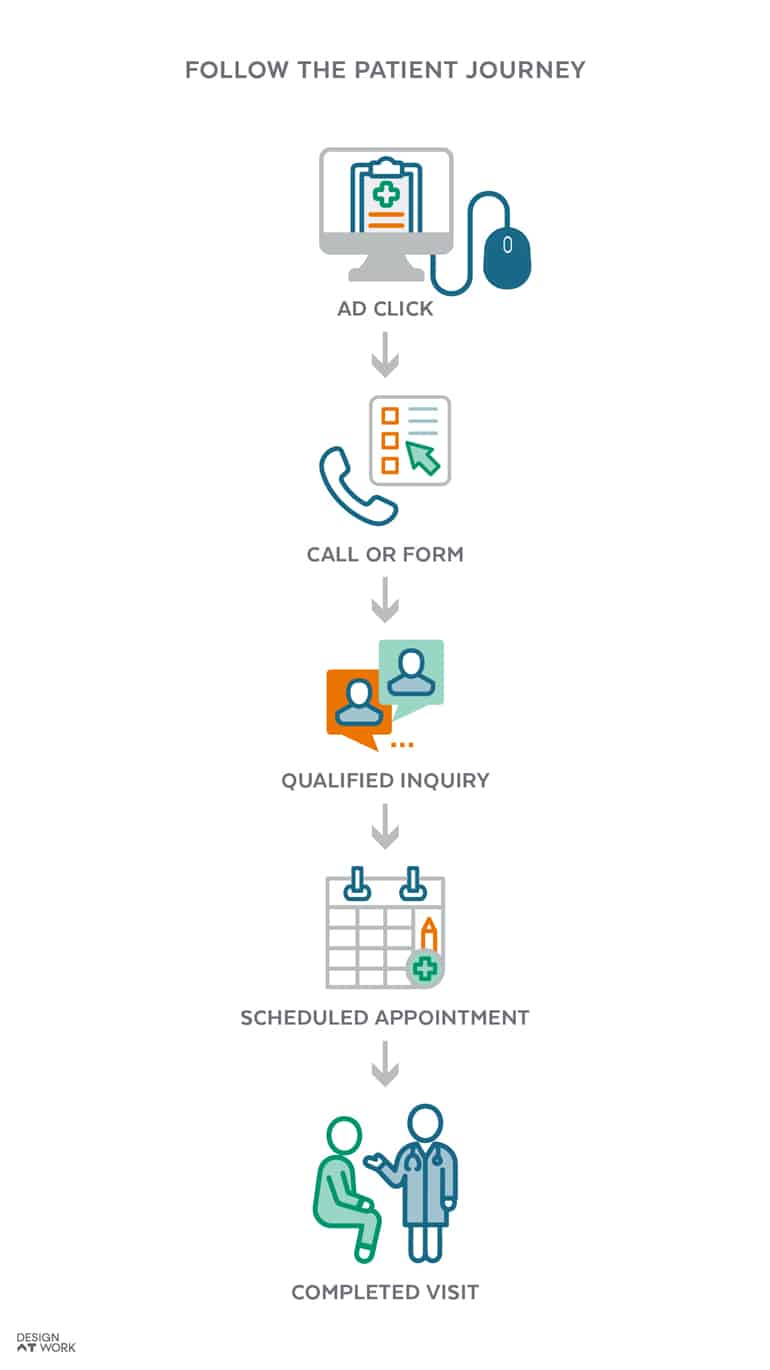
- Clicks with no inquiries? The landing page isn’t answering the patient’s immediate question.
- Inquiries with no bookings? Leads are poor-fit, calls are getting missed or intake response time is too slow.
- Bookings with high no-shows? Pre-visit reminders, wait times or intake procedures need adjustment.
Comparing your lead cost against your actual cost per completed patient shows which campaigns truly drive revenue, not just traffic.
This should go without saying, but your tracking setup should never send names, diagnoses, appointment details, form responses or other patient-identifying information to Google Ads, so have your compliance or legal team review it before launch.
Healthcare Paid Search FAQs
Which Google Ads campaign type works best for doctors?
Search campaigns are usually the best starting point because they reach people actively searching for a provider, procedure or appointment. Display, video and other campaign types may support awareness, but they do not always carry the same immediate patient intent.
Can medical practices use retargeting ads to follow up with website visitors?
Not in the same way as advertisers in nonsensitive categories. When ads promote sensitive health categories, Google does not allow advertiser-created audiences such as Customer Match or website visitor data segments. Some predefined Google audiences may still be available because Google configures them without sensitive health signals. Review Google’s personalized advertising policy before using audience targeting.
Why did my medical ad get flagged as “Eligible (Limited)”?
“Eligible (Limited)” means the ad can run, but Google restricts where or when it can appear. Healthcare policies, landing-page content, location restrictions and certification requirements can trigger this status. Review the specific policy notice in your account to confirm that the restriction is expected or determine if the ad needs changes. Google explains the status here.
How long does it take for Google Ads to bring in new patients?
Unlike organic SEO, which takes months to build momentum, Google Ads can generate patient inquiries within days of launching. However, campaigns typically require 30 to 60 days of initial performance data to optimize bids, refine negative keyword lists and establish a stable cost-per-acquisition.
Can doctors advertise every medical service on Google?
No, Google restricts or prohibits advertising for certain healthcare products and services, and some categories require advertiser certification. Google also limits personalized targeting related to sensitive health conditions. Review the Google Ads healthcare and medicines policy before launching a campaign.
Give Your Google Ads a Health Check
A busy Google Ads account doesn’t equal a full appointment calendar. Design At Work manages PPC for doctors and healthcare organizations that want more qualified patient inquiries. As a healthcare marketing agency, we build campaigns around the services your practice wants to grow and carry that focus through to the appointment process.
Want your Google Ads to bring in more than clicks? Contact Design At Work to see how we can help.
Get marketing tips and news sent to your inbox.